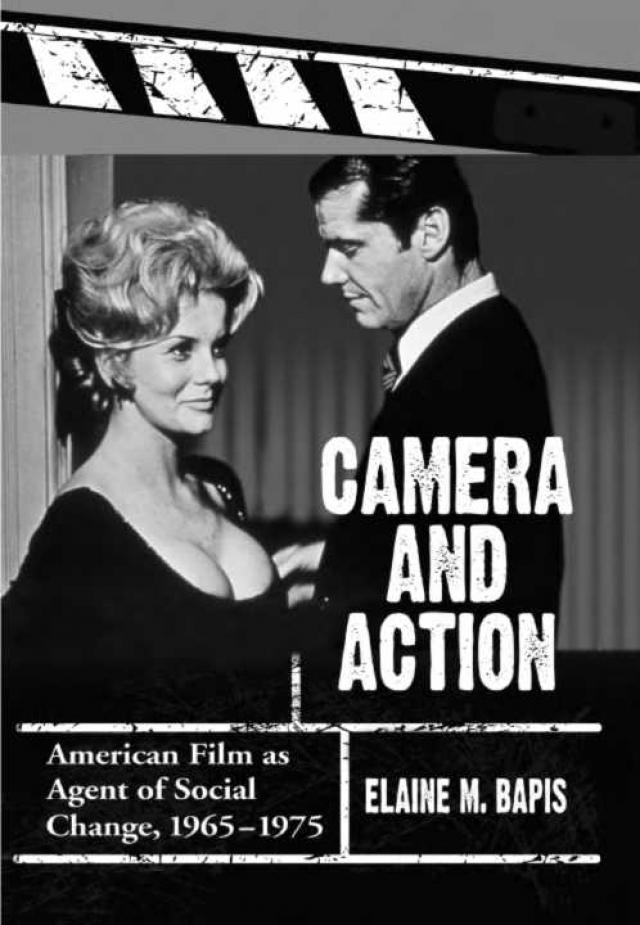
Camera And Action, page 25


At the same time, released in the early seventies, it makes sense that the film would grapple with the same contradictions present in the women's movement. Claiming and legitimizing female subjectivity and calling for gender equality had to begin with imagining women as central characters in traditional male narratives. Adjusting the boundaries was a first step toward declaring women's experience legitimate; women as history-makers was part of the logic in feminism. It assumed that adding positive roles for women in society would lead to the social construction of more even social relations. Certainly this period of "utopian optimism," as Laura Mulvey characterized the early 1970s, sparked the imagination and widened the possibilities for women's agency. Robert Altman contributed to the call for women's liberation through the portrayal of an astute businesswoman who challenged the certainty of the male gaze. Ultimately, however, fitting the formula with a new face ignores the discursive processes - the narrative dependence on men as active and women as passive - by which the genre is constructed in the first place.38
McCabe and Mrs. Miller is one "engraving" in the cinematic history of "Now Movie" experimentation. Altman's film, some thought, proved that America had answered the Europeans' art-cinema with a director of its own. If others had not filled the shoes of the "Bergmans and Fellinis," The New Yorker claimed, Altman did with this film. "Here is an American artist who has made a beautiful film," the writer declared. Altman's product corroborated claims of film art for mainstream audiences, but even the pundits wondered, "Will enough people buy tickets?"39 Julie Christie's Academy Award nomination for her role as the entrepreneurial madam, two years after John Wayne walked away with his Oscar for best actor in True Grit, seemed to mark a turning point for women, but Mrs. Miller lost the contest to Jane Fonda (another prostitute) in Klute. A traditional story that was released a day after McCabe, Klute brings a brash Fonda in line with a glamorous sexuality and shows female bodies parading across the cinematic screen in red lipstick, black leather, and high spikey boots.
McCabe's relative failure at the box offices confirmed the public's disinterestedness in Altman's most compassionate attempt to reconstruct the cinematic past. McCabe and Mrs. Miller stands as a record of what was possible for women in film of the 1970s. The picture gave power and authority to Mrs. Miller but risked commodifying her jovial prostitutes. As feminists sought changes in social norms that exercised control over women's behavior and choices, filmmakers continued their quest of consciousness raising, but for the most part, directors speaking for and representing women were still men. As feminist film critic Teresa de Lauretis argued, women have rarely represented themselves as subjects, nor have "images and subjectivities - until very recently, if at all-... been ours to shape, to portray, or to create."40
This aesthetic integration of changes in attitudes and lifestyle abetted the cultural revolution of the seventies to the point that it was possible. Film helped define the shift in cultural authority from an earlier time when local communities, churches, families and other traditional institutions played a more significant role in determining sexuality and gender roles than popular culture of the 1970s. Movies provided an omnipresent source of reaffirming or adjusting perceptions in a broad way.41 It took another decade for feminism itself to recognize its own limitations and for filmmakers to find new strategies in the struggle for liberation on screen.
Vibrant writing, advocacy, and public organizing undoubtedly forced filmmakers to rethink female roles. Altman's picture commented on the space women might occupy in that story. Just as academics talked about the politics of the image and the role of cinema as an apparatus, a social technology, filmmakers experimented with their art for the mainstream screen and attempted to redefine convention in contemporary terms. These cultural stirrings brought to film a new political dimension. Defining gender roles during this time offered exceptional possibility for the film industry's growth, as Mike Nichols discovered with the controversial and gutsy film Carnal Knowledge. A bit more seasoned since The Graduate, Nichols collaborated with cartoonist Jules Feiffer to experiment with a gender-conscious society, bringing harsh language and portrayals to the screen forcefully and energetically. If experimentation in a conventional industry were to mean anything, Nichols' film would be the test.
And I found myself nostalgic for a period in my life that I absolutely hated. But I wasn't nostalgic for my real past. I was nostalgic for my MGM past, the past that, on Saturday afternoons back in the forties, I saw as my future, which took me out of the East Bronx and into these incredible movie mansions, the real life duplicate of which I have seen only once - at Hugh Heffner's house in Chicago. Because he saw the same movies I did and had it built according to specifications.
-Jules Feiffer's Speech at YMHA
Lights, camera, action. A beautiful co-ed walks into a college party. Tommy Dorsey's "I'm Getting Sentimental Over You" plays in the background, and screenwriter Jules Feiffer tears up and yearns for the Andy Hardy days of fantasy, illusion, and dreamy Saturday afternoon visions of women. Then, cut. It is September 1970. Feiffer is watching his screenplay transformed into what will become a controversial film - loved, hated, banned, and placed on the top-ten best films list. Amidst the sexual revolution, the generation gap, and political upheaval, the New York cartoonist and Old Left socialist finds himself immersed in the then and now on the Carnal Knowledge set with director Mike Nichols and crew.
The East Bronx native sent his script intended for the stage to Nichols in the late sixties, but when the director read the play, he saw a film. After a year of negotiations, Feiffer's original "True Confessions" became Mike Nichols' Carnal Knowledge. The project began and ended with substantial paring down but few major changes in theme. Feiffer's screenplay did not betray his two basic premises: that the truth of men's and women's relationships is that "men really don't like women" and that the likes of MGM had gotten it wrong for decades. With those two perspectives untouched, as Nichols explained, the script was "essentially the same work with the same spine and soul."'
Carnal Knowledge is a meeting of the generations - the middle-aged director and writer - and the newcomers, boomers more than ten years younger. Certainly the two groups joined in mocking the romantic tradition of movie telling. Yet Feiffer was no advocate of the sexual revolution, boomer style. Instead, he cynically pointed to the failure in the sixties' sexual revolution and the seventies' discourse on gender and feminism to bring men and women any closer to healthy relationships. His narrative was harsh in its honesty, with realistic language and mean-spirited banter. Its abrasiveness delivered audiences from the romantic past, all in a seemingly lusty fashion.
Key to the relevance of Carnal Knowledge in the early 1970s was the separation of the sexual from the amorous in a legitimate way. The film discards the classic structure of love stories by refusing to portray heroic individuals discovering their one true love. Instead, the main character, Jonathan Fuerst (Jack Nicholson), ties several loose episodes of love and lust together. He faces the camera in head-on close-ups of clinical-style confessions, pleading his case as viewers learn of his buddy Sandy (Art Garfunkel) and the women in their lives. Jonathan controls the information and leads viewers to his concluding remarks about his sexual interests. With a black and white slideshow of the women that mattered, he brings the film to its finale.
Nichols and Feiffer made sense of changing cinematic standards by filming provocative nude scenes alongside daring dialogue. The film was "honest" and gutsy, even in what one critic called "these ultra-liberated cinematic times."2 Yet, getting sex and love right on screen actually promoted old stereotypes more than it enlightened viewers. The new visuality of both men and women along with frank, unprecedented language invited a voyeurism that perpetuates exactly what irritated Feiffer about American film in the first place - that it peddled fantasy. The Nichols/Feiffer project produced a new myth - that telling it like it is could dispel the enchantment of film. In its attempt to shape the meaning of debates about social relationships and show the absurdity in thinking that the sexual revolution had changed things between men and women, Carnal Knowledge stands as a critical gauge for measuring what was possible in dismantling old notions of romance and replacing them with the way it really was.
According to what audiences see in the movies, "sex in America," Feiffer once wrote, "is a foreign object" with which Americans merely "coexist." Sex "is what happens before and what happens after. What happens during ... is basically irrelevant."3 We have been fed a "gag," he wrote, and that is the fifties' "Dagwood and Blondie" fantasy. He pointed out how mass circulation magazines, from McCall's to the Ladies' Home journal to The New Yorker, peddled the family stereotype. In their representations of American life, movies, like the popular publications, "studiously" evade "one fine point," which is "the attraction that brought father and mother together in the first place. Sex." Rather than complexity, the media peddled "a false dream." Feiffer's art meant to disrupt rather than reinforce the myths of America. As he noted, "art offends"; it "wants 2 violate" the community, "subvert it, and outrage it."4 Carnal Knowledge had to be just that cruel.
The packaged image of romance and marriage delivered a promise of stability and affection in family life. These conventions defined the moral framework of American society until, as Feiffer put it, "God died in the early sixties, then the two Kennedys and King, then America died, and finally hope." While his generation let America die, the younger generation let hope die. "So at last," he wrote, the generations have met. "We're given something solid with which to bridge the generation gap: our mutual failures."5 The solution was the problem to Feiffer. He suspected that the sexual revolution was one more subterfuge. Sexual liberation led men and women to another false "reality" of love yet did not get them closer to intimacy.' CarnalKnowledge presented it another way - with raw honesty. As Bosley Crowther remarked, the film "is merciless toward both its men and its women in order to reach some kind of understanding of them, of their capacities for self-delusion, and for the casual infliction of pain." 7 If the young and old met in failure, the movies had something to do with it; at least, that is how Feiffer told his love story.
The characters in Carnal Knowledge are typical postwar college kids at the beginning of the film who were of the "bobby sox" and "saddle shoes" generation. They used words like "conceited" and "stuck-up" and wore their hair short. They danced "the fox trot" and "the lindy" and made out in the back rows of movie theaters! Moreover, they held the notions of romance - the moonlit nights, dreamy fantasies of star-crossed love and the tragedy of love lost - that most American youth who went to movies absorbed. The story takes this generation through the 1960s to the film's present time, covering twenty-some years of episodes in the quests and conquests of Jonathan and Sandy. The episodic treatment of a love story allows the film to avoid the conventional scenario and skirt the details of romance in favor of the knowledge this film will pass on.
The film opens to two men's voices heard over a black screen. It is October 1946 at Smith and Amherst colleges. Red-lettered credits appear and Jonathan and Sandy discuss women at a fraternity party. "If you had a choice, would you rather love a girl or have her love you?" Jonathan asks. Sandy just wants a nice girl who "doesn't have to be beautiful," someone who would be a companion. Jonathan counters, "I want mine sexy lookin ... tall, very tall ... big tits ... ahead of me" in sexual experience. The back half of a red car then appears and a slow pan recalls the symbolic back seat. Out of the dark, Susan (Candice Bergen) comes into full Technicolor view. The camera follows her into the Smith/Amherst mixer where couples dance "cheek to cheek," sorority women sit on the sidelines, and fraternity men in suit and tie smoke, drink, and prepare to make their moves.
Jonathan and Sandy debate the reality of romance and sustainable, loving relationships when Susan passes by. Sandy is mesmerized by Susan's beauty - a classic strong chin, blonde hair, black sweater, and beautiful, shiny skin. Jonathan begins his game. "You like that? ... I give her to ya." When Sandy accepts his offer, Jonathan tutors him in ways to advance and "talk to girls." Sandy cautiously walks over but immediately returns to Jonathan: "I fucked up," he says and his friend claims, "It's my turn ... you struck out" to which Sandy bargains, "I get two more times at bat." Still shy about his quest, Sandy approaches once more, but Susan is the one who breaks the ice. "This is the first time I've ever been to a college mixer," she acknowledges to Sandy. "It's such a phony way of meeting people," Susan continues. She has engaged Sandy in conversation and initiates the dramatic love triangle, the tension, and the tone set for the rest of the film. Sandy is prodded by Jonathan's brash, confident bravado to "score." Jonathan, however, is attracted to Susan and takes full advantage of Sandy's naivete. Not until the end of the film during a slideshow does Sandy learn that Jonathan seduced Susan. Sandy and Susan marry and later divorce. She disappears from the story when the three are still in college and is later replaced by the film's central beauty, Bobbie (Ann-Margret).
The "male talk" at the mixer defines reality from the men's perspective, since Susan does not hear them speaking. Their brash language appears to liberate the mainstream screen from the MGM past and invites viewers into a new possibility of truth. The film begins its cinematic transgression with "street" talk and then progresses to provocative nudity of Ann-Margret's and Nicholson's characters through engaging images of sexual intercourse, bare bodies, and other myth-shattering visuals.
Ann-Margret proved a perfect choice to advance the film's critical comment on the problem with men and women. Nichols had considered Jane Fonda, Dyan Cannon, and Raquel Welch, but when he settled on Ann-Margret for the role of Bobbie, he brought a very specific persona to the screen.9 By 1971 she was a box-office star, teen idol, and television favorite. Her most famous screen roles were opposite Elvis Presley in Bye Bye, Birdie (1963) and Viva Las Vegas (1964). These films helped begin her career and marked her as the American sexkitten. Critics applauded her acting in Carnal Knowledge where she made "a shattering impact in her portrayal as ... an aging sex kitten who longs for marriage" as Avco-Embassy's publicity department put it.10 The sex-kitten plays the sex-kitten and fulfills Jonathan's fantasy of sex on demand. She is the most important female of the film and the only one in the cast of Carnal Knowledge to be nominated for an Oscar.
The camera brings Bobbie into view out of a pure white image on screen. She is glamorous and graceful as an ice skater at Central Park. Viewers hear Jonathan and Sandy talk about the "cans" on Bobbie. Jonathan then speculates, "I'd get marred in a minute if I could find the right girl." But children with their mother walk by. Jonathan points to her and remarks, "She's a real ball buster ... her kind.... Think a girl goes for you and you find out she's after your money or your balls or your money and our balls," he informs Sandy. Just a few scenes later, glamorous Bobbie, in a plunging black scoop-neck, seduces Jonathan. They have sex to the song "Dream, Dream, Dream" while the screen fills with Ann-Margret's sensuality. She lies on Jonathan's bed as if a "Playboy" bunny. The camera then follows her complete nude profile as she walks to the shower.
The torrid sexual encounters between Jonathan and Bobbie begin in little time and eventually lead to Bobbie's question, "Do you think it would be a fatal mistake in our lives if we shacked up?" The request stops Jonathan dead in his tracks. He sits unclothed in an easy chair with only a small towel draped loosely across his lap and replies that shacking up might just be "very good ... with open eyes." Bobbie vows, "I'm not asking for your hand in marriage" and Jonathan accepts her offer. She leaves her job as a fashion model and in due course finds bedroom fun turning into formidable bickering. As if in a business deal, Jonathan effectively controls the union until Bobbie realizes her interest really is marriage. In little time, Bobbie, the siren, becomes "the girl who craves marriage and babies," as the Daily Mirror put it. She is no longer an available body who sacrifices her successful modeling career for Jonathan." Bobbie is, instead, a victimizer and Jonathan's expendable "other." She rails against him, "I'm a maneater or ballbuster and castrator." He yells back, "You spend more time in bed." Jonathan accuses, "You're trying to kill me.... Get a job" to which she replies, "I don't want a job; I want you." And Jonathan's famous line, "I'm taken by me," ends the sequence.
With no commitment from him, Bobbie simply displaces herself and falls into depression, pills, and booze. Jonathan makes it clear, lest audiences should empathize with Bobbie's victimization, that the trouble is with her. The "shacking up with Bobbie" sequence advances Feiffer's treatise on the MGM past and the sexual revolution present. What happens to Bobbie and Jonathan is the real conclusion to romantic love stories and the new sixties fantasy about sex as liberation. Was it love or lust, deception or honest desire that defined this relationship in all of its progression? Bobbie exemplifies women's capacity to break men. As one critic complained to Feiffer, Bobbie is the film's sacrifice, a submission to "the theory of women as manipulative (Bobbie using emotional blackmail to get Jonathan to marry her).""
The sexual promiscuity that was to save Jonathan from sexual impotence brings him back full circle to feelings of powerlessness, but just as he tires of Bobbie, he meets Cindy (Cynthia O'Neal), the feminist and Sandy's girlfriend. Cindy intrigues Jonathan. "Man, she's really something," he tells Sandy at the tennis club. "Know her problem? She wants balls," and Jonathan covets the challenge. Feminist Cindy, however, is not stuck in the lost era of Bobbie. Cindy is athletic and aggressive. Her independence, for a moment, frees Jonathan from Bobbie's dependency and offers Jonathan a chance for sex without love. She entertains Jonathan's seduction and then rejects his idea that he and Sandy swap partners. Cindy, who is willing to have sex with Jonathan but not be humiliated by Sandy's one-night stand with Bobbie, subverts male fantasy about women. She tantalizes Jonathan's desire to seduce her but has transcended the sexpot image of Ann-Margret's excessive character because she sets the rules.