Another Love Discourse, page 1
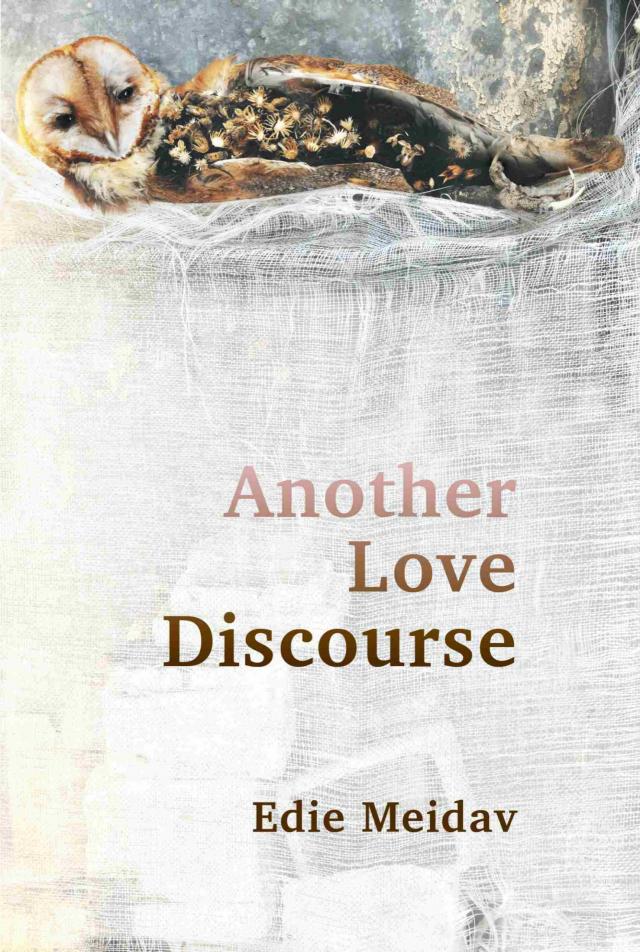


Another Love Discourse
also by Edie Meidav
Kingdom of the YoungLola, California
Crawl Space
The Far Field: A Novel of Ceylon
Strange Attractors: Lives Changed by Chance (editor)
Another Love Discourse
a lyric novel
Edie Meidav
2022
© 2022 by Edie Meidav
ISBN: 978-1-949597-21-9
electronic version
Library of Congress Control Number: 2022931687
All rights reserved.
This is a work of fiction. Any character’s resemblance to actual persons, living or dead, or actual events, is purely coincidental.
published by:
Publisher: David Rothenber
Editor-in-Chief: Evan Eisenberg
Designer: Martin Pedanik
Artwork by: Cecile Bouchier
Proofreader: Tyran Grillo
Set in EB Garamond
printed by Tallinn Book Printers, Tallinn, Estonia
1 2 3 4 5 6 7 8 9 10
www.terranovapress.com
Distributed by the MIT Press, Cambridge, Massachusetts and London, England
d_r0
To all who survived these last years.
May the memory of those who did not
be a blessing.
Contents
To be engulfed
Ravishment
Order
Events, setbacks, annoyances
In the loving calm of your arms
Alone
Identification
Demons
Flayed
In dreams begin responsibilities
Fade-out
Absence
Performance
Fulfillment
Pigeonholed
Adorable
Image
Fade-out
Declaration
To circumscribe
Brief lecture on semiology
We are our own demons
The calendar transformed
Hot flash/the unknowable
Atopos
Anxiety
Attentive
Alteration
Contingencies
Festivity
To hide
Induction
Annulment
Mad
Catastrophe
Connivance
Behavior
To understand
Embarrassment
Body
Quick interlude
Dependency
Remembrance
Fulfillment
Errantry
Faults
Magic
Informer
Drama
What I remember
Errantry
Gradiva
Absence
Her head
Performance, war
Sunset Boulevard
Festivity
Gradiva
Vouloir-saisir
Inexpressible love
Ode to awareness
Faults
Blue coat and yellow vest
Gossip
Affirmation
Alteration
Meetings
Unrest
Intimacy
Clouds
Why
Show me whom to desire
Ravishment
Encounter
Annulment
Askesis
Reverberation
No one spoke: the host, the guest, the white chrysanthemums
Renewal
Expenditure
Atopos
More egg
Truth
Disreality
First heart of the matter
Catastrophe
Palimpsest
Compassion
To understand
Behavior
Connivance
Body
Contingencies
Smitten
Dependence
Declaration
Ode to the owl
The idea
Demons
Drama
Flayed
To write
The cuttlefish and its ink
Embrace
Regretted
Habiliment
Image
Unknowable
Outcomes
Jealously
I-love-you
Languor
Magic
Yet in order not to be torn
Pigeonholed
Ravishment
Disreality
~
Acknowledgments
Bibliography, citations
Mourning: a cruel country where I am no longer afraid.
What I find utterly terrifying is mourning’s discontinuous character.
—Roland Barthes
And David sware moreover, and said, Thy father certainly knoweth that I have found grace in thine eyes; and he saith, Let not Jonathan know this, lest he be grieved: but truly as the LORD liveth, and as thy soul liveth, there is but a step between me and death.
—1 Samuel 20:3
Invite in the mess
so you might crave the order
that is mother
that is love.
To be engulfed
You of course tell
your story from wherever
you find yourself and hope
someone might hear.
Imagine the laws of life:
a mother birthing a tiny creature
on an eastern coast,
critter no larger than the letter T
in time, a life-form seeking not
just survival but thriving.
Imagine a little bug bit me, lower left cranium,
survival center,
and, ignoring protocol
because of the year of our shutdown,
I impatiently pulled it off.
Or imagine a game of chutes
and ladders and the thick
resounding of an echo chamber.
Your mother has died.
You are now motherroot for three daughters.
You have been party to a divorce.
You have moved several times.
Then slide into—! unprecedented
global pandemic (which is not the story
I will try to tell). Let us call it,
however,
the ripcord
(first shock when all of us
tugged
a parachute, the survival
wish) and then
the float
(in which we now live,
forever, prior rules
of time, space,
and communion
suspended).
Now the ripcord:
lost, atwirl
in memory. The float
remains.
You have been alone in isolation
with your daughters for a year.
Let’s say
you also wish to believe
in if not wholly invent some new
language of love (thrill/calm,
belong/discover).
One narcissus-friendly definition: you love
the version of yourself
held in the gaze of the beloved.
Or:
a sense of security over time.
Or:
you love who and what you become in the light of the beloved.
Or:
you have come together to savor and learn,
and in safety, you heal each other’s wounds
and then continue to discover more.
In this case, closeted,
a jewess who rarely outs herself,
a parent far from daughters,
the first time unmasked in a group of strangers,
the fog on the island three days straight.
This mother: find her out on a remote tiny island on which a mythical five-pointed stag as if out of Miyazaki wanders the center, once seen by an allegedly crazy writer who left his own leatherbound journal behind and sought to stay here (in the rough damp cabin in which I find myself, hard-hulled insects drunk on dust swept to the corner).
That crazed writer: wanting to fly solo through the winter, last seen with five cans of beans neatly stacked and many bottles of whiskey, nude with hands outstretched toward huge bonfire, burning another shelter rafter by rafter before the lonely pier.
Roland Barthes, a friend to this text, might tell us: the five cans of beans near the crazed writer’s fire would be the punctum, the detail that punctures the heart of the picture with vulnerability and risk.
You might say that despite the way this island swallows people, offering them the craze of art, despite those who have gone missing, we all start to feel great hope here, as if the mythical five-pointed stag wanders the island bearing good tidings. The beauty of the tiny landscapes around these rocks could make you think that wherever the stag wanders, its hooves heal in the mossfairy forest whatever has been broken.
You might find yourself a mother who, among other
What bedraggled camel can imagine itself back into that wedding in Vegas, walking with then-future husband before the woman taking photos, the shamaness who this last year would end up, briefly, your own mother’s executor, but then, genial in glad rags, photographed you as a couple (myth and icon as Roland might say), signifying future love, connection, ease.
Your white dress, its rip, would that be the punctum? The dress bought cheap at a quinceañera shop in the Mission district of San Francisco, city named after someone who loved animals just as much as the one who became newish love in this last tiny, vast era.
That dress? It ballooned about in the wind. As if you were to stay forever (emotionally) (structurally) fifteen, child bride to a man seventeen years older. Clad disingenuously in white when so many incursions have been made, the sign stripped of its signified, dress whipping westward.
Ravishment
What does anyone want? Reader, here’s the paradox: partly mothered, you made a vow to be there for three (3!) daughters once you had them.
Stayed in your new family long after the welcome mat became coir and then wire so they would have an intact family and you became no longer anyone you knew.
The lover must (wish to) recognize herself.
You instead became: a schreier, a crier.
Then made the break, as if hallucinating a different life.
New love arrived, and as one daughter points out, you became vital as a panther, happy and alive until the scourge hit.
And then your beau came to whatever we wish to call it—to be with you inside quarantine, foxhole, swannery. Your body then became a bridge over which the discomfort of others traveled, as, occasionally, a daughter balked.
I was bad to you, one says, now I don’t have a mother to myself, now I must share.
The very means for finding new family (love sanctuary) was being undone by new family.
Try healing your own unmothered self by being a good mother. Yet approval must (always) be found inside. Try too hard, healing is undone.
The beds also: undone.
Bills: unpaid.
The book which this is not: unwrit.
A new night-hued puppy arrived: unwalked, wishing for the run in the morning instead of your writing this screed.
In the still of morning, a hawk often startles as you open the door, about to take the dog to the great joy of the brook where her nose sniffs others’ noses and heels for rumors of travel, entire novels.
Say you wish for connection, your marriage dying for years for want of it.
Here tilts the paradox: good idea to up-end the apple cart? Choose your marriage every day, the wise friend used to say, advice you steadfastly ignored. Instead you repeated to yourself and your fried nerve endings I don’t believe in divorce.
Riddle for the alert reader: can you love any part of your self if you make yourself a questionable parent by encouraging the end of a loveshorn marriage?
Skies both endless and heavy, you made the decision, as if discontinuity could bring children even more of the mother yours was not.
Zeno’s paradox: the arrow flies close to its target but never quite meets its mark, the distance between tip and goal endlessly subdivided.
Obstacle to the love you covet might very well be the fact of the newish lover: one daughter finds his presence a great support, another blows soup bubbles at the question, a third riddles you (and the spike-head virus brings such queries home all too soon).
What is home for any of us? You get the thing you want, but too soon, at the wrong moment: is this not the structure of most comedy (or tragedy)? The devil forever in charge of timing. Time becomes this problem each of us must resolve.
As Roland whispers from behind the curtains:
Syntagmatic freedom is clearly related to certain aleatory factors: there are probabilities of saturation of certain syntactic forms by certain contents. This phenomenon is called catalysis; it is possible to imagine a purely formal lexicon which would provide, instead of the meaning of each word, the set of other words which could catalyze it according to possibilities which are of course variable—the smallest degree of probability would correspond to a ‘poetic’ zone of speech.
Q: What is rupture, genus personal?
A: To cut to the calendar chase:
February divorce, April cabin, June home purchase, August move from a temporary high-ceilinged apartment, February death of mother and last grandparent, collective isolation for a year in a new home meant to be a safe house for daughters and me, my employment site, the Institute of Roland Studies, about to shut doors, the prospect of hocking everything for a book on Roland ludicrous, teaching his wonderful love book to a community of pixelated faces who find succor, April’s poisoned plants and swarming bugs, bulletholes in the writing shed, and leaving the daughters briefly with ex (X), as our collective isolation stretches, leaving for the first time for a scholar/artist retreat on a May island.
The calendar may jumble but facts stay stalwart.
Moves, home purchase, tenants to support the former, keeping the homefront stable for three gangly daughters light on their feet.
Order
Roland loved shuffling index cards. Roland (as he has come to be known in our house in which my work on him was meant to keep some roof over our heads, since it is true I have hocked everything, including the kids’ own well-being and safety, to write a book on him which has not yet been written) kept playing with order. Any of his books could have achieved anything; how do you know when it should end?
That a story resolves somewhere: why not in another place?
Roland, who forever questioned the binary, would wish to undo the myth of classical narrative as understood in the contemporary writing workshop, to wit:
Someone has a goal and meets an obstacle.
Less interesting choices are made between a clear good and a stark evil.
The greater choice she makes—between a good and a lesser good or an evil and a lesser evil—reveals her character.
Greater pressure begins as a result of her choice.
We keep skidding ahead to the dénouement in which we (if not she) are all the wiser.
Events, setbacks, annoyances
Consider (a bit longer) the whimsy of timing. Wedding one blustery day in Vegas exactly a month before planes of unnamable uncertainty tore through buildings (on what Whitman among others called so lovingly Manhattoes, the isle on which he imagined deer prancing, before capital came to mark deep grooves through streets of numbered minds). I’m from Vegas, your X would shout, as if hefting his angry father’s leather-strapped, smoke-tinged pawnbroker croupier box, his people hunted by pogrom yet miraculously of both Shanghai and Australia, generations of crapshooters and rebellious prisoners from deep within a shared wager (call it history).
In the worst arguments, he shouted: you got to understand how crap plays, this is how we talk, this is how life works! You met him in your slush-cornered college town as you pursued your undegree. Seventeen years older than you, he hung out in a petite diner downtown, having dropped out, liking the perversity of being an anthro grad student gone blue-collar, watching each year bloom new undergrads, living in a spacious empty room over a quick-order stir-fry dive. Having inherited a slim fortune, a scion cut out of the massive part of the family will due to his mother’s intransigence.