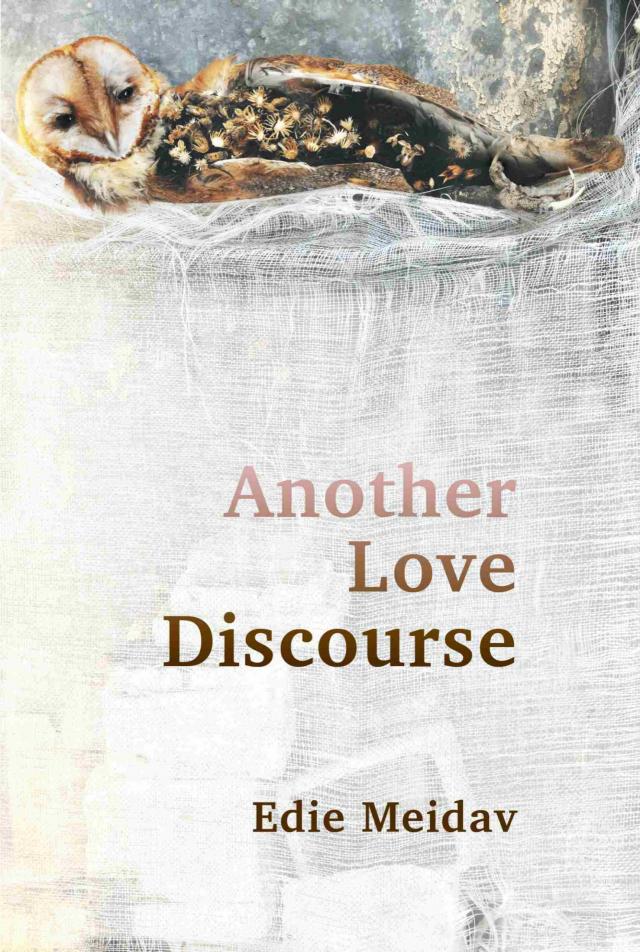
Another Love Discourse, page 13


Perhaps I did not mention there are two sheds. The other one, tiny, meant to be a mellow replica of the writing shed in which I write on Roland, a space for daughters and during our quarantine float, their friends seeking shelter. There is only one way left to escape the alienation of present-day society: to retreat ahead of it.
The tree stood amid sheds and bus and was sacrificed, much like the marriage the year prior. As if airdropped into a new story trying to make do, tugging the ripcord of this time, everyone making do, I’ve started to feel out of myself, more air and fire as daughter number one said. Ungeziefer. I hoped for a safe domesticity of the sort Kafka aimed to flee.
Plot twist: a scene: late night, the dog needs a walk. Youngest daughter and newish love take on the task most often. This time they head out and she speaks dispassionately: the divorce broke me, we are in this new place, I will be in high school and one sister will leave, and I have only just a few years, I need my mother back—this time solo, maybe just a year!—with not you, New Person, I need mother to live with only me. Now.
Now means do not worry about tomorrow’s trouble, for you do not know what the day may bring. Tomorrow may come and you will be no more, and so you will have worried about a world that is not yours! Or at least so says a text sliding into our consciousness from 600 years before the common era. How easy, however, not to worry: as if that slide into the future connects your past with your present.
A story: say you once stood at a coming-of-age ceremony in which the religious officiant stuttered, as he did not know what to say to the young and potentially shallow adolescent who stood before him, someone who liked fashion magazines, primarily. What he ended up offering was great warmth, since everyone so loved the parents, pillars of the community. You are, he said to the young girl whose lips were glossed by the sexualized petroleum-product simulacrum of her hoped-for bubble-gum future of smackery, you are a prophet of the now.
The phrase could pucker the hearing. What is a prophet of the now? Someone who knows how to savor and love this moment? Can you become such a prophet even amid your troubles? How can anyone survive, let alone be happy?
In a place where no one behaves like a human being, you must strive to be human—so says one sage. Despise no one, and call nothing useless, for there is no one whose hour does not come, and nothing that does not have its place, says another. And our days are scrolls; write on them what you want to be remembered. These sayings wallpaper your cranium, layered in you marrow outward. How to become a prophet of the now? Among all we are trying to do and recall and avoid, is it not a wonder that any one of us in our time can still breathe?
Inexpressible love
Why is it that singing
of happiness veers so
quickly to banality?
I would never wish to live
near the seashore, said once
to me by an heiress, too many
other people seek that lifestyle.
Is a thing known by singularity?
I used to make an art of not
just holding myself away from
others, but prizing only what my
eye could see: not the screenstar
celebrated for dimples, but the short fast-talking
neurotic. My eye was (all that remained
of) me: if I curated, I was known.
Some may have nostalgia
for the old-style video or LP shop
with the bossy curatorial clerk:
what great societal role the clerk served, telling
clientele: you don’t want this one, you
want that. (Instead, now we’re served by
predictive aesthetic genome,
algorithms, synced pop songs of idiocy
that I learn from my teens, careening
around my head,
signifying?) Before and yet
still, we wanted to like something
few others did: as if this would confirm
the ruts and grooves
of our own trajectory.
The singular image then: a gentle
sleeping morning shape, the genderless
mountain of new love, atop morning
blankets, in bed, supple and plain,
bare to the elements.
Maybe you have finally learned
that a person’s sexuality stands
apart from yourself in its abandon and
specificity, that it will not consume
you in its seemingly you-specific
fires, but has its own logic and trajectory,
and yet/so all the more suggests
itself as a gift. A person lies there with
abandon, ready, pliant, available.
you do not curate it; it exists
outside of all your eye believes
it is loved for seeing.
Ode to awareness
One thing remains apparent. Find a relationship ending and you may believe you have given more, giving and giving up. Do you have a right to grieve if you helped choose the end of the relationship? What is lost? Is it odd the addiction is still to the possibility of making it right for everyone, to be included in the familiar burr of his voice, as if you could be enfolded in the us-versus-them tribe he offered and get harmony back? All addiction continues because you believe you might get something good with the same bad habit still and yet again. You began with X when you were ill, you got better, and it all ended when what happened between you made you more ill, when you wished for the sun on all wounds.
When beginning with X, back in your early days of Manhattoes, you imagined every part of you could be healed if you had just three months with a love golem who could tend you as you had never been tended. There appeared, however, no fairytale love golem; you were never healed, you still felt bad at heart, and the relationship with X started on its uneven keel; once you found him when he had stormed out on the steps of a giant metropolitan institution and it seemed kismet as well as his rage asked you to stay together; is that even possible? How much of your life have you spent worrying about other people? Why does someone’s twisted look bother you?
Let us say you were that child fearing everyone was angry with you—your survival in question—and then with your children you might feel as if you helped create a reverse love golem: a child who can always find reason to be mad at you.
That’s yours, the genius friend counsels you to think, yours, you can keep it until such time as you wish to bring it up. How odd—you have always thought everything was not anyone else’s but really yours to fix, that you were everyone else’s love golem. Instead, can you be rooted like a tree and not give over to everyone’s winds?
And do you have the right to grieve the percentage of time you have given over to worrying about others? What is grief? Can only the sun name its layers? (As I write this, a ladybug tumbles onto this page, spots uncountable, stopping to sniff the markings, the smearable ink of my pen, before choosing to fly away.)
Faults
Does memory serve?
By inviting ecotenant Luft in, I believed that as much as divorce had gotten us off the grid of conventional storyline, I would support the good life of a decent, kind individual who wanted to live out back, on land, off-grid in all ways, far from lines of convention.
The talk of which tree had to be sacrificed for schoolbus highway blurred in last fall’s lopping cold. The two of us spent hours hearing all sorts of hard-boiled men wielding chainsaws, calling themselves tree people—as if a serial killer would call himself a people person—come and give estimates, the ecotenant and I sudden business partners, both of us oddly committed to his dream, a safe roof over his head. I wanted to keep my word as the marriage (sundered) had not.
Let Luft have his huge bus. Let the prayer of safety for everyone hold. Let people be people people, tree people be tree people.
Together on many moments the ecotenant and I stood, on our improbable hill, listening to these men, raw-faced and blistered, who eyed this skinny beanpole, Luft with his dark glasses, marzipan skin, and angular stance, his polite midwestern listening into which they spoke their own deferrals.
Yeah, they said, you’re a dreamer, sure, man, I wanted to do that once. I’d love to go live in the woods too! (said with scorn for any modern-day Thoreau). The bitterness of the dream deferred!
They mostly told him how improbable it was he could have his future without vermin-laden varmints eating out the undercarriage of his bus.
Everyone sang mortality. Boy, maggots will come! each said. Each in turn found new and exciting ways to try to tell him his dream was one big fat bad idea of loss.
We invited their expertise to advise on how to do the least damage to trees but the glint of their envy kept showing up at the party instead.
Finally a man with the most onomatopoetic moniker—Buzz—arrived to act as its henchman, and sawed it down—timber!
Mourning: one daughter lamented the tiny purple flowers which once pelted the greeny circle of shaded respite, her new bedroom window view lacking the spreading branches, now focused instead on gravel spread by Buzz, my infamous writing shed, the kid version of same, the poke of tenant’s ecobus.
Grasp safety and you lose it.
And then bulletholes only confirmed it all.
What marauder so loves
to come at night and
purposely shell us?
No one has seen our intruder: we assumed a man, for no good reason.
I come in the morning to find a resident possum of unknown gender raising his tiny eyes and sharp nose. Dawns mean more loss and a new scattering of holes in the shed, and I am a day late again writing about Roland, who never aimed to do all that much in matters domestic beyond serve mother Henrietta tea.
Imploring letters about the Institute for Roland Studies go unread. Labor unrest knots the supply chain. My ruddy editor sends me a threat louder than the wind hissing through the holes of this text. I owe
an unspeakable
amount of money;
the children need
stability, and this house
will
disappear
from (what is frequently a happy trample, if I failed to mention) our menagerie.
Blue coat and yellow vest
My lady at the bank, the mortgage lady, is a real whiz. A person must admire her; she seems almost not to breathe, mouth half-open, hunched over her calculator, muttering runic strings of numbers, spitting out percentage.
The distance between her competence and mine stays uncrossable: how joyous she is with her late-afternoon careful folders.
I am good with paper, she says, modest in pearls and starched hair. The thing is, I know she will, with that same speed, fire up repossession of our house; how can I meet the mortgage? The underwriters will know loss. I have no job or marriage, no mother or security, and it turns out the shaman has stepped down. My unblood Rick now executes mother’s will.
To understand the next step: I already pleaded for more time than the ruddy publisher can allow: his is a small anointed venture; him I also owe.
I had promised three daughters, arrayed on a range of skepticism, that our future would be better, that they might encounter the soul of calm to counterbalance all that had not been.
Labile seas would still, depth could be found in surrender. Leave the known and each day reminds you of ritual sacrifice: you only get a strong yes when you make a powerful no.
This axiom I had preached to them so many times—I had put down paintbrushes to become a Roland scholar—and wished to offer our strong yes as something divinely solid rather than whorling sensation, to be someone with an endless capacity for patience, to offer parenthood on tap.
As mentioned, our ecotenant uses the facilities at the local university where he researches protozoa, investigating the motivation for behavior at the level of the cell, but otherwise, self-identified cathemeral as he says, sleeps night and often day inside his tilted beige army-camo Luftbus, careening on an angle of stacked two-by-fours, all jutted toward our home.
Do all you can to mark the small
things, to feel your heart
slope leftward, all that
allows gratitude. Raindrop
with hard acid unknown, the frond
of pine scraping your home, dust footprints
winnowing fish downstream in last
daylight. Here will you find the wisdom
of our moment?
Grateful
for the small you(r spirit or soul
or just brain)
become large
as the sky holding all.
Gossip
And so it must be noted that Luft was first to alert me of the danger, noticing so much of what I don’t: he first sees the footprints, while I just note clogged gutters.
Someone had tracked near him in the predawn: a large-cloaked homeless woman trundling down the driveway of our cul-de-sac toward the shelter two doors down, the former motel making a village of citizens who now get a room of their own, lending them dignity, maybe a job down the road.
Not a bear, he said.
And yet I could not help but think, in a fit of paranoia, that the figure may have been the ruddy editor to whom I had promised the book on Roland.
Affirmation
As you now know, Roland, born in the fall of 1915, long before he died in a fit of boredom/depression, run over by a laundry truck, was dedicated to his mother Henrietta Binger Barthes.
Having lived with her for sixty years, having had pastry crumbs brushed from his lips by her, having sat with her over coffee, tea, comestibles, Roland took Henrietta’s death hard.
When Henrietta died in 1977, her son began writing Camera Lucida, a haunted book. Riddled by the exact theory capable of birthing a hundred baby spider plants, including volumes of what one literary pope calls enigmatic realism, the habit of including photos which have an oblique reference to the text.
Known most often to international readers in the work of Sebald, this habit of enigmatic realism has lived in the earlier and later work of untold writers. Quick recipe: include a picture as a form of oblique denotation, a glancing truth off any interpretation gleaned from the text.
Readers of enigmatic realism note the facticity of the photo which, often poorly reproduced, then becomes another portal to lived experience. Either you as reader enter and find yourself in deeper empathy with your author, or stay in uneasy wrestle, since the text had earlier formed different images in your mind’s eye.
What does the photo then offer? A chance to alter perception. The linguistic and visual blur or focus a topic but ultimately leave you alone in the room of your reading, the two usually operating more in agreement than mutual understanding. So that when a writer enigmatically includes an image, sans caption, the photo both interrupts and augments (echoes) life in which we never can fully cite where we are as observer-participants.
However, consider the work of a friend, a native cartographer, who resists the inclusion of portraits in order to prevent viewers adjudicating degrees of indigeneity based on such images. Absolute systems constrain vision absolutely. In this case, how clear it becomes: our gaze despoils, our minds warped by the colonial: how to find a place away from such tyranny? Not in the image.
In the case of Roland, he lingers over one photo of his mother as a child, dropped into his midst, his use of aorist here meaning the simple past, the action completed:
I observe with horror, he says, an anterior future of which death is the stake. By giving me the absolute past of the pose (aorist), the photograph tells me death in the future. What pricks me is the discovery of this equivalence. In front of the photograph of my mother as a child, I tell myself: she is going to die: I shudder, like Winnicott’s psychotic patient, over a catastrophe which has already occurred. Whether or not the subject is already dead, every photograph is this catastrophe. This punctum, more or less blurred beneath the abundance and the disparity of contemporary photographs, is vividly legible in historical photographs: there is always a defeat of Time in them: that is dead and that is going to die.
Roland tells us a photograph is, like some ancient Egyptian funerary object, the living image of a dead thing, always bearing as main elements the studium and punctum. Studium relates to your first attraction to a photo, what makes your eyes wish to stop and engage, an enthusiastic commitment, but the punctum interrupts the first with an element of purpose, provoking your questions, the punctum that accident which pricks me (but also bruises me, is poignant to me).
Another way to say it: the studium calls out to the part of us most conditioned by historical and cultural experiences.
The Twin Towers.