Another Love Discourse, page 23


that would keep me from infection and death
Please find whatever works for you. Rest.
We were still somewhat new to each other, remember.
Rubbing alcohol wipes over the open nub in my arm toward the hole
that went straight to my heart and its whoosh
Tilting syringe upright
Careful in pushing so a tiny wet bubble appeared at the tip,
expunging its air before with great love he held my gaze and plunged
the four syringes direct into my vein
A Parisian morphine den would have had greater glamour
than our shooting gallery: but here he shot me up with the potential for life.
Are you able to trust anyone so totally?
Even if that person offers the softest kiss at the center of your forehead?
Were you ever that child who swore somewhere inside never to trust?
To never let the outside in?
Our metaphors about death and infection often revert to war.
Here, gentle soul, moth-trapper, disabler of mousetraps
with sweet focus he aimed to kill the intruder
who made me unable to find my mind’s usual canals
even as I continued writing this thing meant
to keep us all going,
survival in our parsonage, aloft in days watery
and unmarkable. And yet (good news!) never
did I feel myself a burden.
Had I ever known this?
Reader’s query, special for you, insert your own ideogram:
did I seize the chance to make of the crisis
opportunity, to remake
the mind, find myself anew, to know the joy of this
moment and the next?
To repattern the brain?
Or do we ever know when
performance inside our greatest
lesson begins or ends?
Pigeonholed
Let us say you once lived in a tight space and yet also overextended.
Imagine you had to flee. How do you rework any neural pathway?
Just touch my periphery, you may have said, when it was your turn.
You may have been about to strike yourself through.
Or begged to hear a certain kind of song. Sing anything, songs of praise, you may have asked others.
Let anyone say
Did you ever have a clue how to soften your head?
Did you ever have a feeling all would collapse?
Let us say that once you started taking the med dispensed by the milk-skinned pharmacist, you start to herx, which, in a beautiful paradox, is a phenomenon named after his great-great-grandfather who discovered that, as illness starts to leave the body, as the bacteria start to die off, the patient might undergo worse symptoms for a while. Herxheimer foresaw our current state. Bring yourself to love and the illness starts to leave the body, which means that for a while you get worse, and yet this tunneling remains part of it, that we get worse for a while means there remains some greater hope of light.
You might not be able to keep the holiness of the I-Thou relation constant with anyone. You might not be able to keep that inexhaustible warm communion with the cosmos at the center of anything. There might be moments when you find yourself lost in seeing the thingness of life and everyone. The bills and chaos. But the waves of some particular love energy stay, rolling in and receding, beautiful tides, and because you let yourself trust, you might as well recognize: as if for the first time your heart becomes that home in which you wish to stay a while.
Ravishment
How can it be that in the great dusty sweep of time that there sprout fresh
moments: at the harvest festival, you rise
with your beau and three kids
to shake the lulav and etrog
in different directions, and there is
a timelessness your beau knows
in the eight minutes he has before he
has to leave, and you feel so
blessed with community, meeting
outdoors in the fall air, blessing
everything. You oil the pan later for dinner,
onion chopped, sprig of mint,
your mind perhaps not fresh but
at least ready.
Disreality
So many moments at the point of death are disreality.
To list them here: once you were on a plane and one of the wings, over which you were sitting, caught on fire. Goodbye to each person you loved, one second of that, and then the flight attendants started to run.
Once you had dengue fever, from a mosquito, and your consciousness lifted out of your body.
One time you saved a friend who had a tropical fever from nurses who kept saying the doctor was coming in an endlessly deferrable now.
One time a friend was killed and at that exact moment, elsewhere, in Jerusalem, you had to leave a class, laughing (and from this sprang all your future writing).
One hour your father was about to die, and your little two-year-old daughter knew it, she was quite insistent about people going into hospitals and never leaving.
One time before that, you woke as if with bricks on your chest the exact minute, a continent away, he had his heart attack.
One time you had a dream of your arms too long for your body and woke to hear your friend’s baby had been born a little person.
One time you told fortunes on the sidewalk, as a twelve-year-old fictive huckster outside a Berkeley sidewalk café who could see people's deaths.
One time your daughter said she knew when people would die.
One time she saw your dead father walking around without his legs.
One time after her death your mother told you not to worry about minutiae, that the disreality of life near death is such thin tissue.
One time someone died and the spell over your writing lifted.
One time you chose to let in allies.
One time a bug bit you and your brain stopped.
One time someone tried to heal you and you aimed for trust.
One time you woke to a beautiful person wanting to cuddle in bed.
Just tell me you don’t touch him when we’re here. Just save it for the times when we’re not here. This your daughter said in the life that has become yours.
The raised gardenbeds have arrived. A praying mantis and ladybug wait on the unopened box. You are trying to create structure from which life might spring. A glance could suffice—ours—for the world to be eternally complete.
~
Acknowledgments
To Carol Frederick, one of the world’s greatest champions of art and heart, and her long-standing presence at the earthly paradise Art OMI, along with all the other directors.
To all those connected to Eastern Island Frontier/Norton Island residency including Mike Reilly, Lizzy, Steve, and Rosy Faver Dunn, and to the magic of the place in which this book found its form.
To Hambidge.
To David Rothenberg, who first risked for this, editor Evan Eisenberg, who entered with enthusiasm and insight, and to the memory of Howard Eisenberg.
To Randall Knoper, Jenny Adams, Joe Black, Jeff Parker, Sabina Murray, Lynne Latham, Tom Racine, Patty O’Neill, and Adam Zucker, as well as other colleagues in the MFA and the University of Massachusetts for research support.
To the lighthouse beam of agent Soumeya Bendimerad-Roberts along with Hannah Popal and Rhea Lyons.
To the enduring, bright tether of Amalena, Jeff Gyvingmore, and Larry Bensky, West Coast legendary activists.
To Sue and Mike Austin and Carol and Michael O’Day for their combined and individual Brookside warm intelligence. To Brenda Kahn,
a mermaid and writer, Judith Silverstein, Mike Healy, a secret mayor, and all the Brookside writers.
To Sara Acker and Susannah Ludwig for illuminated hearts.
To Yael, Ana, and the yedidot.
To all the warm inspiration of those I do not mention here. To friends, neighbors, students, and all teachers.
To Andrea Scrima at Statorec who first culled and published this material, and later used it in the anthology Writing the Virus (Outpost 19), and helped it find perch in the New York Public Library audio vault as well as HERE Gallery (Manhattan) for a stop-motion collaboration with Luna Knightley.
To the fierce real help of Claire Bargout, Theo and Holly Black, Sylvia Brownrigg, Jim Carpenter, Carolyn Cooke, Dafney Dabach, Mariah DeLeon, Margot Douaihy, Sharon Guskin, Debra Immergut, Maria Johnson, Emmy Kinarty, Rae Kootman and family, Amii LeGendre, Rami Margron, Laura Marshall, Josh Meidav and family, Elizabeth Rosner, Kevin Salem, Tara Shafer, Mila Sherman and family, Sheila, Kenny, and all Sonnenscheins, Pam Thompson.
To Michael Ravitch.
To all members of the medical profession who kept me alive, especially Gena Wilson, Jenn Goldstock, and Dr. Paz.
To Tyran Grillo, Colette McCormick, and designer Martin Pedanik, kind, patient, inspired.
To the enduring love of Lerners, Naparsts, Kinartys, Meidavs.
To the innomenence of Ben Richter and family.
To the beloved brilliant ever-unfolding gift of D and E.
Bibliography, background, citations
Barthes: A Lover’s Discourse: Fragments, Roland Barthes, translated from the French by Richard Howard. Foreword by Wayne Koestenbaum. Hill & Wang, a division of Farrar, Straus and Giroux, New York. 1978.
Mourning Diary: October 26, 1977-September 15, 1979, Roland Barthes. Text established and annotated by Nathalie Léger. Translated from the French by Richard Howard. Hill & Wang, a division of Farrar, Straus and Giroux, New York. 2010.
Roland Barthes: A Biography, Louis-Jean Calvet, translated by Sarah Wykes, Indiana University Press, Bloomington and Indianapolis, 1995.
Barthes: A Biography, Tiphaine Samoyault, translated by Andrew Brown, Polity Press, Institut Francais, 2015.
Also of interest
All of Roland Barthes’ work.
Barthes: A Very Short Introduction, Jonathan Culler, Oxford University Press, 1983.
Interdisciplinary Barthes, edited by Diana Knight, published for The British Academy by Oxford University Press. London, 2020.
Roland Barthes, by Patrick Mauriès, Aux Editions du Seuil, L’Imprimerie Floch, Mayenne, 1992.
Bringing Out Roland Barthes, by D.A. Miller, University of California Press, Berkeley, Los Angeles, Oxford, 1992.
A Barthes Reader, edited with an introduction by Susan Sontag, Barnes and Noble Rediscovers, by arrangement with Farrar, Straus & Giroux, 1982.
The Professor of Desire, by Steven Ungar, University of Nebraska Press, Lincoln and London, 1983.
List of illustrations
Pomegranate colander/bounty
Owl plinth/omniscience
Wedding dress/metaphysics
Tower/perception
Stairs/fallen frame
Pool/hunger for memory
Roland and mother
Wedding dress/departure
Dog bridge/who sees you?
Scarecrow/telos
Heroine/aspiration
Chair/the invention of mirth
Wind drawings/escape
Beekeepers/collusion
Inner child/incapacity
Vapor/uncertainty
Pool/mobilization
Bee slats/interpretation
Thorns reaching for light/silence
Wedding dress/orientation
Rafters/beckoning/metempsychosis
Sweet owl/embrace
All images by Cecile Bouchier, except for a few by the author.
Called an “American original,” Edie Meidav is the author of the prose collection Kingdom of the Young and novels including Lola, California, and Crawl Space. Her previous work has been recognized by the Bard Fiction Prize and Kafka Prize and has received support from the Fulbright Program, the Howard Foundation, the Lannan Foundation, and the Whiting Foundation. A senior editor at the journal Conjunctions, she teaches in the MFA program at the University
of Massachusetts at Amherst.
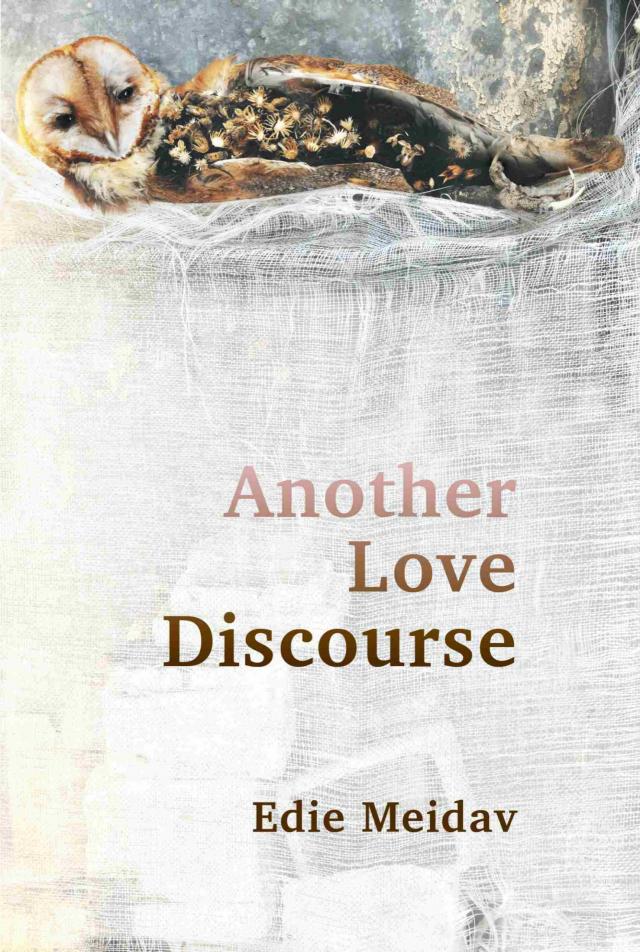
Edie Meidav, Another Love Discourse