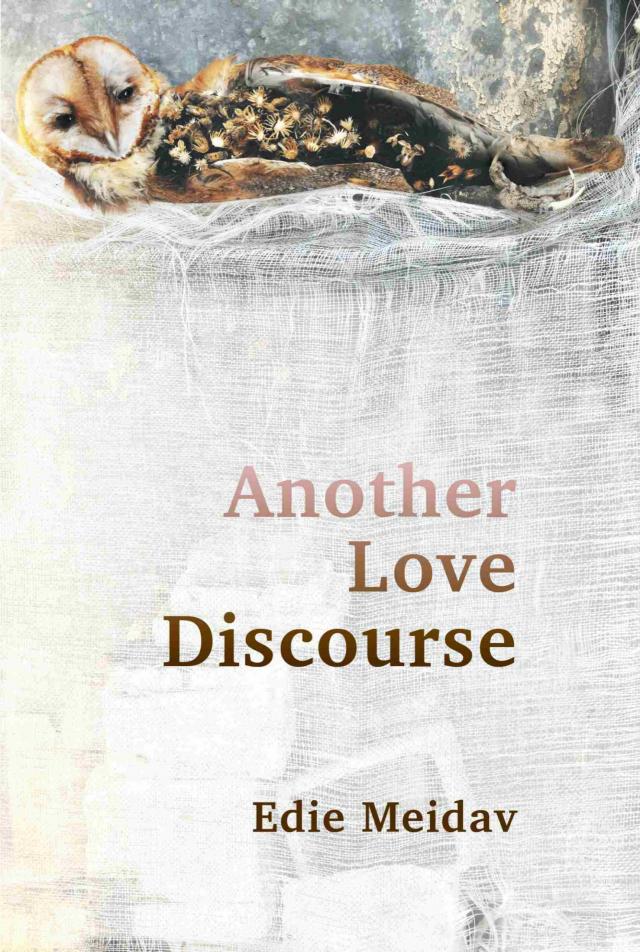
Another Love Discourse, page 20


Will there be problems ahead: if new beau has future children, will he be underslept, will you both get mad? (Memory of hiding with brother as father stormed in, angry at a poorly cleaned household: this informed your later pattern.) Will you ever feel upset about anything connected to new beau? Does anger have to be such a scary shadow thought? This becomes one part of what Roland would call the enigma code of our story.
I look for signs, but of what? What is the object of my reading? Is it: am I loved (am I loved no longer, am I still loved)? Is it my future that I am trying to read, deciphering in what is inscribed the announcement of what will happen to me, according to a method which combines paleography and manticism?
but also
In the encounter, I marvel that I have found someone who, by successive touches, each one successful, unfailing, completes the painting of my hallucination
and yet for that moment I am totally given over to this discovery.
Dependence
Mother buried
under burnt dirtclods
in the unchanging
season that is northern California.
Despite what people say, grief
claims all seasons and none
yet you, if jew, are meant to mourn
for eleven months.
You’ll feel it,
the Californian mystics claim,
she’ll be nearby: forty days and nights,
three months, six months.
You will see treetops, birds, flickered
electricity, balls of energy in corners:
all will signify mother.
And you will see, after a year you’ll feel
her, she will come to you, saying goodbye.
The mystics of California love to be all-knowing; knowledge is seductive; hence mystics are seductive.
Pascal made a famous wager: given the grand prize, might as well believe in God. During your lifetime, act as if God exists, and you sacrifice certain worldly pleasures, the penalty finite. Yet should God turn out to exist, get the infinite reward and go home free!
Roland complains from Morocco, seeing the swallows flying through the summer evening air, I tell myself, thinking painfully of Maman: how barbarous not to believe in souls—in the immortality of souls! cursing himself: the idiotic truth of materialism!
Declaration
One of the most painful parts of writing is revealing oneself. This should be obvious, but it is not. When I was young, Uncle Rick consistently read my diary. I can’t help it, Rick said, your writing is so good. And there was the rub. The first reader to like your work had already violated internal space in more than a few ways: would you wish to share or hide?
Later there was a first writing teacher, his eyepatch making him a swaggering pirate of literature, and how with his writer friends—what a glorious concept to the impressionable mind—they spoke more of the biz of writing, agents and the like, rather than the act itself. His grand injunction was one Roland might have loved: write what you don’t know! Another mentor traveled the world, work soaring upon research, a habit against which he warned. Long had he wanted to be recognized as a fiction writer and yet how well he modeled the life of constant escape and flight.
How might you mix such influences? Say you were working as a waitress in a garden restaurant off the boardwalk south of Santa Monica and a man often came in, a lawyer, and he always asked: how does a young writer manage to write, work, research, and live life? What could be the answer? At that age, curiosity topples over patience.
Say that instead in that period you moved three times over eighteen months and held no job longer than a month. And in this fable, soon one day there came some publication of your Roland work with a stray mention of a grandfather and a relative of yours was disturbed: you dishonor memory, I am used to seeing you as magnanimous, please never write about me or my family.
The revelation of the inner bad
self: this is what writing can do too.
For years, the worst thing you had done was read the journal pages of that older beau. After you confessed, he asked to see the journal you were keeping in your twenties and remarked: it is amazing to see how you are so confident in your interior! Here is the rub of writing; you observe (along grotto walls), the eye keeping its faith when the rest of you or the world might not. The possibility of getting to name sometimes erodes the very state it seeks to attain: the ecstasy of understanding!
Middle daughter, adolescent, walks the beach amid the family of revealed humanity, exclaiming: it is so wonderful, these people and the charisma of the ocean, I become nothing. You lose your ego! you find yourself saying, cheerful in naming too egoically her triumph.
Ode to the owl
We have gone for a masked bike ride, the friend and I, on one of the first sunny days. To a new swing where she enjoys herself with great girlish whoop. We see, from far below on the field, an older serious woman approach.
This friend says of an earlier mate that they are forever linked, having fellow cubbyholes in the universe next to each other, while some current mate and she stay only on swings, parallel, enjoying the temporary ride, soon to jump off. Who might you be with anyone?
The night before, I had been alone at the table; middle daughter had made an exquisite diorama, a tiny version of our lives, a tempest in a giant ark-like house, loving, witty, exact. Youngest daughter stormed upstairs, having stated yet again that it is hard to be quarantined with new mate; everyone fierce in passion, lions retired to their quarters. What will be the right course? I turned to one of my mother’s last videos to me, when I knew we were having one of our last visits. Hooked up to oxygen, she speaks with verve and courage, emphasizing and inventing words, unhitched from language, any one of Roland’s codes floating up to the great noosphere:
My wish for you is that the motto for sake becomes an absolute value in you! And you’re able to adjust to what they’re giving you. And get your had for everything that you put into this amaryst. And that they give you a consistent paybill. What you dearly deserve! And it becomes a matrych for you to wrestle in.
And you get your deserved in the rights of the demon!
Her passion lives: she wants her children to be met by the world. Though, whatever the rights of the demon, no bird could sight the pornography of screens in our time. In this case, let porn denote the orchestrated series of gesture toward preconceived outcome. Take all the lectures and literary readings in which people gesticulate or appear composed toward the camera of their own gaze. Our interactions in this time of pixels would have been so different had none been able to see themselves. While meanwhile the aleatory, flattening porn of screens will not stop, overtaking concepts of soul, serendipity, destiny.
Paranoia multiplies across these screens. He doesn’t love me, she thinks poorly of me, they are bad, I don’t belong in the visual stream. These calls we hear down the corridors of our empty burrows after—if ever—we turn everything off. The real is not representable, Roland would tell them.
I tell my friend how the students of our disbanded Roland Institute are crying, they are alone. One appears in the window square of the computer and says: I never know who I am until I begin talking to another. One tells me of the need to schedule true connection time with their mate, because otherwise the two barely put up with each other in their small apartment. Another keeps insisting there might be imminent departure to Brooklyn, that promised land, though the prior statement had concerned the wish to stick around while a mate finishes a degree. People are seeking escape.
The friend on the swing talks to me and then her eyes alight on a tree behind: an owl, she says, I have a friend who taught me to look for owls, my eyes are always cast away from whatever is around us, or looking out for a threat, even a dog on the trail, but my friend can spot everything, people in love, mushrooms, owls. In a day we find it all.
And as the older serious woman in the field walks uphill toward the swing, she reveals herself to be a girl who turns out to be eldest daughter with her head newly, shockingly shaven and our puppy. You always find our father, she says of Vegas mate, who with other daughters will soon, apparently, approach. The universe has its jokes: I never go to this swing, all those years I probably never quite found him, my heart gone seeking so that realness found me elsewhere. Perhaps, to use my mother's terms, I may not have got my had from the amaryst, but this was my own matrych in which to wrestle. And yet from the owl’s view, everyone is always aligned, moving toward rightful ends upon the surface with little friction.
We talk: the owl flies out over the valley, its wings tremendous, and was it an owl after all, a hawk or, even more unlikely, an eagle? Can we believe what we see and feel and have it stay vast as the unnamed world or does story send it fleeing?
The idea
This morning I read what I had written of a dream my father had a few months before he died. He had been wild-eyed, his helper said, and needed to call me. On the phone, his voice was urgent: are you planning on crossing to the other side, he asked. I really wondered if you’d gotten tickets—made arrangements. Are you asking if I was planning on committing suicide? I asked. The stink of death can be removed so simply, once you near it. Yes. No, I said. But in truth the shade was near; in my marriage, I was burning out goodwill and telomeres besides.
This was some years after my new beau began his crush, though I did not know. Some years after I came close to wondering what it was all for. My father linked to me not just in this way but in his predilection for aqueous floating knowledge.
And then another old video today of my undead mother popped up on my phone, making a verbal legacy for all three of my daughters. Nouns shift, verbs stay mostly intact. This is the wisdom of the end of life: nouns
don’t matter. Spend most of our lives chasing them as we do, but in the end, as with fiction, verbs—and adverbs, and even the adjectives—matter most.
One of those most-quoted poems by my former mentor, Robert, his meditation at Lagunitas, has a few nouns uttered in italics. When I was young, they seemed invocations of pleasure. Blackberry, blackberry. Older, after so many shades visited me, the nouns seem icons of mortality. Is there a difference?
Demons
After her death, imagine this legacy: you have
learned how important it is to listen.
The old-time linguist says men (gendered as such) are taught to do report
talk while women do rapport talk. What are your concerns? Uncle Rick says, in professional mode.
You tell him what you’ve heard: there are liquidators, a pair of loving sisters, they will comb through and rid the lost home of all mother’s belongings. And that it is a good idea to apportion a long day or weekend, the heirs take turns, find a storage facility to store objects that take too much sentiment or thought to trawl: albums, journals. A place communally rented. Not unaware of hostility, you go too much into details, as if to padlock your history.
You have become the bad person. It is an upward struggle, this reach toward the golden ring of self-compassion, hard to grab from your seat on the merry-go-round, a plastered owlchair, paint chipping. The golden ring awaits you but you sit too low to reach it. You must either destroy the merry-go-round or else merely (Roland loves puns a little too much) destory it.
Drama
The hypervigilant brain, trained over many centuries, has been selected for survival. And so you wake another morning having dreamt of being bullied by Uncle Rick, first perpetrator. And then go to pick up children from the house of Vegas mate where you lived your last light-bereft days, a home where other marriages had also gone up in flames. To pick up children: not an experience of ceaseless delight but rather an eon of sitting in a cold dark car, an hour and a half, two hours, some cruelty in the minute-hand, how these transitions continue.
Middle daughter appears, face stricken: we just started a bonfire, the act
suggested by your Vegas mate, no stranger to conflagration, the fire starting long past the hour you were to pick them up.
I hate being a killjoy, you say, this puts me in an awkward position.
And the three girls in the car finally emerge, flippancy a flameproof shield. Maybe our father should bring us next time?
Yes, but you won’t come (on time).
We never come on time for anyone anyway, one says, sinking your heart in prayer. Let them not inscribe themselves into living aslant communal agreement, let them be able to keep their own.
He can’t drive us?
In the silence, a recall of Vegas mate. Soon after the marriage had exploded, soon after you declared the wish for the divorce, he spoke to you affably, speaking of his lower back and its issues. The problem of a leaky gutterpipe, an overhanging branch. He held the ladder for you tenderly, and you saw the way the divorce might unfurl, the two of you companionable on the road called life, moving forward, that twinkle-fingered new constellation of your sky. You wish for peace, does he not want the same? You mounted the ladder, he seemed to be holding tight and firm, until he ended up seized by a fit, the sneezing often used to announce his presence. So intense that he shook the ladder, hard, and then kept shaking, his hands entering a trance as was the case with certain policemen of this time,
he could
not let go
of the grip.
The way you experienced
the falling
in slow
motion, down and around, magically
rolling
as if you had planned this from a karate movie, down across your shoulder and around so that, though you were bruised, after a moment of shock on the ground, you could rise (as if from the marriage) intact.
You could walk away.
The kids saw this from behind the orange curtain of the upstairs window. As you limped back to your car to return to the new temporary other place, a cabin with a woodstove in which you felt the rush of restoration, your own energy surging as if for the first time, music with broad slowing cadence, he shouted at you, as was often the case if you hurt yourself: what, you want to blame me for this?
(And stretched out far behind his shout, as you can feel for his own case, some long legacy of shame made him hear blame everywhere.) It would have been almost fine but for the other incident: the package he mailed with strange dust puffing out that laid you low for a day. What do you want, I couldn’t help it, he yelled over the phone, you blame me for working with rat poison that day, who can be a hundred percent hygienic all the time, didn’t mean to voice tinniest right before hanging up.
Why did he have it in for you? Not bad at heart; of course everything could be explained away.
When you were aiming for new twinkle-family constellation, he for the first time suggested a trip, on inflatable kayaks, borrowed from a friend, a nearby pond. What amazing enterprise he showed; you didn’t know he had it in him; perhaps this was the new functional hidden by years of marriage. You were cheered, you entered a version of (father’s)(later beau’s) picturesque. The happy post-divorce family! He would make plans, all would thrive. You helped each of the three girls go off on their boats and then stepped into the boat designated yours: an unseaworthy vessel. Later you saw all the places the plastic had been stabbed, meant to spring leaks. He and the three kids had their outing; you watched from shore until you could watch no more.
And the last and worst incident. (Let it be forgotten.)
O yeah, daughter says, I forgot.
And say the next day you wake feeling unworthy and terrible, that symbol and syntagm: the bad mother. Bad in all ways: bad keeper of equanimity, money, house, secrets, bad burnisher of the symbolic order of the realm.
You take the dog on a walk since no one else wants to and what is there to write on Roland anyway? Your pockets weighted, heavy with logistics and bureaucracy.
On the phone, a friend tells you her woes: a rain of intrusive thoughts. This is what happens when we receive uneven parenting: intrusive thoughts enter as substitute for pelt, cave, fire.
At home you get an email called pet the lizard, about how we many times in the day must find a way to soothe our reptilian brain, reminding the lizard that it can emerge from its rock with no concern about time.
In this case, your beloved meets the lizard. Readying himself for a shopping expedition, to stand in the sun with others holding phones, masked. Except in this case he wears over his head the scarf your mother gave you, green swirled flamboyance, and the buccaneer costume oddly reminds you of the earliest tender and gleefully invited face he wore when you met him all those years ago.
He is also heading out to deposit a check for you. Could you be more grateful? You look like a ship’s boy, you say: he loves this and basks. That the choice of serving another has become part of your dreamlife: is this not the ultimate luxury?
You will die a happy person if you can play on the instrument of yourself the score of your to-do list without drama. Aspire from the innermost center; the lizard wants no more. No one will fall, get sick, burn, explode. Your X is doing okay, telling you that after the divorce his health improved. All dramas rise and fall, and what will make it out of this story fully alive? Freedom, connection, or the unchartable in-between?