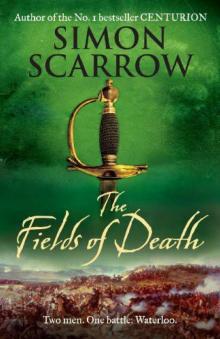
The Fields of Death r-4, page 66
part #4 of Revolution Series


Even though the order was not in the manual, the nearest men had sufficient presence of mind to throw themselves flat, and the horses of the three officers leaped over the Highlanders. As Arthur reined in and turned his mount round the men rose to their feet to face the oncoming cuirassiers.
‘Hold your fire until I give the order!’Arthur shouted, ignoring Picton’s angry expression at his commander’s presumption. ‘Wait . . .Wait . . .’
The men held their muskets tightly into their shoulders, stilling their breath in anticipation. The enemy, having cut down the Dutch, now pounded on towards the redcoats, so close that their savage expressions were clearly visible. At no more than thirty yards Arthur shouted the order. ‘Fire!’
The volley crashed out and from the saddle Arthur saw the leading Frenchmen and their mounts pitch forward in a tangle of arms, legs and horseflesh. Those behind had to swerve aside or rein in and the impetus of the charge was broken. A second volley cut down another score of cuirassiers and then they turned and cantered away, back towards the rise where the Dutch brigades had once stood.
Arthur glanced round and saw that the arrival of fresh troops had stabilised the allies’ position and the French cavalry were in retreat. But already another danger was evident as the first French guns unlimbered to his front. Within fifteen minutes the first cannon balls were pounding the allied line.
For the next two hours the French made several more attacks. But all the time more allied units and guns were arriving from the direction of Brussels and gradually the battle swung in Arthur’s favour. In the approaching dusk the allied line pressed forward, retaking the ridge and farmhouses while the light infantry cleared the French skirmishers out of the woods. As night fell the final shots were fired and then the battlefield was quiet, save for the groans and cries of the wounded.
While more formations continued to arrive, including his headquarters staff, Arthur was growing increasingly concerned by the lack of news from Ligny. The last report from the Prussian headquarters, received at five o’clock, had informed him that Blьcher’s men were holding their positions.
‘In that case,’ Arthur told his aide, ‘we shall be in an advantageous position tomorrow. Once we combine with Blьcher we are sure to overwhelm the enemy.’
‘Assuming Blьcher has held them off.’
‘Of course. But we must be certain.’ Arthur called over one of his staff officers. ‘Colonel Gordon! Over here, if you please!’
The colonel trotted over as Arthur mentally composed his orders before he spoke. ‘You have a fresh horse?’
‘Yes, your grace.’
‘Then I want you to ride to Marshal Blьcher’s headquarters at Sombreffe, north of Ligny. Tell him that we have the crossroads and by dawn the army will be here in sufficient strength to march to join him. Also, I would appreciate a report on his engagement today.’
‘Yes, your grace.’
‘Then off you go. You may find me here when you return.’
Colonel Gordon disappeared into the night, galloping along the road to Sombreffe, and Arthur stretched his shoulders for a moment before settling down by one of the camp fires of the Ninety-second to await his return. The long hours of the night passed without incident as more soldiers arrived at the crossroads and were led to their positions by staff officers. At first Arthur’s spirits were high. It had been touch and go the previous afternoon, but his men had bested the enemy. Even if Blьcher had not won at Ligny, he would be near enough for the armies to combine in the coming day. However, there was no sign of Gordon during the night, and as the first light appeared on the horizon a building sense of foreboding began to gnaw at Arthur’s heart. The sun rose, bathing the rolling landscape in a warm rosy hue. From the south came the faint sounds of trumpets as the French stirred, but there was no attempt to renew the previous day’s fighting.
Finally, at half past seven, Colonel Gordon returned. His horse was blown, its bridle covered in foam, and Gordon’s face looked gaunt as he dismounted and strode up towards Arthur.
‘Well?’
‘If you please, your grace, might we speak out of earshot of the others?’
Arthur frowned, but paced a short distance away from the headquarters staff, who exchanged a mixture of curious and anxious expressions.
‘Blьcher was defeated yesterday, your grace.’ Gordon spoke softly. ‘Many of his formations were routed. The rest were forced to retreat.’
‘I see.’ Arthur felt his heart sink as he digested the news. ‘Then I take it he is no longer at Sombreffe.’
‘No, your grace. He has pulled his army back to Wavre. That’s why it took me so long to find them.’
‘Wavre?’ Arthur was momentarily stunned. ‘But that’s nearly twenty miles from here. By God, we are undone,’ he continued in a hushed tone as the full implication of the news struck home. Blьcher was powerless to intervene if the French attacked Arthur’s army at Quatre Bras. Taking a deep breath, Arthur patted Gordon on the shoulder. ‘My thanks to you. I suppose in England they will say we have been licked. I can’t help it; as the Prussians have gone back, we must go too.’ He shook his head sadly. ‘Find yourself some refreshment. But first, send General Mьffling to me.’
‘Yes, your grace.’
While he waited for the Prussian liaison officer Arthur glanced to the south and east, as if expecting to see the leading formations of the French army already advancing to attack him and seal their victory.
Mьffling came up, hurriedly fastening his jacket buttons. ‘You sent for me?’
‘Yes. It seems that your countrymen were defeated yesterday.’
The Prussian’s jaw sagged in dismay. ‘I had not heard.’
‘That is because we were not told,’ Arthur responded coldly.‘Blьcher has retreated to Wavre. Yes, Wavre. More than a day’s march from here. And his chief of staff did not think to inform us of his reverse at Ligny. For what reason, I wonder? A suspicious mind might conclude that we had been left here, unaware, in order to cover the Prussian retreat.’
Mьffling froze and then shook his head.‘That is an ignoble suggestion, your grace.’
‘Perhaps. And if I am mistaken, then I apologise,’ Arthur replied flatly. ‘But the fact remains, my army is in an exposed position. I will have to withdraw. I want you to ride to Blьcher at once. Tell him that I will fall back to a position parallel with his at Wavre.’ Arthur closed his eyes and imagined the map of the surrounding landscape. He nodded. ‘Tell Blьcher I will make my stand at Mont-St-Jean, if he can promise me the support of at least one of his army corps.’
‘Mont-St-Jean?’
‘The ridge across the road to Brussels. Just before the village of Waterloo.’
‘I know it.’
Arthur clasped his hand. ‘If I am defeated by Bonaparte then I fear that England may never forgive Prussia. In that event the coalition will fail, and the shadow of Bonaparte will descend upon Europe once again.’
Mьffling nodded.‘I understand. I will do whatever I can to persuade Marshal Blьcher.’
Chapter 58
Ligny, 7.00 a.m., 17 June 1815
Napoleon was at breakfast when the first report came in from General Pajol. He had taken his cavalry forward at first light to scout for the Prussians and discover in which direction they had retreated. Pajol’s officer informed the Emperor that a large body of the Prussians had been spotted on the road to Liиge. There were signs that some more of the enemy had headed in the direction of Wavre, but Napoleon dismissed that. If Blьcher was retreating, then he would be sure to fall back on his supply lines and make for Liиge.
Napoleon nodded with satisfaction as he dismissed the messenger and turned his attention back to his breakfast. He had been joined by Grouchy, Soult and some of the headquarters officers. Despite heavy losses, the victory of the previous day had left the Emperor in a good mood, and his subordinates were grateful for that.
‘All is proceeding according to plan,’ Napoleon declared as he cut into a rasher of bacon. ‘The Prussians are on the run, and Ney controls the crossroads at Quatre Bras. Wellington and his rabble will be withdrawing towards Brussels.’ He popped a large piece of meat into his mouth, chewed quickly and swallowed. ‘We have driven the enemy apart and it only remains to complete their destruction.’ He smiled at his officers. ‘This may go down in history as the swiftest campaign I have ever fought. Think on that, gentlemen. In years to come you will be sure to tell the tale to your grandchildren, eh?’
Soult and some of the others chuckled, but Grouchy’s expression remained sombre.
‘What is it, Grouchy?’ Napoleon frowned. ‘Why the long face?’
‘Sire, we should have launched our pursuit of Blьcher last night. If we had, then his army would have been scattered. As it is, we have lost contact with the Prussians. They could be anywhere. Rallying even as as we sit here and eat.’
‘You heard the report. Pajol saw them on the road to Liиge.’
‘He saw some Prussians. They could be deserters. I’m not convinced that our cavalry have located the main body of the Prussian army. Sire, we have to find them.’
A fresh knock at the door interrupted Grouchy. A junior officer entered and handed a slip of paper to Soult. The chief of staff read through it quickly and then cleared his throat. ‘From Ney, sire.’
‘Yes?’
‘He, er, says that he was not able to complete the capture of the crossroads yesterday. Wellington is still holding the position.’
Napoleon lowered his knife and fork and licked his lips as he considered this new information. What was Wellington playing at? He must know that his ally had been heavily defeated.
Soult leaned forward with an excited gleam in his eyes. ‘Sire, the reserve could reach Quarte Bras in a matter of hours. If Ney can pin Wellington to the crossroads, then we can force him to give battle.’
‘Wellington will not fight. He will retreat. In fact, I would be surprised if he had not already abandoned the position. He is not so foolish as to try to remain there now that Blьcher cannot support him.’ Napoleon drummed his fingers lightly on the table as he considered the situation. Then he looked up. ‘As I see it, there are two possible courses of action. First, we leave Ney to keep Wellington occupied, and press on with the rest of the army to find Blьcher and complete the destruction of his army. Second, Grouchy pursues Blьcher with the right wing of the army, while Ney and the reserve take on Wellington. What are your thoughts?’
His officers were silent for a moment and then Soult spoke up. ‘Sire, as we have lost contact with the Prussians any pursuit that we mount now entails the risk of marching in the wrong direction. If Blьcher is making for Liиge and we follow him, then we will have to extend our supply lines. If Wellington manages to elude Ney then he could cut our communications.’
‘If. If. If!’ Napoleon shook his head and continued acidly.‘Thank you for your advice, Soult.’
‘Soult is right to point out uncertainties, sire,’ said Grouchy. ‘We should have remained in contact with the Prussians and destroyed them at the second attempt. Now it is too late. We know where Wellington is, so we must strike at him, as soon as possible.’
Napoleon was angered by the slight on his judgement, yet there was truth in Grouchy’s words. It made sense to fall on Wellington. Yet there were other considerations. ‘Wellington’s army is still intact, whereas Blьcher’s is battered and in retreat. Blьcher was always the bigger threat. If the Prussians are annihilated then we will only have to face the weaker of the two allied armies.’ Napoleon stared at Grouchy.
Grouchy gritted his teeth and sucked in a breath before he responded as calmly as he could. ‘You are right, of course, sire. But the longer we spend looking for Blьcher, the greater his chance to rally his troops and co-ordinate his efforts with Wellington. Whatever we do, we must do it quickly.’
Napoleon was still for a moment. Despite what Grouchy said, the prospect of the destruction of Blьcher was too alluring and too valuable to dismiss. ‘I will give General Pajol a little longer to confirm the location of the main body of Blьcher’s army. If there is no definite sighting, then we shall move on Wellington. Breakfast is over, gentlemen. Marshal Grouchy, you and I will ride to your command. I wish to congratulate your men on their efforts yesterday, while we wait for word of Blьcher.’
For the next three hours Napoleon, Grouchy and a cavalry escort toured the battlefield. There were still thousands of bodies littering the ground about the villages where the fighting had been hardest. On the slopes lay the lines of the Prussian units torn to pieces by French artillery, and further up the scattered corpses of those who had been cut down by the cavalry charges with which the battle had concluded. Many of the French regiments had suffered grievously in the opening attacks, and Napoleon was careful to offer the survivors his praise, and hand out promotions and the promise of reward once the campaign was over. At his side, Grouchy did his best not to fret and surreptitiously checked his pocket watch whenever he could. Eventually he could bear it no more.
‘Sire, it is almost eleven, and no further word from Pajol. You must decide.’
‘Damn Pajol,’ Napoleon muttered. ‘What is he playing at? Why doesn’t he report?’
‘We have to assume he has not found the Prussians, sire.’ Grouchy leaned towards him and spoke in a low urgent tone.‘For pity’s sake, sire. We must act now.’
Napoleon stared at him for a moment and then nodded. ‘Very well. Take your men and pursue Blьcher. Keep your sword in his back. Meanwhile I will use Ney and the reserve to deal with Wellington.’
‘Yes, sire.’ Grouchy bowed his head with a relieved expression. ‘I will set out at once.’
Napoleon nodded his consent and then abruptly turned his horse back in the direction of headquarters and spurred it into a gallop. The decision was made and now he must strike at Wellington as swiftly as possible, before the Duke could retreat out of danger. He returned to Soult just long enough to give the order for the reserve to move on Quatre Bras and then rode towards the crossroads to join Marshal Ney and his men.
The day was warm and the air quite still. To the east the sky was obscured by a dull haze. Directly above him only a handful of clouds floated serenely across the lush green of the Belgian countryside. Yet it was the very peacefulness that concerned Napoleon as he urged his mount on. There was no sound of cannon fire from the direction of Quatre Bras. If Wellington was still there then surely he should be hotly engaged by Ney’s forces?
As the road crested a rise Napoleon saw the sprawling camp of the left wing of his army. There was no sign of any formation ready to advance and do battle. Ahead, astride the crossroads, he could see the thin red blocks of Wellington’s army, interspersed with artillery batteries as they stood ready to defend their position. Beyond, in the distance, he could see more columns, moving in the direction of Brussels. Napoleon felt his stomach knot in fury as he beheld the scene, and he dug his spurs in sharply as he galloped on.
A mile later the road passed through an infantry regiment. The men were sitting quietly around their camp fires where pots of stew simmered, suspended beneath the iron cooking tripods. The pounding of hooves drew the attention of the closest men and they sprang to their feet as they recognised the Emperor, but the first cheers died in their throats as Napoleon reined in and shouted at them.‘What the hell is this? What are you doing here? To arms, you fools!You there!’ Napoleon thrust his finger towards the nearest sergeant.‘Find your colonel. You tell him the Emperor wants this regiment formed up and ready to march in ten minutes. If it isn’t I’ll have him shot. And pass the word on to other units!’
‘Yes, sire!’The sergeant saluted stiffly then turned to bellow orders to his men. Napoleon rode on, ignoring the other regiments he galloped through as he sought out Ney’s headquarters. By the time he reached the farm a mile south of the crossroads his mount was blown, and its flanks heaved like bellows as Napoleon climbed down from the saddle and walked stiffly to confront Marshal Ney.
‘Why are you not attacking the enemy?’ he snapped.
Ney’s face flushed red, and he opened his mouth to respond angrily, but controlled his temper just enough to growl back,‘I have not had any fresh orders to attack, sire. Not since I sent you my report of yesterday’s action.’
‘Orders? You do not need orders when you can see for yourself the need for action!’ Napoleon clenched his hands tightly. ‘Dear God, Wellington is all that stands between us and victory and you sit here on your arse and give him every opportunity to escape. Are you mad, Ney?’
‘No, sire.’
‘Then you must be a fool.’ Before Ney could respond to the insult Napoleon continued bitterly,‘Form your men up to attack. We can only hope that we can still catch Wellington before he slips away. Get to it, Ney. There is not a moment to waste!’ Napoleon turned away from his marshal, and found that he was facing General d’Erlon.
‘France has been ruined,’ Napoleon said bitterly. ‘Go, General. Place yourself at the head of your cavalry and make ready to pursue the enemy’s rearguard.’
It took nearly an hour for Ney’s forces to prepare for battle. In that time the haze had spread across the land and now dark clouds were closing up on the crossroads. The air felt hot and clammy and made Napoleon’s mood worse. He could only watch helplessly as, one by one, the regiments of Wellington’s line pulled back and joined the retreat.
Quatre Bras, 2.30 p.m.
‘Looks like we’re in for quite a storm,’ Uxbridge commented as he looked up at the dark clouds edging overhead.
Arthur nodded absent-mindedly. His attention was fixed on ground to the south of the crossroads. He had been expecting the French to renew their attack all morning, and yet nothing had happened. The army had started to withdraw towards Mont-St-Jean long before midday and now only the rearguard remained. Uxbridge’s cavalry, together with Mercer’s horse artillery and the rocket batteries, were all that stood between the crossroads and the enemy. At last, a few minutes earlier, he had heard the sound of bugles coming from the direction of the French and the men of the rearguard waited in tense expectation for first sight of the enemy.