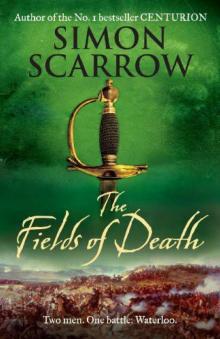
The Fields of Death r-4, page 49
part #4 of Revolution Series


‘Gentlemen, we’re in for some hot work,’ Napoleon announced. ‘The enemy have launched a full-blooded attack. St-Cyr, you take charge of the defences. Hold them off. Ney, Mortier, Murat, you will take one third of the Imperial Guard each and form a reserve, Mortier to the left, Ney to the centre and Murat on the right. You are to have your men ready to move at an instant’s notice. But you are not to act without orders, unless the enemy break through the line in the suburbs. Then you may use your own discretion. But don’t overreach yourself. Eject them from the city and fall back to your original position. We cannot afford to throw away any men unnecessarily. Dismissed.’
When the three men had mounted their horses and galloped back into the city, Napoleon took a last look around the largest earthwork and then, satisfied that it would hold the enemy at bay, he and St-Cyr led their entourage back to headquarters in the cathedral. The sound of artillery and the lighter crackle of musketry echoed along the entire length of the old city and Napoleon pointed up at the cathedral tower.
‘I have to see what’s happening. Where are the stairs?’
St-Cyr showed him to a small doorway in the corner of the nave and, telescopes to hand, the two began to climb the steep spiral steps winding up inside the gloomy stone interior. Breathing heavily and hearts pounding, they emerged into the belfry with its high arched windows affording fine views in every direction. To the south the city was ringed with banks of smoke as the guns of both sides continued to blast away at each other. In between the enemy batteries, and on either flank, the columns of enemy infantry advanced on the defences behind screens of skirmishers, who did their best to provide enough covering fire to keep some of the defenders’ heads down and put them off their aim. As he slowly tracked his telescope across the line Napoleon was gratified to see that St-Cyr’s men were holding their own.
As he watched the attack on the fort he had visited shortly before he saw the remains of the column that had been savaged by the canister fire struggling to get in through the embrasures. The ditch was littered with bodies and those who had reached the rampart were not carrying any ladders and were having to clamber up on to the shoulders of their comrades. Another column was sweeping round the left flank of the fort, hoping to make the most of the distraction caused by their comrades. A ripple of flames from the French guns on the far side of the Elbe announced their entry into the battle and roundshot ploughed through the column.
The assault reached a climax shortly after noon as the Austrians brought their guns closer to the city and attempted to blast gaps in the defences guarding the suburbs. The men in the forts took full advantage of the opportunity to lay down a devastating fire on the enemy batteries, blasting gun crews to ribbons, and smashing their gun carriages. The enemy endured an hour of the cruel punishment before withdrawing the cannon and continuing the assault with infantry. But without any scaling equipment all their discipline and courage came to nothing as they stalled in front of the French lines. St-Cyr’s men held on grimly through the afternoon and as the cathedral clock struck five Napoleon decided that it was time to launch his counter-stroke.
Climbing down from the tower he emerged into the nave and summoned Berthier. ‘The Imperial Guard’s hour has come. Tell Murat and Ney to drive the enemy back. But they are not to lose their heads. The Guard is to advance no more than a mile from the outer works, and then fall back. Be sure that they understand that.’
‘Yes, sire. And what of Mortier? Is he to be held in reserve?’
‘What, and risk the wrath of his guardsmen?’ Napoleon chuckled. ‘I think I had better deal with them myself and put an end to their grumbling.’
‘Be careful, sire,’ Berthier said, in parting, as Napoleon hurried out of the cathedral to mount his horse. He rode east through the streets whose walls echoed the roar of the cannonade and shook under the reverberation of the artillery of both sides. Mortier was waiting at the head of his men, formed up in the confines of a large market square close to the edge of the eastern suburbs. The men, many sporting fine bushy moustaches and the gold earrings that had become something of a fashion amongst the elite corps, were called to attention as their Emperor came in sight. Napoleon slowed his horse to a walk as he made his way down the front rank, scrutinising the silent faces as they stared straight ahead, muskets held at the slope, the tall bearskins making them look like giants.
‘Your men look as formidable as ever, Marshal Mortier,’ Napoleon called out as he approached the commander of the corps. ‘It would be a shame to sully such a fine turn-out by sending them into action.’
‘Don’t you dare hold us back!’ a voice bellowed from the rear of the leading battalion. ‘We’ve earned a chance for glory.’
‘And you shall have it!’ Napoleon called back. His smile faded as he turned to Mortier. ‘The Austrian attack has failed. It is time to throw them back. The Guard is to retake the Great Garden.’
‘Yes, sire.’
‘And I shall be joining you for the attack.’
Mortier knew better than to question the Emperor’s judgement and he nodded. ‘It will be an honour to be at your side, sire.’
‘Then let’s be about it,’ Napoleon replied. ‘The Guard will advance.’
Mortier shouted the order and the drums began to beat the advance, a deep rhythmic rattle that echoed off the surrounding buildings. Then, at the command, the Guard began to march out of the square, down the broad avenue that led to the road leading out of Dresden towards Pirna. As they drew near to the edge of the old town, they passed the wounded being treated in the side streets and they cheered the Guard as they marched past. Now shots were flying overhead with a light zipping sound. The glass in the upper storeys of the houses was shattered and the masonry was pockmarked by musket balls. There were also gaping holes in walls and roofs where Austrian cannon balls had smashed through.
Then, as the avenue bent a little to the right, Napoleon saw that they had reached the edge of the town. A barricade lay across the road and a line of infantry, three deep, were taking turns to fire over it, then duck back and reload. Several bodies had been dragged to the side of the road so as not to encumber their comrades. A thick smog filled the open ground ahead of them, but little blooms of light marked the positions of the Austrians a short distance away, returning fire. A shot whipped by Napoleon’s horse and one of the guardsmen bent forward under the impact, and then crumpled to one side of the column, dropping his musket as he clutched a hand to his stomach.
‘Make way for the Guard!’ Mortier bellowed, then he turned to Napoleon. ‘Sire, if you please, wait here for the colour party. It will be the obvious place for the men to look for you.’
‘And keep me safe, eh?’
‘Yes, sire.’ Mortier nodded sombrely.
‘Very well.’ Napoleon drew in his reins and urged his horse to the side of the avenue. Ahead, the lieutenant commanding the company on the barricade ordered his men to cease fire and clear the way. The enemy, unaware of the new danger, continued to shoot, inflicting several more casualties, and then the way was clear, just as the first guardsmen came marching up. They passed into the powder smoke and emerged on the other side, deployed into line and returned fire with two withering volleys, then lowered their bayonets and marched on.
Immediately behind the first battalion came the colour party, and Napoleon edged his horse alongside the standards and rode out of the town, through the dispersing bank of acrid smoke. On the far side the column passed through two lines of fallen bodies, one French, the other in the white uniforms of the Austrians. Ahead, two battalions of Austrian infantry stood in line, either side of a pair of field guns, but the guardsmen did not falter for an instant as they climbed over the rubble and steadily re-formed ranks. An instant later the guns boomed out and a spray of shot hissed through the leaves and struck down several guardsmen with a chorus of sharp thuds. Napoleon watched as they closed ranks and stepped out towards the enemy. Two times the guns fired, striking down more guardsmen. Then, as they closed to musket range, the Guard stopped, readied their muskets, took aim, and unleashed a volley before their colonel bellowed the order to charge, and Napoleon watched them disappear into the smoke as they swept the Austrians away.
Having endured hours of withering fire from the defenders and failed to break into the city, the enemy had little enough fight left in them, and they hurriedly withdrew in the face of the Imperial Guard’s onslaught. By the time dusk fell, the enemy had been driven back as far as the line of villages where St-Cyr’s men had established their original outposts. Napoleon had returned to his headquarters, pleased with the afternoon’s work. There, Berthier reported that the first elements of Marmont’s and Victor’s corps were entering the city on the other side of the Elbe. Napoleon left instructions for his senior officers to join him at ten o’clock to be briefed for the next day’s battle, and then ordered a hurried meal to be brought to him. Before the light faded completely, he climbed the tower one last time to survey the enemy’s position. The camp fires flickered in a wide arc about the south of the city, but it was clear that the greatest concentration was on the line of hills the locals called the Racknitz Heights. Napoleon stared towards the dull loom in the clouds above the hills for a while and then nodded to himself.
‘It is my belief that the enemy will launch another attack on Dresden tomorrow,’ Napoleon announced to his marshals and senior generals as they sat on the pews arranged around St-Cyr’s map table. ‘They still outnumber us, but cannot be sure of our precise strength. The bulk of the two corps that arrived at dusk will not have been seen, so they will be confident of overwhelming us. However, we shall strike first, as soon as it is light. Since the centre is where their strength is, we shall feint there, and strike at their flanks. Every available man will go into our battle line tomorrow. Murat will command the right wing, Ney the left, and St-Cyr and Marmont will hold the centre. The enemy’s centre and left flank are divided by a tributary river off the Elbe, here.’ He indicated the map. ‘The river Weisseritz. There is only one bridge across the river for several miles, at the village of Plauen. Murat, if you take that, then the enemy’s left cannot be reinforced and will be at your mercy.’
Murat leaned forward and noted the village. ‘Plauen will be mine within the hour, sire.’
‘Good. Just make sure that you can hold on to the bridge.’ Napoleon paused briefly. ‘My intention is to force the enemy down the road to Pirna.’
‘Pirna?’ Ney frowned. ‘Why Pirna?’
‘Because Marshal Vandamme’s corps crossed the river at Pirna this morning. He has cut the enemy’s communications, and will block their retreat.’
The officers, except Berthier who already knew, stirred at this news and Napoleon was delighted to see the spirit that it had rekindled in their tired faces.
‘If we succeed tomorrow, and Vandamme plays his part, then the Army of Bohemia will be eliminated from the campaign. That will leave only Blьcher, and our friend Marshal Bernadotte, to deal with. Bernadotte has been tasked with defending Berlin, and Marshal Oudinot is advancing to deal with him even now. Blьcher cannot hope to defeat us on his own. We are within a matter of days of ending this campaign and winning this war, my friends.’ Napoleon smiled warmly, and then suddenly raised a finger. ‘Ah! There is one further piece of intelligence I wish to impart to you. Earlier this evening, our pickets heard the enemy guns give the salute three times. It would appear that we are graced with the presence of not only Emperor Francis, but Tsar Alexander and King Frederick William as well. If they are taken in our trap, then the coalition is finished at a stroke. Questions?’
There was a pause before Mortier nodded. ‘The plan is sound, sire. But there is one detail that concerns me.’
‘Well?’
‘Marshal Vandamme, sire. Is one corps enough to block the enemy’s path?’
‘I judge it to be sufficient,’ Napoleon replied flatly. ‘If we do our work well tomorrow then the allies will be a spent force and will surrender the moment they realise we have cut their line of retreat. Anyone else?’ He stared round the table. ‘Then it is settled. You know your roles, gentlemen. Now prepare your men for victory.’
Chapter 43
It rained heavily during the night, easing off just before dawn as the soldiers of the Grand Army, wrapped in their greatcoats and with oilskin covers fastened over their shakos, filed into their positions for the start of the coming battle. The ground was slick with mud and the Weisseritz stream had swollen into a swift current, too dangerous to attempt to ford. The last of the cavalry was forming up on the flanks as the first rays of dawn glimmered, dull and grey, above the hills to the east.
Napoleon had climbed the cathedral tower and stood with Berthier and a handful of other staff officers to watch the opening of the battle. As he had hoped, the thin light revealed that the enemy had been slow to prepare for battle. Unlike the French, who had been billeted in the town and slept in warm and dry conditions, the Austrian and Prussian forces had been camped in the open and the heavy rain had soaked them to the skin and made it almost impossible to sleep. As a result they stirred slowly and formed up in their battalions dispirited and tired.
As the cathedral clock struck six, the signal gun fired and the men massed on the French flanks rippled forward. To the left, they were opposed by the Austrian troops who had taken a mauling in their attempt to assault the city the previous day. Two divisions of the Young Guard led the way, marching steadily across the soft ground, pausing to deliver volley fire at any enemy units attempting to stand their ground. Further out, at the end of the French line, the cavalry picked their way across the muddy fields towards the forest that lined the banks of the Elbe and drove off the infantry who had tried to find shelter beneath the trees during the night.
Turning to the other flank, Napoleon watched the columns of Victor’s corps striking out to the west, their left flank on the Weisseritz, while to their right Murat’s cavalry formed line and waited for the order to begin their pursuit, once the infantry had broken up the enemy’s formations.
Within the hour the bridge at Plauen had been captured and covered with a battery of horse guns, severing the link between the allied left and its centre. Thousands of the enemy, caught in the mud and unable to escape in time, were pressed back against the swollen stream and trapped. Victor’s men stopped to deliver several devastating volleys at close range, and then the enemy began to throw down their muskets and surrender. A few hundred tried to cross the current, but lost their footing and were swept away, crying feebly for help before they disappeared from view and were washed down to the Elbe.
In the centre, St-Cyr and Marmont faced the greatest difficulty as they would be heavily outnumbered and the enemy had fortified every village and farmhouse that lay before the centre of the allied army. Sure enough, by eight o’clock they had been fought to a standstill and a thick bank of powder smoke lazily expanded for almost two miles as murderous volleys were exchanged at close range.
At midday the rain began to fall again and there was a brief lull in the fighting as the soldiers of both sides drew back a short distance to re-form their ranks, and steel themselves for the next onslaught. St-Cyr took advantage of the pause to bring his guns forward in readiness to blast his way through the enemy’s front line.
Napoleon rested his elbows on the parapet as he gazed over the battlefield. He felt a peculiar sense of detachment and realised that it was down to the nature of the battle. Aside from a small force of the Old Guard, every man had been placed in the line and there were no reserves for him to send forward if they were needed. His subordinates had clear orders and the enemy lacked the initiative and the will to do anything but sit on the defensive, so there was nothing for Napoleon to do but act as a spectator as his marshals drove in the allied flanks and attempted to break their centre.
A staff officer brought him a basket of cold chicken and some small loaves of the dark German bread that Napoleon had little liking for. As he ate, the enemy guns began to open fire on St-Cyr’s batteries as they unlimbered and soon a large-scale artillery duel had developed, the deep roar carrying across the battlefield.
‘There has not been much progress in the centre,’ Berthier observed. ‘I fear the attack might be forced to a halt, sire.’
‘It might.’ Napoleon nodded, then jabbed a half-eaten chicken leg towards the Pirna road. ‘Until Vandamme threatens their rear. Then the centre will break.’
‘I trust it will, sire.’
‘It will.’ Napoleon took another bite, chewed swiftly and swallowed. ‘Any news from Vandamme?’
‘The last despatch was timed two in the morning, sire. He had run into the enemy outposts.’
‘Then let us hope he had the sense to drive on through them and march to the sound of the guns here at Dresden.’
As the rain continued, the sound of musket and cannon fire began to dwindle. The left flank had been fought to a standstill, but over on the right Napoleon saw that Murat had unleashed his cavalry. The wet ground was making movement difficult and Napoleon slapped his thigh in delight as he saw large pockets of enemy soldiers trapped in the muddy fields surrounded by French cavalry and forced to surrender. By mid-afternoon the enemy’s left flank had all but ceased to exist. But the centre still held, impervious to the frequent attacks that the French soldiers made at bayonet point.
At length, Napoleon took a deep breath. ‘The army has done all it can for today, Berthier. This rain is bogging us down. Give the order to break off the attack. The men can spend another night under cover, and the enemy in the open, and we’ll see how quickly their spirit breaks tomorrow.’
‘Yes, sire.’
‘And I want reports from every division. Butcher’s bills, and the number of enemy captured and their casualties. By nightfall. There’s another day of battle to prepare for,’ he concluded irritably. ‘Tomorrow we will finish this.’