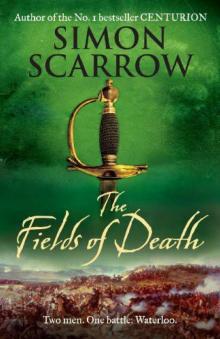
The Fields of Death r-4, page 41
part #4 of Revolution Series


Escorted by one of the few remaining squadrons of Guards cavalry, Napoleon spurred his horse forward. They passed the Imperial Guard at the head of the column and then followed the road west. The thaw had brought some of the peasants out of their huts to replenish their stocks of firewood. As soon as they saw the small column of distant horsemen they ran for cover. There was still no sign of the Cossacks and as night fell Napoleon rode on until they came up to one of the cavalry patrols observing the distant fires of the Russian soldiers on the far side of the river.
Napoleon dismounted as the colonel in charge of the dragoons made his report. ‘The enemy has invested the town, sire. Must be upwards of five thousand men. We’ve seen more of them up and downstream, patrolling the far bank.’The colonel turned to point to the north where a dim glow reflected off some low clouds scudding in from the east. ‘See that? Camp fires. But there’s no knowing how many of them are over there, sire.’
Napoleon nodded, then looked closely at the colonel. ‘What regiment do you command?’
‘Regiment?’ The colonel looked surprised. Then he smiled ruefully. ‘Sire, I command all that is left of Nansouty’s cavalry corps. All the remaining horses have been allocated to the dragoons. All two hundred of us.’
Napoleon struggled to hide his shock as he glanced round at the handful of pitiful-looking mounts that were tethered to the back of a small hut where the colonel’s men were sheltering for the night.‘Where are the rest of your men?’
‘I have one troop to the south and one close to the bank to observe Borisov. The other two troops are scouting the river to the north, looking for any crossing points.’
‘Good work.’ Napoleon nodded towards the shed where a welcoming glow lit the door frame. ‘I will spend the night with you.’
‘Sire, we’d be honoured.’
Napoleon turned to the commander of the Guards squadron.‘You’re dismissed. Find some shelter for you and your men, then report back here in the morning.’
The officer saluted and then wearily ordered his men to follow him as he trotted off into the darkness.
‘That’s the situation, gentlemen,’ Napoleon concluded as he ended the briefing of his senior officers in the dacha on the outskirts of Loshnitsa. ‘The cavalry patrols have scouted thirty miles upstream and every bridge and ford is defended by Russian guns and infantry. They also report that the recent thaw has caused the ice on the Berezina to break up.’ He paused. ‘We have to consider our options.’
He sat back and waited for his officers to respond. There was silence for a moment before Davout spoke for them.
‘I will say what is on all our minds, then. The choice is between a long march to the north, until we can cut round the upper reaches of the Berezina, or negotiating an armistice with the Russians. It is more than likely that the Tsar will deny us an armistice. He will want nothing less than a full surrender of the Grand Army.’ Davout nodded towards the Emperor. ‘Sire, if that happens, then it is vital that you are not taken prisoner along with the rest of the army. I must ask if you have made any plans to escape in the event of a surrender?’
There was a silence as Napoleon looked round at his officers, men he had known for years. He nodded. ‘I have considered the possibility, but not the precise details.’
‘Then might I urge you to think on it?’ Davout insisted.
‘Very well.’ Napoleon stirred and sat up. ‘I don’t think there is anything else to be said, gentlemen. I bid you good night. Oh, and Davout . . .’
‘Sire?’
‘It seems you were right about the pontoon bridges. I was wrong to give the order for them to be burned.’
‘I know.’ Davout nodded. ‘Good night, sire.’
When the last of the officers had left the shuttered drawing room a sentry closed the door. Berthier remained seated at the table, having returned to his routine of updating the dwindling figures from the strength returns in his notebooks. Napoleon twisted one of the silver buttons on his greatcoat.
‘What do you think, Berthier?’
Berthier replied without looking up. ‘Think of what, sire?’
‘My abandoning the army.’
Berthier lowered his pen and looked up. ‘I think it may shortly become a necessity, sire.’
‘And will it be a mistake? Speak honestly, my friend.’
‘If you are captured by the Tsar, then you can expect little mercy from him given what happened to Moscow, and the other towns and villages we have marched through. Even if your life is spared, you can be sure that you will be humiliated, and France along with you. So, yes, sire. If it comes to it, then you must do everything in your power to avoid being taken by the Russians.’
‘Everything?’ Napoleon asked quietly.
‘Yes, sire,’ Berthier nodded. He had understood. ‘Even that.’
‘My surgeon has some phials of poison. I have always ensured that he carried them in case of such an emergency. I will keep one on my person from now on. As a precaution.’
‘It would be wise, sire.’
Both men were silent for a while before Napoleon stirred. ‘Of course, if I abandon the army, they will say I am a coward, my enemies.’
‘You must expect that. But the people of France will understand that it was necessary. They will know that as long as you are alive France must be counted a great nation. While you live, you inspire our soldiers to acts of greatness, and you awe our enemies. Soldiers can be replaced. You, sire, can not.’
Napoleon searched Berthier’s face for any sign of flattery or insincerity, but his chief of staff seemed utterly convinced by his own words. Napoleon smiled warmly at him. ‘You, too, cannot be replaced, my friend. You are the word to my thought. It is through your words that my will is exercised and France has won its greatness on the battlefield. I should have thanked you before now.’ Napoleon felt an uncomfortable surge of guilt as he recalled the numerous occasions he had slighted or insulted Berthier. He shifted uncomfortably and gestured towards the door. ‘I must think, alone. Leave your books for tonight. Go and find something to eat, some wine to drink and a bed by a warm fire.’
Berthier hesitated, then nodded. He gathered up his notebooks, placed them in his large leather despatch case and quietly left the room. Napoleon rose stiffly from his chair, then carried it across to the remains of the small fire glowing in the grate. He carefully placed some more logs on the flames and sat back, closing his eyes, surrendering to the comforting warmth. He pushed troubling thoughts aside and pictured himself on the lawn at Fontainebleau, in the summer, playing with his infant son.
‘Sire.’ A hand shook his shoulder gently.
Napoleon woke immediately, eyes wide as he looked into Berthier’s excited features.
‘What is it?’
‘Marshal Oudinot is here with me, sire.’ Berthier stepped aside to reveal Oudinot.
‘So?’
‘It’s best if the marshal explains himself.’
‘Explains what?’ Napoleon eased himself up. He glanced at the clock on the mantelpiece. It was three o’clock in the morning. He had been asleep for over five hours, he realised, angry with himself.
Oudinot stepped forward. ‘I’ve come straight from my headquarters. sire. I’ll come to the point.’
‘Please do.’
‘A column of reinforcements under General Corbineau joined my command this evening.’
‘I know about that. He commands a brigade that was sent for from Vilna.’
‘That’s right. Corbineau intended to cross the Berezina at Borisov on his way to join us, but the day before yesterday he discovered the town was in Russian hands. So he questioned a local peasant to see if there was another place to cross the river. The peasant guided him to a ford eight miles north of Borisov, at the village of Studienka.’
‘I know it, but there’s no ford there.’
‘None marked on the map, sire. But Corbineau crossed there.’ Oudinot could not help smiling. ‘He says the water was no more than waist deep.’
There were several flashes in the night as the firing on the far side of the river faded away. Corbineau and his men had succeeded in storming the two guns that had been left to cover the unmarked ford. They had earlier waded across the freezing river, muskets held high, and driven off a company of Russian infantry before turning on the guns. Evidently the enemy had also known about the ford, but since it had not been marked on any maps they had posted only a token force to protect the crossing place. In the distance, to the south, there was an occasional rumble of artillery as Oudinot’s men carried out their diversionary attacks opposite Borisov. As Napoleon had hoped, the Russian forces strung out along the far bank had hurried south, marching to the sound of the guns.
As soon as Corbineau sent word back across the river that he had control of the far bank Napoleon gave the order for General Eblй’s engineers to set to work. The plan called for two bridges to be constructed in the darkness and the army was to begin crossing the moment they were completed. Davout’s and Victor’s corps were to cover the approaches to Studienka while the rest of the army crossed over. The swiftness of the current and the unevenness of the river bed had ruled out any attempt to ford the river in strength. Half the army would have been swept away and the rest would have been frozen by the immersion in the icy water.
A handful of braziers were lit on the east bank to provide illumination for the engineers, and a short time later some more fires appeared on the far bank as a second team of Eblй’s men began work from the other end, a hundred paces away. Napoleon strode down to the river bank to watch the progress. He found Eblй directing the work, a few feet from the edge of the icy current swirling downstream. Out in the river the dark figures of his men stood braced against the current as they held stout timbers in place while their comrades used a makeshift piledriver to ram the timbers into the river bed.
‘How goes it, General?’
Eblй turned and saluted. ‘The first trestle is in position, sire. We’ve been lucky with the frost.’
‘Lucky?’ Napoleon stared at the men standing up to their thighs in the river.
Eblй stamped his boot on the frozen river bank. ‘It’s hardened the mud. Makes it easier to get the materials down the bank.’
‘I see.’ Napoleon gestured towards the handful of wagons behind them. ‘I thought I gave orders to have all the wagons burned at Orsha.’
‘Yes, sire. However, I gave orders for my men to save a handful of wagons for our tools and nail barrels.’
‘You disobeyed my order.’
Eblй stared at him and then shrugged. ‘Evidently.’
‘Good man. I wish half my generals showed such initiative.’ Eblй looked relieved, but Napoleon pointed a finger at him. ‘Just don’t make a habit of it.’
Eblй laughed.
Napoleon looked round at the timber piled on the bank. ‘Will you have enough material to complete the job?’
‘That depends on Studienka, sire. The timber comes from the houses. My men are busy tearing the buildings down to get what we need. As long as the village is big enough, you can have your bridges.’
‘When will they be completed, General?’
‘Before noon tomorrow, if we are lucky. But the river is starting to rise, and there’s ice in it. That may slow us down. I can’t let the men work in these conditions for more than an hour at a time. I’ll work them in shifts. An hour in the water, and half an hour resting by the fires. Still, we’re going to lose many of them to the cold, sire.’
The sound of the engineers’ hammers and piledrivers continued through the night. Meanwhile, the stragglers and non-combatants were arriving at the village and filled the streets of Studienka while they waited for the bridges to open. Napoleon intended to get the bulk of the army over the river before giving the civilians their chance. Last of all would come Victor and the rearguard, then the bridges would be destroyed.
As dawn broke, weak and pallid as clouds obscured the sun and threatened snow, a party of Cossacks was sighted a mile to the south on the far bank. They observed the bridge-building for a few minutes before turning and galloping away.
‘They’ll reach Borisov within the hour,’ Napoleon muttered to Berthier. ‘It will take the commander there an hour or so to form his men up and begin to march towards the ford. Give them three hours at the most to reach us, and another to deploy. We can expect them to start attacking our outposts early this afternoon.’ He turned to examine the bridges. Trestles extended from both banks and the engineers were hard at work nailing support beams and planking in place. The smaller bridge, built for infantry to cross, still had a gap of some twenty paces between each end. The second bridge was larger, constructed to bear the weight of the army’s remaining guns and the wagons that had escaped the fire at Orsha. It was going to take somewhat longer to complete.
‘Shall I give the order for Oudinot to withdraw to the bridgehead, sire?’ Berthier asked.
‘What?’
‘The Russians know what we are up to. There’s no need for Oudinot to continue his diversionary action now.’
‘Yes, of course. Recall him at once.’
The first bridge was completed just after one in the afternoon and the leading elements of Oudinot’s corps which had just reached Studienka were the first to cross, hurrying over the bridge to advance along the causeway that stretched over the marshy land on the far side of the Berezina. It was the only means of escape and Napoleon had ordered Oudinot to keep the causeway open at all costs.
As soon as the first soldiers were marching across the bridge Eblй and his engineers concentrated their efforts on the larger structure. Already, a third of the engineers had been swept away, or were too weakened to work any further. Napoleon joined them by their braziers and did what he could to lift their spirits by praising them for their bravery and the sacrifice they were making for the army. The men listened in numbed silence as they shivered in their ice-crusted uniforms, struggling to keep their places close to the brazier.
Towards the middle of the afternoon, Eblй informed the Emperor that the second bridge was ready. Napoleon gave the order for the artillery and the Imperial Guard to begin crossing and then embraced Eblй.
‘Your men have performed a miracle, General.’
Eblй was trembling with the cold and fatigue and he could barely stay on his feet. He nodded.‘Thank you, sire, but our job is not over yet. The river is still rising, and I don’t know how long the trestles will withstand the pressure of the floes. It would be best to get the army over as swiftly as possible.’
Napoleon smiled. ‘That is my intention. Now, you’d better re-join your men. Berthier, find the general and his men some brandy. I believe there are still a few kegs in the headquarters stores.’
‘Yes, sir.’
As Berthier turned away to order one of his aides to find and distribute the brandy there was the crump of artillery to the east, adding to the faint sound of guns and musket fire from the far bank, where Corbineau and his men were holding their ground, steadily being reinforced by the troops crossing the first bridge. Napoleon strained his ears as he looked to the east. Soon the cannon fire from the rearguard action merged into an almost continuous rumble. The trap was closing on the French. Kutusov and the main Russian army would arrive from the east at any time. The survival of the Grand Army depended on Eblй’s bridges, hurriedly constructed using scavenged timber from the village.
For the rest of the day and into the evening the soldiers, cavalry and guns continued to cross the river. As soon as the civilians had heard that the bridges were open they had made for the river, and a strong cordon of infantry with fixed bayonets was holding them at bay, keeping the bridges open to military traffic. During the night a section of the second bridge collapsed, taking a gun carriage with it. Two hours were lost as the exhausted engineers repaired the bridge. The following morning the bridge was open again and the army continued to cross. At noon Napoleon ordered his headquarters to move to the far bank, together with the remaining elements of the Imperial Guard. The sound of cannon fire behind them had died away during the afternoon and the latest report from Victor was that the enemy were manoeuvring to the south, as if they still expected Napoleon to attempt to force the crossings at Borisov. Napoleon was watching the steady flow of guns and wagons over the second bridge. He could not help smiling as he read Victor’s report.
‘It seems there is no overestimating the caution of our enemy. They have us in a vice and yet Kutusov fears to tighten it.’
‘Lucky for us, sire,’ Berthier responded. ‘Fortune seems to be favouring you again. Oudinot’s cavalry have taken all the bridges along the causeway without encountering any Russians. The road to Vilna is open.’
‘Yes, fortune is with us, Berthier. Fortune, and sheer pluck, eh?’
Berthier was about to agree when there was a splintering crack. Both men turned to watch as one of the trestles in the second bridge started to collapse. Planks split and tumbled into the water. The rear wheels of an ammunition cart fell into the gap. For an instant everyone stopped to stare; the staff of the headquarters, the soldiers and civilians on the far bank. Then there was another crackle of shattering timber and a second trestle shivered and lurched to one side. The planking fell away and the wagon slipped back, even as the driver lashed his horse team to pull forward. The horses were weak and the heavy burden dragged them back towards the widening gap. Then the wagon tipped and fell into the river, dragging the horse team after it, kicking and whinnying in terror. There was a succession of splashes and the wreckage of the wagon, the debris from the bridge and the struggling horses were swept downriver.
‘Did the driver survive?’ asked Berthier, breaking the silence. ‘Did anyone see?’
Napoleon stared at the bridge. Three trestles had gone, leaving a large gap in the centre. Already, Eblй and most of his engineers were running towards the bridge while other men grabbed long poles and rushed on to the smaller bridge to try to fend the wagon away from its slender trestles.