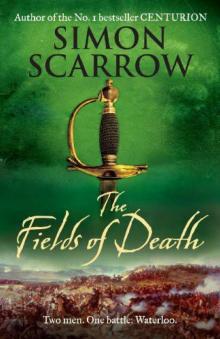
The Fields of Death r-4, page 10
part #4 of Revolution Series


The first sergeant laughed.‘Ignore him. Pierre’s just an old-fashioned Jacobin. He’s always grumbling. I wonder . . .’ He looked eagerly at Massйna and Napoleon. ‘You must have seen him. What’s he like?’
‘The Emperor?’ Massйna puffed his cheeks at the awkward situation. ‘Well, he’s just a man, like any of us here. He may be Emperor when he’s in the palace in Paris, but here, in the field? Here, he’s a soldier. He takes his risks with the rest of us.’
‘And what about you?’ asked the sergeant called Pierre, staring directly at Napoleon. ‘What do you think?’
Napoleon stared back at him for a moment, tempted to reveal his identity, but at the same time loath to break the illusion that they were all comrades. He set down his cup and stood up, punching Massйna lightly on the shoulder. ‘I think it’s time we got back to our battalion. It’s going to be a busy night.’
Massйna handed back his cup and stood up. ‘Good luck to you all.’
‘And you,’ the first man nodded back.
‘What do you think?’ Napoleon asked quietly, as he and Massйna strode off.
Massйna glanced at him. ‘Sire?’
‘Don’t be a fool, Massйna. I’m talking about what those men said. Are they right? Have I betrayed the Revolution and simply created a new form of tyranny?’
‘You are talking about politics, sire, and I am a soldier. It’s not my field.’
‘You are evading the issue.’ Napoleon laughed softly. ‘When a man fears to speak the truth then he does indeed live in a tyranny. It seems that the sergeant was right.’
‘King or emperor, what difference does it make?’ Massйna responded. ‘The fact is, France is at war and it is the duty of every soldier to fight for his country. When the fighting begins there is no place for questioning the cause of it.’ He was quiet for a moment. ‘Besides, what use have I for peace? It would do me out of a fine living.’
Napoleon looked at him and shook his head. ‘Marshal Massйna, you have a brutally practical way of looking at life. Even so, I must admit I had hoped that a little idealism burned in your heart.’
Massйna shrugged. ‘I’ll leave idealism to the philosophers, sire. As long as there’s fighting, fucking and fortunes to be made, I am your man.’
‘And what if I make peace? What of your allegiance to me then?’
‘Sire, that sergeant was right about one thing. While you are Emperor there cannot be peace in Europe, whether you will it or not. And that suits me perfectly.’
They returned their borrowed jackets when they reached headquarters and made their way into the map room. Berthier was leaning across the table with a pair of dividers as he calculated the march timetables for the remaining columns still moving forward to join the army. He straightened up and bowed his head as the Emperor and Massйna entered.
‘Everything proceeding to plan?’ asked Napoleon.
‘Yes, sire. The entire army should be over the river by the second day. One hundred and eighty thousand men, less the garrison to cover the bridges.’
‘What’s the latest intelligence on Archduke Charles?’
‘According to the reports from the cavalry corps, the Austrians have something in the order of one hundred and fifty thousand men concentrated against us. Of course, we are still unsure of the precise location of Archduke John’s army. He began his withdrawal from Italy two weeks ago, and might be close enough to intervene.’
‘What’s his strength?’
‘No more than fifteen thousand, sire.’
‘Then he is of little consequence to us,’ Napoleon decided. He clicked his fingers. ‘Massйna, the map.’
Massйna took out the diagram of the river crossings and unfolded it beside the larger-scale map that Berthier had been working on. Napoleon tapped his finger on the pencilled markings on the eastern side of Lobau island. ‘This is where we cross. Have the map copied and sent to the commander of the engineers. He is to have the pontoon bridges ready to move into position at nightfall.’
‘Yes, sire.’
Napoleon studied the map in silence for a moment before he nodded with satisfaction. All the pieces were in place. Archduke Charles had concentrated his army around the French troops in the Mьhlau salient. It appeared that he had taken the bait and was waiting to meet the French attack over the same ground as where they had attempted to force a crossing just over a month earlier. Instead, Napoleon would strike two miles to the east, towards the village of Wittau. In overwhelming strength the French would pour across the Danube and immediately wheel round to take the Austrians in the flank and rear and crush them. Napoleon looked up at Marshal Massйna and smiled.
‘We have the enemy precisely where we want them. Tonight, you will have the honour of leading the army across the Danube and on to victory.’
Chapter 9
The storm broke just after night fell over the Danube. Lightning illuminated the landscape in brilliant flashes of dazzling white which caught thousands of men, horses, guns and silvery streaks of rain in a frozen tableau for an instant before plunging the world back into darkness. Then, as the men marched forward through the mud towards the pontoon bridges, the thunder crackled and boomed like a vast cannonade in the heavens.
‘It could hardly be better,’ Napoleon commented to Berthier as they sat on their horses, watching the first columns of Massйna’s corps move forward to the river bank, ready to cross over the moment the bridges were swung into place. Napoleon gestured towards the western side of the island, nearly two miles away. ‘This storm, and the diversionary attack from Mьhlau, will provide perfect cover for Massйna’s assault.’
Berthier nodded, and reached for his pocket watch. He waited a moment, and then read the time as lightning flashed overhead.
‘Just gone nine o’clock, sire. Less than ten minutes to go now.’
They waited in the darkness while the rain hissed down, pattering off the flat tops of the soldiers’ shakos and soaking through their greatcoats and the uniform jackets beneath. Around them, the trees that lined the river bank swayed in the gusts of wind that sounded like the sea as it swept through the leafy boughs. Every time the lightning burst across the landscape the soldiers looked like statues, Napoleon mused as he hunched his neck down into his collar to try to keep the water from trickling down his neck. Then, at the appointed time, there was a deep roar from the west that echoed across the island as the guns massed opposite Mьhlau blasted the Austrian lines. At the same time General Legrand would be launching his diversionary attack, engaging the enemy outposts as aggressively as he could to draw Archduke Charles’s attention away from his left flank.
As soon as the cannonade began, the five hundred grenadiers of Massйna’s assault force rushed the small boats they had been issued down the bank and into the river, before clambering aboard and paddling across the current as swiftly as possible. No shots were fired from the Austrian sentries, who were either sheltering from the storm or distracted by the furious sounds of battle away to the west. In the darkness, Napoleon could just make out the boats surging across the river, the men landing and then heading cautiously up the far bank, muskets at the ready.
As soon as the assault force was across, the first of the pontoon bridges was towed into position. Behind it came the other nine, emerging from the small channel where they had been waiting, hidden from Austrian eyes. The engineers hauled them into position and fastened them to the posts already driven into the bank of Lobau island. Napoleon urged his mount forward to the nearest of the pontoon bridges and sent for the officer in charge.
‘How long will it take you to get the bridge into position, Lieutenant?’
‘Fifteen minutes, sire,’ the engineer replied at once.
‘I will give you five minutes,’ said Napoleon as he reached for his pocket watch. ‘I’ll be timing you.’
‘Yes, sire.’ The engineer saluted and turned to run down the bank to his men, already shouting his orders to get a boat across the river with a cable and some stout stakes to drive into the far bank. As soon as the stakes were pounded into position the engineers pulled the cable attached to the end of the bridge and with ponderous grace the line of pontoons and trestles angled across the current until it extended from bank to bank. As soon as the last cables had been tied securely to the stakes the engineering officer sprinted up to his Emperor and saluted as he stood to attention, chest heaving from his exertions.
‘Beg to report, the bridge is ready, sire.’
Napoleon thrust his pocket watch back inside his coat. ‘With nearly half a minute to spare. Fine work.’
‘Thank you, sire.’
‘Now, I’d be obliged if you would get the first of Massйna’s men across that bridge of yours.’
‘Yes, sire.’ The engineer saluted smartly and hurried off to the head of the bridge and waved the first company forward. The soldiers broke step as they reached the first trestle and then strode as quickly as they could across to the far bank. Further downriver Napoleon could just discern the outlines of the other bridges being swung into position across the current, and more of Massйna’s corps quickly crossed to the far bank. A few hundred paces inland, individual muskets flared as those enemy soldiers on watch who had managed to keep their powder dry opened fire on the assault party. Once the first division was across it marched off along the bank of the river to the north, making for the fortified village of Gross-Enzerdorff before pressing on to Essling.
To the right, Oudinot and Davout led their men across and drove the enemy back as they fanned out across the plain and formed their corps up on Massйna’s right flank. By the early hours of the morning half of the Grand Army was already over the Danube. Napoleon and his staff crossed the river and set up headquarters in the hamlet of Uferhaus, where the Emperor’s bodyguard unceremoniously turfed out the owner of a small estate and surrounded the walls with pickets. Inside Napoleon sat at a hastily arranged map table and took a bowl of soup as Berthier eagerly read over the reports sent back from each of the three corps which had already crossed the river.
‘No reports of any serious opposition, sire. The Austrians seem to be retreating right across our front.’ Berthier sifted through a few more sheets of paper before he looked up again. ‘Casualties are minimal.’
‘Good. And what of the bridges? Are they still in one piece?’
‘As far as I know, sir. At least, there have been no reports to the contrary.’
Napoleon stared at his subordinate for a moment, wondering if he could trust his junior officers to keep him fully informed of the army’s progress across the river. After the debacle of the last attempt to force a crossing of the Danube, Napoleon was determined to ensure that the army’s lines of communication were unhindered. He pushed the bowl to one side. ‘Berthier, send an officer to the river bank. I want to know the instant anything happens that might frustrate our plans, in any way. Is that clear?’
‘Yes, sire.’
Napoleon gazed at the map, deep in concentration. By dawn three army corps and the Imperial Guard would be drawn up in a line facing north across a six-mile front from the bank of the Danube across the plain to the east. A hundred thousand men. Opposed to them would be a hundred and fifty thousand Austrians. Napoleon was confident that his men could hold their line, even though outnumbered, until the last formations of the Grand Army crossed the Danube and swelled the total to over a hundred and eighty thousand men. If Archduke Charles retreated, then the Grand Army would be obliged to pursue him, all the time stretching their lines of communication, and being forced to leave behind men tasked with guarding vital supply routes.
Very well, then, Napoleon resolved, the enemy must not be given any chance to break contact. At first light, the first three corps must be launched against the Austrians, forcing them to stand and fight.
When the sun rose across the plain in the morning, it was clear that the Austrians had been caught by surprise. Through his looking glass Napoleon could see enemy lines scattered across the landscape. The largest concentration of Austrian forces was between the villages of Aspern and Essling where the diversionary attack had struck the previous evening. Elsewhere individual units were hurriedly forming up into lines to face the coming onslaught. As the light strengthened across the drenched fields, he saw that some of the enemy formations were already pulling back, heading for the Russbach river. The bank was raised on the far side of the river and would provide the Austrians with some defence against a French attack.
During the first hours of the morning there was no attempt to counter-attack and most of the French soldiers had the chance to chew on some bread and sip some water. They stood in the muddy fields, muskets slung over their shoulders as thin wisps of steam rose from their uniforms into the warm air. As they waited a steady stream of infantry, cavalry and artillery hurried across the river. Three more corps were due to cross the Danube during the day, and the last, commanded by Marmont, would join them on the morrow. In little over a day, almost all the army would have reached the far bank. It was an achievement to be proud of, Napoleon mused to himself as he stretched his shoulders and watched the men of Prince Eugиne’s corps stepping out across the pontoon bridges.
His heart warmed at the thought of his stepson. Eugиne had proved himself to be an able commander and, more important, a loyal subordinate - unlike the commander of the corps that was waiting to cross after Eugиne’s men. Marshal Bernadotte had become increasingly arrogant in the years since Napoleon had been crowned Emperor. Recently, there had been reports from some of his officers that Bernadotte had been speaking very openly of his superiority to the Emperor in military affairs. While it was tempting to dismiss the marshal and be done with him, the fact was that Bernadotte was popular with his men, and well connected amongst the politicians in Paris. He would present more of a danger if left to his own devices in the capital than here in the field, where Napoleon could keep a close eye on him. Even so, there was a limit to how far the Emperor would tolerate such a troublesome officer.
He thrust Bernadotte from his mind and returned to his consideration of Eugиne. It was a shame that he had not fathered such a fine man, Napoleon reflected sadly. That had been a fond hope and ambition of his marriage to Josephine. But there was no chance of her bearing another child now. She was too old for that, and even if she had still been fertile she would not be prepared to risk another childbirth. Yet France needed an heir to the imperial throne. Without a son to succeed him, Napoleon could not give his empire the stability it so desperately needed. Since he had fathered a son by the Polish Countess Walewska, he knew that his own fertility was not at fault. If there was to be an heir, then he must find himself a new wife. Yet he shrank from the consequences of that knowledge. Despite the discovery of Josephine’s numerous affairs, and her failure to give him a son, Napoleon loved her more deeply and surely than any woman he had ever known.
He sighed heavily. Once the campaign was over, and Austria had been humbled, then he would have to deal with the matter of providing his empire with a successor, no matter how much pain that would cause him, and Josephine. Duty and destiny must prevail over emotion, he resolved.
He was disturbed by the arrival of a young dragoon officer who stood to attention and saluted as he stood before his Emperor.
‘What is it?’ Napoleon snapped.
‘Sire, Marshal Massйna sends his compliments and begs to inform you that the Austrians are beginning to withdraw from Essling.’
‘Are they now?’ Napoleon frowned. It seemed that Archduke Charles had finally realised the danger of his situation and was starting to extricate his army. ‘Tell Massйna that he is to press forward at once. He is to push the enemy back, and stay in contact with them. They must not be allowed to escape, or be given any respite. Massйna must drive all before him. Now go!’
‘Yes, sire!’
Throughout the afternoon the French soldiers pressed forward, driving the enemy back across the plain. The last clouds had long since gone and the sun blazed down from a clear blue sky. But while there was serenity in the heavens, the Marchfeld was marked by great banks of rolling gunpowder smoke and the litter of war. Bodies of the dead and wounded lay strewn in the trampled grass, together with discarded equipment, shattered gun carriages and lame or abandoned horses that grazed between the corpses. The air was heavy from the heat, and reverberated with the sounds of cannon and the lighter crackle of musket fire.
Late in the afternoon Napoleon and his escort rode forward to assess the situation. He stopped by a small church on a dusty road heading north from Aspern, and climbed its tower with Berthier. There was little space at the top, and they had to squeeze past the old bronze bell before they could open the shutters and look out over the battlefield. Both men raised their telescopes and slowly swept them along the French line, taking in the formations of men and horses advancing under their tricolour and imperial eagle banners. They were dark against the shimmering gold of wheat fields, and the verdant green of meadows.
Napoleon could see that his army formed a giant wedge, driven into the centre of the Austrian line. He felt the familiar excitement tingle in his scalp as he viewed the over-extended enemy.
‘Berthier, do you see?’
‘Sire?’ Berthier lowered his looking glass and waited patiently while his Emperor briefly examined the battlefield once again before he lowered his own glass and turned round with a cold smile.
‘Berthier, we have them, provided we strike swiftly. Come!’
Napoleon led the way back down the narrow steps of the tower and they emerged in the cool plastered nave. Striding across to the altar, Napoleon swept the ornaments aside.
‘Let me see the map.’
Berthier unfasted the strap of the leather document case hanging from his shoulder. He took out the map, unfolded it and spread it across the altar. Napoleon leaned forward and stared at it a moment, eyes darting across the features, and then he nodded.