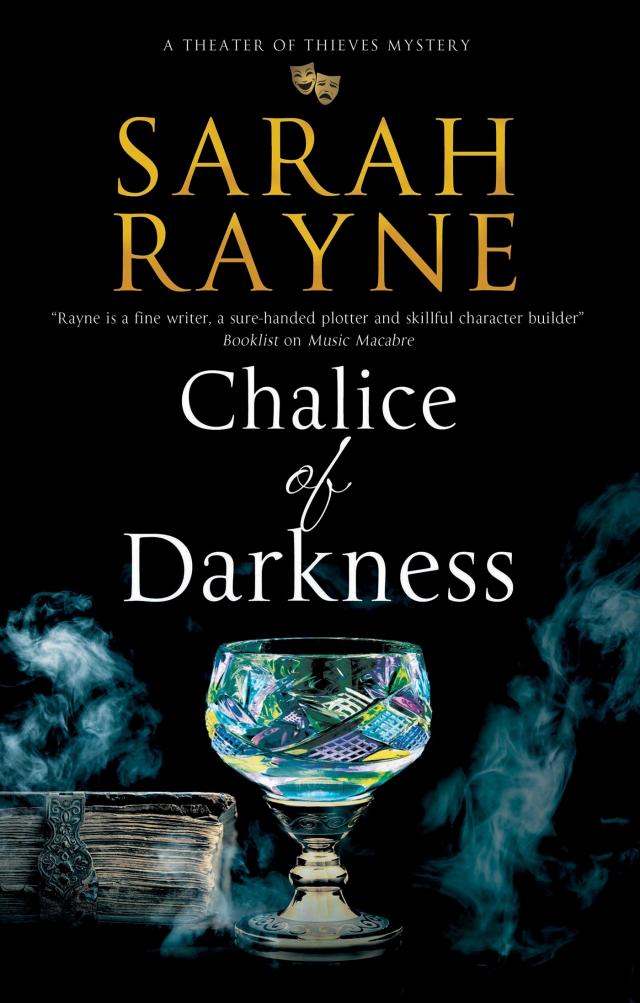
Chalice of Darkness, page 3


‘Fortune’s gone a-begging, and the luck’s gone out the door.’
It was printed on the page, as clear as it could be. But under it were three more lines that certainly had not been chanted.
Gus picked up the magazine, haggled over the cost, since Mr Inkling’s day would have been ruined had he not done so, managed to decline a fourth glass of malmsey, and made a slightly unsteady way back to Mr Jack’s rooms.
By nine o’clock that evening everything was ready for the journey to Vallow. Gus was about to show Mr Jack the song sheet when Mr Byron appeared at the door, dressed in one of his swirling capes and clutching a large envelope.
‘I was going to come to King’s Cross in the morning to see you off,’ he said. ‘But I thought I might miss you in all that exhausting bustle and noise, so I’m here now.’
‘To stage a dramatic farewell in case I don’t come back a free man?’ asked Jack.
‘To bring you this.’ Mr Byron handed over the envelope.
‘What—?’
‘It’s a draft for the first act of our play about the Talisman Chalice. Mainly a synopsis, but I’ve jotted down possibilities for scenes. It might give you some reading material for the journey.’
‘That’s very industrious of you,’ said Jack.
‘For the last four nights,’ said Mr Byron, impressively, ‘I’ve been sitting up until the small hours over this. I work best by candlelight, of course. All the great poets did. At such times the shadows are my companions and—’
‘Weren’t the gas jets working? Or hadn’t you paid the bill?’
‘—and if I could track down a human skull to have on my library desk,’ said Byron, loftily, ‘I should be completely at one with the Muse.’
‘I suppose by “library” you mean the lumber room at the head of the stairs in your rooms, do you?’ said Jack. ‘I remember the last time I tried to get in there we had to move two trunks and Great Uncle Benjamin’s sea chest before we could open the door.’
‘If you don’t want to read what I’ve written—’
‘Of course I want to read it.’
‘I expect we’ll find the chalice’s story is all a lot of romanticizing or embroidering of what facts there actually are,’ said Byron. ‘But I did find the exact line about the ill luck. It tells that, “If the chalice falls into the hands of someone who has no right to it, then that person is dragged into a darkness from which he or she can never emerge.” I can’t find who originally said it, but it seems to date from around the fourteen hundreds.’
‘Whenever it dates from, we could make use of it, couldn’t we?’ said Jack. ‘It’d give a really dark feel to the piece. We could knock Stevenson’s manic Jekyll and Hyde creation – and that sinister hypnotist du Maurier conjured up—’
‘Svengali.’
‘That’s the one. We can knock them into a cocked hat.’
‘I must say,’ said Byron, ‘that if the chalice does date back to the Plantagenets I’d have expected the present royal family to look after it a bit better. It’d be a considerable treasure – you wouldn’t think they’d risk losing it or letting it be pilfered.’
‘Or pawned if one of them happened to be a bit broke,’ said Jack, straight-faced.
‘Oh, wouldn’t that make a good comedy piece,’ said Byron, momentarily diverted. ‘Old Queen Victoria marching into Tod Inkling’s shop and waving the chalice at him, demanding a few thousand and threatening him with her brolly. But you know, that warning about ill luck – that seems quite persistent. You remember Rudraige and Aunt Daphnis singing that snatch of song?’
‘“There’s a fortune gone a-begging/And the luck’s gone out the door …”’ said Jack, nodding. ‘And you thought the actual line was, “Fortune’s gone a-begging”.’
Gus thought this was as good a cue line as any ever given on the stage of the Amaranth, so he said, ‘Mr Byron’s right. That was the line.’ Then, as they both turned to look at him, he said, ‘I found part of the song earlier today.’
‘Where on earth—? No, don’t tell me. Tod Inkling,’ said Jack. ‘You’d find just about everything in the world inside that shop. It didn’t occur to me to have a look when I was there to fence the St John’s Wood stuff. Gus, you’re a marvel.’
It was a good feeling to lay the tattered fragment of the song sheet on the table by the fire, and to see Mr Jack and Mr Byron study it with close attention.
‘As you’ll see,’ said Gus, ‘the title’s clear enough. “The Lament of the Luck-filled Vessel”. And somebody’s scribbled at the top to say it was performed in 1893 in one of those cellar places in Maiden Lane – mind you, they’d have anything on stage in those places.’
‘They would indeed. I remember some of my father’s stories, when I was very small. And,’ said Jack, leaning over to trace the words with a fingertip, ‘there are three more lines from the one Rudraige and Daphnis remembered.’ Very softly, he read out the whole verse.
Fortune’s gone a-begging, and the luck’s gone out the door
And the fences are a-cheering and the King ain’t safe no more
For rum-dubbers picked the locks when no one was around
And they’ll all be at the Tuck-up Fair/If the Talisman don’t return.
‘It’s got to have been written around the time the chalice vanished,’ said Byron. ‘The dates fit, near enough, and that line about “The King ain’t safe no more” would mean the King wasn’t thought safe because the chalice had been stolen. The luck had been poured away.’
‘But who stole it?’ demanded Jack. ‘Who could have got near to it? And do we know what a Tuck-up Fair is, by the way?’
‘The gallows,’ said Byron, darkly.
‘Oh, yes, of course it must be. Gus, that must have been quite a search you embarked on.’
Gus did not say he would have scoured the entire city and taken apart buildings to find the song in its entirety – or that he might still do so when they got back to London.
‘Did Tod Inkling see this, Gus?’ asked Mr Byron suddenly. ‘Because if he thinks there’s money to be made anywhere—’
‘I know that. I didn’t let it seem to be very important.’
‘Good man. Jack, I’ll wend my way homewards.’ Mr Byron paused in front of a small mirror to make sure his hair was in its customary careful disarray. ‘I’ll keep working and delving, and I’ll be very interested to hear what you think of my first couple of scenes. But for the moment, it’s goodbye, Godspeed and good luck.’
He allowed himself to be ushered out of the door and into the big, carpeted hall, which Mr Jack’s rooms shared with four other sets of gentlemen. It was as well they were all currently away, because once out there, Mr Byron launched into a speech that appeared to have something to do with a journey to an undiscovered country from whose bourn no traveller returned. Gus did not recognize it, but Mr Jack laughed, and said this was just about the most gruesome farewell speech anyone could deliver, and if Byron had to quote Hamlet, he might at least find lines that didn’t concentrate on death.
Mr Byron waved his hat, and ran lightly down the stairs to the street door. As Mr Jack closed the door, he said, ‘I’ll save Byron’s draft for the journey tomorrow. Are we all packed and ready, Gus?’
‘I think so. I’ve packed your dinner jacket, as well, Mr Jack, in case you’re asked to dine with any of the local families while we’re at Vallow.’
They looked at one another. ‘Such as the mysterious Maude’s family?’ said Jack. ‘She’s probably no longer there after all these years, of course, you do realize that?’
‘Very likely not,’ agreed Gus. ‘But I’ve packed the jacket anyway.’
After Gus had gone to bed Jack took out the photographs of Maude, and studied the one showing her holding the legal-looking document. A will? Title Deeds to a property?
Byron had mentioned two properties in Vallow that the mythical Joseph Glennon might inspect with a view to purchasing. A schoolhouse, he had said. Chauntry Schoolhouse. And a place called Bastle House near the Scottish border.
There was no reason to wonder if the unreadable lettering on the blurred parchment in Maude’s photograph might read Bastle House. But since Joseph Glennon was supposed to be looking for a country residence to purchase, if Bastle House really was empty, it should at least be looked at. There was no reason in the world to feel apprehensive about it.
Maude Vallow had been frightened of Bastle House since she had first seen it.
She would always remember that first glimpse – she had only been at Vallow Hall for a week, still trying to get used to being married, still cautiously exploring the house and finding out about its history. But the moment she saw Bastle House from an upstairs window she had felt as if something dark and smothering had fallen around her.
It stood by itself on a high ridge of land, jutting up against the sky like a single rotting tooth, and local people said it was a real landmark, although they wondered why vagrants never broke into it, because it had been empty ever since anyone could remember. It was generally felt, though, that whoever owned the old place – speculation about that varied considerably – had made it secure enough to keep out vagrants.
Maude tried to think that Bastle House would be perfectly ordinary inside. A faded dictionary in Saul’s study had an entry explaining that the word bastle derived from the French bastille, meaning, in essence, a fortification or a defence. That seemed to explain the house’s appearance. It had narrow windows set deeply into the thick stone walls – even from the bedroom window they looked like slitted eyes, as if the house was constantly watching the surrounding countryside for potential intruders. Maude did not know if the house stood in Northumberland and was therefore an English stronghold against the Scots, or whether it was just over the border in Scotland, and consequently a Scottish defence against the English.
But whatever it was, and whichever country it stood in, even seen from here it had a stern, dour look, as if it would stand no nonsense from Plantagenet kings plotting to conquer Scotland, or, of course, from rioting Scots storming and pillaging their way down into England in order to restore dispossessed Stuart kings to England’s throne.
She often went quietly up to that particular bedroom, always waiting until no one was around. Once there, she would curl into the deep windowsills, and stare across the treetops trying to understand why Bastle House made her feel like this.
She wondered if one day she would go out to it. It was the wildest idea in the world, and probably living in the gloom of Vallow Hall was affecting her mind. But sometimes you felt compelled to revisit a nightmare to make sure it was not real, or you had to deliberately open a book at a page with the frightening drawing – like the wolf lying in bed waiting for Red Riding Hood – so you could assure yourself it could not hurt you.
One day she might go along Candle Lane and over the stile, and along the woodland path and confront Bastle House. It was only a house. It could not hurt her.
Vallow Hall could not hurt her either. At first, Maude had thought it resembled a house in a novel – not any particular novel, but one of the dark, mysterious dwellings you read about. She had thought it was a house she could explore, and whose history she could uncover, but all there was to uncover was that it was cold and damp and unfriendly. Spiteful little winds found their way down the twisty old chimneys, so that sour smoke drifted out leaving a sooty film on the mirrors, and marks on the walls as if invisible hands had groped along them when nobody was around. If Maude had been a heroine from a novel, she would have uncovered all kinds of secrets and mysteries about the house.
But heroines in novels would not have let themselves come to Vallow Hall in the first place, because they would not have given way to Maude’s overbearing Aunt Hilda, and submitted meekly to marriage to a humourless man with skin like a shrivelled walnut shell. A man who got into Maude’s bed every Saturday night, and prodded gruntingly at the parts of her body she had thought were meant to be entirely private, then fumbled under his nightshirt for what seemed an age, eventually getting angrily out of her bed and stumping off to his own room. Maude was not at all sure what actually happened in a bed after people were married, but she thought there was more to it than these grunting fumblings and proddings.
Heroines in novels, when faced with this kind of situation, generally took a lover and ran happily off with him. But Maude had no idea how to go about taking a lover, even if there were any likely candidates in Vallow, which there were not, and she could not imagine where they could run off to anyway. She certainly could not run back to Aunt Hilda, who, from Maude’s seventeenth birthday onwards, had scoured the county to find a husband – any husband – for a niece whom she had grudgingly taken into her house because of it being her duty.
Sometimes Maude imagined packing a small bag, and walking down to the tall iron gates and on to Candle Lane, and then all the way to the railway station. Vallow Halt was only a couple of miles from the Hall, and once there she would simply wait for a train to arrive and get into it. The trouble was that Saul or one of the servants – most likely the sour-faced Agnes who was not quite a housekeeper but a bit more than a maid – would appear on the platform, and haul her back to Vallow.
Even as she wove these half-plans she did not think she would ever have the courage to put them into action. She thought she was destined to remain at Vallow Hall for the rest of her life.
THREE
Saul Vallow had not wanted to marry Maude. He had not actually wanted to marry anyone. But it could not be avoided: Vallow Hall was in severe need of renovation – the roof leaked in four separate places and Mrs Cheesely, the cook, said the sound of rain dripping into the enamel buckets and saucepans placed at judicious intervals was enough to drive a body demented, never mind spoil a person’s hand with pastry. As if that were not enough, the wretched kitchen maid Lily put her foot through a rotting board in a stairway and then hobbled around with it bandaged for several days, which Saul considered nothing but attention-seeking.
He might, of course, have raised a mortgage on the Hall, which would have provided him with funds for the leaking roof and the rotting floorboards, but would have meant the bank and his solicitor knowing the Vallow coffers were empty. The bank was an impersonal body, based in Alnwick, but the solicitor, one Ernest Meazle, was local, and local people gossiped. Saul was not having half the county knowing that he had had to resort to such means.
And then Maude had been put in his way by the pushy Hilda Grout. Normally, Saul would not have paid this any heed, but Maude was quite a considerable heiress.
He took a long time to make the decision, but when finally he approached Hilda Grout, she accepted his request for Maude’s hand with alacrity. Of course she did. Saul was Vallow of Vallow Hall – a person of standing and substance in the county. During the preparations for the wedding, and throughout the ceremony itself, he reminded himself that Maude had only just reached her eighteenth birthday, and that she had clearly led a very sheltered life. It was unlikely that she knew what to expect on the wedding night.
She did not. She stared at him with wide, scared eyes from the depths of the deep old four-poster in Vallow Hall’s master bedroom, clutching the embroidered nightgown around her. When Saul climbed in, pulling up his nightshirt with optimism (because you never knew what you might find yourself capable of), she lay back, her fists clenched in fear.
It was as well that she was so very innocent, because despite Saul’s determined efforts, what he had not been able to achieve as a young man, he certainly could not achieve twenty years on. However, he reserved the second Saturday of each month for regular attempts. He did not note it in his diary, of course, but it coincided with the vicar’s monthly meeting to check the church accounts for which Saul acted as unofficial treasurer, so that acted as a good reminder.
After a little while, he thought it advisable to limit, as far as possible, Maude’s socializing. He did not want her making unguarded remarks to acquaintances, or hearing exchanges of confidences between married women that might provide her with precise knowledge of marriage beds and what happened in them – to the extent that she realized none of it had happened in her own marriage bed. It was not very likely that ladies would discuss such matters, but Saul had occasionally been present when a certain bawdy flavour had crept into gentlemen-only conversations. He had put most of the tales down to boasting or, at best, exaggeration, and he could not imagine ladies talking in that way. Even so, he was not taking any risks.
He made no objection to the charity work she undertook with the church – in fact people might have looked askance if the mistress of Vallow Hall had not made some contribution to that. Nor was there any reason for concern about her occasional modest involvement with Chauntry School and its concerts. She would certainly not hear any descriptive stories about marriage beds among the church helpers, and as far as Saul had ever noticed, Chauntry’s precentor was one of those vague academics, whose life was entirely bound up with the school and his work.
However, when Maude broached the possibility of holding one or two modest musical soirées, Saul had to say he did not care for the idea. He would not, he said, forbid her from playing the piano in the music room – the room that had been created by a long-ago mistress of the Hall – and he supposed the instrument ought to be kept in use. But he could not be doing with a constant drone of dreary tunes – he did not care who had composed them, he said. Agnes must make sure the room was kept locked, and only opened once a week for a couple of hours. Lily might as well go in to dust and sweep it at the same time.
In the autumn following the wedding an invitation arrived to spend a weekend at Hymbre House.
Saul told Maude she need not attend.
‘I shall have to accept, though. They’re important people in the county, Sir John and Lady Hymbre, and I don’t want to offend them. He’s chairman of the Bench, and her brother has a position at court – a very minor position, I think, but even so … It will be very formal and probably extremely tiresome – not at all what you would like, so you had better write a polite note declining. You can say your health is poor.’