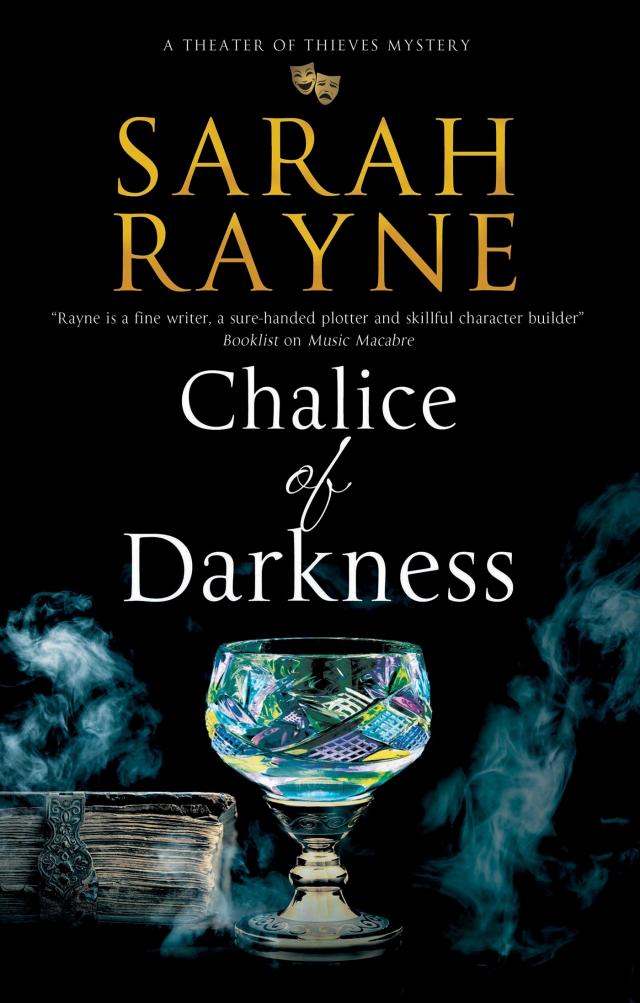
Chalice of Darkness, page 23


‘Or,’ said Mr Byron, ‘the writing of a man who suffered a shock so immense that it damaged him for what was left of his life.’
I am deeply thankful, in light of recent events, that I am no longer part of the Boleyn household. I am glad that after so many years, my lady offered her home and her hearth, and that I accepted – and finally and at last we are together in the house overlooking All Hallows Church. Esther is often with us, for her duties in the Boleyn household are much reduced.
As for wider events – I believe it has been said that there is no fall so deep as the fall of those who have risen to high places. The truth of this is apparent now, like the unfurling of some dark pageant. It is known that the Queen – the girl who once was plain Mistress Boleyn, the girl who came to my room in the castle that day and eyed the Plantagenet chalice with avarice – has been taken to the Tower, there to await her execution. All of London – all of England – waits to hear if there will be a reprieve.
There has been no reprieve. I did not expect there to be. The King is vicious and brutal, and where once he loved so violently, now he hates with an even deeper violence. Damning evidence has been brought against the Queen – shocking accusations, some perhaps true, some perhaps with only a speck of truth – and some or perhaps all outright fabrications by her enemies. I do not think anyone can ever be sure of the truth. What is sure, though, is that the Queen will die. I think back to that girl at Hever, and I think she will face her enemies – and at the end her execution – with arrogance and scorn.
Esther is to be one of the ladies who will attend the Queen in the Tower during her final hours. She is reluctant, but she will do it, for she served the Boleyns for many years, and feels she must help perform this last service for them.
The candles are burning low and night has long since closed down on the City.
Esther came to the house earlier today to tell us of the execution. She is deeply distressed.
The execution was played out with all the macabre ceremony that attends such events – although I have never been at an execution, and pray God I never will be. The executioner was a swordsman, brought from France especially. It is said the Queen demanded it, which I find believable. She would be arrogant and imperious to the last, and I admit to an unwilling admiration.
Esther sat as close to the fire as she could, her hands cupped around a bowl of the mulled wine I had prepared, as if to draw its warmth into her hands and into the coldness of her heart.
‘The blow was clean and swift and merciful enough,’ she said, her eyes shadowed with the memory. ‘Those of us who had been in the Boleyn household – some in the Queen’s own service – thanked God for it. But afterwards—’
She shivered, and I knelt down to replenish the fire.
‘It was afterwards that the horror came,’ Esther went on. ‘There she lay, the lady who had been England’s Queen – who I had served at Hever Castle when she was a girl – her blood soaking into the sawdust, her hair tumbled about what was left of—’ She broke off, but then drew a deep breath and continued.
‘But we went forward, the other ladies and I, thinking to at least carry her coffin and to give some dignity to her death.’
My lady said, in her gentle voice, ‘There is solace in the decent burying of the dead.’ She glanced at me as she said this, and I nodded, and took her hand briefly.
‘There was no solace,’ said Esther. ‘For there was no coffin – no arrangements for what should be done after the execution.’ She gave an angry shrug. ‘People simply walked away, and we were left with – with what lay on the ground in the blood and the mess … Not knowing what to do – not knowing what we were expected to do or were allowed to do …’
She broke off again, then said, “I did not dare put myself forward – I had been a lowly member of the household. But at last, two of our number went away to see what could be found to give her some kind of burial. The rest of us waited on Tower Green in the warm sunshine – that sunshine felt like a mockery. Presently, our people returned. They had found something within the Tower itself – I believe two of the guards helped them – and they carried it out between them. It was not a coffin, of course, but they said, shame-facedly, that it was the best they could find, and they believed it would suffice.’
A cold horror was starting to take hold of me. I said, ‘What was it they carried out to use as a coffin? Esther, what was it?’
As if from a distance I heard her next words. ‘An arrow chest,’ she said. ‘They had found it in the old armoury, and they thought it would be deep enough to take … what it had to take, and that there would be a dignity in using it.’
I knew what was coming, and I wanted to run from that warm safe room, and not hear any of it. But I had to stay, of course. I had to listen, and Esther’s next words have burned into my mind, and I shall never be able to forget them.
‘Between us we prised up the lid of the arrow chest,’ said Esther. ‘It was stiff and it resisted – clearly it had been closed for a very long time. And inside …’ Again the shiver, and now tears were running down her face.
‘They were nothing but small outlines that lay inside,’ she said. ‘The shapes of two children – just their bones and some scraps of hair and cloth.’
And so there it is. Finally I know what happened to my two ill-starred boys. I know now for certain that they died, and that I caused their deaths. I had no murderous or malicious intent, but there is no comfort in knowing that. I could not even restore the Plantagenet chalice to its rightful owners and I cannot do so now.
Or can I …?
Esther has told us that the few possessions the Queen still had are to be taken to Court – probably to Whitehall or perhaps Hampton Court.
‘Is the chalice among them?’ I asked.
‘Yes. I have been asked to help place all the items in some chests and wrap the more fragile ones, and the chalice is there.’
It was then that I know the same thought passed between my lady and myself. That often happens for us – perhaps it happens for others, although I would not know. But we share thoughts, she and I, and we did so then. She spoke first, though.
‘Godfric, if the chalice is to be returned to the royal household, could your chronicles of its history be placed with them in some way? Secrecy would be needed, but it would be a sad thing if the chalice’s story were never to be known in the future.’
I said, slowly, ‘There are parts of those pages I would not want to be read.’
‘They could be removed.’
‘Yes,’ I said, staring at her. ‘They could.’ I thought for a moment. ‘Esther – you said you and some of the other ladies would be wrapping up the Queen’s possessions.’
‘Yes.’
‘Would it be thought strange if the chalice were found to have a box of its own – a box in which it had always been stored?’
She looked at me. ‘It would not seem strange,’ she said, slowly. ‘It would be thought sensible for such a fragile object to be protected. But we do not have such a box.’
‘We could have,’ I said.
When I left the monastery all those years ago, I did so with a great many different emotions. There was resentment at the years I had wasted on God, but there was also gratitude at having found solace in prayer and music. That is something that has stayed with me.
But in most religious houses it is obligatory to learn a number of skills. I was always regarded as a scholar – the time spent tutoring the princes, and then the years in the Boleyn household bear witness to that. I had, though, acquired a number of more homely abilities during my monastic years. I could cook a reasonable meal; I could till a plot of land and sow seeds; I could even spin cloth (this last not very well). And I could turn my hand to simple carpentry – not to the extent of being able to make a piece of furniture, but I could fashion wooden bowls for the supper table, or shelves for household objects. I could make a small, lidded box …
The task had to be completed quickly, and I worked through two nights with very little sleep. I knew the precise size it had to be, for I had held the Plantagenet chalice in my hands many times. The lid was not hinged, for I had no knowledge of how to achieve that. But it was grooved and dovetailed, so that it clamped down on the base smoothly and firmly.
I sanded and polished it to a satin sheen. Then I fashioned, from softened beeswax and resin, a kind of oval plaque to be affixed to the side, and while it was still warm I carved into it the arms of the Essex monastery – the emblem of the prior who had founded the House, and who had come from a noble house. When it had cooled and hardened the outline was clear.
‘And you see,’ I said, showing the finished article with modest pride to my lady and to Esther, ‘if you slide a fingernail into the base on the box’s inside …’
‘Oh! Oh, how clever of you.’
I was pleased at their reaction and I was pleased with my work. I had created a small, secret compartment in the box’s base, and into it I shall place these pages. I shall include that sad, brave confession written by the princes, since it is as much part of the chalice’s story – and of their own story – as the rest of this.
Esther will put the chalice inside the box, and it will be taken to Henry Tudor’s Court, to be stored away with the rest of his valuable jewels and objects. She will do so quietly and unobtrusively, for she is clever and kind. Also, of course, she is a permanent and deeply happy reminder of that long-ago afternoon beneath a willow tree, watching the sunlight reflect on the surface of a river … It should have been a shameful act for the professed man of God I was at the time, but I only ever felt pride and love, and I still feel that for my lady – and for my daughter.
The Plantagenets are no longer on England’s throne, but the chalice that, to a few of us, bears their name, will be owned by their successors, and for those who look, its story is with it.
I hope, though, that the chalice brings to future generations better fortune than it did to Richard II, to Prince Edward and his brother, and to Anne Boleyn.
TWENTY-TWO
For a long time no one in Todworthy Inkling’s room spoke. Gus felt as if the memories were folding themselves back into their shadowy corners, a little regretful at having to retreat, but glad to have had their strange, sad stories brought into the present.
Eventually Tod said, ‘That’s a remarkable story.’
‘How believable is it, Tod? That part about the arrow chest having to be used as a coffin for Anne Boleyn …’
‘As a matter of fact I’ve come across that story,’ said Tod. ‘I think it was in the work of a writer of the last century called Agnes Strickland. She wrote a remarkable series of books called The Lives of the Queens of England. As far as I recall it runs to ten or even twelve volumes.’ He took off his spectacles and polished them thoughtfully. ‘She recounts that anecdote about Anne Boleyn,’ he said, replacing the spectacles on his nose. ‘I believe she says something about how King Henry showered Mistress Boleyn with riches – jewels, furs, houses – while she was his lady love, but that at the end he could not even bother to provide her with a coffin. But I don’t know how much credence can be given to it. It might be one of those rather dark legends that’s been passed down. But this …’ He tapped the manuscript with a fingertip. ‘This sounds to be almost a first-hand account. It’s grisly and very sad.’
‘Very,’ said Mr Byron shortly, and Gus heard in his voice that he had banished all thoughts of mounting an Amaranth piece based on the chalice’s history. But he suddenly said, ‘Gus, that “Lament” you found,’ and Gus jumped, because although he had not exactly forgotten about the ‘Lament of the Luck-filled Vessel’, he had been more taken up with Godfric. ‘Have you got it with you?’ asked Mr Byron.
‘Yes.’
‘Lament?’ said Tod, looking up. ‘What lament?’
‘It’s something Gus found in a magazine here a while back. We didn’t know if it would add anything to all this, but now that we’ve deciphered Godfric, one or two things might tie up.’
‘You never know what might tie up,’ said Tod rather dryly. ‘Let’s hear it, Gus.’
Gus glanced at Mr Byron, and, receiving a nod, took out the magazine and read the lines.
Fortune’s gone a-begging, and the luck’s gone out the door
And the fences are a-cheering and the King ain’t safe no more
For rum-dubbers picked the locks when no one was around
And they’ll all be at the Tuck-up Fair/If the Talisman don’t return.
For Yorkist Dick, the first of thieves, did die a dungeon death;
And after that, in Tower depths, two boys gasped final breaths.
A concubine then stole the Luck, but met deserv’d fate.
For Coppernose took grim revenge, and summoned up the blade.
Tod said, ‘Coppernose is Henry VIII – you did realize that?’
‘Oh my goodness, yes of course it is. I knew I ought to recognize it,’ said Byron. ‘It was one of his nicknames – although not a very friendly one and not as well known as some of the other things he was dubbed.’
‘Anne Boleyn was called the Concubine at various times, of course,’ said Tod, nodding. ‘And Henry’s grim revenge was to decapitate her.’
‘It looks as if whoever wrote the ballad must have known quite a bit about the story,’ said Byron. He stood up and reached for the manuscript. ‘Tod, I’m immensely grateful to you for all this,’ he said. ‘Jack will be, too. I’ll write to him today and let him know what we’ve found.’
‘You’ll let me know the outcome?’
‘Of course.’
Tod walked through the shop with them, which Gus knew to be a considerable compliment, because he did not often escort people to the street door. Not unless he thought they might filch a few choice items on the way out.
What Mr Byron called the Fitzglen elders were summoned to a small meeting that evening, and listened with fascination to the story of the Chauntry manuscript, and Godfric’s tale, although Cecily had to reach in her bag for the hartshorn at the thought of the two boys so cruelly done to death.
They congratulated Gus on his findings over the ‘Lament’, Mr Rudraige saying he had always known Gus was one of the best things that had ever happened to the Fitzglens, Miss Daphnis saying crisply that Gus was entitled to feel very proud of himself, and Mr Ambrose shaking him by the hand. Cecily, recovering from the pathos of the two princes, bestowed an emotional kiss on his cheek.
‘But you do see,’ said Mr Byron, ‘that this isn’t going to be something on which we can base a play.’
They did see it, although they were disappointed. Ambrose said rather sadly that he had been researching Richard II in readiness for the dungeon scene, and had already discussed with Bill the Chip how they might construct stone walls.
‘I’d have liked to take on Henry VIII for those scenes with Anne Boleyn,’ said Rudraige, wistfully. ‘I think I could have done it justice, as well.’
‘You’d have had to dye your hair,’ said Cecily. ‘Or wear a wig.’
‘I don’t approve of wigs,’ said Rudraige firmly. ‘I remember the night old Furnival Gilfillan’s wig fell off while he was playing Shylock. Smack in the middle of his best speech it was, and somebody accidentally kicked it off the edge of the stage and it landed in the lap of the president of the Thespis Club, who was in the front row. Furnival never got over it, although the Gilfillans put a story about that it had been deliberate sabotage.’
‘But of course we can’t do any kind of chalice piece,’ said Ambrose, returning to the subject in hand. ‘Even allowing for the current fashion for melodrama, this is – dammit, it’s real. It all happened.’
‘And,’ said Daphnis thoughtfully, ‘it happened to the ancestors of our present royal family, and whatever else we do, we don’t want to upset anybody.’
‘I should think not, indeed.’
‘Those poor little boys …’
‘I wonder who was the saucy old so-and-so who wrote that ballad,’ asked Rudraige, as Cecily hunted for the hartshorn again. ‘I’ve been to one or two of those cellar clubs—’
‘Strange places you’ve frequented, Uncle Rudraige.’
‘—and some of them had very good quality performers,’ said Rudraige. ‘Well, we’d better do that French Revolution thing next instead. The Scarlet Pimpernel. A lively piece, the Pimpernel.’
‘If you’re thinking of playing Sir Percy Blakeney, Rudraige, I’ll tell you now you’d never manage it,’ said Daphnis, at once. ‘All that sword-fighting and leaping around outside the Bastille. That’s Jack’s part if it’s anybody’s. But we couldn’t possibly afford to build the Bastille or a guillotine. Bill the Chip would have an apoplexy.’
‘Not if we had a revolve he wouldn’t.’
‘Even with a revolve, how would we cope with all the crowd scenes? You can’t stage the French Revolution with three or four extras.’
‘We couldn’t manage an entire army of revolutionaries, but I should think several of the regulars at The Punchbowl would come along,’ said Rudraige, hopefully. ‘They’d only need to stand around, shouting things like, “Liberty, Equality and Fraternity”, and, “To the lamp-posts with the aristos”.’
‘Well, we’ll wait for Jack’s reactions, but for now I suggest we repair to The Punchbowl and drown our sorrows. Byron – Gus, too – deserve a glass or two after all their work.’
But as they walked along Sloat Alley, he suddenly said, ‘If Jack manages to find and actually filch the chalice, what the devil are we going to do with it? We couldn’t sell it.’
‘We could not,’ said Ambrose. ‘It’d be like trying to sell the Koh-i-Noor.’
‘We could keep to the original plan of Daphnis being given it by an anonymous admirer from her past,’ suggested Byron.
‘Yes, and present it to the King quite openly. We ought to get some kudos out of that.’
‘Never mind a reward.’
‘I hope it’d be a generous reward,’ remarked Rudraige. ‘Don’t let’s forget the dry rot in the Amaranth.’ He stood back as Ambrose pushed the door of The Punchbowl open, surveyed the room, and said, ‘It looks as if there are some of their mutton pies left. Nonsense, Cecily, they’ll do your dyspepsia a power of good. We’ll drink to Jack’s success in finding the chalice.’