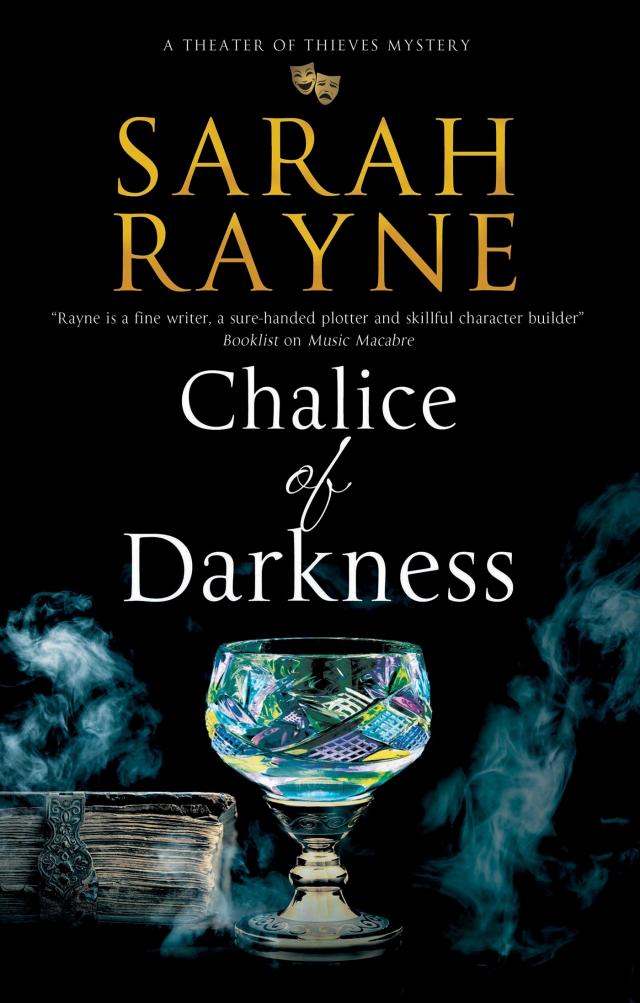
Chalice of Darkness, page 17


‘The musicians came out, so he’s bound to be with them,’ said a female voice. ‘And Aiden’s over there – no, wait, he’s going back into the theatre …’
Saul turned to see Aiden Fitzglen running across the cobbled pavement and vanishing through the stage door.
‘He’s mad!’ shouted the older voice. ‘Somebody stop him.’
‘Rudraige, calm down, or you’ll have an apoplexy. Aiden’ll be out in a couple of minutes – he’ll have gone back to rescue something valuable.’
‘Daphnis, there isn’t anything so valuable in there it’s worth risking a fire!’
‘There’s that script of Sheridan’s, signed by him—’
‘And there’s the chair David Garrick sat in when he played Lear,’ chimed in another voice. ‘Guest appearance it was, and the house packed to the rafters.’
‘Aiden wouldn’t go into a burning building for a chair or a signed play script.’
Aiden Fitzglen had already vanished through the stage door, and Saul knew it was his last chance. People were craning their necks, trying to see if any flames were visible at the upper windows, or they were running to the end of the alley to watch for the arrival of the fire brigade, and no one was looking in his direction. The deepening twilight and the rain were blurring everything – if he was quick and watchful he could go back inside without anyone noticing. It would be quite safe, because the fire would not have got much of a hold yet.
He stepped back from the throng, and re-entered the theatre.
Once at the upper corridor, though, smoke was already everywhere, and he could hear the crackling of flames, as well. He had not, in fact, meant the fire to be so bad; he had only wanted to cause sufficient disruption to get at Aiden Fitzglen. But it could not be helped now.
Fitzglen was at the far end of the long corridor – half-running towards the narrow stairway that went up to the roof. Saul’s heart began to thud almost painfully against his ribs, but he ran forward and grabbed Fitzglen’s arm.
‘Come back down the stairs and out into the street,’ he said, his voice urgent. ‘They’re saying something might be about to collapse in here.’
‘Oh, God, no …’ Fitzglen jerked his arm free, then looked sharply at Saul. ‘Who the devil are you?’ he said. ‘And is everyone safe?’
‘Everyone’s quite safe,’ said Saul. ‘I was sent in to fetch you. The fire people will be here any minute – we have to get out and leave the way clear for them.’
‘Is Jack all right?’ said Fitzglen, and before Saul could answer, they heard the boy’s voice.
‘It’s Jack. He’s followed me,’ said Aiden, and began to run towards the double doors that led to the auditorium. ‘Jack – where are you? Are you all right?’
The reply came faintly. ‘In the theatre – I’ve been trying to find you—’
Saul followed him into the auditorium, which was thick with smoke. The curtains of the royal box and the one next to it were burning up, and as he looked, a small figure appeared, outlined against the flames.
‘Jack! Jack, run out into the corridor at once. I’m coming up to get you.’
Saul thought Aiden murmured something like Please God, let him be safe, and then he was running again, round to the corridor with the doors on to the boxes. The boy came tumbling out, his hands reaching for his father, who seized them.
‘Everything’s all right, Jack. You’re safe – we’re both safe.’ He looked through the billowing smoke into the box. ‘And it isn’t at all bad, is it? It’s just the smoke. If I can stamp that bit of fire out, it’ll stop it spreading … But you run outside, Jack. Quickly now. Go down into the alley, and find Uncle Rudraige and Aunt Daphnis. They’re all there, aren’t they?’
‘Yes …’
‘Everyone got out all right? Bill the Chip? And the musicians? Connor – Mr O’Kane?’
‘I think they’re all outside.’ The boy looked from his father to Saul, who was standing in the corner, then gave a half nod, and went back out towards the main corridor.
Saul knew that Aiden’s words had been intended for reassurance, because the flames had a firm hold of one entire side of the curtains. Fitzglen flinched, coughing slightly, flinging up a hand to shield his face, then squared his shoulders and went into the box, reaching for the curtains hanging on the other side, flinging them over the flames that were licking up in the other corner, and stamping on them.
‘Can you help me?’ he shouted to Saul. ‘It really isn’t much of a blaze, and if we can smother these flames—’
Saul said at once, ‘Yes, I will. And the fire brigade will be here any minute.’
It was easier than he had thought to rip from its hangings the unscathed swathe of curtain, and seem to be helping Aiden to smother the flames. It was very easy indeed to suddenly shout to him that the fire was catching on the edges of the box.
‘Over there – look …’
Fitzglen was at the edge of the box, and the smoke was swirling everywhere, here and there shot with flames. As he turned to look where Saul was pointing, Saul went forward, his hands outstretched, and pushed with all his strength.
There was a moment when Aiden Fitzglen fought – when he resisted and tried to save himself – but it was too late. He was already toppling backwards, over the balcony, down, down into the auditorium below. He cried out, and the cry spun and echoed all around the theatre. It broke off abruptly and there was a crunching, thudding sound. Saul reached the balcony’s edge, and peered over the rail. Supposing Fitzglen had survived? But of course he had not. He was sprawled across the seats below, his head at an unnatural angle. Broken neck? Yes, for sure. Quick and clean and easily done. And no one had seen what had happened.
Saul went out, coughing and shielding his face as much as possible from the smoke. All he had to do now was reach the iron stair and be down it and out into the alley.
He was halfway along when on the rim of his vision he caught a movement – as if something small had darted through the smoke and huddled into a corner. Saul’s heart lurched with fear, and despite the danger he stood where he was, trying to see if anyone was here, the smoke half-blinding him and making it difficult to make out shapes. He took a few steps towards where the movement had seemed to be, but he could not see anything, and if he did not get out now he might be trapped.
He went quickly to the iron stair, and down into the alley. The Amaranth people were still there, and it looked as if a great many passers-by had joined them. They were huddled in doorways, collars turned up, umbrellas open. A huge, cumbersome contraption, drawn by two horses, had arrived at the opening of the alley, and everyone’s attention was on it. No one saw Saul slip out of the stage door.
Men were already running along the alley, brandishing pipes and uncoiling hoses, and bringing ladders, and Saul was able to go unobtrusively along Sloat Alley – ostensibly a solitary passer-by who had taken only the most rudimentary interest in what was going on. He paused at the intersection and glanced back, but no one was watching him. He walked for a considerable distance through the streets before he felt sufficiently distanced from the theatre to hail a hansom and return to his hotel.
That night, in the hotel bedroom, he thought he could be pleased with how he had handled everything. There was nothing to be concerned about, and he was safe. Wasn’t he? What about that movement he had seen through the smoke? It had almost certainly been the swirling smoke, but it might just possibly have been the boy Jack. Had he been hiding – watching Saul?
But even if Jack Fitzglen had remained in the theatre, and even if he had seen what Saul had done, he could only have seen a shadowy figure – a figure whose face would not have been visible because of the turned-up collar. Even then, he would have had no idea who Saul was or where he came from. He would know nothing about Vallow Hall.
It was two days later, back at Vallow Hall, that Miss Grout read the newspaper reports about the fire to Saul over breakfast.
‘A shocking thing. I am not, generally, favourably disposed towards the theatrical profession. My father used to say it was full of rascals and profligates and loose livers. But it’s terrible to hear of such an historic building being partly destroyed. They list some of the famous men and women of the theatre who have appeared on its stage – not that I have heard of any of them.’ She rustled the pages, and peered more closely at the article over her rimless spectacles. ‘It says it happened only a few hours before a memorial concert for the Duke of Clarence. To my mind there have been more than enough memorials to that young man.’
‘It’s very sad,’ said Saul from behind The Times, willing the wretched woman to shut up, because he did not want to hear how tragic it was that an old theatre had been so severely damaged, or how venerable the Fitzglen dynasty was thought to be. He dared say it would not take much for the newspapers to start asking whether the fire might have been started deliberately – perhaps with some anti-royalist malice behind it. Nor did he need to know if the newspaper mentioned Aiden’s son.
‘They even go so far as to speculate whether it was a deliberate attempt to ruin the concert,’ said Miss Grout, ‘and ask if there might have been any anti-monarchist intention.’ She crackled the page, reading down the column. ‘Oh, and they say the theatre will be inherited by a boy of twelve – but that trustees within the family will administer it until he’s of age.’
SIXTEEN
Gus thought you would not expect fragments of the past to reach you accompanied by the scents of paraffin lamps and the lingering aroma of the Turkish cigarettes which Todworthy Inkling smoked almost incessantly.
It did not matter, though, because in this shop the past was everywhere. Mr Byron said softly, ‘Hands from the long ago are reaching out to us, aren’t they?’ Gus at once nodded in agreement. Mr Byron often used flowery language, but this time he was right – it felt exactly as if invisible hands were trying to pull all three of them – the room and even the entire shop, as well – back into the time when someone had written those yellowing pages.
It was clear that Mr Byron had no intention of leaving Tod alone with the Chauntry document, and Gus did not blame him, because he would not have left Tod alone with it, either. Flog it as soon as look at it, old Inkling would.
As the two of them leaned over the desk, Todworthy setting a horn inkstand and old-fashioned goose-quill pen to hand and a sheaf of notepaper on which to set down his findings, Gus got up.
‘Tod, I’ll take a look round your shelves while you work on this, if you don’t mind.’
‘What? Oh, certainly, dear boy.’ Tod waved a vague hand, indicating that Gus was to make himself free of the entire premises, and Mr Byron dived forward to rescue the inkpot which was in danger of being swept off the edge of the desk by Tod’s gesture.
Gus was thankful to be out of the fug of paraffin and cigarettes, although he would have liked to hear what Tod made of the strange manuscript. Probably, though, it would take a long time to decipher it – always supposing it could be deciphered – and then there would be a haggling session as to what Mr Byron was going to pay him. The entire day might go by before Gus knew anything.
It was a very good opportunity to look for more copies of old theatre magazines – in particular, ones that might contain more of that strange old song, ‘The Lament of the Luck-filled Vessel’.
Fortune’s gone a-begging, and the luck’s gone out the door
And the fences are a-cheering and the King ain’t safe no more
For rum-dubbers picked the locks when no one was around
And they’ll all be at the Tuck-up Fair/If the Talisman don’t return.
Mr Rudraige and Miss Daphnis had said the chalice was supposed to have been stolen in the early 1890s, and the scrap of playbill Gus had found in this shop had been dated 1893, which fitted.
Even though he had known Inkling’s shop since he was quite small – since those days when he would come here in the hope of earning a penny or two which would buy a meat pie for the family’s supper – it still held surprises. He might stumble across a room he did not recall seeing before – a room that had shelves or tables piled high with books and maps and old engravings. Or there might be a flight of steps going down to a room below street level where you had to fumble to light a candle to see your way.
It always looked as if the things in the shop had been crammed on to the shelves at random, but Gus knew it was really quite orderly. Rooms had their own particular subjects – the room he was in now was almost entirely given over to theatrical books and papers. Memorabilia it was called – Gus had heard both Mr Jack and Mr Byron use the word.
Here were the shelves where he had found the playbill, and he thought there might be a few new acquisitions since his last visit. People brought things in to sell – perhaps somebody had died and they were clearing out rooms, or perhaps they had found things in attics that they thought might be worth some money. Tod took almost everything that was offered him.
As Gus worked through the faded pages, the sense that he was touching a wholly different part of the past folded around him. It was not the past Mr Byron and Tod were trying to reach through the old manuscript; this was the past of a very particular section of London theatres. Rickety stages in underground clubs that had been called cellar clubs – the old lime cones that once had lit up stages. Bill the Chip and Mr Rudraige sometimes talked reminiscently about limelight – how it had given a bright but somehow mellow light of its own, and how a performer could move in and out of it as the character or the play or the song required.
In these pages, some of them with blurred sketch illustrations, was the very essence of those days. Gus turned pages carefully. From beyond the shop he could hear, very faintly, the ordinary, familiar street sounds. Voices, the rumble of cabs and omnibuses. But those sounds seemed to belong to another world, and he was scarcely aware of the shop and the clutter and the gas jets burning gradually lower.
It was a shock to suddenly hear Mr Byron saying, ‘I should have known you’d be in here, Gus. Come back into Tod’s room. We’ve deciphered most of the manuscript – which is to say Tod has – although there are a few pages left. Come and hear it all.’
Gus thrust the magazine he had been reading in the deep pocket of his coat, and followed Mr Byron. The manuscript was on Tod’s desk, and next to it were several pages covered with Mr Byron’s writing.
‘What I’d like to do,’ began Mr Byron, ‘is to … Angels and ministers of grace defend me!’
‘What is it?’ said Gus, as Mr Byron went to stand at the door and peered through the small glass pane.
‘Over there. Standing by those bookshelves.’
‘I can’t see …’ And then Gus did see. A slender figure, wrapped in a stylish coat with a high turned-up fur collar, the whole outfit finished with a small hat that had a saucy little veil partly covering the face.
Mr Byron said, softly, ‘As I live and die – Viola Gilfillan.’ He glanced at Tod. ‘Do Gilfillans often come in here, Tod?’
‘It has been known,’ said Tod, inspecting the figure over the top of his spectacles. ‘But it’s something of a coincidence to see the lady here on the same day that you’ve brought that manuscript. Is she keeping an eye on you, do you suppose – at least, not on you personally, but on the family in general?’
Mr Byron said, ‘They do try to find out what we’re doing. But I’d have to admit that we do the same with them.’ A bit unwillingly, he said, ‘Viola was in The Punchbowl the other night, and my Uncle Rudraige was talking at full pelt after the third glass. She might have heard something – you can’t stop Rudraige once he gets going.’ He watched Viola as she bent to examine some of the magazines Gus had left on a chair.
‘I don’t think the Gilfillans actually know for sure what we do off-stage,’ he said, after a moment. ‘Well, I don’t think anyone outside the family does, or we’d all have been in the clink long since. But it’s always been thought that they know more than we’d like. Uncle Rudraige was very chummy with old Furnival Gilfillan in their giddy youth. And if they’ve heard whispers that we’ve got a filch planned, and that it’s a very big filch indeed, they might be trying to catch us out.’
Viola Gilfillan had taken two magazines from the pile, and was walking across to the small untidy desk where one of Tod’s underlings sat. She handed over some coins, put the magazines in her bag, and strolled across to the street door. It might have been pure coincidence that she looked into Tod’s room as she did so, but Gus did not think it was coincidence that caused her to wink at Byron very saucily, and put up a hand in a kind of mock-salute, before stepping out into the street.
‘She’s up to something,’ said Byron, watching her make an unhurried way along the street. ‘But it’s no use me going after her and trying to find out what she’s plotting – if she’s plotting anything. She’s clever, that one. She doesn’t give away her family’s secrets.’
Tod, his eyes on the manuscript on the desk, said in an absent voice, ‘Of course, she might give them away to Mr Jack.’ He looked up, regarding Gus and Byron over the tops of his spectacles.
Mr Byron glanced at Gus, and then said, noncommittally, ‘So she might.’
Todworthy smiled, then with an air of a man addressing a serious matter, said, ‘I suggest you read out your notes, Mr Byron, and I’ll compare it to the manuscript as you go along.’
‘That way we can make sure I’ve understood it,’ agreed Mr Byron. ‘Gus, we’ve had to make a number of guesses at a great many of the words and expressions, and I’ve tried to put it in reasonably modern language. But I think between us we’ve got a fair sense of what was originally written. We both think you should hear the findings so far. You’re as much a part of this as any of us.’
This pleased Gus so much he could only mumble something about finding it all very interesting and being glad to help.
‘I’ll be writing to Jack later today,’ said Mr Byron. ‘Sending the transcript.’