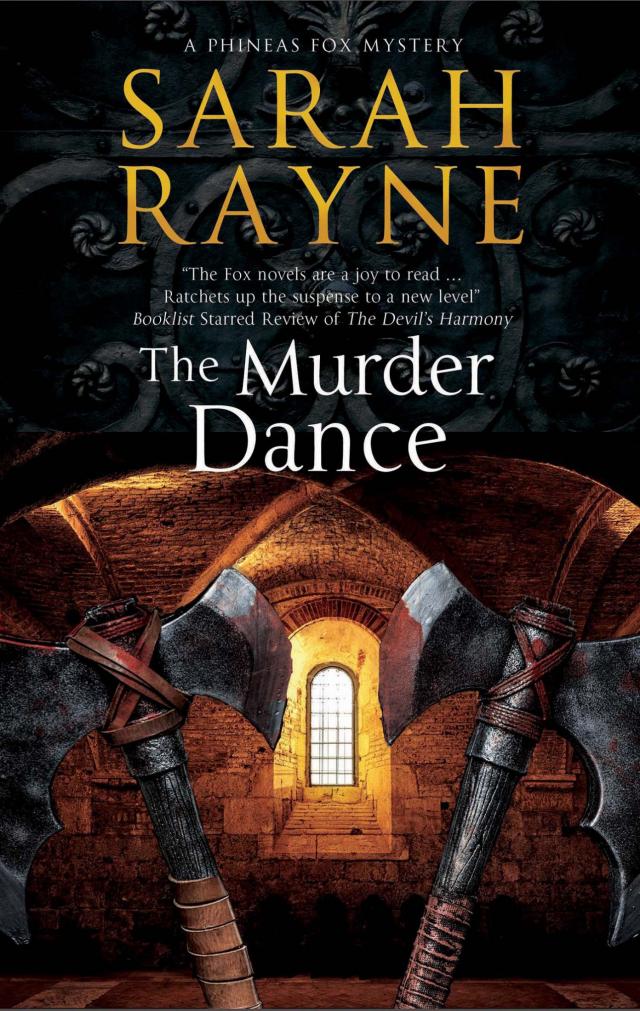
The Murder Dance, page 1


Contents
Cover
Also by Sarah Rayne from Severn House
Title Page
Copyright
Chapter One
Chapter Two
Chapter Three
Chapter Four
Chapter Five
Chapter Six
Chapter Seven
Chapter Eight
Chapter Nine
Chapter Ten
Chapter Eleven
Chapter Twelve
Chapter Thirteen
Chapter Fourteen
Chapter Fifteen
Chapter Sixteen
Chapter Seventeen
Chapter Eighteen
Chapter Nineteen
Chapter Twenty
Chapter Twenty-One
Chapter Twenty-Two
Chapter Twenty-Three
Chapter Twenty-Four
Chapter Twenty-Five
Author’s Note
Footnotes
Also by Sarah Rayne from Severn House
The Phineas Fox mysteries
DEATH NOTES
CHORD OF EVIL
SONG OF THE DAMNED
MUSIC MACABRE
THE DEVIL’S HARMONY
The Nell West and Michael Flint series
PROPERTY OF A LADY
THE SIN EATER
THE SILENCE
THE WHISPERING
DEADLIGHT HALL
THE BELL TOWER
THE MURDER DANCE
Sarah Rayne
This ebook is copyright material and must not be copied, reproduced, transferred, distributed, leased, licensed or publicly performed or used in any way except as specifically permitted in writing by the publishers, as allowed under the terms and conditions under which it was purchased or as strictly permitted by applicable copyright law. Any unauthorised distribution or use of this text may be a direct infringement of the author’s and publisher’s rights and those responsible may be liable in law accordingly.
First world edition published in Great Britain in 2021 and the USA in 2022
by Severn House, an imprint of Canongate Books Ltd,
14 High Street, Edinburgh EH1 1TE.
Trade paperback edition first published in Great Britain and the USA in 2022
by Severn House, an imprint of Canongate Books Ltd.
This eBook edition first published in 2021 by Severn House,
an imprint of Canongate Books Ltd.
severnhouse.com
Copyright © Sarah Rayne, 2021
All rights reserved including the right of reproduction in whole or in part in any form. The right of Sarah Rayne to be identified as the author of this work has been asserted in accordance with the Copyright, Designs & Patents Act 1988.
British Library Cataloguing-in-Publication Data
A CIP catalogue record for this title is available from the British Library.
ISBN-13: 978-0-7278-5012-6 (cased)
ISBN-13: 978-1-4483-0637-4 (trade paper)
ISBN-13: 978-1-4483-0636-7 (e-book)
This is a work of fiction. Names, characters, places and incidents are either the product of the author’s imagination or are used fictitiously. Except where actual historical events and characters are being described for the storyline of this novel, all situations in this publication are fictitious and any resemblance to actual persons, living or dead, business establishments, events or locales is purely coincidental.
This eBook produced by
Palimpsest Book Production Limited,
Falkirk, Stirlingshire, Scotland
ONE
The first emotion to strike Quentin Rivers when he read the solicitor’s letter was shock. Sheer astonishment that he had apparently inherited the old house that had been a vague legend in his family ever since he could remember. The astonishment was tinged with disbelief at first, but when he read the letter a second – and then a third – time, it was clear that there was no mistake. The Tabor, the house that no one in the family seemed ever to have seen, and that most of them said was only a legend. A story out of somebody’s imagination, they said – probably somebody a generation or two back had spun a story, wanting to make the family out to be posh and rich. Even if it had existed, it would long since have passed to some unheard-of branch of the family, or crumbled away to nothing, and had a tower block or a shopping centre built on its foundations.
Zillah’s grandmother did not say The Tabor had crumbled away or was just someone’s imagination, though. She had a way of nodding to herself if The Tabor were ever mentioned, as if she knew a great deal more than the rest of them.
The aunts and uncles – and Quentin’s own parents when they were alive – had always maintained that Zillah’s grandmother was a bit odd, and you could not believe a quarter of what she said. Still, the stories were good ones, if you had time to listen to them. Oh, and presumably it was all right to let the children spend so much time with the old girl, was it? Young Quentin and Zillah?
Zillah.
Quentin’s second emotion at receiving the news of the legacy had been delight and hope, because it was suddenly possible that this astonishing, unexpected inheritance might mean he could realize his dream. For years he had wanted to protect Zillah from the boys – later the men – who admired her, but who would certainly not treat her as she deserved to be treated. Quentin wanted her to himself. What was that line of poetry …? Something about, ‘The world forgetting, by the world forgot.’ He was not a great one for poetry, but he had come across that once, and it had lodged in his mind. That was how he wanted it to be with Zillah. Just the two of them, in their own world.
There had been one or two girls in his life while Zillah was growing up – of course there had. He thought he could say he was by no means bad-looking, and there had been opportunities. The trouble had always been that the image of Zillah came between him and any girl he ever got close to.
Lately, he had even begun to wonder if it was a mixed blessing to live in the same house as Zillah, but it had seemed the ideal solution after both sets of parents had died in the car crash, leaving Quentin with the tall old house and the modest proceeds of two insurance policies, and Zillah with nothing at all, because her parents had been what everyone called thriftless.
That was when Quentin had divided the house into two flats, living on the ground floor himself, with Zillah on the top floor. He liked to think of her up there; it was like living with a will o’ the wisp in the attic – one of those elusive, dancing creatures reputed to flit across marshlands, or beckon tauntingly to travellers to follow them to the rainbow’s end and the fabled pot of gold. And there he was again, with the poetic imagery. Zillah would laugh if he said any of that to her; she would say the marshlands would suck you down into their squishy depths, and the rainbow’s pot of gold would turn out to be a cracked old stew-pot.
She would not laugh about The Tabor, though. Quentin would tell her all about it this evening – it would give him a good excuse for suggesting they had supper together; not that he needed an excuse, but it would sound better. He would cook a pasta dish for her; she liked pasta. And he would tell her about this elderly cousin, Osbert Rivers, whom he had never heard of before, but who had left a will naming Quentin as his sole heir. He would tell her, as well, about the Norfolk village called Reivers where the house stood, and how, if he went to live there, he would be Rivers of Reivers. Would that impress her, or would she laugh and say, for heaven’s sake, Quen, are you living in some mouldy medieval world? She was very modern, of course.
It might be a good idea to look up Reivers beforehand to find out what kind of a place it was. He had better find out what the word Tabor meant, as well. Appearing to know such things would impress Zillah; she would listen, and nod, her eyes drinking it all in, and she would occasionally smile, and probably tease him about being a fusty old romantic. And her eyes would crinkle at the corners as they always did when she smiled …
She had never known about the jealous rage that seized him if he saw a man going up to her flat, or when he heard her skipping down the stairs to meet someone who was taking her out. None of the men meant anything to her, Quentin knew that, and it would all be completely innocent. But it was good that she had never had the smallest suspicion of how he felt. He would not do anything that might upset the comfortable, happy existence they had. He knew how much she liked living here.
Zillah Rivers had wished for years that she could afford to move out of this house and get away from her cousin Quentin’s jealousies and possessiveness. Every time she went out of her own flat and every time she returned to it, he was there, peering furtively through a chink in his curtains in the downstairs half of the house. He was like those inquisitive women in old-fashioned films, twitching the lace curtains to see what their neighbours were up to. It was infuriating and it was also very restricting, because if Zillah was going out with someone, she nearly always had to arrange to be collected at the end of the street, where Quentin could not see her. If she brought anyone back for a drink or coffee, they had to tiptoe up the stairs, not speaking, stepping over the creaking floorboard on the half-landing. At times this could be turned into a joke, but if one of these late-night visits progressed to the bedroom – and Zillah did not pretend to be an angel – there was nothing remotely jokey about having to explain that noise must be kept down because there was a jealous cousin downstairs who would listen to every groan and gasp and creak of bedsprings. That would be the surest passion-shriveller for the most virile man in the world, and if Zillah had enough money to move to another flat, she would do so, and neither Quentin nor this dreary suburban street would see her again. She sometimes thought that the only thing keeping her sane was the knowledge that there was something good ahead – something that would mean she could move away and have her own place, and not have to worry about money, or about keeping Quentin sweet so that he would pay all the bills.
The Tabor. It had been promised to her, and it had been something to cling on to. It had meant she need not bother about actually working or trying to have a career, which was what people expected these days. In the meantime, she drifted into helping Quentin with his small market-research set-up. It mostly meant making telephone calls or emailing questionnaires, finding out what people bought from supermarkets or furniture shops, or what shampoo they used. It was pretty boring, really, but it was at least a job of sorts and Quentin paid her a tiny salary. It was very tiny indeed, because he was as mean as a miser, and Zillah could not possibly afford her own place on this pittance. But it would not be for ever; she had kept a tally of the years, and at intervals she had been able to remind herself that Osbert Rivers must be well over 80 … That he must be approaching 90 now … Turned 90 … And when he died, The Tabor would be hers.
But now, tonight, eating the very good pasta that Quentin had cooked (if you had to say something favourable about him, you would have to say he cooked well), it seemed that after all these years of waiting, The Tabor was not going to be hers after all. Osbert had died, but now that his affairs had been sorted out it seemed the stupid old fool had reneged on his word, and had left The Tabor to Quentin. Zillah could have screamed with rage and thrown things around. She did not, of course. But she stared at Quentin across the table and felt a deep slow anger and resentment begin to burn upwards. Quentin had no right to The Tabor. He had no right to be sitting here, with that maddeningly complacent look, telling her about the house as if he knew it intimately. He did not know it all, and he had no right to it whatsoever.
‘I daresay the place will be falling to pieces,’ he was saying. ‘But it turns out that it really is Elizabethan, just as the stories said. The solicitor says there are dates on the Title Deeds – well, on what’s left of them, because they’re pretty ancient, but the place dates back to at least Elizabethan times.’
Zillah had to fight not to shout at him that she knew The Tabor was Elizabethan, in fact she knew it was even older than that, and she knew far more about it than Quentin. He passed her the solicitor’s letter to read, and then told her what was in it anyway.
‘And I phoned the solicitor this afternoon – he sounded a dry old stick, but we had a good talk. I always think it’s as well to find out as much as possible about these things,’ said Quentin, as if, thought Zillah, inheriting an Elizabethan house was an everyday occurrence. But she read the letter, and listened to Quentin, and she managed to sound interested and pleased. But all the while she could feel the old nightmare stirring in the darkest corner of her mind.
Quentin, folding the letter back into its envelope, said, with an air of importance, that he would have to go to Norfolk to see the house.
‘It’s quite a long journey, but there are documents I’ve got to sign, and the solicitor doesn’t want to put them in the post because some of the documents are very old and quite fragile. His office is only a few miles from Reivers, though – in a market town, I think. It’ll be too far to go there and back in the same day, so we could stay for a night or two.’
‘“We”?’
‘You’ll come with me, won’t you? I want to see the house, and I want you to be part of it all.’
‘Yes,’ said Zillah, managing a smile. ‘Yes, I would like to come with you. I would like to be part of all this.’
‘I thought you would. In fact, before you came in I booked us into a place in the centre of Reivers village – a local pub who do B&B and bar meals. It sounds quite nice and, according to the map, The Tabor’s just on the outskirts of the village.’
‘We may as well go straight to the pub,’ said Quentin, two days later as they drove through the flat, fen country. ‘I’d have liked to stop off and take a look at the house – we won’t have the keys until tomorrow, but we could see the outside of it. But it’s getting a bit late now, and it’ll soon be dark.’
‘Let’s wait until tomorrow,’ said Zillah. ‘Let’s get the keys and see it properly.’ In daylight, said her mind, not like this, in this half-light, where you imagine that figures are crouching, watching, waiting to reach out to you …
‘Yes, all right. The appointment’s for 9.15 anyway, so we’ll have most of the day to ourselves after that.’
A roadside sign eventually proclaimed that they were about to enter Reivers, and they went around a curve in the road with a straggle of buildings on each side. Ahead of them was a small market square with several shops and a stone cross at the far end.
‘That looks like our pub,’ said Quentin, slowing down. ‘See over there?’
‘You were right – it does look nice,’ said Zillah, peering out of the car window. It was a low, double-fronted old place; lights glowed warmly in its windows, and there was the impression that there would be oak beams and chintzes inside. Near the door was an A-board advertising accommodation and good food, and quite a number of cars were parked on the forecourt.
Quentin carried the cases into the panelled reception area, and Zillah was glad that he did not comment on the extra suitcase she had brought. She had packed rather more than was necessary for a single night, on the grounds that it was as well to be prepared for anything.
Over their dinner in the small dining area that opened off the bar, Quentin talked about The Tabor.
‘It’s bound to be a bit run-down,’ he said. ‘Osbert died a good two months ago, according to the solicitor, so the place will have been standing empty.’
‘We haven’t talked about what you’ll do,’ said Zillah, carefully. ‘Will you sell it?’
He did not immediately answer, then he said, ‘Properties can be renovated.’
‘Renovated? How would you afford it? Or did Osbert leave any money?’
‘Nothing to speak of. But I’d sell my present house, of course. That would release a fair amount of dosh.’
He had said ‘my’ house. Not ‘our’ house.
‘And live in The Tabor?’ said Zillah. It was good that her voice sounded absolutely normal.
‘Not while the major work’s being done, obviously. But I could camp out there for a while later – it might be a bit rough and ready, but I’d be able to oversee the renovations. I wouldn’t expect you to live like that, of course. You’re such a fragile little plant, aren’t you?’ There was a half-movement, as if he might have been about to reach for her hand across the table, then thought better of it. ‘But once our own house is sold and we’ve moved out, you could stay here,’ he said, glancing about him. ‘I expect we could get some kind of reduced rate for a long-term stay. I’d semi-live here – I could have my meals here most of the time, so you wouldn’t be on your own very much. You could come and see all the work being done. We might even run to a little car for you.’
Zillah wanted to hit him for this smug condescension, but she said, ‘But when it’s all done? What then? What would you live on? You couldn’t stay with your market-research work, could you? Not all the way out here?’ Quentin did not have to travel very much, because a good deal of his work was via phone and email from home, but he sometimes had to make brief trips to companies who commissioned more in-depth surveys and reports. Zillah had never let him know that she lived for those brief absences, or that she made the most of having the entire house to herself.
‘As a matter of fact,’ said Quentin, ‘since I got the solicitor’s letter, I’ve been thinking about an idea I’ve had for a long time. A kind of dream, really. The kind of thing you pretend you might one day do, but you never really believe you will.’ He leaned forward, his pale, rather long face serious and intent. ‘One of the things the solicitor mentioned was that in the deeds is a reference to the house having been some kind of lodging house, or even a tavern at one time,’ he said. ‘Sort of sixteenth-century B&B, I think. Did your grandmother have any stories about that? She used to ramble on a good deal about the place, didn’t she?’