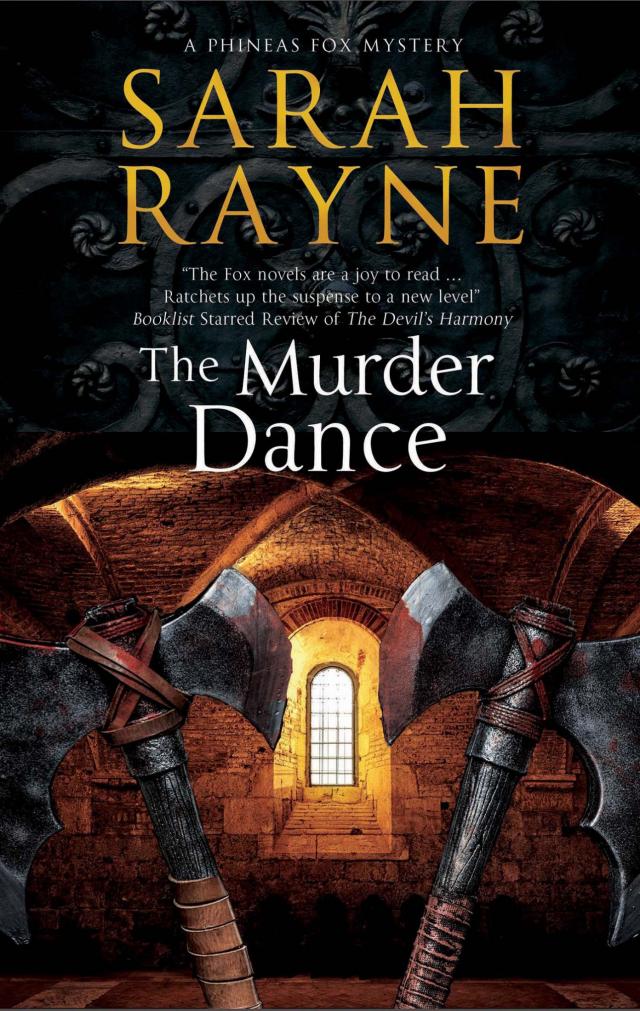
The Murder Dance, page 7


It was near the end of our convivial evening that my master, likely invigorated by the amount of wine he had drunk, made his announcement. With considerable exuberance, he told them that tomorrow afternoon he would give a special dance for them.
‘I see your splendid courtyard,’ he said, waving a hand in the vague direction of the window, beyond which the courtyard could just be glimpsed. ‘And so I shall give you my Morrice on the Morrow, that’s what I shall do.’
This was greeted with cheers, and then someone called out to say that if Master Kempe would indeed give them of one of his jigs – a special performance for the people of Reivers, you might call it – then the people of Reivers, by way of reciprocation (the voice had to make three attempts at the word), then they would put on their own special performance that same evening in return.
At once suggestions were made as to what might be performed, and a heated argument began between two rival factions. However, a determined voice rang out, shouting down the rest. ‘Only one dance we can give on such an occasion,’ said this voice.
‘Ho, Master Grindall, and what might that dance be?’
Master Grindall, unseen by myself until then, strode to the centre of the room and took up a challenging stance.
‘Why,’ he said, beetling his brows at his listeners, and hooking his thumbs in his belt, ‘what else should we give our guests other than our very own piece of history? Tomorrow night, as the sun sets, we’ll perform for Master Kempe and his company the famous and ancient Reivers Dance itself.’
An extraordinary silence fell on the room, and people glanced at one another. Then someone – I think it was one of the women – called out, ‘How about the old legend? Aren’t you worried about that, Jeremiah Grindall?’
‘No, I am not,’ said Jeremiah Grindall, still standing in the room’s centre.
And still no one responded, but after another few moments – Master Kempe and I glanced at one another, half wondering if we should intervene – someone else called out, ‘Well, ’course he isn’t worried. Catch Jeremiah worried about anything – not in a pig’s eye, you wouldn’t. Caper across a legend any day, those Grindalls. Nimble Grindalls, that’s what they call them.’
There was some laughter, but there was affection in it, and the odd little moment seemed to have passed. There now seemed to be general acceptance that this dance, whatever it was, should be performed, and everyone who could manage it should join in.
‘Could we do it, though?’ asked a worried voice from a corner. ‘For it hasn’t been seen for – well, since Evelyn Rivers was put to the sword in that very courtyard.’
There was a vague murmur of acknowledgement of this, but then a sprightly old gentleman banged the table with his fist, and said that o’course they could do it.
‘It was writ down since many a long year and more,’ he declared. ‘And I say it should be performed again, and we’ll remember Evelyn Rivers when we do it. That’s the way to honour our ancestors,’ he said, glaring round the room.
‘I say we leave the Reivers Dance where it is,’ said the first voice. ‘Blood-tainted, that’s what it is. Because for why was Evelyn executed that day? For speaking out against the King, that was for why. Richard II it was on the Throne in those days, and him no more than a beardless boy at the time, and ruled by his ministers. Evelyn Rivers should have known better, I say.’
The elderly one was not having this. ‘It’s part of our history, the Reivers Dance,’ he said. ‘We don’t forget our history in Reivers, and we don’t forget Evelyn, neither. I say we perform it.’
‘Also,’ piped up Master Grindall, ‘the Dance is still there in church records, all wrote down, and all parson’s got to do is open the records, and there it’ll be for us to follow.’
‘If,’ muttered the doubter from the other corner, ‘someone’ll read it all out for them as aren’t in the way of reading.’
But this gloomy view was drowned by a cheer, and people began to say that of course they ought to revive the Dance, for wasn’t this the famous Master Kempe all the way from London? And of course they’d all be able to follow the steps, never mind if it did have to be read out for some of them.
The worried section thought they ought to go along to the church to find the writing that very night, for you couldn’t tell how easy it might be to lay hand on the paper, but Parson Marplot said no one need trouble about that; he knew exactly where to put his hand on the Dance, and they would look it out first thing in the morning. There could be a bit of a practice, he said. He was in favour of honouring the past, as his forebears in Reivers church had been. He beamed and pretended not to hear several people muttering that earlier Reivers’ parsons had been nothing but ranters, and that there was a story of how one former incumbent had been thrown into the local duckpond for preaching against the taking of strong drink on the Sabbath.
‘How times change,’ observed someone else, eyeing Parson Marplot’s newly replenished tankard of ale.
And now, in my own room, on the comfortable window seat that looks down over that very courtyard, I’m setting it all down while it’s still fresh in my mind. I should also set down that I don’t like the sound of the Reivers Dance. I don’t care how far back its origins are, or even if it was handed down by William the Conqueror when he landed at Hastings, or whether the druids offered it in pagan libation in the deep past – I’m increasingly unhappy about its performance tomorrow.
I wonder whether I can persuade Master Kempe to leave Reivers at first light tomorrow.
* * *
Phin had suspected that tracking down information about Will Kempe would be difficult, and it was looking as if he had been right. He had not yet tracked down a copy of Kempe’s own account of his nine days’ dance from London to Norfolk. Except for the vague mentions of Kempe in the seventeenth-century Tydings, and the even vaguer hints of an old Norfolk dancing legend in the turgid work on clowns, jesters and wise fools, all he had unearthed was a waspish exchange between a pair of eighteenth-century academics. One of these gentlemen stated truculently that Will Kempe had been illiterate, while the other said that although Kempe had possessed no classical learning, he had been very far from illiterate – you had only to remember his famous Nine Daies’ Wonder. This had brought forth a scoffing rejoinder that everyone knew perfectly well that Will Kempe had employed a chronicler on his journey, and that it was the chronicler who had written the Nine Daies’ Wonder, very likely spicing it up on his own account, since it was believed that he (the chronicler), had been one of the worst womanizers in London, and had rogered his way across Norfolk and had met some nameless, but probably apt, fate there as a result.
Phin’s attention was instantly caught, and he was just wondering whether it would be possible to track down the chronicler, when an email from Arabella announced itself as having arrived. Anything involving Arabella would certainly be more cheerful than carping eighteenth-century scholars, so Phin abandoned Will and the ill-fated chronicler, and read the email.
Phin, dear,
This wretched phone signal is still refusing to make any real connection – we had a reasonable series of crackles earlier, didn’t we, but only about one word in ten was audible – although at least we’ll be connecting in a better sense tomorrow. I’m looking forward to you seeing The Daunsen and the ancient sketch of The Tabor, and most of all I’m looking forward to you seeing The Tabor itself. Because this morning I saw it.
I was eating my breakfast, and I’d found a couple of old books on local history in a little antique in the square outside – gorgeous old place, and there’s a separate little book section, so you’ll have to see that when you get here. I’d got one of the books propped up against the marmalade pot so I could make a few notes about the Peasants’ Revolt. There was a really good chapter on how several Reivers’ people had been involved, but were squashed by Henry le Despenser who had them summarily executed. It all sounded very public and grisly.
I was just trying to decide whether any of this would fit into a modern-day publicity campaign, when Quentin materialized at the table. He sat down, and asked if I could go out to The Tabor later that day. He added (with a smiling shrug) that he supposed he had to regard himself as Rivers of Reivers. Can you believe he actually said that! It made me think about robber barons, and all the ribald old practices like droit du seigneur – or do I mean that other thing – jus primae noctis? Anyway, that tradition where the lord of the manor had first go at any local maidens who took his eye, particularly on the night before the girl’s wedding. Literally, ‘Right of the first night’, the licentious old goats. Can you imagine using that one on today’s, ‘Your place or mine?’ generation? Nobody’s actually said that the inhabitants of Reivers ever did any of those things, of course, but still.
According to Quentin, a builder and a surveyor were due at the house that morning, and Quentin had the idea that it might be useful for me to be in on some of the renovation plans. I’d suggested to him last evening that we could do some ‘before, during and after’ illustrations.
‘You won’t expect too much at this stage, will you?’ said Quentin, leaving me to the marmalade pot and the Peasants’ Revolt. ‘Drive straight in – I’ll leave the gates open for you.’ From his tone, he might easily have been saying, ‘I’ll have the drawbridge lowered.’
‘It isn’t in a very good state of repair,’ he added. ‘But you’ll be able to look beyond that, I know.’
Fortunately, Toby’s car was returned this morning, so I was able to drive out there under my own steam. The Tabor is in a very bad state of repair indeed, even to my untutored eye. But the brickwork has that marvellous coppery glow that you only ever see in a genuinely old house, and if it really is fifteenth or sixteenth century, you have to hand it to the Tudors, who might have pillaged and plundered and beheaded regardless, but who knew how to build. I think it must have been a beautiful house in its heyday, with sunshine on lawns and well-mannered children playing in the gardens. But it’s clearly a very long time since it had a heyday, or any kind of day at all.
The builder was already there. He turned out to be a chatty soul wearing a colourful jumper, and his van proclaimed him to be George Grindall, and his company master builders to the county since the 1800s.
We set off on the tour, with George Grindall taking measurements and making gleeful notes as he totted up how much everything was going to cost. The surveyor arrived while we were halfway round. He jabbed spiky things into bits of woodwork and muttered about Coniophora puteana, and how the roof has Merulius lacrymans. I politely asked for clarification, and it turns out that one is wet rot and the other is dry rot. I suppose he thought it would sound better in Latin, although I should think it’ll be expensive to remedy no matter what language you put it into.
I helped Mr Grindall to prop his stepladder against a wall in the attics, so he could get into the roof space. He was very nice when I got part of the ladder wedged between two joists, causing a section of timber to fall onto his toe. He said it was a thing that could happen to anyone, and it went to show what a shocking state the woodwork was in. The surveyor muttered in Latin again, and Mr Grindall added another row of figures to his scribbled estimate.
Then we tramped around the bedroom floor. They all made notes, and I tried to look serious and scholarly.
‘This’ll have been old Osbert’s room, I daresay,’ said Mr Grindall, opening a door on to a large, high-ceilinged room with grubby wall hangings and a rickety-looking four-poster.
It appears that Osbert Rivers is the gentleman who died recently, leaving the house to Quentin. Mr Grindall confided that he had had a great-aunt who used to do a bit of cleaning at the house in her youth. ‘A few of the local girls did,’ he said. ‘They were always very strictly supervised, though. My great-aunt used to tell that Osbert Rivers had been a bit of a lively lad at times. In fact, Miss Tallis, she often said that the four-poster in this room could tell a few tales.’ (At this point he gestured to the four-poster.) ‘Not meaning any disrespect, of course,’ he added, with one eye on the door, where Quentin was holding a glum conversation with the surveyor.
I was about to ask him about Osbert, but Quentin came back into the room, clearly having heard most of the conversation, and obviously ready to quell the over-familiar peasants. Mr Grindall began to talk determinedly about window frames, and Quentin frowned at him, then went away to measure something.
And now I don’t know whether to regard The Tabor as a fascinating old country house, and a possible source of robust gossip, or whether to see it as just a crumbling ruin, best left to its own devices.
PS … You notice I haven’t once mentioned the possibility of it being haunted.
Typing a suitable reply, Phin was not inclined to think very favourably of Quentin Rivers, who seemed to have such astonishing ideas of feudalism, and who invited a female into a rickety old house with rotten timbers and unreliable floors. But he was becoming increasingly intrigued by The Tabor, although when it came to ghosts he was going to reserve judgement.
Driving to Norfolk with Toby on Sunday morning, he tried to think that Reivers would be an ordinary English market town with no more melodrama and murder in its past than any other village.
Toby provided an enthusiastic commentary on their route, telling Phin where Arabella had misread the map and taken them miles out of their way; he had also tried phoning and texting Zillah several times without any success.
‘But she’ll be very busy,’ he said, firmly. ‘She and her cousin will have a great many things to do. She’ll be waiting for me at the pub, though.’
SEVEN
Zillah had decided she would be conveniently out of the way when Toby reached The Daunsen on Sunday. In a way it was a pity not to allow things to develop, and Toby had certainly been smitten from the outset. But she would need to tread a very delicate path with Quentin for the next week or two, and she did not want to risk doing anything that might antagonize him. Also, Quentin’s bedroom at The Daunsen was next to Zillah’s, so he would know – and hear – everything she did, and who she did it with.
She would not brush Toby away altogether, of course, mainly because he had offered to invest in Quentin’s project, and although no actual amount had been mentioned, Zillah was not going to upset things to the extent of losing out on any funds that might be coming in, because she was starting to see that if she really did put her plan into action, whatever went into Quentin’s bank account might end up in her own.
Toby had texted to say he and Phineas Fox would probably reach Reivers shortly after lunch, so Zillah had an early snack at The Daunsen, then went out to explore. There would not be much to see on a Sunday afternoon, but she would rather be out of the way when they arrived.
Reivers was too big to be called a village – it had been added to, and small modern housing estates had grown up around it over the years – but it was nowhere near large enough to qualify as a town. There was an ancient church, but even from the footpath it looked small and damp and as if it would be filled with sad echoes, so she thought she would not bother, and instead came back into the square. She peered in one or two of the shop windows – there was a little antique shop, which was called Savory Antiques and which had a sign over its door saying, ‘Proud to be a family-owned business since 1920’. Zillah had been into the shop the previous day; there was a lot of old furniture and things which were probably quite valuable, and the Savorys were two rather frumpy ladies who might be any age between fifty and seventy. They had been delighted when Zillah bought a jade necklace from a display of Victorian jewellery, and explained eagerly that she might not have seen any of it at all if it had not been for Miss Tallis visiting the shop earlier. They did not normally put jewellery on open display, they explained – you could not be too careful these days, could you?
Miss Tallis had been particularly interested in their small stock of books about local history, and while she was looking through them, somehow or other the locked glass-topped case of jewellery had been tipped off its plinth, and everything had tumbled out on to the floor. She had insisted on putting everything back for them, and had crawled into all the little corners, which was very helpful, because their rheumatics made getting down like that a bit awkward for them. But she had fielded some mourning brooches with locks of hair, and a bracelet, and also a necklace that was said to have been worn at the famous Waterloo Ball in 1815, and which it would have been a pity to have lost down the gap in the floorboards. The glass top had been perfectly intact, but Miss Tallis had insisted on going along to the little local stationer’s shop to buy them a length of green baize by way of apology, which had certainly not been necessary, and had helped to rearrange the entire display against it. The sisters would not have thought of green baize, which they associated with billiard tables, but when it was all set out, they were extremely pleased, because the baize made a very nice background indeed for the jewellery.
But Savory’s was firmly closed this afternoon, and everywhere was shrouded in what Zillah supposed was a Sabbath hush, so there was nothing to do but return to The Daunsen. Annoyingly Toby was in the little bar by the main reception area. He had a newspaper propped up on the table, but Zillah knew he would have been watching for her.
‘I’ve missed you,’ he said, jumping up and putting out his hands. ‘Didn’t you get my calls?’
‘Oh, did you try to call? The signal here is dreadful.’
‘Never mind, I’m here now,’ he said. ‘Let’s go up to my room – or yours – before dinner. Just so we can have an hour alone to catch up on how our week’s been. I’m looking forward to hearing how it’s all going with The Tabor and what you’ve been doing.’
He had made this kind of overture soon after their meeting, but Zillah had declined, and she was going to decline now. Even if she had intended to let this go further, it was far too soon for the bed thing. She was not having Toby or anyone else think she was no better than a tart.