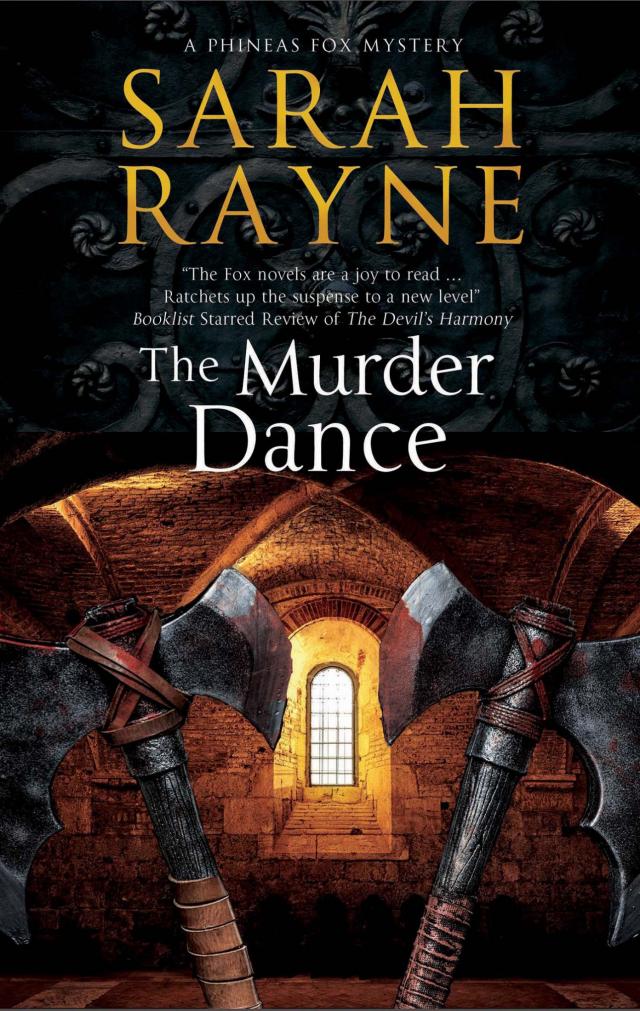
The Murder Dance, page 9


‘I’m always pleased to see him, as well,’ said Arabella. ‘But just for once, shall we tiptoe past his bedroom so he doesn’t hear us? Let’s pretend we’re in a French farce, and I’m smuggling you into my bedchamber. Or we can be in D.H. Lawrence, and you can be the sexy gamekeeper—’
‘Arabella, you don’t know how much I’ve missed your inconsequence,’ said Phin, smiling at her.
‘Well then, Mellors, come and be consequential upstairs.’
A considerable time later, Arabella said, ‘Phin, have you fallen asleep or are you mentally looking for clues between Dancing Murderers and dubious philanthropists?’
Phin had been falling into a comfortable half-sleep, with Arabella’s head against his shoulder, but he said, ‘Only half-looking.’
‘For Walter Rivers or Will Kempe?’
‘Will Kempe,’ he said, at once. ‘And the Murder Dance.’
‘I’ve been thinking about that, too. Could there really be a connection between Kempe and the Dance?’
‘I don’t know.’ Phin sat up and reached for a pillow. ‘I’m trying not to make connections yet,’ he said. ‘But that material I found before I came here – always supposing it can be trusted – hints that something might have happened while Kempe was in Reivers. Always assuming it was Reivers, because it wasn’t actually named. But then he died quite soon afterwards. “In poverty and unregarded”.’
‘That’s sad, isn’t it.’
‘Yes, it is. He isn’t especially revered or even particularly remembered,’ said Phin, ‘but he’d performed with some of the theatre world’s finest in his day. He’s supposed to have been Shakespeare’s inspiration for Falstaff and he was hailed as the great clown actor of his day.’
‘He’s got to you, hasn’t he? Oh – are you getting up?’
‘Yes, although I’d much rather stay here, and maybe have some food sent up,’ said Phin. ‘But then we’d have to face Toby’s knowing eye later.’ He reached for his shirt. ‘I hope Will Kempe doesn’t turn out to be First Murderer,’ he said. ‘But he’s not very well documented, so at the moment all I know about him for sure is that he danced his way from London to Norfolk and that he took nine days to do it.’
EIGHT
Greenberry’s diaries, circa 1600
I’d like to think that if anyone does read these pages, he or she might want to try forming a small mental image of the author – by which I mean me – scribbling away in an encroaching twilight, in a house on the edge of a Norfolk village. In case that unknown reader might consider likening me to Geoffrey Chaucer, I will explain that although I’m hoping I might emulate in some small way his Tales, I bear no resemblance to him physically. Instead, a rather thin-faced man should be pictured – pale, but not certainly sallow, and not a callow youth, although definitely not in the sere and yellow. I’d like it known that I am neither sallow nor callow nor yellow. Add to the image a flop of light brown hair which is slightly longer than the prevailing custom, owing to my ears being set slightly high which I do not care for, even though it has moved more than one lady to use the word ‘elvish’ about my looks. I do not care for being considered elvish either, which is why I wear my hair quite long. I sometimes look a bit careless.
The Tabor looks a bit careless as well. It’s still a beautiful place, though – as lovely and imposing as any we’ve stayed in during our journey, and we have stayed in some very grand places as well as the more modest ones. The Tabor has been passed down over the generations – like the Reivers Dance – and now it’s lived in by a brother and sister. Ralph Rivers, who has darting, watchful eyes. And his sister.
Rosalind Rivers.
I’ve heard men – occasionally ladies – lyricize about this kind of sudden lightning-strike feeling, but I never believed it existed. Until tonight. Because there was what I can only describe as recognition when I saw Rosalind Rivers – not recognition in the way you might see a friend and put out a hand in greeting, but something deeper. I looked at her, and the thought: so here you are at last, formed in my mind, exactly as if I had been waiting at a pre-arranged meeting – and as if she had arrived a little late, but arrived nonetheless. Because there she was. Black cloudy hair like smoke, and a little, sweet face, with guileless eyes, and a mouth that was made for mischief and kisses.
I suppose I sat there staring at her like a yokel, and she turned to look at me, almost as if she had felt my regard. She smiled – a slightly three-cornered smile it was, and absurd as I know this is going to sound, I had the sense of our minds locking. There was a feeling of such absolute rightness, that I simply sat there like a moonstruck youth. Eventually I managed to smile back, and the moment moved on.
Having reread those sentences, I see I was right. They do sound absurd.
And yet, and yet …
It’s the wildest daydream man ever had to wonder if there could be a future for me with Rosalind Rivers. On a single meeting – on the basis of a smile exchanged through a smoke-filled room – I’m reshaping my entire life.
It’s an impossibility. Rosalind belongs here – people have a place in the world; not all of them find that place, and a great many of them spend most of their lives searching for it. But some people are born into their rightful places, and I think The Tabor and Reivers is Rosalind’s rightful place. Even if she did agree to leave, what sort of life could I possibly offer her? I have hardly any money, no property of my own, and precious little in the way of prospects.
There’s also the question of her brother. He’s presumably her sole male relative and her protector, and as such he would have to give his consent to her marriage. He might not be wealthy by many people’s standards, but he’s Rivers of Reivers, owner of The Tabor. He’s hardly likely to hand over his sister to a penniless scribe she met yesterday – a man who has spent the last two weeks wandering the hedgerows and byways of England in company with an itinerant player.
Master Kempe is quite dejected about one aspect of our evening. This is very unlike him, but he’s gloomily remembering how he blithely offered to provide his own entertainment for the local people.
‘Morrice on the Morrow – that’s what I said, wasn’t it, Greenberry,’ he’s just said, glumly. ‘I said I’d give them a Morrice on the Morrow. My God, man, why didn’t you stop me?’
There’s no point in telling him that at the time he said it, he was standing on a table, waving a tankard and leading a rousing chorus of ‘Cuckolds All Awry’. It would have been nigh on impossible even to make my voice heard above the singing, never mind restrain him from scattering extravagant promises around. Nobody can restrain Will Kempe when he’s leading a roomful of people in a song.
‘Tell me I didn’t say it,’ he said, hopefully.
‘You did say it, and in those very words. As a phrase, I thought it had a good sound to it,’ I said, hopefully.
‘As a phrase, I think it has a disastrous sound to it,’ said my master. ‘I was drunk, you know, Greenberry – well, of course you know, because we were all of us drunk to larger or lesser extent. I expect I still am. I expect you are, too, because I don’t suppose you passed up the ale that was circulating so freely, yourself.’
I had passed up most of the ale, and the cider too, as it happened, but I did not say this. After a moment, Master Kempe went to sit on the far window seat, leaning out to look down. Then he turned back, and in a brighter tone, said, ‘Greenberry, anything I do tomorrow is going to be overshadowed by this local Dance they’re planning. Would you agree?’
‘I would.’ He has finally seen a graceful way out. I had seen it ages ago, but it was more tactful to let him get to it by himself. I said, thoughtfully, ‘I suppose you can’t very well suggest that you dance for them the following day, can you?’ This principle of making a negative statement – with the aim of getting the opposite in a response to it – is a trick I learned long ago. It nearly always works, and it worked now.
‘Why can’t I suggest it?’ demanded Master Kempe. ‘Dammit, Greenberry, I shall suggest it.’ He beamed at me. ‘This is a very good plan,’ he said. ‘There’ll be much more time for us, as well, because this performance they’re giving tomorrow sounds a bit long-winded. They’re going to march along the streets to this house—’
‘Accompanied by a variety of musical instruments.’
‘And it’s all timed for the actual Dance to commence at sunset. That will be very effective – dancing figures seen against a setting sun. I don’t know but what I mightn’t try to achieve that myself some time.’
Now it was the man of the theatre speaking, and he had cheered up and I was relieved. He’s now thinking about this sunset figure, which is allowing me a few moments to set down that our small entourage is housed in this set of rooms, which are apparently called the courtyard rooms. I say, ‘entourage’, but it’s actually my master and myself, along with Slye, our drummer, and Bee, who is my master’s general servant. They’re sharing a room across the passage.
‘That courtyard below our windows is a very good setting for a performance of any kind,’ Master Kempe said, still leaning out of the window.
‘As long as it doesn’t rain.’
‘It won’t rain. There’s plenty of room around the sides for folk to gather,’ he said, still looking down at the courtyard. ‘And also there’s that walkway arrangement up here, just outside these rooms. Did you notice that? It’s quite a theatrical setting, isn’t it, although it’s hardly The Globe or The Rose, but then—’
‘But then what is?’
‘What indeed?’ nodded my master. He found his nightcap, and donned it, saying he would be grateful for a good night’s sleep in a decent bed.
‘For here I am with blisters up to my knees, not to mention a strained hip. You remember about the strained hip, Greenberry?’
‘I remember. We were between Bury and Thetford when you began to suffer it,’ I said. ‘We were lodging with the Widow Everett that night, and she sent for a surgeon.’
‘Yes, and the wretched man wanted to wrap my hips in a cabbage leaf, or apply a compound of pigs’ marrow boiled up with herbs and the gall of a hare.’
He shuddered, then said, ‘But she was a generous and kindly soul, the Widow Everett. Ah well, Greenberry, tomorrow’s a new day, and tomorrow we’ll watch this Reivers Dance for ourselves. Handed down, father to son, so they said, and for a good two hundred years. And while we watch, we’ll have a tankard of that remarkable cider.’
I have no objection to the cider, although I suspect it’s better taken in moderate quantities.
I’m writing this in my own bedchamber. Master Kempe tumbled himself into his bed about half an hour ago, complete with nightcap, and I came along to the room allotted to me. The twilight is thickening and the day drowsing and drooping, but in here wax candles are casting a soft glow over these pages as I write. It’s warm and comfortable, and there’s a faint scent of beeswax and lavender from the Spanish chest under the window.
Slye and Bee are in their own room, at the far end of the passage. They like this house, and Slye, a taborer since he was a boy, is pleased at its name, seeing it as a good omen for Master Kempe’s future. He has stacked his drums with jealous care against his bed, and woe will betide anyone who trips over them, which is something Bee is likely to do during the night, probably fumbling for the chamber pot in the dark, especially after the imbibing of all that cider. He has already complained of a symptom that my master, with reasonable delicacy, calls bloating, but which Bee refers to as The Belches. Whatever name it’s given, I suspect Slye is in for a disturbed night, but neither is likely to hear me if I steal along the moonlit passage and down to the courtyard below, and from there across to the main house.
Am I going to do that? And if I do, will she have left a door open for me? Perhaps I misread that strange, startling moment earlier on. Even as I write the words, I know I did not, though. I know it at some deep instinctive level – a level I never knew I possessed until now. It means that I know if I steal into the house, she will be waiting.
If my master were privy to my thoughts about Rosalind Rivers, he would probably shake his head, call it folly, and borrow from the lines of his former friend at The Globe, to say, ah, Greenberry, remember that love is merely a madness, and it deserves no better than a dark house—
Madness and a dark house. The words conjure up an image of places such as Bedlam, with poor mad creatures shut away in perpetual darkness.
I could wish I had not lit upon that line. Love is not madness, even if tonight it was born in a dark house.
Later
A soft dawn-light is trickling through the windows of The Tabor as I write this.
My mind is in turmoil, and I’m hoping it may restore a degree of calm if I set down what has happened. I shall need to destroy the pages later, of course – of all my writings, inking out these lines will not be enough. But for now, this is my confessional.
The light that is coming into my room, is lying across the floor in diamond shapes, because almost all of The Tabor’s windows are of the kind the Queen has always admired – thin strips of metal that trellis the glass panes. Owing to the Queen’s preference, such windows have been fitted in a number of buildings during her reign. They’re beautiful, and earlier tonight they caused moonlight to lie like a silken carpet across the floor of a large bedchamber in the main house. There was a moment earlier tonight when I stood at an open door and saw the moonlight, and when I felt as if an enchanted carpet from one of the old Persian tales of love and intrigue and passion had been unfurled for me to tread on.
Because of course I went from my room and crossed the courtyard to the main house. I took no light with me – even the tiniest flame from a candle might have been seen, but I could see my way perfectly easily.
At first I feared I might find my way to the wrong bedchamber, and end up in the bed of some unsuspecting serving maid, my ardour wilting embarrassingly at the horrified realization of my mistake. (I should mention that I have never been at all prone to wilting – for that I thank whichever of the gods has sway over such things – but circumstances alter cases, and a man never knows what may shrivel his fervour.)
I did not enter the wrong room, though. There are any number of sayings about how a lover’s arousal will always point unerringly and uncontrollably in the direction of his lady’s bedchamber, in the way the iron needle points towards the northern star. Some of the sayings are quite solemn and poetic, while others are outright bawdy. I shall not set any of them down here, though; I shall only write that a deep instinct guided me to the right room.
The door was not locked, and she was sitting on a deep window seat, her head turned towards the door, as if she had been watching for it to open. The diamond-shaped moonlight painted its patterns in her hair.
‘I knew you’d come,’ she said, softly. ‘I wanted to come downstairs to meet you, only I didn’t dare. But nor did I want you to get lost and end up in the wrong bedchamber, like a character in a stage comedy.’
And there it was again – that meeting of minds, that way of seeing the same wry amusement in a situation.
I said, ‘I found the way. I wasn’t sure if I would be welcome, though.’
‘Oh, Greenberry,’ she said. ‘How could you think that?’
‘Easily.’ I went over to her and took her hands. ‘Even now I’m here,’ I said, ‘I’m not sure what is going to happen next.’
The three-cornered smile came again. ‘Isn’t that up to you?’ she said, demurely. But her eyes went to the bed, where the coverlet was turned back. My arm was around her waist by that time, and we walked towards the bed together. It was as simple and as natural as that.
If I do decide against destroying these pages, and if my unknown reader is hoping for revelations and descriptions in the style of Bocaccio, I shall disappoint. I am only going to say that it was a night filled with the most explosive delight any man could ever wish to experience.
If only we could have remained safely inside in that magical world, Rosalind and I.
It was some time later – it was quite a long time later, in fact – that I came partly out of a sleep that might have been the drowsy mandragora-induced slumber of any number of Will Shakespeare’s fictional lovers. At first I had no idea what had waked me; there was only a deep pleasure at the realization of where I was, and that she was here with me – Rosalind, her hair spilling across the pillow like silk, her head warm against my shoulders, a faint sheen on her eyelids.
And then I was aware of some sound close at hand, and I half sat up in the bed, trying to identify what it was. I was not especially concerned, for all houses have their own small sounds and whisperings, and The Tabor was old enough to have a great many.
It came again, and with it a faint concern, because I was able to identify it. The door to Rosalind’s bedchamber was thick and heavy, but I had shut it when I came in. Now it was ajar, and light from the galleried landing beyond trickled in and lay across the floor. Outlined in the bar of light was a blurred outline. I watched it, trying to believe it was the shape of something outside the door – a wall hanging, even a statue. But there are no statues in The Tabor, and as I watched, my heart began to beat faster with apprehension. Because the outline had moved. Someone was out there – someone was standing just outside the door, and whoever it was must have eased the door very slightly open. To listen? To peer in and watch? I felt a lurch of what was almost sickness at the thought of someone witnessing what had happened between myself and Rosalind tonight.
Then the light shifted and the blurred shape seemed to step back. A floorboard creaked, and there was a faint, stealthy sound that might have been footsteps going away, or that might only have been old timbers settling slightly. Even so, I slid out of bed, padded to the door, and peered cautiously out. There was nothing there, though, only a faint greyness from the breaking dawn. No one was there. Had there ever been anyone? Perhaps an inquisitive maidservant, wanting to giggle with the other servants later, and tell how their mistress had been made love to by the impudent travelling player? If that was the truth, I hoped I would not lose in the telling. That’s outrageous vanity, of course, but we are what we are.