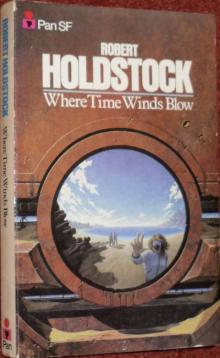
Where Time Winds Blow, page 5


“But they’re all in suits,” said Faulcon. “Rift suits—we call them r-suits. Have you had any practice in an r-suit yet?” He knew the answer of course.
“I tried one on,” said Kris. “Why?”
“Because a rift suit is a life-saver. And it takes a lot of practice to learn how to respond to what the suit does. Until you’ve practised you won’t be allowed within shouting distance of that wind channel down there. No one goes there naked. Not unless they’re stupid. You’re not stupid, are you Kris?”
Kris Dojaan’s only reply was a contemptuous—irritated—snigger; but he kept his eyes to the viewscope, and Faulcon noticed him frown. “No one goes there naked, eh? Well, what about him?” There was a moment’s silence. Faulcon sensed the sudden shock that struck Kris rigid. The boy said only, “It can’t be … it can’t be …”
“What the hell are you looking at?”
As Kris Dojaan drew away from the viewscope, Faulcon saw tears in his eyes, a frown of disbelief on his face. “It can’t be … not so old …” as if imploring.
Faulcon had tried to stop the machine cutting out as Kris’s pressure eased on the red button; he failed. He slipped his credit disc into the slot again and peered into the distance. After a second he noticed what Kris had seen, and he couldn’t restrain a laugh. “That’s nothing to be afraid of,” he said. “That’s our phantom.”
“I don’t understand.” Kris’s voice was quiet, worried.
“Our time phantom,” explained Faulcon. “Or at least, so it’s said. He’s wearing the remnants of a Steel City uniform, and he first appeared out there, by the valley … oh, I don’t know. Before my time. Ten years ago? You can’t get near him. Either he teleports, or there are hidden burrows that only he has discovered—or he vanishes into time … Nobody bothers him, and he doesn’t bother us.”
Even as he said the words, so Faulcon recognized the death of wonder in his statement. He felt a prickle of cold sweat as he glanced through the great windows at the wind-swept landscape, and the distant figure—indistinguishable from the waving vegetation in which he crouched—that was the phantom. Nobody bothers him, and he doesn’t bother us. The words seemed to mock him. A man who could travel through time itself! But he doesn’t bother us. Faulcon’s gentle laugh was impossible to read. We don’t understand him, and on VanderZande’s World that’s the same as losing interest! The coldness clawed at his stomach. He looked to Kris Dojaan, and might have said something about the sudden terror he felt, the sudden focus upon the process of dehumanization, but Kris was speaking, responding to Faulcon’s words of the second or so ago.
“He doesn’t bother you? That’s nice. Well let me tell you, Leo, he bothers me. And it’s a damned shame that he didn’t bother someone in Steel City, because he might have been saved a lot of agony.”
Puzzled, but aware that Kris was fantasizing about, or identifying with, the ancient relic of humanity that was crouched out by the deep valley, Faulcon focused again on the phantom, and reappraised the man. It was some weeks since he had last seen the apparition, and to be fair to Kris Dojaan, he had at first been excited at the thought of the man who had apparently conquered time.
The time phantom was an ancient, shrivelled figure; it was difficult to make out detail in the fading light, but he seemed to be staring straight at Faulcon as the viewscope peered down upon him, staring from shrunken eyes hidden in massive wrinkles of flesh and twisted facial muscle. His nose was squat, giving every appearance of having been crushed; it seemed to twitch as if he smelled Faulcon’s scrutiny, but this was almost certainly imagination. His hair was lank, long, grey as ash—though there were those who said the phantom had hair of a different, darker hue—and from this distance seemed filthy; it blew, in the breeze, straggling and unkempt. By way of breathing apparatus he seemed to wear a corrupted respirator that covered the lower part of his face, held in place only by the pressure of his lips.
Suddenly he had risen to his feet. Stooped with age he began to lope along the edge of the valley. Now Faulcon could see that he was tall and withered, his arms skeletally thin when glimpsed through the ragged fabric of his clothes. When he crouched again he seemed to fold up into himself.
His garments were the fading remnants of a body suit, the clothing worn beneath the bulky rift suit. He could see no identification tag, nor any insignia.
The man was an enigma, and, excited by Kris Dojaan’s freshness and the youngster’s interest in all he saw about him, Faulcon re-experienced the thrill of mystery about the phantom. He was a man who no longer talked, who no longer allowed any contact from his fellow human beings, but a man who had undoubtedly once been of the city. He had been snatched by time and flung somewhere, somewhen, some place and time where he had screamed and not-quite-died … a prison where the walls were centuries, where time itself was his gaoler.
And despite all that, he was a man who had come back!
Whether he had been lost from Faulcon’s time, or from a time several or many generations hence, it was impossible to know. The man said nothing, and always ran from company as it approached. He was to be seen only on occasion, and had the knack of vanishing into thin air. The belief that he was one of the timelost was based more or less on this fact of his sudden appearance and disappearance, but it was true that he might well have been able to teleport; on a handful of colonized worlds such latent talents were more sharply pronounced than on Earth.
Faulcon cared to believe that the time phantom was just that … a time traveller. He had been in Kriakta Rift a few weeks before when the man had last been seen by a crowd. All work had stopped, all eyes turned on the enigmatic, aged figure, as it had scurried along the base of the cliffs, darting between one piece of alien ruin and the next. There had been a slight breeze blowing, an ordinary wind, bearing with it no sign that it was concomitantly blowing through time. But abruptly the phantom had vanished, and the conviction was that a time squall had taken him. But a week later he had been sighted at the southern end of the valley … more than three weeks’ walk away!
Faulcon had found himself in considerable awe of the man, a man who could somehow ride the time winds, ride the whole of time itself.
Kris agitated for access to the viewscope, and Faulcon stood back, keeping his finger on the operating button. Kris, as he stared across the distance, was silent for a long time, although his breathing grew more pronounced and Faulcon saw that he had begun to sweat. All the while he fiddled with the star-shaped amulet, already developing Steel City superstition.
Quite suddenly Faulcon’s body turned cold; he felt chilled to the bone and began to shiver. He wrapped his arms around his body and frowned, shocked by the suddenness of the sensation, then increasingly apprehensive. He took a step back from Kris, his gaze shifting between the stooped youngster and the haze of distance and dusk that bordered Kriakta Rift. He knew what was happening, not by virtue of any experience, but by having heard so often from older inhabitants of Steel City that this sudden awareness was one of the most frightening tricks that VanderZande’s World could play.
Faulcon wanted to shout, but he kept determinedly quiet; he felt sick; his head was spinning, and cold panic began to drain the blood from his face. If Kris should have looked up at that moment he could not have failed to see the mask of shock that twisted his colleague’s face. He would have asked pertinent questions, and Faulcon knew that he would not have been able to hide the truth from the boy.
Kris continued to watch the phantom, unaware of the deepening sickness in the man behind him. He himself was still agitated, upset by what he could see, recognizing, or identifying something about the distant figure, and Faulcon wondered whether Kris was gradually coming to realize just why he was experiencing that feeling of familiarity.
Faulcon began to walk quietly away from his team mate. He felt the rigidity in his face, the expression of bitterness (Kris was so young, it was so unfair!) and the deeper shades of unease. There was no question in Faulcon’s mind, however, that those in Steel City who preached the strangeness of the world were right; there had always been those who held the view that within a few weeks of arriving on the world, certain senses expanded, certain sensitivities became more acute. It was said that you could tell the moment when a man’s destiny linked with time, the very instant at which fate decided a man was to be lost into Othertime, even though the event may have subsequently taken a year or fifty years to come about.
Kris Dojaan was a marked man, marked out by the world to be swept into the greedy maw of years. Faulcon heard hastening steps behind him, realized that the boy was hurrying to catch up with him. But he wanted distance. He felt very sick, and there was a sharp pain in the pit of his stomach: tension. To be on the same team as a man whose death you have discerned is a terrifying ordeal, for once the team is formed it is formed until the end. Where Faulcon went, outside the City, Kris would also go, and Lena too, and one day a breeze would come, and perhaps as it took Kris Dojaan away into time it would spare a gusting afterthought for the others of the team as well. There was comfort in the simple action of raising the leathery piece of skin, his amulet, to his lips, wishing away the evil gaze of Old Lady Wind.
He stopped, then, and turned to face his colleague, not surprised to see tears in Kris’s eyes. Not knowing what else to do he patted the youngster’s arm, then began to walk with him towards the lift. “You know, then. You’ve realized …”
In retrospect Faulcon realized how cruel those words might have been, because surely Kris Dojaan had not had time to hear about the acuteness with which humankind on Kamelios came to be aware of time, and all its tricks. His words had been as cold, as thoughtless, as fleeting as a sudden bitter breeze.
He nodded his agreement, miserable, yet somehow resigned, now, to his new knowledge. They dropped to the lower levels, and began the lengthy walk to where the Commander of Section 8 would be waiting for them. Kris said, “I should be at least grateful that I’ve seen him, even though he’s …” He broke off, shaking his head, perhaps shaking away tears. He slammed the amulet on his chest. “I was so sure I’d find him, and then I felt so elated—it never occurred to me that what I’d find would be … oh hell!” He laughed bitterly, then, and went on, “I came here in the desperate hope that I would find out what had happened to him. The letters we received were not very specific, but I think we all guessed what had happened. Someone had to come and find him again. I dreamed of him, one night, I could hear him talking to me, telling me to follow him to Kamelios. You can’t just sign on for a stay here, but I found a way of getting accepted quickly, and I came out.” He turned anxious eyes on Faulcon, who was by this time disturbed by the fact that he had misunderstood Kris’s distress. He was also apprehensive, for he was aware of the youngster’s fate when Kris Dojaan himself, it now seemed, was not. Kris said, “Leo, I must get out to the valley. He’s alive out there and I suppose that’s all that matters. I’m sure that’s him, and I’m sure he’ll recognize me. I must get out to the valley …” Faulcon saw him shiver, saw doubt touch his features. “And yet, I’m reluctant to. Deep down I don’t want to face him, not like that. But I must …”
“Who are we talking about?” asked Faulcon carefully. His own agitation was growing. “Your father?”
“My brother,” Kris said, as if surprised that Faulcon could have thought differently. “My elder brother, Mark. He vanished nearly a year ago.”
“Mark Dojaan,” Faulcon said, and he felt clear-headed and ice cold as the name sprang out at him from among the lists of the timelost. In his months on Kamelios over forty men had vanished into time; incautious behaviour, perhaps, or the unpredictable time squalls that were the bane of the Riftwatch Stations, and the men who staffed them, catching them unawares. Faulcon knew all those forty names, could have written them out when drunk. You never remembered the names of those who had disappeared before your arrival on Kamelios; but you never forgot the names of those who disappeared while you were there.
So Kris was now convinced that the time phantom, the wizened enigma out by the valley, was his lost brother Mark; and Faulcon thought he knew for sure that the phantom was Kris Dojaan himself, thus accounting for the boy’s sense of familiarity with the dimly seen figure. Both beliefs, both ideas, were unreasoned, unreasonable, unshakeable. Faulcon felt torn as to whether or not he should tell the youngster of his feelings, and whether he should tell him tactfully, or bluntly. One thing, he realized, was essential, and that was to take Kris out to the canyon as soon as he could, to let him get as close as possible to the man he believed to be his brother.
Another part of the strange lore of Steel City was that a man who is about to die at the whim of the time winds can always sense it, out there where the cliff walls dropped steeply to the alien lands below. He can stand there and hear the wind that will take him. When Kris Dojaan heard it he would know, of that Faulcon was sure. Kris was a man destined to be lost, and perhaps to be found again, found as an aged and withered creature whose movements and existence baffled and frustrated Steel City’s security.
Faulcon wanted to be with his colleague, and yet he was afraid to be near him. This was the terrible paradox of Steel City, and the time wind teams; the terrible irony of friendship on this strange world.
CHAPTER FOUR
Between and above the six domes of the traverse units, the central city core was a great bulbous construction, divided into twenty-four levels, each with an area of a quarter of a square mile. Each level was equipped with its own scattering of lounges, “open space” illusion, tight-packed living quarters, and less cramped administrative centres. Winding corridors linked extremes of each level, interlinked levels themselves, and connected the whole city mass with the traverse units, and with the utility sections in the wide stem of the central core. From most levels it was possible to look inwards and outwards across the vast, central plaza.
Steel City was crowded, often claustrophobically so; only 5 per cent of its population ever ventured out to the alien world with any real regularity. What had drawn them here, what kept them here, what motivated the fact of their contentment with VanderZande’s World was something Faulcon had only vaguely ever understood. And even though he sensed it might be important to understand the reason for this massive commitment of human energy to such an apparently worthless existence, he had long since lost that natural inquisitiveness that might have led him into deep, psychological waters.
This was not to say that everyone on Kamelios, or in the city, or out among the neocolonial towns, was kept here for no apparent reason. The communities were genuine long-term settlements, granted by Federation Charter, supplied by Federation ships, listed with the Galactic Health Organization, and granted full rights under Galactic Law. The same was not true of Steel City, which was officially a “military installation”, still part of the same Federation, but responsible to a different Earth-based Committee of Interstellar Affairs. And even in Steel City itself, among that aimless population of clerks and cooks, cleaners and doctors, musicians, writers and entertainers of every sort, maintenance engineers, troops and the rich élite who had spent a fortune to buy the boredom of the mobile city on VanderZande’s World, even here there were those who knew exactly why they stayed, whose whole lives depended on, and functioned because of, the quirks and mysteries of the planet beyond.
Commander Gulio Ensavlion was, among these few, the most manic, the most obsessed, the most fascinating.
As leader of Section 8, the exploration and monitoring section of which Faulcon was a member, Ensavlion lived, brooded and planned in a vast semi-circular office on level nine. One side of the room was a single, tinted window, overlooking the land between Steel City and Kriakta Rift. The curved wall seemed taken up not with gentle pictures, or soft, relaxing colours, but with maps, designs and charts: contour maps, detailed and precise, of practically every square mile of the main continents of the planet; satellite photographs of the world; meteorological charts of the wind flow, cyclone distribution, rain belts, earth-quake zones. Colourful, confusing, convincing, the man was surrounded by VanderZande’s World in so much detail that it was doubtful if he could ever finish the exploration of his walls, let alone the real world outside.
One map display above all dominated the room: a one to ten thousand aerial map of the rift valley, all two hundred winding, enigmatic miles of it, taking up yards-long rows across the middle of the wall. The map seemed blurred at first, until Faulcon realized that each display was in fact several views of the valley taken at different times, showing the effects of each of the really powerful time winds that had blown through it over the last few years. The regular geometric patterns that laced the valley were the ruins, the structures of other times and other beings. Of some of these Ensavlion had pictures and plans: the towering temple-like building that had popped into view almost two whole years before, only to be snatched away a month later; the cubes, and spires, the domes and twisting, unaesthetic structures, hollow and more often than not empty, sometimes filled with such meaningless garbage that might be found in any building—containers, vessels, objects of decorative nature, supporting structures and a plethora of incomprehensible, ostensibly functionless trivia. Ensavlion’s office was filled with such things, many in cases, some on open display. He even had models of a few of the more elaborate ruins in the valley.
As Faulcon led the way into the room, at last, summoned by the Commander, Kris Dojaan’s eyes lit up. There was something even more exciting about seeing such junk in Ensavlion’s office than in scrutinizing a carefully labelled display in the museum. It was as if the fact of its presence in the room of a Section Commander lent an aura of importance and mystery to the objects.
The door closed silently behind the two explorers. Faulcon relaxed, probably the effect of some ease-inducing chemical in the air, and smiled at Lena, across in Ensavlion’s small interview area, away from the enormous desk where he worked. She was stretched out in an easy chair, legs sprawled, hands behind her head. She looked bored, tired, and extremely irritable. She raised a hand and waved at Faulcon, but her face never changed its expression of total fatigue. No doubt Ensavlion had been questioning her with great enthusiasm. The hazards of leadership.