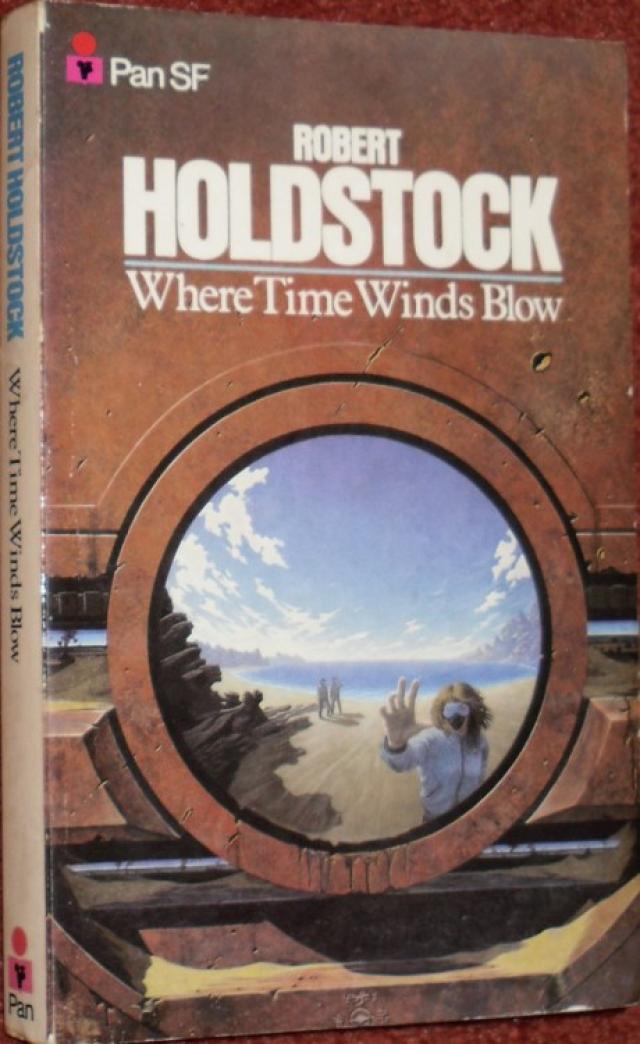
Where Time Winds Blow, page 4


CHAPTER THREE
Two hours after their return to base, Faulcon was comfortably attired, cleaned inside and out, and replete after an uncomfortably generous meal of charcoal-baked tongue and boiled vegetables. He sprawled in his small room for a while and considered the state of his existence. For a man of thirty-two, with—time winds permitting—more than sixty active years ahead of him, he had not done so badly. He owned this room, although it had cost him two K-years’ service pay to acquire it. The first year had passed: one to go; and of course every bonus he earned was his to keep, and he rarely went short of anything. Being, in this sense, freelance, with no regular income, was a spur to his activities in the field—it made him work all the harder. It galled him sometimes to meet explorers, traders, dieticians, administrators, any and all of the hundreds of functionaries on VanderZande’s World who had signed on for the same brief spell of service and who were already, after one or two years, regularly amassing small fortunes and would leave Kamelios rich. He himself would have nothing to sell save his room, and the value of that asset might have changed radically. His consolation was that on a world as insecure as Kamelios this nest of security, this huddling place that was unobserved, impenetrable, his and his alone, was at the moment of immense value to him, and not just in a financial sense.
He would marry Lena whether she liked it or not. One day, one year, they’d sort themselves out, and in the meantime they were two people with their own rooms in the belly of Steel City, who shared a lot of fun, a considerable amount of love, and who were both as blank about the future as each other. Except for the desire to live together eventually they looked forward to nothing beyond the excitement, and risk, of VanderZande’s World. Lena had lost her awe of the place, and Faulcon was well aware that he himself was changing, becoming jaded. Lena had bought her room outright, with money left to her by her parents, both of whom had died in a fire on New Triton, a world they had come to from Earth when Lena had still been in her infancy. So perhaps it was the fact that he was working for his special possession, his forty feet square of apartment, that kept his regard for Kamelios somewhere in between the extremes of feeling represented by Lena and Kris Dojaan. Unquestionably he experienced the same lack of concern, the same indifference to the scattering of alien artifacts that had been dredged up by the time winds that Lena and all the long-termers on the planet had come to feel; but equally he had found himself sharing in Kris’s excitement, his eager concern with the wonders of other times. Faulcon was the bridge between attitudes in the team, fluctuating between those extremes according to whose company he found himself sharing. Like Kamelios itself, like all who lived in Steel City, Faulcon was a unit of change, an unfixed star, someone whose emotions could twist about in an instant for reasons other than the effect of the world upon him.
Despite the pleasurable anticipation of a small wallet containing his bonus—perhaps two or three thousand chits, the Kamelion unit of credit, on good, old-fashioned plastic notes—Faulcon decided he could not face Commander Gulio Ensavlion just yet. By rights, and by tradition, he should have gone straight to the section head to report on the expedition, and to answer questions. In practice there was always an hour or so delay before such debriefings, but Faulcon would have preferred to keep Ensavlion and his bizarre obsessions at bay for a whole night-day cycle. He called through to Lena but received no reply; checking with administration, he found that she had been summoned peremptorily to Ensavlion’s office, and had been with the Commander for nearly an hour. As team leader it was not surprising that she had been called alone in the first instance, but it did mean that there was more to the mission than would at first seem obvious. It was not routine, Faulcon imagined, but he could not think what could have been so different about it that the leader should be summoned on her own. Surely not the discovery of just another derelict? Unless the damage that Kris had caused to the interior had got her into trouble, but that was most unlikely.
Suspecting that he might himself be summoned imminently, and still unwilling to face Ensavlion, Faulcon called the dormitory where Kris was billeted. The youngster also was unobtainable, but one of his room mates suggested that he might have gone up the Riftwatch Tower, to get the view from those wind-shaken heights before dusk settled.
So Faulcon left his room and made his way along the level until he came to the main plaza. Here there were colourful, spacious lounges, comfortable and quiet save for a distant susurration—the air conditioning—and the occasional drift of attractive, alien music. Voices were muted, though attention could be drawn across a distance by the careful use of speakers built into the ivory and jade columns; purely decorative structures, with no supporting function at all, the columns rose from the plush flooring into the hazy distance of the roof space, and served to give a sense of territory to the area. The lounges were crowded, and in one corner, muted behind a translucent screen, a celebratory party was occurring, with dancing and not a little drunkenness. Moving rapidly about, and giving to the plaza a certain sense of panic, were teams of repair men, and engineers, and a few medical personnel, hastening from damage point to damage point in order to seal and secure the city before the next Kamelion night.
Faulcon navigated this confusion, and resigned himself to the unpleasant sensation of the lift-chute in the plaza’s centre, that whisked him from stable ground to a point five hundred feet above the lounge area on what appeared to be no more than a whim of warm air. But abruptly he was on a solid surface again, and stepping into the swaying platform that was the observation zone of valley and surrounding lands. A circular area that could support five hundred persons, it was now relatively empty, despite the city’s change of location. Its motion had stopped and Faulcon walked around its inner path, away from the jutting windows; he was uncomfortable in the sun’s glare, despite the fact that no harmful rays, nor distracting light, could reach him; but he had spent several days beneath the blinding disc—very unred in its passage across the heavens, and showing its age only at dawn and dusk—and he preferred to remain out of sight of that warming sphere unless it was absolutely necessary.
He spotted Kris Dojaan, and hastened towards him.
Kris was now robed casually in a short red tunic and thigh-hugging half-jeans. His feet were bare, and his hair was tied back in several elaborate ringlets, a fashion that Faulcon himself adopted. He was leaning against the restraining bars that kept observers from the thick, faintly tinted windows. His eyes were narrowed as he peered, without the aid of any of the several telescopes, at the distant valley.
As Faulcon came up beside him, the youngster turned and nodded acknowledgement, almost as if he had been aware of Faulcon for several minutes. Faulcon noticed the alien shard, now slung on a thin, leather necklet. Again he felt disturbed at the sight of the amulet, its regularity, its manifest deliberateness. Kris touched the tiny star and smiled, never taking his gaze from Faulcon’s face. For a fleeting moment Faulcon had the sensation of being in the presence of a mischievous child. Kris had said that the object had been lying just inside the passageway exposed by his thoughtless discharge. He had seen it, grabbed it, become filled with a senseless panic, and had run down to the ocean, dropping to his knees and shaking for several minutes. Only Faulcon’s arrival, searching for him, had calmed him down. But having taken the relic, nothing would make him give it back.
Now he fingered the object almost reverently. “It’s warm,” he said. “Here. Feel. It has some sort of inner warming mechanism.”
As he held the amulet towards Faulcon, Faulcon found himself almost reluctant to touch it. But touch it he did, and he felt a thrill of fear, a shiver of apprehension, as his fingers communicated the information to his brain that the amulet was ice cold to the touch; ice cold.
After hesitating a moment, he closed his mind to the insistent voice that told him to say nothing, and informed Kris of the sensory contradiction.
“Cold?” Kris, who had seemed vaguely amused, now was puzzled for a second, stroking the star and staring at Faulcon as if it was taking some time for him to decipher the brief words. Then he looked away, out across the evening-lit surface of Kamelios. “I suppose that’s not surprising. You’re already cold towards this place. You’re as cold as Lena, like all of this city. Something like this, like this piece of history, well …” he struggled for words to express what was subsequently revealed as a garbled thought. “I’m sure that things like this star respond to emotional warmth. To a sort of feeling of wonder, a feeling of respect and love for this world as it once was. Maybe Lena is right and I’ll lose it, but if this jewel is warm, I guess that means for the moment the world is on my side. Does that make sense, Leo?”
Faulcon laughed, a gesture not without humour, but with an edge of considerable regret. He bit his lip before answering, framing words carefully. “It makes as much sense as anything on this planet. But you’re wrong to say I’ve lost my respect for the place. It gets covered up at times, but with you around …”
Kris grinned, and in his face and manner there was a disquieting hint of patronage as he prompted, “With me around …?”
“It brings it all back,” Faulcon concluded. “The sense of the ancient. The sense of the alien. The sense of excitement.”
“Touch the pendant,” said Kris encouragingly. Faulcon shook his head—a gesture of resignation—as he reached out and laid two fingers on the ice-cold crystal. Perhaps there was just a hint of warmth there.
Instantly afterwards Faulcon learned the reason for the relative desertion of this highly popular viewing platform: one of the traverse units was about to detach itself from the mother city, and the Riftwatch Tower would be withdrawn. The announcement had already been made and those who remained obstinately on the high level were now chased to the lift-chutes by several irritable security men. Faulcon hustled along with the small crowd, and when they were back at level four he dragged Kris by the arm and led him towards the museum.
Here, presented in something akin to organized chaos, was a cross-section of everything of interest that the time winds had dredged up on VanderZande’s World, from the smallest “toy”, a wheeled object that had perhaps been the model of some land transport carrier, to the largest coffin-shaped enigma, four hundred feet long, still sealed along all edges, and according to every sensory probe used against it, filled with nothing but an assortment of small, differently shaped boxes, all lying free. Function, like the function of nearly everything in the museum: unknown.
Kris Dojaan’s amazement at many of the things he saw, in particular some of the human-looking artifacts, his almost boyish energy, had a dramatic effect on Faulcon, charging something within him until he not only recalled the near-hysteria that had accompanied his first tour of this junk yard, but actually relived it. He led Kris through the galleries, round the cases, up to and away from the reconstructions of the planetary surface, as far as they had been elucidated by the enormous teams of geologists and topographists; and eventually, almost breathless, they arrived in the biology section.
In silence, reverent, awed, they peered at the main exhibit, the preserved carcasses of two carapaced, winged creatures that had lived upon this world perhaps fifty million years before, or which might yet be born to occupy it at some age long after Steel City had vanished into desert dust. Dredged through time these two unintelligent (it was believed) creatures had died quickly in the awful air of Kamelios. The rift team had lost two men to a following squall as their duty members had dragged the twisted corpses out of the deep valley.
Still staring at the largest of the two creature’s enormous, dulled eyes, Kris said, “And they don’t know where they came from?”
Faulcon shook his head. He was trying to imagine these beings in full flight above the rich, forested lands of primeval Kamelios. They looked heavy, the carapace being thick, and armoured, all wings and the long-necked head protruding from beneath it. It would have been difficult to make exaggerated flying motions—the drawings in the next display demonstrated that—but gliding was the most likely main motion of the beasts.
“The trouble is, you can’t date things that are swept through time as new. The only way you can get an idea where they came from, or rather when they came from, is by looking at what gets dredged through with them. Bits of rock, perhaps whole rock scarpments, dust, things like that. The geological history of this planet has been reasonably worked out, and you can sometimes match a time-torn rock with a dated and recognizable rock formation close by. Again, the trouble is that the rift valley itself is such a mess, such a mixture of different ages, that any sort of dating work is just guesswork.”
There were other creatures labelled as “extinct”; they were mostly small, insignificant-looking things, conforming basically to a “spring-limb” structure, with several scrabbling and holding limbs, often much modified, for example into the carapace of the winged creatures. And there were displays of the existing life of Kamelios, animals that had been named in the early days of the colony: skarl, snake-hare, easiwhit, olgoi, and the gigantic gulgaroth, shown only in holographs, and frightening even so. There was too much information on life-style and symbiotic relationships—the strange olgoi-gulgaroth sexual relationship especially—for Kris, restlessly fascinated, to stay long at any one display.
Ultimately he was disappointed in the display of the ancient, extinct (or successional, as yet unevolved) life of the world. What was missing, of course, was any life-form manifestly intelligent … Where the hell? …Nothing? “No thinking creatures at all?”
They walked back to the tower, now that the traverse unit had departed. “There obviously were intelligent creatures here … over a span of thousands of years almost certainly.”
“Obviously,” Kris repeated irritably. “What I meant was, where are they? Surely somewhere, something got caught by a time wind.”
They had reached the chute and made the stomach-churning ascent to the top of the tower. “You’d certainly think so, but no one has ever found such a creature.”
“Or seen? No sightings?”
Faulcon smiled and glanced at the youth. “That’s a matter of debate. There have always been sightings, claims that are never backed up with hard evidence. Everybody would like to see an intelligent alien, and it’s just too easy for the mind to fill in the missing image. Everything’s been seen over the last few years, from God to giant squids; and some things that aren’t quite as amusing as that.” Faulcon ceased to talk, unwilling to volunteer what he knew without further prompting. He always hated to talk about the pyramid, and the sighting of a year ago. Why his mouth should go dry, why Ensavlion’s unwillingness to drop the subject should upset him so much, he often found difficult to answer.
Kris, ever inquisitive, said, “Have you ever seen anything?”
Faulcon smiled and shook his head. “I’ve seen it all, Kris. And in a year, so will you. I see things in my dreams that ought to drive me insane. And there are some who say that every waking hour on Kamelios is a dream.”
“So you’ve never seen a real, live, indisputable alien?”
Faulcon couldn’t help laughing at Kris Dojaan’s eagerness. “Only one man on Kamelios persistently claims that privilege; usually the certainty of the sighting fades with time, but this one man …”
“Tell me about it.”
“I think not. I’ll let the man himself tell you. It’s more fun coming from him.”
Kris sensed Faulcon’s meaning instantly and looked suitably impressed. “Commander Ensavlion, you mean. That makes it tough, though. I mean, what I’ve heard about him isn’t exactly flattering. Some call him mad, others deluded.”
“A bit of both,” agreed Faulcon as they walked to the edge of the platform, facing the darkening Kriakta Rift. “And it’s the sighting that turned him. But as I say, he’ll fill you in on the details, I’m sure. He’s always glad of a new boy to talk to.”
The plump man who had been using the telescope nearest to Faulcon suddenly swung the instrument round on its housing and walked away from the viewing platform. Faulcon moved swiftly into possession, and slipped a coding disc into the slot, pressing down on a small red button on the body of the binocular magnifiers. “As long as you like,” he explained to Kris, “but if you take your finger off the button you have to pay again. Yes, I know … it’s like something out of an old film.” Kris was looking vaguely horrified at such a primitive viewing system. “Everything on Kamelios is old-fashioned and clumsy. You’ll find that out soon enough.”
Before allowing Kris access, however, Faulcon himself took a slow and steady look at the distant valley, sweeping the field of view from the small, squat Riftwatch Station at the head of the gorge, right along to the distant gleam of some spiral structure which, rising a few yards above the edge of the cliffs, marked Rigellan Corner, where the valley curved round to the south.
As he peered across the mile or so to the rift, so Kris followed his gaze, squinting against the distance and the growing darkness. He said, “Why wouldn’t they let me trip out to the rift? It was the first place I wanted to see …”
By way of an answer Faulcon swung the viewscope and focused on a jagged rise of purple rock and scree which seemed almost incompatible with the surrounding dun-coloured landscape. “Take a look,” he said, and when Kris had looked, and was still staring through the binoculars in some confusion, Faulcon said, “That was once a Riftwatch Station … You can still see part of it. Between one windy gust and the next it had gone; that small crag, the result of some future movement of the planetary crust cracking the valley wide open, and then being eroded down … That lump of rock is all that remained. To go to valley’s edge is to invite a wind to snatch you away.”
Kris pointed out the hundreds of dark shapes moving darkly along the top of the valley, some of them quite obviously dropping over the cliffs and into the hidden deeps beyond.