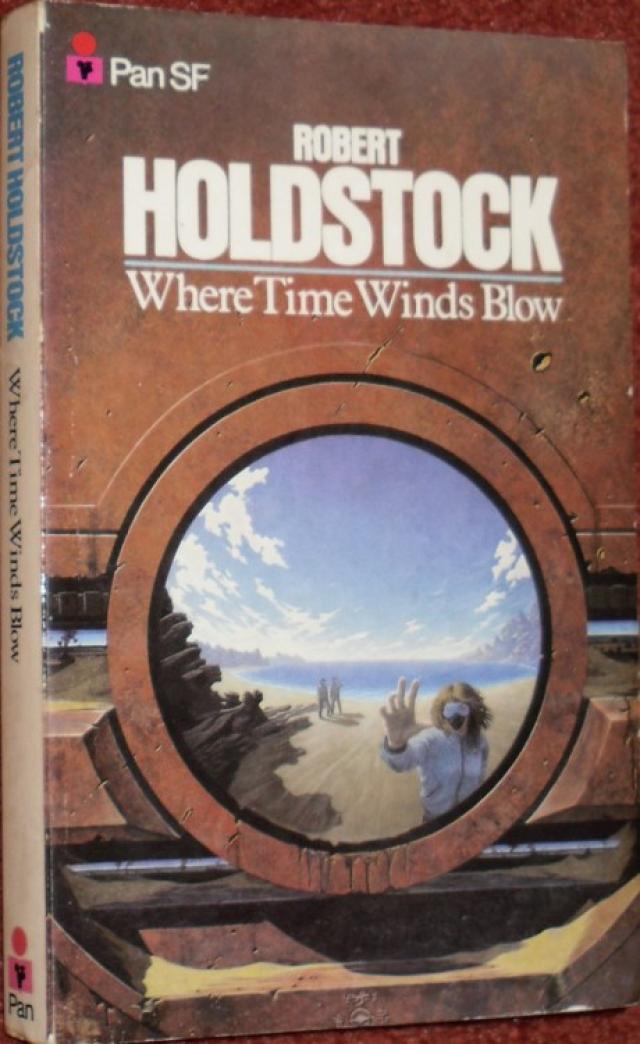
Where Time Winds Blow, page 20


Faulcon could only assume that as the phantom rose to its feet it met the eyes of the woman who raced towards it, and in that terrible instant of recognition the shock, the surge of confusion and of comprehension that passed through Lena must have stopped the motion of the suit. Faulcon was half a mile beyond her as he strained to see backwards and saw her sprawling on the rocky ground, the time winds swirling around her and taking her in the gusting of a sudden breath.
Abruptly Faulcon’s suit was veering to the right even more, running diagonally across the approaching wave-front of the wind. He reached the canyon wall and rose up, his body twisted and jarred by each rocket-powered ascent and every clumsy impact on ledge, or outcrop, or less hostile slope. Screaming for speed, helpless, fearing that he would not make the canyon’s rim, he was stumbling across the lip of the valley before he knew it, tumbling end over end, being braced and grasped by helping hands. The time winds swept past in the canyon, darkness overtaking him, thunder, lightning, and the screeching of wind turning the safelands into a nightmare of their own.
It was gone then, and there was quiet, and the darkness lifted as it sped away to the east. Faulcon lay in his suit, on his back, for a long, long time, staring up at the afternoon sky, waiting for the shaking to begin and the tears and the shock. Somewhere he was sure he could hear the phantom laughing, her voice so horribly familiar to the man who imagined it.
PART THREE
Manchanged
CHAPTER FOURTEEN
He realized that he had never known true loneliness. He experienced, now, an aloneness, a discontinuity, that physically hurt him until he cried, or vomited, or dulled his senses with alcohol and drugs. There had been many times in his life when he had categorized the particular feelings of frustration and solitariness that he had been experiencing as “loneliness”; now he accepted that he had merely been in transit from one moment of aliveness to the next, and that what he had been feeling was impatience. Loneliness had never truly entered his life before, and now he found that he could not confront it, only succumb to it; the loneliness washed through him like the change winds, poked icy, mocking fingers into every nook of his body, shouted to him through the echoing void inside his skull. He was alone, totally alone. There were people around him, but they were not with him; there were two Universes of sensation that overlapped, theirs and his, but there was no communication. He was a Galaxy away, literally a Universe apart. When they smiled at him, those ghostly participants in Kamelios life, the smile was not for him, for he was no longer the body that people saw. He was carried by it, but he was not a part of it. He was alone even from himself.
For five days he haunted the corridors and plazas of Steel City, drifted through bars and lounges, and finally curled up in his silent quarters. After a while he became aware of the feelings of hostility being directed towards him. Abruptly he realized that the early expression of sympathy, in regard to his personal losses, had somehow transformed to an expression of anger that he was still not lost alongside of them. The rituals of Steel City came back to him with startling clarity, filling him with the coldness and bitterness of fear. He recognized that his presence was not only resented, but his death was rapidly required. Fear and loneliness combined to empty his mind of everything but panic, and on the sixth morning, at the break of dawn, he left the city; afraid for his life, he was pursued every step of the way by the silent guardians of Steel City ritual, the angry few who remained unseen as they followed him, but whose presence he could discern quite clearly. They hesitated round corridors, hid among machinery, and hovered among the limp suits in the suiting and shedding lounge. He signed out his byke, rather than his r-suit, and rode out into the gusting dawn wind. The moment he was out of easy eye-shot of the city, he turned away from the rift.
He rode up into the wide lands to the south, through the limestone and chalk drifts, then travelling beyond the sprawling forests to Hunderag Country. In the foothills of the Jaraquath mountains he came to a high plateau where a large and thriving settlement of manchanged had long been established. The journey took five days and he did not eat in all that time. His only drink had been mouthfuls of warm water from a flask. Hunger had been an insistent pain every ten hours for the first two days; now he was aware only that he ought to eat to sustain his strength. The only hurt was the hurt of his loss.
So he approached the settlement, his byke making low noises as he crawled between fences and areas of cultivation, wondering where he should stop, and for how long. In the distance he could see the clustered buildings, white upon white, rarely more than two storeys high. The houses were huddled together about a wide compound as if they were insecure, unsure of themselves, and had not yet found the courage to spread outwards a little, to find their own space. He could see people working in the fields of green and purple crops, and as he rode past they glanced up, but quickly turned back to their work.
He was always discomfited by the appearance of these fourth and fifth generation inhabitants of the high plateaux, their bulging eyes shining unnaturally, their arms ridged where the purifiers beneath their skin showed through the lean flesh of their arms. They had not yet achieved full independence of technology; Kamelios was still a strange land to them, but slowly they evolved in the modern way, and soon men would walk about this hostile place and be able to say that they truly belonged here.
Faulcon stopped his slow ride some hundred yards from the township. He had not yet seen the only manchanged he knew. He dismounted and walked through the buildings into the compound, aware that he was watched from windows, conscious that he was causing something of a stir. Few rift-folk ever came this high up into the mountains, and Faulcon knew that he was not welcome. And yet he was abruptly surprised as a slim, dark-haired young woman walked from a barn-like building, through the doorless exit and into the compound, waving to him as she came, and smiling. Behind her appeared a tall, muscular looking man, his hair turning white, his skin weather-beaten and leathery. Behind his mask, Faulcon smiled as best he could.
In this way, grateful for the persistence of the human faculty for friendship, despite the adjustments to the alien, Leo Faulcon made the proper acquaintance of Audwyn, and his young wife Allissia.
“I wasn’t sure if it was even the right plateau,” he said, nervous and uneasy. “I need food, that’s all. Just something to eat, and a little rest, and then I can be on my way.”
“You’ll stay until you go,” said Audwyn with a smile, leading Faulcon into a small, claustrophobic house, two-roomed, with a table, bed and cooking area, and precious little else; the toilet was outside.
“Well, that’s very kind of you,” said Faulcon. “If you’re sure …”
“Try doing otherwise,” said Audwyn with a chuckle, and waved Faulcon to a stool at the table. “It seems to me you rifters believe everything you hear about the ‘manks’… That’s what we’re called, isn’t it?”
“I assure you that it is,” said Faulcon, leaning on the table and watching as Allissia began to cut thick slices of grey meat from an unappetizing-looking joint. Audwyn himself drew drinks from a wooden barrel, three clay mugs of a green liquid that smelled sweet and tasted sweeter. With the steaks taking care of themselves, Allissia sat down. Faulcon was less relaxed with her than with her husband, and he knew this was because she was a lovely-looking girl below and above the enormous, sheathed eyes. But as he regarded her he noticed the flexing of her nose and the glisten of hard, yellow substance, the poisons and dusts of Kamelios that were gathering within the cavity. During the next few hours he grew quite accustomed to the way she and her husband would turn to the left and delicately eject the hardened, colourful mucus onto the floor.
Before they ate, Faulcon fetched his gear from the byke, and pushed the machine into shelter. He approached the task of eating with some apprehension, since the mask was not an efficient filter when it was being used in this way. He ate very little, and felt queasy even as he was finishing; but his digestive system was able to cope with the native meat, and two mugs of the sweet, alcoholic drink helped enormously. He was amused, as he ate, to notice the flickering of light in the room that told of the surreptitious staring-in of the locals. Whenever he looked up they had vanished, but he felt their watching eyes and minds.
After the meal Allissia watched him sympathetically, assuring him that if his stomach rejected the food she could find vegetables that might be less poisonous. Faulcon thanked her, but declined, and after a horrifyingly sweaty and cold few minutes the nausea passed away and he relaxed, replete, and grateful for the dizzying effect of the drink.
“Why aren’t you working?” he asked Audwyn, and was told, “We are. We were settling calcas, a fleshy root crop we grow up here. Settling means we were burying it in worm-soil. In a few weeks the worms will have processed the roots into a more digestible and solid cake which we then use both as a winter staple for ourselves and our animals—we even have a few adapted terrestrial animals, pigs, horses—and also for making the brew that you appear to be enjoying.” Faulcon smiled as he leaned back in the only straight-backed chair in the house; he raised the mug appreciatively to his lips and felt a shock of revulsion as he saw the bloated shape of a small worm floating close to the bottom. Flavouring, Audwyn said, apparently innocent of the appalling effect such detritus could have on off-worlders. Faulcon carefully picked the offending corpse out of his mug.
“Now that you’ve come we’re still working, being hospitable. Only when the fields need furrying—that’s clearing them of parasites—do we have to be out all day. How about you? What brings a rifter so far from his metal womb?”
Faulcon wondered quickly what he should say, how much he should say. When the silence had begun to embarrass him he murmured, “A friend of mine died. I had to get away from Steel City, get out of myself for a while.”
As he spoke he was not unconscious of the almost amused glance that was exchanged between his hosts. Whatever it was they shared they didn’t share it with him, and he wrote it off as part of the strange behaviour of these mountain farmers. Only later did he discover what had tickled them; he was introduced to a younger man, a cousin of Allissia’s, when he was on his way out to the fields to participate. “This is Leo Faulcon,” said Audwyn as Faulcon and the youth shook hands. “Mister Faulcon is only partly here, some of him is still down by the valley. There’s enough of him to work, though, so show him how to furry-up pulp-scab, and perhaps root-up as well.”
Faulcon enjoyed the work he undertook for the next two days. It was hard, and the pulp-scab parasites that crawled through the crops were small and elusive. There weren’t many of them, but they were highly destructive to the maturing crops. Faulcon came to understand how delicate and dangerous was the balance up here between success and starvation.
The work enabled him to shed his tears inside, and in silence. He fought against crying out loud, but too often for his liking he gave in to emotion, feeling ashamed and embarrassed as he realized his weeping had been heard by others around him. He noticed, however, that they took no notice, and made no sympathetic gestures. Occasionally he would stand, leaning on the wooden-handled furrying tool, and stare across the plateau to where the lands to the north were green and grey, rolling and rising from hill to mountain, the valley forming a recognizable network back towards the crop-lands around the canyon where time was master. As he stared at those distant, natural sights, he saw Lena; over and over again he saw her, walking towards him, or sitting quietly and moodily, trying to shake off the effects of a fiersig. He missed her with all the pain in his body, and all the reaction of the nerves in his torso, and all the coldness that his spirit could muster. He worked hard and furious, letting anger rule him, enjoying that anger, and shouting at the parasites that wriggled in his grasp as he squashed them between thumb and forefinger, letting their sticky juices spread their stink across his flesh.
Each night, as he shuffled around in the blanket roll that Allissia had provided for him, he spoke through the open door between the two rooms to his hosts, themselves quite comfortable and unbothered as they lay or loved in their own bed. “I’d better not impose another night. I’d better leave.”
Audwyn said, on each occasion, “You’re welcome to stay until you leave, Leo. One thing’s for sure, there’s not a chance in a million that you’ll still be here after you’ve left.”
On the third day he cut his hand very badly, and walked up to the village to find Allissia. As he made his way between the houses he was again uncomfortable, the stranger in this tight and unfriendly little community. He had met only a handful of people and they had been friendly and communicative, but he sensed their distance, their unwillingness to commit themselves to him; they were friendly because that was the way to be. But they watched him, and wondered about him, and many of them resented his intrusion here. He knew he would have to leave soon, because he knew he was upsetting the delicate balance of life in the community.
He found Allissia in the small forge, working on a complex-looking tool whose spirally curved blade had sheared in two. The forge was hot, the brazier of organic rock glowing bluely as she operated a small bellows with her foot; she was hammering the metal blade with remarkable proficiency, and Faulcon stood and watched her work until the thin line of the join had vanished and she seemed reasonably satisfied with the job. “It’ll do for now,” she said, smiling at Faulcon. She noticed the blood on his hand and said, “You’ve been using your fingers and not the furrier.”
“That’s right,” he said. “You have some vicious stones in your soil up here.”
“They’re sun-dew crystals, and they’re quite rare in the fields. Show me where you were working, later, and we’ll dig the thing up and send it back to the City with you.”
He followed Allissia into the small house and found Audwyn hard at work riveting a large, skagbark barrel. He was unsympathetic towards Faulcon’s wound, but Allissia smiled at him as she cleaned the gash and bound it with a dark, rather pungent linen. “Have a drink before you go back out,” said Audwyn, banging the last rivet into place and reaching for the mugs.
Faulcon said, “You’ll have to give me another job. I’ll have to rest this hand for a while.” He sat down at the table.
Audwyn smiled as he splashed the sweet drink, which they called calcare, into the earthenware mugs. “Defeated by a shard of crystal, Leo? It amazes me that with an attitude to life like that, you could have reached the age you have. I’m surprised you didn’t succumb to the first discomfort that ever got the better of you.”
Faulcon was grateful for the warming glow of the drink; the plateau was cold and exposed. As he savoured the drink, alert for worms, he said, “I couldn’t operate the furrier if I wanted; my hand won’t grip at the moment.”
Audwyn laughed and shook his head. “You rifters …”
“I’m an off-worlder.”
“That’s even worse!’ Don’t you know that you can do anything if you really want to? Don’t you know, didn’t anyone ever tell you, that a man is bigger and more magnificent than a piece of dirt? I guess they didn’t, eh Leo? Pain, discomfort, irritating circumstances, they’re all bigger than you, aren’t they?”
Unwilling to provoke an argument, despite the throbbing pain in his hand, Faulcon said, “I can certainly try and hold the furrier …”
“I don’t want you trying to do anything, Leo. If I try and talk to you I don’t talk to you. If you try and hold the tool you don’t hold it. If you hold the tool you hold it. I don’t mind you doing that. I don’t mind you doing what you’re doing, but it seems pretty pointless to try and do something that you’re not doing if all that’s going to happen is that you’re going to go on not doing it.”
“Give me another drink,” said Faulcon dully, and watched, frowning, as his mug was filled. His hand hurt like hell, and he was feeling silently angry at what seemed to him to be an unforgivable carelessness on Audwyn’s part. “Are you saying that you’d go out and work again with a four-inch gash across the palm of your hand that is stopping your hand clenching, and causing you considerable agony, and stopping you being efficient?”
“Well, why not? If I trip over I don’t lie there saying, ‘I’ve been overwhelmed by Mother Earth who has thrown me down, so I’ll just lie here for the rest of my life and acknowledge that I’m insignificant against the huge presence of circumstance.’ I don’t do that, Leo.”
“I hardly do that myself, but—”
“You’ve been doing that all your life, Leo! The hell you haven’t. You’ve been totally content when you were happy and totally discontent when you were miserable; you’ve evaluated the moments of your life into good and bad, and you, and the billions like you, have never comprehended that there are no good and bad moments, only moments when you’re alive, moments when you’re experiencing life, being with life, no matter whether you’re in pain, or pleasure, or depression, or solitariness. It’s extremely easy, as you will no doubt be the first to acknowledge, to be happy when you’re happy; but it’s so damned hard to be depressed when you’re depressed—you’ve always got to fight it, right? You’ve always got to treat depression as something to be got rid of, to be resisted, when in fact it is a commonly known truism that nobody is ever not depressed when they’re depressed. Nobody ever has a pain in the hand when they don’t have a pain in the hand. The point is, are you bigger than that pain; are you prepared to shrug your shoulders and say, so I’ve got this throbbing, hurtful, agonizing pain in my hand, so what? You see, Leo, that’s the way we lead our lives up here, and we find it works rather well. We do things, we don’t let things do us; we get hungry, but we don’t let hunger get us. I can tell you with absolute certainty, Leo, that there’s not a man, woman or child on this plateau who isn’t hungry when he’s hungry. The difference between us and you, Leo, is that here on the plateau hunger is a part of our experience, part of the life we lead, part of living; to you it’s an ache that has to be satisfied in order to make it go away. Hunger gets you every time you get hungry … it distracts you, it nags you. Up here, when we get hungry we get hungry, and later on when we eat we eat, and when we sleep we sleep. Do you follow me, Leo?”