Where Time Winds Blow, page 10
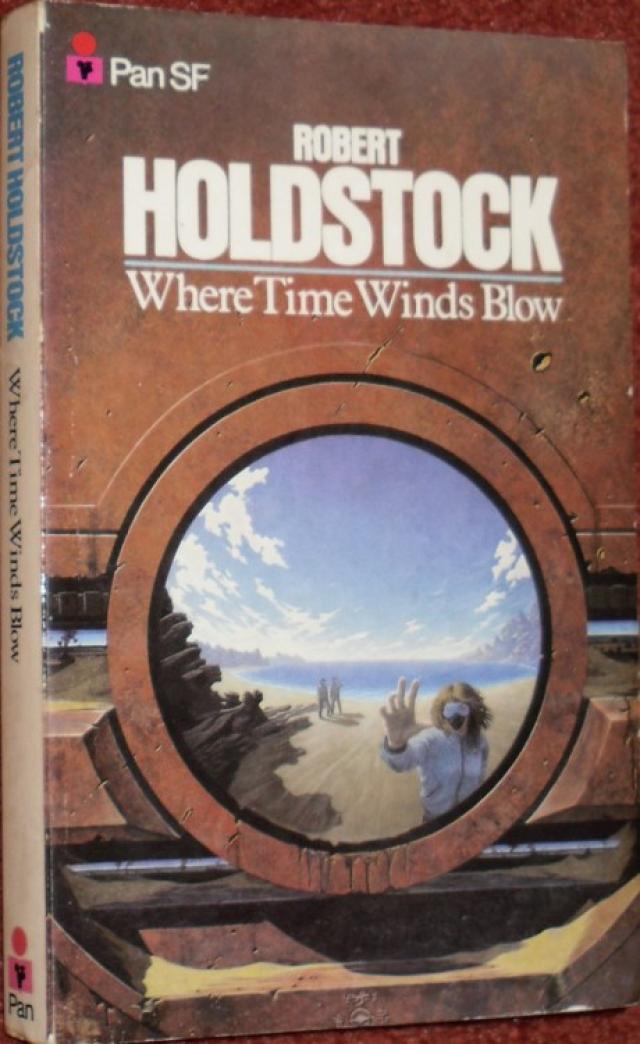


The suits were not just bulky, they were immense. Even a largely built man seemed no more than a stick insect within the voluminous confines of the machine, his arms padded and cushioned in the severally-jointed upper limbs, his body supported naturally and comfortably within the body space, surrounded by tubes, the ridged coverings of crystalline power transmuters, the brightly marked “organs”, each the dispenser of some survival ingredient. Inside the suit it was soon easy to forget that you were riding a structure half again as high as your own body, with five times your body’s volume; your legs dangled free and comfortable into the cavernous thigh of the suit—the “idea” of walking was enhanced by the slight pedal pressure available if a normal walking action was undertaken. The silent, swift response of the suit, walking as you wished it to, belied the power available to it if escape action was needed: at two hundred miles an hour it gripped you somewhat more firmly, pulled your legs up to your chest, free of the limbs which now moved like pistons, almost blurringly fast, taking the body away from danger as an athlete sprinting for the finish line.
On the first day, after completing their mission reports, they introduced Kris to his personal r-suit, sealed him in, and let him experience the frightening disorientation, and uncoordination, of a machine that was overwhelmed by his conflicting conscious orders. They were in the special environment, in one of the low levels of traverse unit Pearl. Kris’s preliminary running-falling-turning-tripping activity was hilariously funny to watch, although Kris himself was less amused. Nevertheless, that first training session helped to lighten the moodiness that was still residual from the passage of the fiersig, the night before. Kris had been violently affected by it, he said, and had thought he was going out of his mind. Perhaps that accounted for his tiredness, Faulcon thought, and reassured him.
Within a day, after that shaky start, Kris was making good progress, at ease with the suit, and with the irritating skull contacts that always pressed harder than expected, and which could become a source of intense itching, or aching, or other psychological manifestation of newness and new awareness.
On the second day, again ignoring Kris’s protests and claims that he was ready and able to go out at least near to the rift, they took him on a south run, through the hills and stumpy forests of Tokranda County, and along the wide, stone roadways that linked the townships. Immediately on passing out of the protective walls of Steel City Faulcon felt his unease at being close to Kris Dojaan surface again, the awful fear of time’s grasp that can infect men close to one whose fate has been ordained. But as they put distance between the rift and themselves, the concern fell away, itself outdistanced, perhaps.
Kris had little time, as they ran, to observe the sprawling areas of wood and brick houses, smoke rising from primitive chimney stacks, animals and men practically indistinguishable against the muddy backgrounds of their communities; even their clothes, skin and farmhouses seemed stitched into the visual fabric of Kamelios. The towns were often this primitive, although they drew much in the way of luxury and services from the Federation installations around them, in particular Steel City itself.
The people who lived here maintained close links with their home-worlds, and the governing and economic bodies that had, in part, financed their colonization. The simple use of primitive building materials was as much due to the smallness of those financial contributions as to the widely felt principle that it was important to build using the world and its resources, and not depend from the outset upon the imported materials that could make an air-tight, heat-tight living unit. It was true, also, that most external finance was channelled into medical supplies, for while the hundreds of tiny communities in each county could support themselves from their hunting and farmlands, they were unable to produce that natural resistance to disease organisms and pollen that the manchanged (whom they loathed) could achieve. These lowland communities had opted for the middle ground, a toughing-it-out type of colonization, more integrated with Kamelios than the “instals” of Steel City and its associated supply and watch stations, but not prepared to undertake the violent, and grotesque, bio-adaptive processes of the manchanged, whose territories were well away to the south.
The lowland farmers wore breathing and eating masks against the organic ravages of the world, but within their houses they took advantage of technology to maintain a tolerably low organic level, and by generations, and agony, would come to terms with the environment.
The mountain road through Tokranda County meandered through the settlements, then turned to run, no more than a track, along the edges of the dusty, white-wood forests. Faulcon led the others along this track, in a suit-programme designed to test each and every reflex in their new team mate’s body.
Kris ran and walked and became adept at living within his suit; he became expert at controlling it. He learned to relax as the suit’s internal mechanisms gently manipulated his body … Turning, for example, made him feel as if four hands were pushing him into the direction of the turn. Starting to run gave a sensation of being lifted bodily. To slow gave pressure on chest and back, and made him feel as if gentle hands gripped his skull. The final practice on the run-back that second day was allowing his body to be squeezed into the crouched position preparatory for a rapid run. His suit was not yet programmed for that, but he went through the motions of snap-shutting his eyes, opening his mouth and letting his legs be painfully pushed up out of the thick, highly-motored legs of the machine. Each time this happened he found his knees jarring agonizingly on the front of the thigh region of the armour. Buttock to knee he was two feet in length, and the suit, built to accommodate the longness of this body section of his, was dangerously close to inefficiency with its mid-quarters so bulky.
The mechanism demonstrably worked, however, and when the suit decided to move Kris out of danger, it would work again; it would skin his knees, maybe even break them (this was not unknown); that discomfort, Kris was assured, was far better than the alternative.
As they moved at forty miles an hour, back through the farmlands in the hills, towards Steel City, Kris complained bitterly that he would have to spend a third day training, this time at the bone-wrenching speeds of 150-200 mph. But, since there was no escape from a time wind in an upwards direction, this was the suit’s primary function, and it was the hardest function to live with.
He was still bitching when they crossed the dirt trackway that skirted one of the townships and came suit to face with a straggling band of manchanged.
“Who the hell are they?” rasped Kris, the surprise and revulsion clearly evident in his voice. Faulcon was still moving along the track, towards the hesitant group. Now he stopped, turned, and snapped at the youngster, “Keep your mouth shut, Kris. These are manchanged.”
The manchanged were a group of twelve individuals, six males, four females, and two drawn-faced rather ragged children. Faulcon thought he recognized the leader at once and lifted a hand as a gesture of greeting.
The whole group stopped, visibly tensing. Enormous, bulging eyes stared at Faulcon, mouths opened and closed, taking tiny gasps of breath. Skin, white and unpleasant looking, flushed slightly, a bluish grey colour, not the red flush that Faulcon was used to. They looked, otherwise, perfectly human, and of course that was exactly what they were. Humankind, changed to accept the organic poisons of the world, to be able to see without their eyes melting away, to breathe without corroding the linings of their respiratory tracts.
The sight of three towering, threatening armoured-suits was discomforting them greatly. Manchanged were rare visitors to the lower lands, especially to the communities and installations along Kriakta Rift. They brought sun-dew, of course, bright yellow crystals that formed in the deep earth, and were useful—though not essential—to the power supplies of Steel City. It was diplomatic trade, and the only reason for a manchanged group to be this far north.
Faulcon saw the several sacks of the precious substance, carried by the men. It would have been a long walk from their plateau. They would be glad to get rid of the crystals.
Switching on his exvox, Faulcon said, “I’m sorry if we startled you. Please don’t be afraid. We’re only training.”
The older man who led the group stepped forward and raised both hands. “We’re not afraid. Just startled, as you said. We’re taking sun-dew to the City.”
“So I see.” The nagging familiarity of the man’s face made Faulcon strain to remember where he had met this particular manchanged before. “Are you the man Audwyn? I seem to recognize you.”
The manchanged smiled; his face could not show surprise. “Yes, I am. I am Audwyn.” He came right up to Faulcon’s suit and stared into the helmet. “The gulgaroth hunter—is it you in there?” He seemed pleased.
“Leo Faulcon. Yes. Hello again.”
As best they could, manchanged and armoured-suit shook hands. Much of Faulcon’s unease slipped away in those few moments. He stood and stared at the strange man before him, half wanting to get away from the unpredictable creatures, half remembering the occasion, those months back, when his presence in the foothills of the Jaraquath mountains had marked a meeting of destinies, his and Audwyn’s; his snap-shot had caught the rogue gulgaroth in mid-leap, saving the unsuspecting manchanged from the particularly hideous death that the beasts imparted to their human prey. Gulgaroth did not usually feed on man, but somewhere in the half-awareness of their brain-masses they felt resentment for the alien intruders on their domain.
Behind Faulcon, Lena murmured, “Let’s go, Leo. We have a lot to do. Come on.”
Perhaps Audwyn sensed the restlessness, the discomfort of the group of rifters. A hint of a smile touched his lips, making Faulcon feel at one and the same time both guilty and irritated. There was little love lost between the two types of human—didn’t rifters refer to the manchanged as “manks”, a particularly unpleasant epithet—and little trust. The manchanged were withdrawn, hostile to outsiders, and hid away in their plateau-based communities, learning their own rules about VanderZande’s World.
“Would you carry our crystals to the City?” asked Audwyn. “It would save us a day’s walk, and your suits …”
“Can carry tons. Yes, of course, we’d be happy to. But don’t you want paying … trade?”
Audwyn said, “This is final settlement for several boxes of metal shapes. Thank you.” And he turned from Faulcon, gesturing to the rest of his band. The group turned and began to walk back towards the far mountains.
There were five sacks of sun-dew and Faulcon carried the single, largest. They continued on their way towards Steel City, just visible in the distance, beyond the band of tall, twisted chalk formations that was Whitefinger Row. The nearest of the colonies to Steel City lay the other side of the desiccated area, on ground that rose slightly towards the edge of the canyon. As they ran, Lena queried the occasion on which Faulcon had previously met the manchanged. “I didn’t know you went off alone so much,” she said, as Faulcon described the unexpected turn of events during his routine stalking of a male gulgaroth that had left its forest haunts and climbed into the foothills.
“I like to be alone at times—”
“Don’t I know it.”
“I went hunting more in the early months. I found it relaxing.”
Lena made a sound like a laugh, but without humour. “You didn’t seem very relaxed when I came with you.”
They arrived back at the City in mid-afternoon, all three of them sweaty with effort, although the suits had kept them otherwise comfortable. They powered into the shedding lounge and switched off suit power. Instantly the three towering structures froze into silent stiffness. The backs opened and with difficulty Faulcon hauled himself out into the cool room, shivering as the fresh air around him made the clinging sweat of his woollen undergarment cold and clammy.
When Kris was with him Faulcon stared up at the r-suit helmets and said, “Are you beginning to get the idea that if Steel City regards these monstrosities as necessary for survival, then the rift valley is not quite the day-trip, picnic-view area that you seem to think it is?”
Kris grimaced as he stared at the suits. “They’re so damned ugly.”
“You should have seen the man who designed them,” said Lena coldly. She was still moody, and slightly depressed, but the worst effects of the abrupt changes brought about that evening, two nights before, had mellowed as her real personality inched through again. Faulcon himself felt tired, short-tempered. He had not slept well, mainly because he had been eating rich foods, and drinking too much injuzan, an alcoholic drink with a high caffeine content. Similar indulgence was possibly the reason for Kris Dojaan’s weary features, and his constant, nagging complaints about the continuing denial of his access to the valley area.
Later that day, during the slide show in which the final structural and functional suit mechanisms were explained to the bored and drowsy recruit, Commander Ensavlion stepped into the room and stood silently watching the small company. When Lena noticed the man she switched off the projector, and Faulcon and Kris rose to their feet, uneasy with the intrusion.
Ensavlion had been a frequent observer during Kris’s training. On the second day his loping form, r-suit clad, had dogged their tracks for several miles before vanishing, presumably to change course and head back to the valley, to stand and watch, awhile, for a sign of the travellers. The Commander had said nothing and in no way interfered, but it was apparent that he was taking an immense interest in the new recruit, and equally apparent that something about him was disturbing Kris.
“He makes me shiver,” Kris had confessed the evening before, whilst they were still out on a short run. “He just watches me, and never smiles, just frowns. Then he waves and walks away.”
“He’s taken an interest in you,” said Faulcon. “He’s not the only one. The story of the luck you’ve brought our team is quite widespread now. You’re a minor celebrity.”
“I don’t think it’s anything to do with the machine we found,” said Kris quietly. They had been resting, still in their suits, and were preparing to make their way back to the City. “I think it’s my brother. I think he knows something more about Mark’s loss into time and he doesn’t know how or when to tell me. It has to be that, doesn’t it, Leo? He was Mark’s Section Commander, and it was Ensavlion who wrote to my family, telling us of Mark’s heroic death during an assignment. Now he seems to fight shy of even mentioning my brother’s name; but it’s obvious he hasn’t forgotten him. I know you only knew Mark in passing, but can you remember anything that happened back then, anything between Mark and Ensavlion?”
“It’s easy to forget things on VanderZande’s World,” said Lena quietly; she was uncomfortable with the discussion.
Faulcon laughed bitterly as he agreed. “And when you forget caution, you forget everything. But you may be right about Ensavlion. It may well disturb him that you’ve come. One man dies, and his brother comes almost to take his place … I’d imagine the old man is feeling the responsibility he may have to bear if you fall foul of the winds.”
It was Kris’s turn to laugh. The pale features that regarded Faulcon from behind the gleaming face plate seemed almost stretched into a smile. “Do you realize you said ‘if’ and not ‘when’?”
“So I did. I must be taking you for granted.”
Now, in the Visual Education room, Ensavlion waved Lena back to work: “Please carry on with the programme. Leo, would you step outside a moment, please?”
As the room darkened again, and Kris settled glumly back in his seat, eyes fixed on yet another cutaway of an r-suit, Faulcon followed Commander Ensavlion into the passageway, and the two men walked slowly towards the main through-way.
“How’s the training programme going? Well, I hope.”
“He’s very adept, very keen,” agreed Faulcon. “He’s half an inch too long for total comfort in an r-suit.”
Ensavlion seemed slightly amused. “Cumbersome bloody things. And so damned impractical.”
“So Kris Dojaan has been pointing out to me for two days. He’s overwhelmed by how primitive much of Steel City is … masks, bykes instead of air-platforms, force-fields only on the entrance-ways. You’d think he came from Earth, the way he misses technology. But the r-suits, they annoy him most of all.”
Ensavlion shook his head. “He has a dream about how advanced it’s possible to be; he’d never even experienced spaceflight before he came here, and he’s disappointed not to be able to float around as if by levitation. And he has no idea of cash flow in the Galaxy. He thinks force-fields grow on trees. As for the suits, there’ll be a new design up from Base Seventeen soon; hopefully it’ll be less restrictive—and smaller in size.” He was silent for a moment, and Faulcon wondered whether he should stop his slow amble, indicating his wish to return to the VE room. But Ensavlion said, “What stage is he at?”
“Kris? He takes a fast run with Lena, tomorrow.”
“And the canyon the day after?”
“Or later in the day. He’s itching to get out there; he can’t understand the delay and our refusal to let him just go and see it, to peer over the edge.”
Ensavlion slapped his hands together behind his back, turned to Faulcon as he stopped walking, and Faulcon saw the mixture of pleasure and concern in the Commander’s face. “That’s good,” he said. “The boy has a good potential. But you won’t let him go to the canyon until he’s fully ready; you won’t flaunt the rules, will you, Leo?”
“Of course not, Commander.” He didn’t add that it had been Ensavlion’s encouragement that had given Kris high hopes of a rapid access.
Ensavlion looked back towards the room. “I wouldn’t want anything going wrong. I don’t think he fully comprehends the danger, and the nature of death on this world, not yet, not fully. You’ll help him understand that. You didn’t mind taking over the training yourselves, did you?”