Conan the Adaptable, page 89
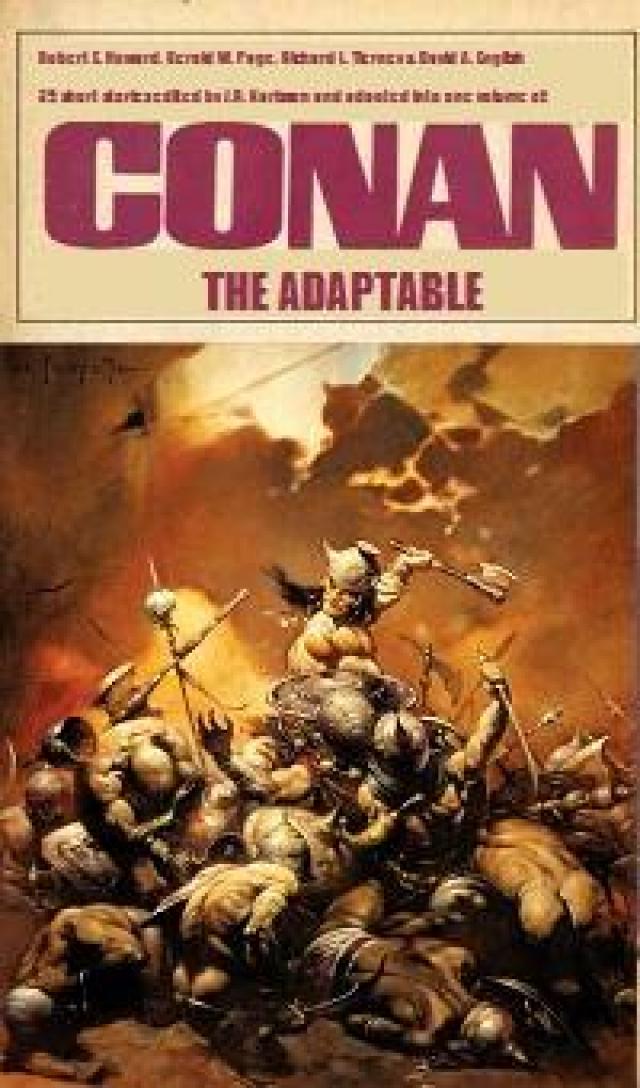


The Rualla went berserk when they saw women of their race falling under the swords of the Turanians. A wild yell shattered the brazen sky, and recklessly breaking cover, the Shemites pelted down the slopes, howling like fiends. Conan could not check them, nor could Mitkhal. Their shouts fell on deaf ears. The walls vomited projectiles as withering volleys raked the oncoming hordes. Dozens fell, but enough were left to reach the wall and sweep over it in a wave that neither arrows nor steel could halt.
And Conan was among them. When he saw he could not stop the storm he joined it. Mitkhal was not far behind him, cursing his men as he ran. The shaykh had no stomach for this kind of fighting, but his leadership was at stake. No man who hung back in this charge would ever be able to command the Rualla again.
Conan was among the first to reach the wall, leaping over the writhing bodies of half a dozen Shemites. He had not charged wildly, hacking at foes as he ran like the Zuagirs, to reach the wall exhausted. He sheathed his sword until the arrows from the barrier were a scant distance from his face, and then swept it out in a flurry that left a bloody gap where there had been a line of fierce dark faces an instant before. Before the gap could be closed he had swarmed over and in, and the Rualla poured after him.
As his feet hit the ground a rush of men knocked him against the wall and a blade, thrusting for his life, broke against the rocks. He drove his hilt into a snarling face, splintering teeth and bones, and the next instant a surge of his own men over the wall cleared a space about him.
The Turanians had been forced back from the wall in a dozen places now, and men were fighting all over the sangar. No quarter was asked—, none given. The pitiful headless bodies sprawled before the blood-stained land had turned the Zuagirs into hot-eyed demons. Their quivers were empty now and their own swords were out. The yells had died down to grunts, punctuated by death-howls. Above these sounds rose the chopping impact of flailing blades, the crunch of fiercely driven fists. So grimly had the Zuagirs suffered in that brainless rush, that now they were outnumbered, and the Turanians fought with the fury of desperation.
It was Conan’s blade, perhaps, that tipped the balance. He cut through the ranks without haste and without hesitation, and at this range he could not miss. He was aware of a dark shadow forever behind him, and turned once to see black Hassan following him, smiting methodically right and left with a heavy scimitar already dripping crimson. Even in the fury of the strife, Conan grinned. The literal-minded Kushite was obeying instructions to keep at Conan’s heels. As long as the battle hung in doubt, he was Conan’s protect, or, —ready to become his executioner the instant the tide turned in their favor.
“Faithful servant,” called Conan sardonically. “Have a care lest these Turanians cheat you of my head!”
Hassan grinned, speechless. Suddenly blood burst from his thick lips and he buckled at the knees. Somewhere in that rush down the hill his black body had stopped an arrow. As he struggled on all fours a Turanian ran in from the side and brained him with a blow. Conan killed the Turanian with his last arrow. He felt no grudge against Hassan. The man had been a good soldier, and had obeyed orders given him.
The sangar was a shambles. The men on their feet were less than those on the ground, and all were streaming blood. The white wolf standard had been torn from its staff and lay trampled under vengeful feet. Conan bent, picked up a saber and looked about for Osman. He saw Mitkhal, running toward the horse-pen, and then he yelled a warning, for he saw Osman.
The man broke away from a group of struggling figures and ran for the pen. He tore away the ropes and the horses, frantic from the noise and smell of blood, stampeded into the sangar, knocking men down and trampling them. As they thundered past, Osman, with a magnificent display of agility, caught a handful of flying mane and leaped on the back of the racing steed.
Mitkhal ran toward him, yelling furiously, and snapping a pistol at him. The shaykh, in the confusion of the fighting, did not seem to be aware that the gun was empty, for he pulled the trigger again and again as he stood in the path of the oncoming rider. Only at the last moment did he realize his peril and leap back. Even so, he would have sprung clear had not his sandal heel caught in a dead man’s abba.
Mitkhal stumbled, avoided the lashing hoofs, but not the down-flailing saber in Osman’s hand. A wild cry went up from the Rualla as Mitkhal fell, his turban suddenly crimson. The next instant Osman was out of the gate and riding like the wind—straight up the hillside to where he saw the slim figure of the girl to whom he now attributed his overthrow.
Olga had come out from behind the rocks and was standing in stunned horror watching the fight below. Now she awoke suddenly to her own peril at the sight of the madman charging up the slope. She drew a bow and let fly. She was not a very good shot. Three arrows missed, the fourth killed the horse, and then the quiver was empy. Conan was running up the slope, and behind him streamed a swarm of Rualla. There was not a fresh arrow amongst the whole horde.
Osman took a shocking fall when his horse turned a somersault under him, but rose, bruised and bloody, with Conan still some distance away. But the Turanian had to play hide-and-seek for a few moments among the rocks with his prey before he was able to grasp her hair and twist her screaming to her knees and then he paused an instant to enjoy her despair and terror. That pause was his undoing.
As he lifted his saber to strike off her head, steel clanged loud on steel. A numbing shock ran through his arm and his blade was knocked from his hand. His weapon rang on the hot flints. He whirled to face the blazing slits that were Conan’s eyes. The muscles stood out in cords and ridges on Conan’s sunburnt forearm in the intensity of his passion.
“Pick it up, you filthy dog,” he said between his teeth.
Osman hesitated, stooped, caught up the saber and slashed at Conan’s legs without straightening. Conan leaped back, then sprang in again the instant his toes touched the earth. His return was as paralyzingly quick as the death-leap of a wolf. It caught Osman off balance, his sword extended. Conan’s blade hissed as it cut the air, slicing through flesh, gritting through bone.
The Turanian’s head toppled from the severed neck and fell at Conan’s feet, the headless body collapsing in a heap. With an excess spasm of hate, Conan kicked the head savagely down the slope.
“Oh!” Olga turned away and hid her face. But the girl knew that Osman deserved any fate that could have overtaken him. Presently she was aware of Conan’s hand resting lightly on her shoulder and she looked up, ashamed of her weakness. The sun was just dipping below the western ridges. Musa came limping up the slope, blood-stained but radiant.
“The dogs are all dead, effendi!” he cried, industriously shaking a plundered watch, in an effort to make it run. “Such of our warriors as still live are faint from strife, and many sorely wounded. There is none to command now but thou.”
“Sometimes problems settle themselves,” mused Conan. “But at a ghastly price. If the Rualla hadn’t made that rush, which was the death of Hassan and Mitkhal—oh, well, such things are in the hands of Allah, as the Shemites say. A hundred better men than I have died today, but by the decree of some blind Fate, I live.”
Conan looked down on the wounded men. He turned to Musa.
“We must load the wounded on camels,” he said, “and take them to the camp at the Walls where there’s water and shade. Come.”
As they started down the slope he said to Olga, “I’ll have to stay with them till they’re settled at the Walls, then I must start for the coast. Some of the Rualla will be able to ride, though, and you need have no fear of them. They’ll escort you to the nearest Turanian outpost.”
She looked at him in surprise.
“Then I’m not your prisoner?”
He laughed.
“I think you can help Feisal more by carrying out your original instructions of supplying misleading information to the Turanians! I don’t blame you for not confiding even in me. You have my deepest admiration, for you’re playing the most dangerous game a woman can.”
“Oh!” She felt a sudden warm flood of relief and gladness that he should know she was not really an enemy. Musa was well out of ear-shot. “I might have known you were high enough in Feisal’s councils to know that I really am—”
“You're the cleverest, most daring secret agent the Brythunians employ,” he murmured. The girl impulsively placed her slender fingers in his, and hand in hand they went down the slope together.
The Treasure of Khawarism
(Originally The Treasure of Tartary)
- Robert E. Howard & J.R. Karlsson
I
Key to the Treasure
It was not mere impulsiveness that sent Conan into the welter of writhing limbs and whickering blades that loomed so suddenly in the semidarkness ahead of him. In that dark alley of Forbidden Khawarism it was no light act to plunge headlong into a nameless brawl; and Conan, for all his Cimmerian love of a fight, was not disposed thoughtlessly to jeopardize his secret mission.
But the glimpse of a scarred, bearded face swept from his mind all thought and emotion save a crimson wave of fury. He acted instinctively.
Full into the midst of the flailing group, half-seen by the light of a distant cresset, Conan leaped, kindhjal in hand. He was dimly aware that one man was fighting three or four others, but all his attention was fixed on a single tall gaunt form, dim in the shadows. His long, narrow, curved blade licked venomously at this figure, ploughing through cloth, bringing a yelp as the edge sliced skin. Something crashed down on Conan’s head, bludgeoning him, and he reeled, and closed with someone he could not see.
His groping hand locked on a chain that encircled a bull neck, and with a straining gasp he ripped upward and felt his keen kindhjal slice through cloth, skin and belly muscles. An agonized groan burst from his victim’s lips, and blood gushed sickeningly over Conan’s hand.
Through a blur of clearing sight, the Cimmerian saw a broad bearded face falling away from him—not the face he had seen before. The next instant he had leaped clear of the dying man, and was slashing at the shadowy forms about him. An instant of flickering steel, and then the figures were running fleetly up the alley. Conan, springing in pursuit, his hot blood lashed to murderous fury, tripped over a writhing form and fell headlong. He rose, cursing, and was aware of a man near him, panting heavily. A tall man, with a long curved blade in hand. Three forms lay in the mud of the alley.
“Come, my friend, whoever you are!” the tall man panted in Turanian. “They have fled, but they will return with others. Let us go!”
Conan made no reply. Temporarily accepting the alliance into which chance had cast him, he followed the tall stranger who ran down the winding alley with the sure foot of familiarity. Silence held them until they emerged from a low dark arch, where a tangle of alleys debouched upon a broad square, vaguely lighted by small fires about which groups of turbaned men squabbled and brewed tea. A reek of unwashed bodies mingled with the odors of horses and camels. None noticed the two men standing in the shadow made by the angle of the mud wall.
Conan looked at the stranger, seeing a tall slim man with thin dark features. Under his khalat which was draggled and darkly splashed, showed the silver-heeled boots of a horseman. His turban was awry, and though he had sheathed his scimitar, blood clotted the hilt and the scabbard mouth.
The keen black eyes took in every detail of the Cimmerian’s appearance, but Conan did not flinch. His disguise had stood the test too many times for him to doubt its effectiveness.
The Cimmerian towered above all but the tallest of men, heavily built with broad shoulders and corded sinews which gave him a strength out of all proportion to his weight. He was a hard-woven mass of wiry muscles and steel string nerves, combining the wolf-trap coordination of a natural fighter with a berserk fury resulting from an overflowing nervous energy. The kindhjal in his girdle and the scimitar at his hip were as much a part of him as his hands.
He wore the Iranistani boots, vest and girdled khalat like a man born to them. His keen features, bummed to bronze by desert suns, were almost as dark as those of his companion.
“Tell me thy name,” requested the other. “I owe my life to thee.”
“I am Ali el Ghazi, an Iranistani,” answered Conan.
No hint of suspicion shadowed the other’s countenance. Under the coiffed Arab kafiyeh Conan’s eyes blazed lambent blue, but blue eyes were not at all unknown among the warriors of the Iranian lands.
The Turanian lightly and swiftly touched the hawk-headed pommel of Conan’s scimitar.
“I will not forget,” he promised. “I will know thee wherever we meet again. Now it were best we separated and went far from this spot, for men with knives will be seeking me—and thou too, for aiding me.” And like a shadow he glided among the camels and bales and was gone.
Conan stood silently for an instant, one ear cocked back toward the alley, the other absently taking in the sounds of the night. Somewhere a thin wailing voice sang to a twanging native lute. Somewhere else a feline-like burst of profanity marked the progress of a quarrel. Conan breathed deep with contentment, despite the grim Hooded Figure that stalked forever at his shoulder, and the recent rage that still seethed in his veins. This was the real heart of the East, the East which had long ago stolen his heart and led him to wander afar from his own people.
He realized that he still gripped something in his left hand, and he lifted it to the flickering light of a nearby fire. It was a length of gold chain, one of its massy links twisted and broken. From it depended a curious plaque of beaten gold, somewhat larger than a silver coin, but oval rather than round. There was no ornament, only a boldly carven inscription which Conan, with all his Eastern lore, could not decipher.
He knew that he had torn the chain from the neck of the man he had killed in that black alley, but he had no idea as to its meaning. Slipping it into his broad girdle, he strode across the square, walking with the swagger of a nomadic horseman that was so natural to him.
Leaving the square he strode down a narrow street, the overhanging balconies of which almost touched one another. It was not late. Merchants in flowing silk robes sat cross-legged before their booths, extolling the quality of their goods—Mosul silk, matchlocks from Herat, edged weapons from Vendhya, and seed pearls from Baluchistan, hawk-like Afghans and weapon-girdled Kosalans jostled him. Lights streamed through silk-covered windows overhead, and the light silvery laughter of women rose above the noise of barter and dispute.
There was a tingle in the realization that he, Conan, was the first Westerner ever to set foot in forbidden Khawarism, tucked away in a nameless valley not many days’ journey from where the Afghul mountains swept down into the steppes of the Turanians. Posing as a wandering Iranistani, traveling with a caravan from central Afghulistan he had come, staking his life against the golden lure of a treasure beyond men’s dreams.
In the bazaars and serais he had heard a tale: To Shaibar Khan, the Kosalan chief who had made himself master of Khawarism, the city had given up its ancient secret. The Kosalan had found the treasure hidden there so long ago by Mechmed Shah, king of Khawarism, the Land of the Throne of Gold, when his empire fell before the Hyrkanian invaders.
Conan was in Khawarism to steal that treasure; and he did not change his plans because of the bearded face he had recognized in the alley—the face of an old and hated enemy. Yar Akbar the Afghuli, traitor and murderer.
Conan turned from the street and entered a narrow arched gate which stood open as if in invitation. A narrow stair went up from a small court to a balcony. This he mounted, guided by the tinkle of a guitar and a plaintive voice singing in a language unknown to him.
He entered a room whose latticed casement overhung the street, and the singer ceased her song to greet him and make half-mocking salaam with a lithe flexing of supple limbs. He replied, and deposited himself on a divan. The furnishings of the room were not elaborate, but they were costly. The garments of the woman who watched interestedly were of silk, her satin vest sewn with seed pearls. Her dark eyes, over the filmy yasmaq, were lustrous and expressive, the eyes of a Iranistani.
“Would my lord have food—and wine?” she inquired; and Conan signified assent with the lordly gesture of a Iranistani swashbuckler who is careful not to seem too courteous to any woman, however famed in intrigue she may be. He had come there not for food and drink, but because he had heard in the bazaars that news of many kinds blew on the winds through the house of Ayisha, where men from far and near came to drink her wine and listen to her songs.
She served him, and, sinking down on cushions near him, watched him eat and drink. Conan’s appetite was not feigned. Many lean days had taught him to eat when and where he could. Ayisha seemed to him more like a curious child than an intriguing woman, evincing so much interest over a wandering Iranistani, but he knew that she was weighing him carefully behind her guileless stare, as she weighed all men who came into her house.
In that hotbed of plot and ambitions, the wandering stranger today might be the Amir of Afghulistan or the Shah of Iranistan tomorrow—or the morrow might see his headless body dangling as a feast for the birds.
“You have a good sword,” said she. He involuntarily touched the hilt. It was an Arab blade, long, lean, curved like the crescent moon, with a brass hawk’s head for a pommel.
“It has cut many a Turanian out of the saddle,” he boasted, with his mouth full, carrying out his character. Yet it was no empty boast.
“Hai!” She believed him and was impressed. She rested her chin on her small fists and gazed up at him, as if his dark, hawk-like face had caught her fancy.
“The Khan needs swords like yours,” she said.
“The Khan has many swords,” he retorted, gulping wine loudly.