Conan the Adaptable, page 43
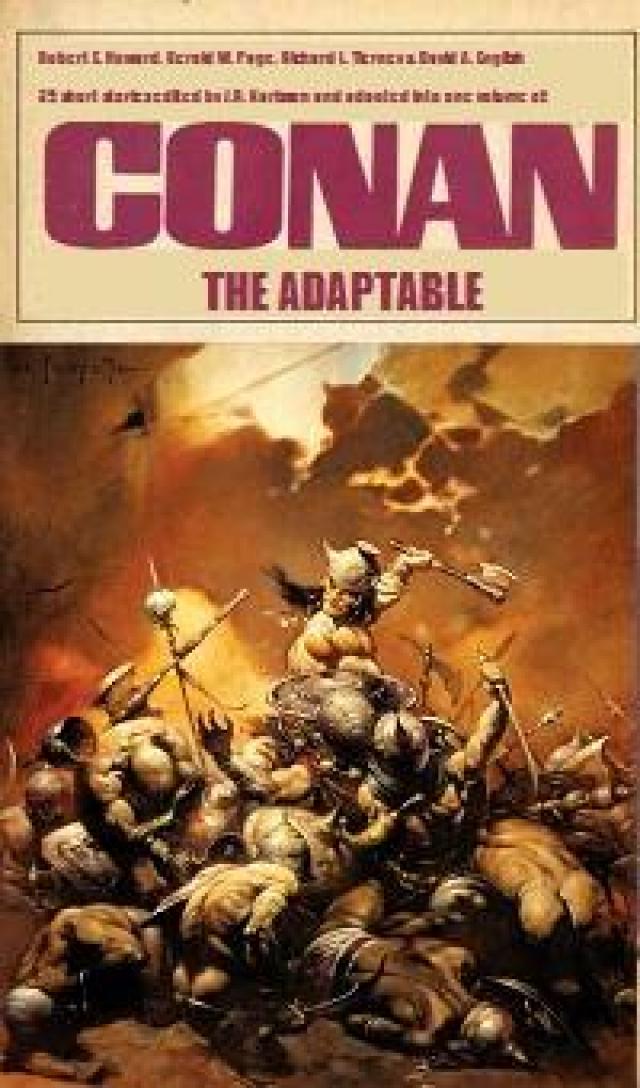


Conan had not paused. That same terrific lunge had torn his left arm free, and heaving up on the slab, he smashed his left fist against the jaw of the man who gripped his right arm. The impact was like that of a caulking hammer, and the Attalan went down like a butchered ox. The other two lunged in, hands grasping. Conan threw himself over the slab to the floor on the other side, and as one of the warriors lunged around it, he caught the Attalan’s wrist, wheeled, jerking the arm over his shoulder, and hurled the man bodily over his head. The Attalan struck the floor headfirst with an impact that knocked wind and consciousness out of him together.
The remaining kidnaper was more wary. Seeing the terrible strength and blinding speed of his smaller foe, he drew a long knife and came in cautiously, seeking an opportunity for a mortal thrust. Conan fell back, putting the slab between himself and that glimmering blade, while the other circled warily after him. Suddenly the Cimmerian stooped and ripped a similar knife from the belt of the man he had first felled. As he did so, the Attalan gave a roar, cleared the slab with a lion-like bound, and slashed in mid-air at the stooping Cimmerian.
Conan crouched still lower and the gleaming blade whistled over his head. The man hit the floor feet-first, off balance, and tumbled forward, full into the knife that swept up in Conan’s hand. A strangled cry was wrung from the Attalan’s lips as he felt himself impaled on the long blade, and he dragged Conan down with him in his death struggles.
Tearing free from his weakening embrace, Conan rose, his garments smeared with his victim’s blood, the red knife in his hand. Abdullah staggered up with a croaking cry, his face green with pain. Conan snarled like a wolf and sprang toward him, all his murderous passion fully roused. But the sight of that dripping knife and the savage mask of Conan’s face galvanized the outsider. With a scream he sprang for the door, knocking the torch from its socket as he passed. It hit the floor, scattering sparks and plunging the room into darkness, and Conan caromed blindly into the wall.
When he righted himself and found the door, the room was empty except for himself and the Attalans, dead or senseless.
Emerging from the chamber, he found himself in a narrow street, with the stars just fading for dawn. The building he had just quitted was dilapidated and obviously deserted. Down the narrow way he saw the house of Perdiccas. So he had not been carried far. Evidently his abductors had anticipated no interference. He wondered how much of a hand Bardylis had had in the plot. He did not like to think that the youth had betrayed him. But in any event, he would have to return to the house of Perdiccas, to obtain the packet he had concealed in the wall. He went down the street, still feeling a bit sick and giddy from that blow that had knocked him senseless, now that the fire of battle had cooled in his veins. The street was deserted. It seemed, indeed, more like an alley than a street, running between the backs of the houses.
As he approached the house, he saw someone running toward him. It was Bardylis, and he threw himself on Conan with a cry of relief that was not feigned.
“Oh, my brother!” he exclaimed. “What has happened? I found your chamber empty a short time ago, and blood on your couch. Are you unhurt? Nay, there is a cut upon your scalp!”
Conan explained in a few words, saying nothing of the letters. He allowed Bardylis to suppose that Abdullah had been a personal enemy, bent on revenge. He trusted the youth now, but there was no need to disclose the truth of the packet.
Bardylis whitened with fury. “What a shame upon my house!” he cried. “Last night that dog Abdullah made my father a present of a great jug of wine, and we all drank except yourself, who were slumbering. I know now the wine was drugged. We slept like dogs.
“Because you were our guest, I posted a man at each outer door last night, but they fell asleep because of the wine they had drunk. A few minutes ago, searching for you, I found the servant who was posted at the door which opens into this alley from the corridor that runs past your chamber. His throat had been cut. It was easy for them to creep along that corridor and into your chamber while we slept.”
Back in the chamber, while Bardylis went to fetch fresh garments, Conan retrieved the packet from the wall and stowed it under his belt. In his waking hours he preferred to keep it on his person.
Bardylis returned then with the breeches, sandals and tunic of the Attalans, and while Conan donned them, gazed in admiration at the Cimmerian’s bronzed and sinewy torso, devoid as it was of the slightest trace of surplus flesh.
Conan had scarcely completed his dressing when voices were heard without, the tramp of men resounded through the hall, and a group of yellow-haired warriors appeared at the doorway, with swords at their sides. Their leader pointed to Conan, and said: “Ptolemy commands that this man appear at once before him, in the hall of justice.”
“What is this?” exclaimed Bardylis. “Conan is my guest!”
“It is not my part to say,” answered the chief. “I but carry out the commands of our king.”
Conan laid a restraining hand on Bardylis’s arm. “I will go. I want to see what business Ptolemy has with me.”
“I, too, will go,” said Bardylis, with a snap of his jaws. “What this portends I do not know. I do know that Conan is my friend.”
The sun was not yet rising as they strode down the white street toward the palace, but people were already moving about, and many of them followed the procession.
Mounting the broad steps of the palace, they entered a wide hall, flanked with lofty columns. At the other end there were more steps, wide and curving, leading up to a dais on which, in a throne-like marble chair, sat the king of Attalus, sullen as ever. A number of his chiefs sat on stone benches on either side of the dais, and the common people ranged themselves along the wall, leaving a wide space clear before the throne.
In this open space crouched a vulture-like figure. It was Abdullah, his eyes shining with hate and fear, and before him lay the corpse of the man Conan had killed in the deserted house. The other two kidnappers stood near by, their bruised features sullen and ill at ease.
Conan was conducted into the open space before the dais, and the guards fell back on either side of him. There was little formality. Ptolemy motioned to Abdullah and said: “Make your charge.”
Abdullah sprang up and pointed a skinny finger in Conan’s face.
“I accuse this man of murder!” he screeched. “This morning before dawn he attacked me and my friends while we slept, and slew him who lies there. The rest of us barely escaped with our lives!”
A mutter of surprize and anger rose from the throng. Ptolemy turned his somber stare on Conan.
“What have you to say?”
“He lies,” answered the Cimmerian impatiently. “I killed that man, yes —”
He was interrupted by a fierce cry from the people, who began to surge menacingly forward, to be thrust back by the guards.
“I only defended my life,” said Conan angrily, not relishing his position of defendant. “That outsider dog and three others, that dead man and those two standing there, slipped in my chamber last night as I slept in the house of Perdiccas, knocked me senseless and carried me away to rob and kill me.”
“Aye!” cried Bardylis wrathfully. “And they slew one of my father’s servants while he slept.”
At that the murmur of the mob changed, and they halted in uncertainty.
“A lie!” screamed Abdullah, fired to recklessness by avarice and hate. “Bardylis is bewitched! Conan is a wizard! How else could he speak your tongue?”
The crowd recoiled abruptly, and some made furtive signs to avert conjury. The Attalans were as superstitious as their ancestors. Bardylis had drawn his sword, and his friends rallied about him, clean-cut, rangy youngsters, quivering like hunting dogs in their eagerness.
“Wizard or man!” roared Bardylis, “he is my brother, and no man touches him save at peril of his head!”
“He is a wizard!” screamed Abdullah, foam dabbling his beard. “I know him of old! Beware of him! He will bring madness and ruin upon Attalus! On his body he bears a scroll with magic inscriptions, wherein lies his necromantic power! Give that scroll to me, and I will take it afar from Attalus and destroy it where it can do no harm. Let me prove I do not lie! Hold him while I search him, and I will show you.”
“Let no man dare touch Conan!” challenged Bardylis. Then from his throne rose Ptolemy, a great menacing image of bronze, somber and awe-inspiring. He strode down the steps, and men shrank back from his bleak eyes. Bardylis stood his ground, as if ready to defy even his terrible king, but Conan drew the lad aside. Conan was not one to stand quietly by while someone else defended him.
“It is true,” he said without heat, “that I have a packet of papers in my garments. But it is also true that it has nothing to do with witchcraft, and that I will kill the man who tries to take it from me.”
At that Ptolemy’s brooding impassiveness vanished in a flame of passion.
“Will you defy even me?” he roared, his eyes blazing, his great hands working convulsively. “Do you deem yourself already king of Attalus? You black-haired dog, I will kill you with my naked hands! Back, and give us space!”
His sweeping arms hurled men right and left, and roaring like a bull, he hurled himself on Conan. So swift and violent was his attack that Conan was unable to avoid it. They met breast to breast, and he was hurled backward, and to his knee. Ptolemy plunged over him, unable to check his velocity, and then, locked in a death-grapple they ripped and tore, while the people surged yelling about them.
Not often did Conan find himself opposed by a man as strong as himself. But the king of Attalus was a mass of whale-bone and iron, and nerved to blinding quickness. Neither had a weapon. It was man to man, fighting as the primitive progenitors of the race fought. There was no science about Ptolemy’s onslaught; he fought like a tiger or a lion, with all the appalling frenzy of the primordial. Again and again Conan battered his way out of a grapple that threatened to snap his spine like a rotten branch. His blinding blows ripped and smashed in a riot of destruction. The tall king of Attalus swayed and trembled before them like a tree in a storm, but always came surging back like a typhoon, lashing out with great strokes that drove Conan staggering before him, rending and tearing with mighty fingers.
Only his desperate speed and the savage skill of wrestling that was his had saved Conan so long. Naked to the waist, battered and bruised, his tortured body quivered with the punishment he was enduring. But Ptolemy’s great chest was heaving; his face was a mask of raw beef, and his torso showed the effects of a beating that would have killed a lesser man.
Gasping a cry that was half curse, half sob, he threw himself bodily on the Cimmerian, bearing him down by sheer weight. As they fell he drove a knee savagely at Conan’s groin, and tried to fall with his full weight on his foe’s breast. A twist of his body sent the knee sliding harmlessly along his thigh, and Conan writhed from under the heavier body as they fell.
The impact broke their holds, and they staggered up simultaneously. Through the blood and sweat that streamed into his eyes, Conan saw the king towering above him, reeling, arms spread, blood pouring down his mighty breast. His belly went in as he drew a great laboring breath. And into the relaxed pit of his stomach Conan, crouching, drove his left with all the strength of ridged arm, iron shoulders and knotted calves behind it. His clenched fist sank to the wrist in Ptolemy’s solar plexus. The king’s breath went out of him in an explosive grunt; his hands dropped, he swayed like a tall tree under the axe. Conan’s right, hooking up in a terrible arc, met his jaw with a sound like a cooper’s mallet, and Ptolemy pitched headlong and lay still.
V
In the stupified silence that followed the fall of the king, while all eyes, dilated with surprize, were fixed on the prostrate giant and the groggy figure that weaved above him, a gasping voice shouted from outside the palace. It grew louder, mingled with a clatter of hoofs which stopped at the outer steps. All wheeled toward the door as a wild figure staggered in, spattering blood.
“A guard from the pass!” cried Bardylis.
“The Afghulis!” cried the man, blood spurting through his fingers which he pressed to his shoulder. “Three hundred Afghuls! They have stormed the pass! They are led by a white man and four Turanians with bows. These men shot us down from afar off as we strove to defend the pass. The Afghulis have entered the valley —” He swayed and fell, blood trickling from his lips. A wound from an arrow showed in his shoulder, near the base of his neck.
No clamor of terror greeted this appalling news. In the utter silence that followed, all eyes turned toward Conan, leaning dizzily against the wall, gasping for breath.
“You have conquered Ptolemy,” said Bardylis. “He is dead or senseless. While he is helpless, you are king. That is the law. Tell us what to do.”
Conan gathered his dazed wits and accepted the situation without demur or question. If the Afghulis were in the valley, there was no time to waste. He thought he could hear the distant popping of firearms already.
“How many men are able to bear arms?” he panted.
“Three hundred and fifty,” answered one of the chiefs.
“Then let them take their weapons and follow me,” he said. “The walls of the city are rotten. If we try to defend them, with Hunyadi directing the siege, we will be trapped like rats. We must win with one stroke, if at all.”
Someone brought him a sheathed and belted scimitar and he buckled it about his waist. His head was still swimming and his body numb, but from some obscure reservoir he drew a fund of reserve power, and the prospect of a final showdown with Hunyadi fired his blood. At his directions men lifted Ptolemy and placed him on a couch. The king had not moved since he dropped, and Conan thought it probable that he had a concussion of the brain. That pole-ax smash that had felled him would have split the skull of a lesser man.
Then Conan remembered Abdullah, and looked about for him, but the outsider had vanished.
At the head of the warriors of Attalus, Conan strode down the street and through the ponderous gate. All were armed with long curved swords; some had unwieldy hammers, ancient weapons captured from the hill tribes. He knew the Afghulis would be no better armed, but the bows of Hunyadi and his Turanians would count heavily.
He could see the horde swarming up the valley, still some distance away. They were on foot. Lucky for the Attalans that one of the pass-guards had kept a horse near him. Otherwise the Afghulis would have been at the very walls of the town before the word came of their invasion.
The invaders were drunk with exultation, halting to fire outlying huts and growing stuff, and to shoot cattle, in sheer wanton destructiveness. Behind Conan rose a deep rumble of rage, and looking back at the blazing blue eyes, and tall, tense figures, the Cimmerian knew he was leading no weaklings to battle.
He led them to a long straggling heap of stones which ran waveringly clear across the valley, marking an ancient fortification, long abandoned and crumbling down. It would afford some cover. When they reached it the invaders were still out of bow fire. The Afghulis had ceased their plundering and came on at an increased gait, howling like wolves.
Conan ordered his men to lie down behind the stones, and called to him the warriors with the matchlocks — some thirty in all.
“Pay no heed to the Afghulis,” he instructed them. “Shoot at the men with the bows. Do not shoot at random, but wait until I give the word, then all fire together.”
The ragged horde were spreading out somewhat as they approached, loosing their arrows before they were in range of the grim band waiting silently along the crumbled wall. The Attalans quivered with eagerness, but Conan gave no sign. He saw the tall, supple figure of Hunyadi, and the bulkier shapes of his turbaned Turanians, in the center of the ragged crescent. The men came straight on, apparently secure in the knowledge that the Attalans had no modern weapons, and that Conan had lost his bow. They had seen him climbing down the cliff without it. Conan cursed Abdullah, whose treachery had lost him his weapon.
Before they were in range of retaliation, Hunyadi fired, and the warrior at Conan’s side slumped over, drilled through the head. A mutter of rage and impatience ran along the line, but Conan quieted the warriors, ordering them to lie closer behind the rocks. Hunyadi tried again, and the Turanians fired, but the arrows whined off the stones. The men moved nearer and behind them the Afghulis howled with blood-thirsty impatience, rapidly getting out of hand.
Conan had hoped to lure Hunyadi into reach of their projectiles. But suddenly, with an earth-shaking yell, the Afghulis stormed past the Nemedian in a wave, knives flaming like the sun on water. Hunyadi yelped explosively, unable to see or shoot at his enemies, for the backs of his reckless allies. Despite his curses, they came on with a roar.
Conan, crouching among the stones, glared at the gaunt giants rushing toward him until he could make out the fanatical blaze of their eyes, then he roared: “Fire!”
A thunderous volley ripped out along the wall, ragged, but terrible at that range. A storm of lead blasted the oncoming line, and men went down in windrows. And lost to all caution, the Attalans leaped the wall and hewed into the staggering Afghulis with naked steel. Cursing as Hunyadi had cursed, Conan drew his scimitar and followed them.
No time for orders now; no formation, no strategy; Attalan and Afghuli, they fought as men fought a thousand years ago, without order or plan, massed in a straining, grunting, hacking mob, where naked blades flickered like lightning. Yard-long Zhaibar knives clanged and ground against the curved swords of the Attalans. The rending of flesh and bone beneath the chopping blades was like the sound of butchers’ cleavers. The dying dragged down the living and the warriors stumbled among the mangled corpses. It was a shambles where no quarter was asked and none given, and the feuds and hates of a thousand years glutted in slaughter.