Conan the Adaptable, page 10


“Daughter,” quavered the priest of Mitra, afraid, not for himself, but for her, “bethink you! This man offers you more than many a man would offer. It is at least an honorable married state.”
“Aye,” rumbled Athelstane, “marry him like a good wench and make the best of it. There’s more than one foreign woman on the cross benches of the north.”
What can I do? The question tore through Conan’s brain. There was but one thing to do—wait—until the ceremony was over and Thorfel had retired with his bride. Then steal her away as best he could. After that—but he dared not look ahead. He had done and would do his best. What he did, he of necessity did alone; a masterless man had no friends, even among masterless men. There was no way to reach Mara to tell her of his presence. She must go through with the wedding without even the slim hope of deliverance that knowledge of his presence might have lent. Instinctively, his eyes flashed to the Dark Man standing somber and aloof from the rout. At his feet the old quarreled with the new—the pagan with the Mitran—and Conan even in that moment felt that the old and new were alike young to the Dark Man.
Did the carven ears of the Dark Man hear strange prows grating on the beach, the stroke of a stealthy knife in the night, the gurgle that marks the severed throat? Those in the skalli heard only their own noise and those who revelled by the fire outside sang on, unaware of the silent coils of death closing about them.
“Enough!” shouted Thorfel. “Count your beads and mutter your mummery, priest! Come here, wench, and marry!” He jerked the girl off the board and plumped her down on her feet before him. She tore loose from him with flaming eyes. All the hot Brythunian blood was roused in her.
“You yellow-haired swine!” she cried. “Do you think that a princess of Brythunia with King Brian’s blood in her veins, would sit at the cross bench of a barbarian and bear the tow-headed cubs of a northern thief? No—I’ll never marry you!
“Then I’ll take you as a slave!” he roared, snatching at her wrist.
“Nor that way either, swine!” she exclaimed, her fear forgotten in fierce triumph. With the speed of light she snatched a dagger from his girdle, and before he could seize her she drove the keen blade under her heart. The priest cried out as though he had received the wound, and springing forward, caught her in his arms as she fell.
“The curse of Almighty Mitra on you, Thorfel!” he cried, with a voice that rang like a clarion, as he bore her to a couch nearby.
Thorfel stood nonplussed. Silence reigned for an instant, and in that instant Conan went mad.
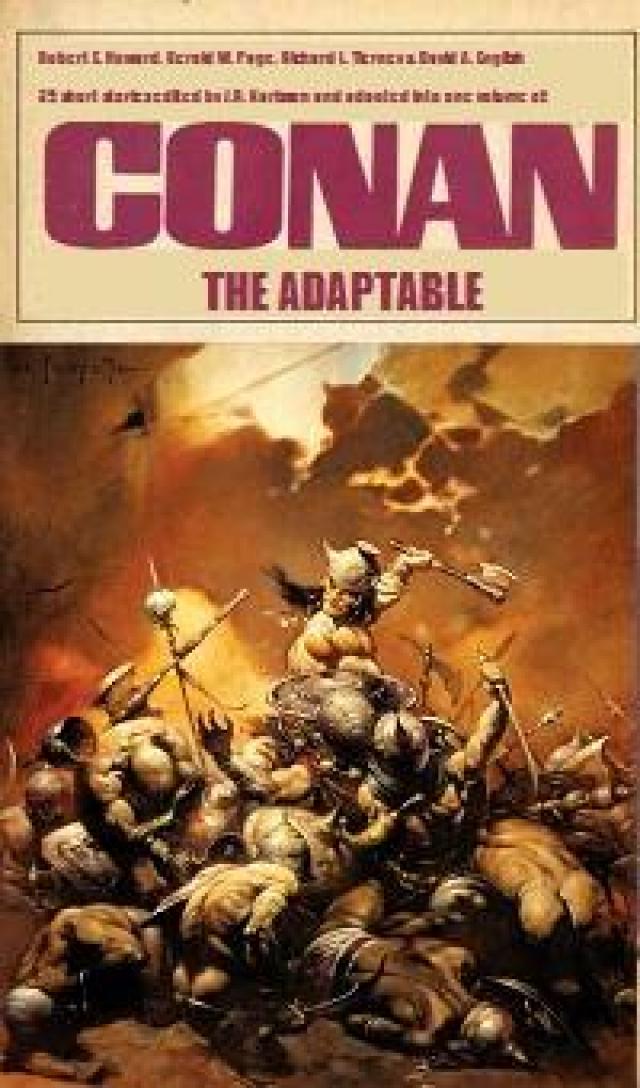
The war cry of Cimmeria ripped through the stillness like the scream of a wounded panther, and as men whirled toward the shriek, the frenzied barbarian came through the doorway like the blast of a wind from Hell. He was in the grip of the black fury beside which the berserk rage of the Vanir pales. Eyes glaring and a tinge of froth on his writhing lips, he crashed among the men who sprawled, off guard, in his path. Those terrible eyes were fixed on Thorfel at the other end of the hall, but as Conan rushed he smote to right and left. His charge was the rush of a whirlwind that left a litter of dead and dying men in his wake.
Benches crashed to the floor, men yelled, ale flooded from upset casks. Swift as was the Celt’s attack, two men blocked his way with drawn swords before he could reach Thorfel—Halfgar and Oswick. The scarred-faced Vanir went down with a cleft skull before he could lift his weapon, and Conan, catching Halfgar’s blade on his shield, struck again like lightning and the clean ax sheared through hauberk, ribs and spine.
The hall was in a terrific uproar. Men were seizing weapons and pressing forward from all sides, and in the midst the lone Cimmerian raged silently and terribly. Like a wounded tiger was Conan in his madness. His eerie movement was a blur of speed, an explosion of dynamic force. Scarce had Halfgar fallen when the Cimmerian leaped across his crumpling form at Thorfel, who had drawn his sword and stood as if bewildered. But a rush of carles swept between them. Swords rose and fell and the Cimmerian ax flashed among them like the play of summer lightning. On either hand and from before and behind a warrior drove at him. From one side Osric rushed, swinging a two-handed sword; from the other a house-carle drove in with a spear. Conan stooped beneath the swing of the sword and struck a double blow, forehand and back. Thorfel’s brother dropped, hewed through the knee, and the carle died on his feet as the back-lash return drove the ax’s back-spike through his skull. Conan straightened, dashing his shield into the face of the swordsman who rushed him from the front. The spike in the center of the shield made a ghastly ruin of his features; then even as the Cimmerian wheeled cat-like to guard his rear, he felt the shadow of Death loom over him. From the corner of his eye he saw the Vanir Tostig swinging his great two-handed sword, and jammed against the table, off balance, he knew that even his superhuman quickness could not save him. Then the whistling sword struck the Dark Man on the table and with a clash like thunder, shivered to a thousand blue sparks. Tostig staggered, dazedly, still holding the useless hilt, and Conan thrust as with a sword; the upper spike of his ax struck the Vanir over the eye and crashed through to the brain.
And even at that instant, the air was filled with a strange singing and men howled. A huge carle, ax still lifted, pitched forward clumsily against the Cimmerian, who split his skull before he saw that a flint-pointed arrow transfixed his throat. The hall seemed full of glancing beams of light that hummed like bees and carried quick death in their humming. Conan risked his life for a glance toward the great doorway at the other end of the hall. Through it was pouring a strange horde. Small, dark men they were, with beady black eyes and immobile faces. They were scantily armored, but they bore swords, spears, and bows. Now at close range they drove their long black arrows point-blank and the carles went down in windrows.
Now a red wave of combat swept the skalli hall, a storm of strife that shattered tables, smashed the benches, tore the hangings and trophies from the walls, and stained the floors with a red lake. There had been less of the black strangers than Vanir, but in the surprize of the attack, the first flight of arrows had evened the odds, and now at hand-grips the strange warriors showed themselves in no way inferior to their huge foes. Dazed with surprize and the ale they had drunk, with no time to arm themselves fully, the Vanir yet fought back with all the reckless ferocity of their race. But the primitive fury of the attackers matched their own valor, and at the head of the hall, where a white-faced priest shielded a dying girl, Conan tore and ripped with a frenzy that made valor and fury alike futile.
And over all towered the Dark Man. To Conan’s shifting glances, caught between the flash of sword and ax, it seemed that the image had grown—expanded—heightened; that it loomed giant-like over the battle; that its head rose into smoke-filled rafters of the great hall—that it brooded like a dark cloud of death over these insects who cut each other’s throats at its feet. Conan sensed in the lightning sword-play and the slaughter that this was the proper element for the Dark Man. Violence and fury were exuded by him. The raw scent of fresh-spilled blood was good to his nostrils and these yellow-haired corpses that rattled at his feet were as sacrifices to him.
The storm of battle rocked the mighty hall. The skalli became a shambles where men slipped in pools of blood, and slipping, died. Heads spun grinning from slumping shoulders. Barbed spears tore the heart, still beating, from the gory breast. Brains splashed and clotted the madly driving axes. Daggers lunged upward, ripping bellies and spilling entrails upon the floor. The clash and clangor of steel rose deafeningly. No quarter was asked or given. A wounded man had dragged down one of the dark men, and doggedly strangled him regardless of the dagger his victim plunged again and again into his body.
One of the dark men seized a child who ran howling from an inner room, and dashed its brains out against the wall. Another gripped a woman by her golden hair and hurling her to her knees, cut her throat, while she spat in his face. One listening for cries of fear or pleas of mercy would have heard none; men, women or children, they died slashing and clawing, their last gasp a sob of fury, or a snarl of quenchless hatred.
And about the table where stood the Dark Man, immovable as a mountain, washed the red waves of slaughter. Vanir and tribesmen died at his feet. How many red infernos of slaughter and madness have your strange carved eyes gazed upon, Dark Man?
Shoulder to shoulder Sweyn and Thorfel fought. The Saxon Athelstane, his golden beard a-bristle with the battle-joy, had placed his back against the wall and a man fell at each sweep of his two-handed ax. Now Conan came in like a wave, avoiding, with a lithe twist of his upper body, the first ponderous stroke. Now the superiority of the light Brythunian ax was proved, for before the Saxon could shift his heavy weapon, the Cimmerian ax lit out like a striking cobra and Athelstane reeled as the edge bit through the corselet into the ribs beneath. Another stroke and he crumpled, blood gushing from his temple.
Now none barred Conan’s way to Thorfel except Sweyn, and even as the Cimmerian leaped like a panther toward the slashing pair, one was ahead of him. The chief of the Dark Men glided like a shadow under the slash of Sweyn’s sword, and his own short blade thrust upward under the mail. Thorfel faced Conan alone. Thorfel was no coward; he even laughed with pure battle-joy as he thrust, but there was no mirth in Conan’s face, only a frantic rage that writhed his lips and made his eyes coals of blue fire.
In the first swirl of steel Thorfel’s sword broke. The young sea-king leaped like a tiger at his foe, thrusting with the shards of the blade. Conan laughed fiercely as the jagged remnant gashed his cheek, and at the same instant he cut Thorfel’s left foot from under him. The Vanir fell with a heavy crash, then struggled to his knees, clawing for his dagger. His eyes were clouded.
“Make an end, curse you!” he snarled.
Conan laughed. “Where is your power and your glory now?” he taunted. “You who would have for unwilling wife an Brythunian princess—you—”
Suddenly his hate strangled him, and with a howl like a maddened panther he swung his ax in a whistling arc that cleft the man from shoulder to breastbone. Another stroke severed the head, and with the grisly trophy in his hand he approached the couch where lay Mara. The priest of Mitra had lifted her head and held a goblet of wine to her pale lips. Her cloudy gray eyes rested with slight recognition of Conan—but it seemed at last she knew him and she tried to smile.
“Mara, blood of my heart,” said the outlaw heavily, “you die in a strange land. But the birds in the hills will weep for you, and the heather will sigh in vain for the tread of your little feet. But you shall not be forgotten; axes shall drip for you and for you shall galleys crash and walled cities go up in flames. And that your ghost go not unassuaged into the realms of beyond, behold this token of vengeance!”
And he held forth the dripping head of Thorfel.
“In God’s name, my son,” said the priest, his voice husky with horror, “have done—have done. Will you do your ghastly deeds in the very presence of—see, she is dead. May Mitra in His infinite justice have mercy on her soul, for though she took her own life, yet she died as she lived, in innocence and purity.”
Conan dropped his ax-head to the floor and his head was bowed. All the fire of his madness had left him and there remained only a dark sadness, a deep sense of futility and weariness. Over all the hall there was no sound. No groans of the wounded were raised, for the knives of the little dark men had been at work, and save their own, there were no wounded. Conan sensed that the survivors had gathered about the statue on the table and now stood looking at him with inscrutable eyes. The priest mumbled over the body of the girl, telling his beads. Flames ate at the farther wall of the building, but none heeded it. Then from among the dead on the floor a huge form heaved up unsteadily. Athelstane, overlooked by the killers, leaned against the wall and stared about dazedly. Blood flowed from a wound in his ribs and another in his scalp where Conan’s ax had struck glancingly.
The Cimmerian walked over to him. “I have lost all my hatred for you,” said he, heavily, “but blood calls for blood and you must die.”
Athelstane looked at him without an answer. His large gray eyes were serious, but without fear. He too was a barbarian; he too realized the rights of the blood-feud. But as Conan raised his ax, the priest sprang between, his thin hands outstretched, his eyes haggard.
“Have done! In God’s name I command you! Almighty Powers, has not enough blood been shed this fearful night? In the name of the Most High, I claim this man.”
Conan dropped his ax. “He is yours; not for your oath or your curse, not for your creed but for that you too are a man and did your best for Mara.”
A touch on his arm made Conan turn. The chief of the strangers stood regarding him with inscrutable eyes.
“Who are you?” asked the Cimmerian idly. He did not care; he felt only weariness.
“I am Brogar, chief of the Picts, Friend of the Dark Man.”
“Why do you call me that?” asked Conan.
“He rode in the bows of your boat and guided you to Helni through wind and snow. He saved your life when he broke the great sword of the Vanir.”
Conan glanced at the brooding Dark One. It seemed there must be human or superhuman intelligence behind those strange stone eyes. Was it chance alone that caused Tostig’s sword to strike the image as he swung it in a death blow?
“What is this thing?” asked the Cimmerian
“It is the only God we have left,” answered the other somberly. “It is the image of our greatest king, he who gathered the broken lines of the Pictish tribes into a single mighty nation, he who drove forth the Vanir and Brythunian and shattered the legions of Acheron, centuries ago. A wizard made this statue while the great one yet lived and reigned, and when he died in the last great battle, his spirit entered into it. It is our god.
“Ages ago we ruled. Before the Vanir, before the Cimmerian, before the Brythunian, before the Acheronian, we reigned in the west. Our stone circles rose to the sun. We worked in flint and hides and were happy. Then came the men of the north and drove us into the wilderness. They held the southland. But we throve in the north and were strong. Acheron broke the Britons and came against us. But there rose among us our king, of the same blood as Brule the Spear-slayer, the friend of King Kull of Valusia who reigned thousands of years ago before Atlantis sank. He became king of all Hyboria. He broke the iron ranks of Acheron and sent the legions cowering south behind their Wall.
“He fell in battle; the nation fell apart. Civil wars rocked it. The Cimmerians came and reared the kingdom of Hyboria above the ruins of what was once ours. The last remnant of the Pictish empire faded like snow on the mountains. Like wolves we live now among the scattered islands and the deep jungles, among the crags of the highlands and the dim hills. We are a fading people. We pass. But the Dark Man remains—the Dark One, the great king, whose ghost dwells forever in the stone likeness of his living self.”
As in a dream Conan saw an ancient Pict who looked much like the one in whose dead arms he had found the Dark Man, lift the image from the table. The old man’s arms were thin as withered branches and his skin clung to his skull like a mummy’s, but he handled with ease the image that two strong Vanir had had trouble in carrying.
As if reading his thoughts, Brogar spoke softly: “Only a friend may with safety touch the Dark One. We knew you to be a friend, for he rode in your boat and did you no harm.”
“How know you this?”
“The Old One,” pointing to the white-bearded ancient, “Gonar, high priest of the Dark One—the ghost comes to him in dreams. It was Grok, the lesser priest and his people who stole the image and took to sea in a long boat. In dreams Gonar followed; aye, as he slept he sent his spirit with the ghost of the Morni, and he saw the pursuit by the Vanir, the battle and slaughter on the Isle of Swords. He saw you come and find the Dark One, and he saw that the ghost of the great king was pleased with you. Woe to the foes of Mak Morn! But good luck shall fare the friends of him.”
Conan came to himself as from a trance. The heat of the burning hall was in his face and the flickering flames lit and shadowed the carven face of the Dark Man as his worshippers bore him from the building, lending it a strange life. Was it, in truth, that the spirit of a long-dead king lived in that cold stone? Bran Mak Morn loved his people with a savage love; he hated their foes with a terrible hate. Was it possible to breathe into inanimate blind stone a pulsating love and hate that should outlast the centuries?
Conan lifted the still, slight form of the dead girl and bore her out of the flaming hall. Five long open boats lay at anchor, and scattered about the embers of the fires the carles had lit, lay the reddened corpses of the revelers who had died silently.
“How stole ye upon these undiscovered?” asked Conan. “And whence came you in those open boats?”
“The stealth of the panther is theirs who live by stealth,” answered the Pict. “And these were drunken. We followed the path of the Dark One and we came hither from the Isle of Altar, near the Scottish mainland, from whence Grok stole the Dark Man.”
Conan knew no island of that name but he did realize the courage of these men in daring the seas in boats such as these. He thought of his own boat and requested Brogar to send some of his men for it. The Pict did so. While he waited for them to bring it around the point, he watched the priest bandaging the wounds of the survivors. Silent, immobile, they spoke no word either of complaint or thanks.
The fisherman’s boat came scudding around the point just as the first hint of sunrise reddened the waters. The Picts were getting into their boats, lifting in the dead and wounded. Conan stepped into his boat and gently eased his pitiful burden down.
“She shall sleep in her own land,” he said somberly. “She shall not lie in this cold foreign isle. Brogar, whither go you?”
“We take the Dark One back to his isle and his altar,” said the Pict. “Through the mouth of his people he thanks you. The tie of blood is between us, Cimmerian, and mayhap we shall come to you again in your need, as the great king of Pictdom shall come again to his people some day in the days to come.”