Conan the Adaptable, page 85
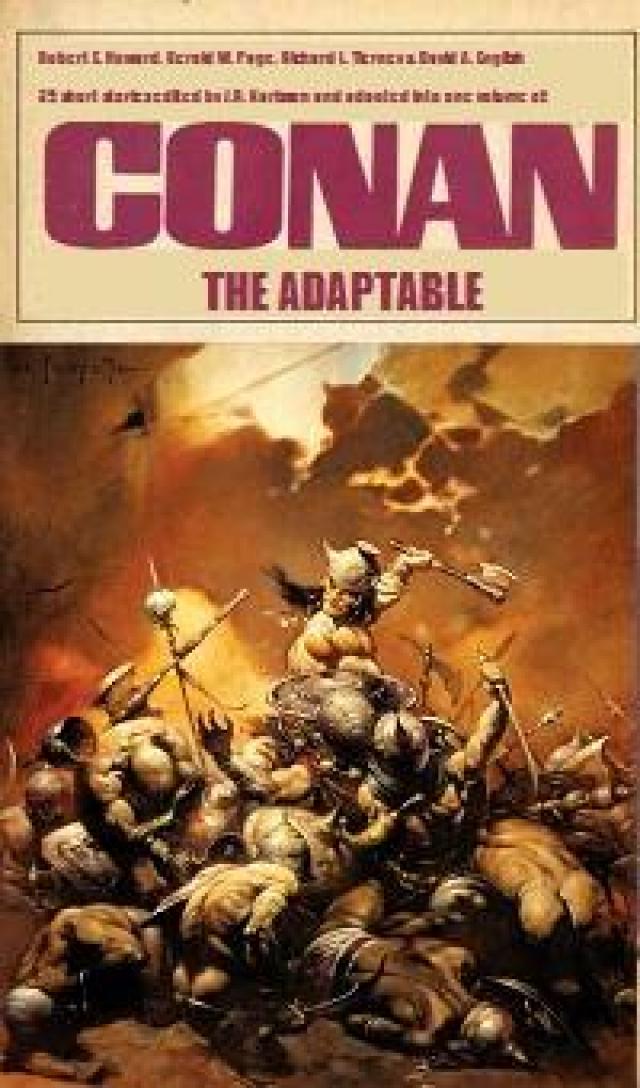


“To me, Kassa!” snapped the man, his somber despair changed to dynamic action. “Out of the door behind me – back, dogs, I say!”
Out of the pavilion he backed, and the soldiers who ran up, sword in hand, stopped short as they saw the imminent peril of their lord’s favorite. Conan knew that the success of his action depended on speed. The surprize and boldness of his move had taken Zenkri off guard, that was all. A group of horses stood near by, saddled and bridled, always ready for the king’s whim, and Conan reached them with a single long stride, the grooms falling back from his threat.
“Into a saddle, Kassa!” he snapped, and the girl, who had followed him like one in a daze, reacting mechanically to his orders, swung herself up on the nearest mount. Quickly he followed suit and cut the tethers that held their mounts. A bellow from inside the tent told him Zenkri’s momentarily scattered wits were working again, and he dropped the child unhurt into the sand. His usefulness was past, as a hostage. Zenkri, taken by surprise, had instinctively followed the promptings of his unusual affection for the child, but Conan knew that with his ruthless reason dominating him again, the king would not allow even that affection to stand in the way of their recapture.
The man wheeled away, drawing Kassa’s steed with him, trying to shield her with his own body from the arrows which were already whistling about them. Shoulder to shoulder they raced across the wide open space in front of the royal pavilion, burst through a ring of fires, floundered for an instant among tent-pegs, cords and scurrying yelling figures, then struck the open desert flying and heard the clamor die out behind them.
It was dark, clouds flying across the sky and drowning the stars. With the clatter of hoofs behind them, Conan reined aside from the road that led westward, and turned into the trackless desert. Behind them the hoof-beats faded westward. The pursuers had taken the old caravan road, supposing the fugitives to be ahead of them.
“What now, Conan?” Kassa was riding alongside, and clinging to his iron-sheathed arm as if she feared he might fade suddenly from her sight.
“If we ride straight for the border they will have us before dawn,” he answered. “But I know this land as well as they – I have ridden all over it of old in foray and war with the counts of Edessa; so I know that Jabar Kal’at lies within our reach to the southwest. The commander of Jabar is a nephew of Muin-ed-din Anar, who is the real ruler there, and who, as perhaps you know, has made a pact with our allies against Zenkri, his old rival. If we can reach Jabar, the commander will give us shelter and food, and fresh horses and an escort to the border.”
The girl bowed her head in acquiescence. She was still like one dazed. The light of hope burned too feebly in her soul to sting her with new pangs. Perhaps in her captivity she had absorbed some of the fatalism of her masters. Conan looked at her, drooping in the saddle, humble and silent, and thought of the picture he retained of a saucy, laughing beauty, vibrant with vitality and mirth. And he cursed Zenkri and his works with sick fury. So through the night they rode, the broken woman and the embittered man, handiworks of the Lion who dealt in swords and souls and human hearts, and whose victims, living and dead, filled the land like a blight of sorrow, agony and despair.
All night they pressed forward as fast as they dared, listening for sounds that would tell them the pursuers had found their trail, and in the dawn, which lit the helmets of swift-following horsemen, they saw the towers of Jabar rising above the mirroring waters of the Corinthia. It was a strong keep, guarded with a moat that encircled it, connecting with the river at either end. At their hail the commander of the castle appeared on the wall, and a few words sufficed to cause the drawbridge to be lowered. It was not a moment too soon. As they clattered across the bridge, the drum of hoofs was in their ears, and as they passed through the gates, arrows fell in a shower about them.
The leader of the pursuers reined his rearing steed and called arrogantly to the commander on the tower, “Oh man, give up these fugitives, lest thy blood quench the embers of thy keep!”
“Am I then a dog that you speak to me thus?” queried the soldier, clutching his beard in passion. “Begone, or my archers will feather thy carcass with fifty shafts.”
For answer the man laughed jeeringly and pointed to the desert. The commander paled. Far away the sun glinted on a moving ocean of steel. His practiced eye told him that a whole army was on the march. “Zenkri has turned aside from his march to Mosul to hunt down a pair of fleeing jackals,” called the man mockingly. “Great honor he has done them, marching hard on their spoor all night. Send them out, oh fool, and my master will ride on in peace.”
“Let it be as the gods wills,” said the other, recovering his poise. “But the friends of my uncle have thrown themselves into my hands, and may shame rest on me and mine if I give them to the butcher.”
Nor did he alter his resolution when Zenkri himself, his face dark with passion as the cloak that flowed from his steel-clad shoulders, sat his stallion beneath the towers and called to him: “By receiving mine enemy thou hast forfeited thy castle and thy life. Yet I will be merciful. Send out those who fled and I will allow thee to march out unharmed with thy retainers and women. Persist in this madness and I will burn thee like a rat in thy castle.”
“Let it be as the gods wills,” repeated the man philosophically, and in an undertone spoke quietly to a crouching archer, “Drive me quickly a shaft through yon dog.”
The arrow glanced harmlessly from Zenkri’s breastplate and the king galloped out of range with a shout of mocking laughter. Now began the siege of Jabar Kal’at, unsung and unglorified, yet in the course of which the dice of Fate were cast.
Zenkri’s riders laid waste the surrounding countryside and drew a cordon about the castle through which no courier could steal to ride for aid. While the king and the lords of remained in ignorance of what was taking place beyond Corinthia, their ally waged his unequal battle.
By nightfall the wagons and siege engines came up, and Zenkri set to his task with the skill of long practice. The manish sappers dammed up the moat at the upper end, despite the arrows of the defenders, and filled up the drained ditch with earth and stone. Under cover of darkness they sank mines beneath the towers. Zenkri’s ballistas creaked and crashed, and huge rocks knocked men off the walls like ten-pins or smashed through the roofs of the towers. His rams gnawed and pounded at the walls, his archers plied the turrets with their arrows everlastingly, and on scaling-ladders and storming-towers his soldiers moved unceasingly to the onset. Food waned in the castle’s larders; the heaps of dead grew larger, the rooms became full of wounded men, groaning and writhing.
But the commander did not falter on the path his feet had taken. He knew that he could not now buy safety from Zenkri, even by giving up his guests; to his credit, he never even considered giving them up. Conan knew this, and though no word of the matter was spoken between them, the commander had evidence of the man’s fierce gratitude. Conan showed his appreciation in actions, not words – in the fighting on the walls, in the slaughter in the gates, in the long night-watches on the towers; with whirring sword-strokes that clove bucklers and peaked helmets, that cleft spines and severed necks and limbs and shattered skulls; by the casting down of scaling-ladders when the clinging mans howled as they crashed to their death, and their comrades cried out at the terrible strength in the man’s naked hands. But the rams crunched, the arrows sang, the steel tides surged on again and again, and the haggard defenders dropped one by one until only a skeleton force held the crumbling walls of Jabar Kal’at.
V
In his pavilion little more than a bowshot from the beleaguered walls, Zenkri played chess with Ousama. The madness of the day had given way to the brooding silence of night, broken only by the distant cries of wounded men in delirium.
“Men are my pawns, friend,” said the king. “I turn adversity into triumph. I had long sought an excuse to attack Jabar Kal’at, which will make a strong outpost against the Corinthians once I have taken it and repaired the dents I have made, and filled it with my soldiers. I knew my captives would ride hither; that is why I broke camp and took up the march before my scouts found their tracks. It was their logical refuge. I will have the castle and all of Corinthia, which last is most vital. Were they to learn now of my intrigue with the emperor, my plans might well come to naught. But they will not know until I strike. Conan will never bear news to them. If he does not fall with the castle, I will tear him between wild horses as I promised, and the infidel girl shall watch, sitting on a pointed stake.”
“Is there no mercy in your soul, Zenkri?” protested the Shemite.
“Has life shown mercy to me save what I wrung forth by the sword?” exclaimed Zenkri, his eyes blazing in a momentary upheaval of his passionate spirit. “A man must smite or be smitten – slay or be slain. Men are wolves, and I am but the strongest wolf of the pack. Because they fear me, men crawl and kiss my sandals. Fear is the only emotion by which they may be touched.”
“You are godless at heart, Zenkri,” sighed Ousama.
“It may be,” answered the man with a shrug of his shoulders. “Had I been born beyond the rivers to the east and bowed to yellow Erlik as did my grandsire, I had been no less Zenkri the Lion. I have spilled rivers of gore for the glory of the gods, but I have never asked mercy or favor of Him. What care the gods if a man lives or dies? Let me live deep, let me know the sting of wine in my palate, the wind in my face, the glitter of royal pageantry, the bright madness of slaughter – let me burn and sting and tingle with the madness of life and living, and I quest not whether paradise, or Erlik’s frozen hell, or the blackness of empty oblivion lies beyond.”
As if to give point to his words, he poured himself a goblet of wine and looked interrogatively at Ousama. The Shemite, who had shuddered at Zenkri’s blasphemous words, drew back in pious horror. The king emptied the goblet, smacking his lips loudly in relish.
“I think Jabar Kal’at will fall tomorrow,” he said. “Who has stood against me? Count them, Ousama – there was Sadaka, and the Athros, and Timurtash, and the sultan Dawud, and the king, and the count of Edessa. Man after man, city after city, army after army, I broke them and brushed them from my path.”
“You have waded through a sea of blood,” said Ousama. “You have filled the slave-markets with girls, and the deserts with the bones of warriors. Nor have you spared your rivals.”
“They stood in the way of my destiny,” laughed the man, “and that destiny is to be Emperor of Hyboria! As I will be. I have welded the swords of many into a single blade. Now with the aid of the Corthinians, all Hell can not save the west. Slaughter? Men have seen naught; wait until I ride into Aquilonia and Nemedia, sword in hand!”
“Your heart is steel,” said the Shemite. “Yet I have seen one touch of tenderness in you – your affection for Nejm-ed-din’s son Yusef. Is there a like touch of repentance in you? Of all your deeds, is there none you regret?”
Zenkri played with a pawn in silence, and his face darkened.
“Aye,” he said slowly. “It was long ago, when I broke Sadaka beside the lower reaches of this very river. He had a son, Achmar, a girl-faced boy. I beat him to death with my riding-scourge. It is the one deed I could wish undone. Sometimes I dream of it.”
Then with an abrupt “Enough!” he thrust aside the board, scattering the chessmen. “I would sleep,” said he, and throwing himself on his cushion-heaped divan, he was instantly locked in slumber. Ousama went quietly from the tent, passing between the four giant soldiers in gilded mail who stood with wide-tipped scimitars at the pavilion door.
In the castle of Jabar, the commander held counsel with Conan. “My brother, for us the end of the road has come. The walls are crumbling, the towers leaning to their fall. Shall we not fire the castle, cut the throats of our women and children, and go forth to die like men in the dawn?”
Conan shook his head. “Let us hold the walls for one more day. In a dream I saw the banners of our allies marching to our aid.”
He lied in a desperate attempt to bolster up the fatalistic commander. Each followed the instinct of his kind, and Conan’ was to cling with teeth and nails to the last vestige of life until the bitter end. The man bowed his head.
“If the gods will it, we will hold the walls for another day.”
Conan thought of Kassa, into whose manner something of the old vibrant spirit was beginning to steal faintly again, and in the blackness of his despair no light gleamed from earth or heaven. The finding of her had stung to life a heart long frozen; now in death he must lose her again. With the taste of bitter ashes in his mouth he bent his shoulders anew to the burden of life.
Ashes.
“Think me not a coward, Commander. For I must ask for your leave. I have found a way to make their forces retreat.”
In his tent Zenkri moved restlessly. Alert as a panther, even in sleep, his instinct told him that someone was moving stealthily near him. He woke and sat up glaring. The fat eunuch Yaruktash halted suddenly, the wine jug half-way to his lips. He had thought Zenkri lay helplessly drunk when he stole into the tent to filch the liquor he loved. Zenkri snarled like a wolf, his familiar devil rising in his brain.
“Dog! Am I a fat merchant that you steal into my tent to guzzle my wine? Begone! Tomorrow I will see to you!”
Cold sweat beaded Yaruktash’s sleek hide as he fled from the royal pavilion. His fat flesh quivered with agonized anticipation of the sharp stake which would undoubtedly be his portion. In a day of cruel masters, Zenkri’s name was a byword of horror among slaves and servitors.
One of the soldiers outside the tent caught Yaruktash’s arm and growled, “Why flee you, gelding?”
A great flare of light rose in the eunuch’s brain, so that he gasped at its grandeur and audacity. Why remain here to be impaled, when the whole desert was open before him, and here were men who would protect him in his flight?
“Our lord discovered me drinking his wine,” he gasped. “He threatens me with torture and death.”
The soldiers laughed appreciatively, their crude humor touched by the eunuch’s fright. Then they started convulsively as Yaruktash added, “You too are doomed. I heard him curse you for not keeping better watch, and allowing his slaves to steal his wine.”
The fact that they had never been told to bar the eunuch from the royal pavilion meant nothing to the soldiers, their wits frozen with sudden fear. They stood dumbly, incapable of coherent thought, their minds like empty jugs ready to be filled with the eunuch’s guile. A few whispered words and they slunk away like shadows on Yaruktash’s heels, leaving the pavilion unguarded.
The night waned. Midnight hovered and was gone. The moon sank below the desert hills in a welter of blood. From dreams of imperial pageantry Zenkri again awoke, to stare bewilderedly about the dim-lit pavilion. Without, all was silence that seemed suddenly tense and sinister. The prince lay in the midst of ten thousand armed men; yet he felt suddenly apart and alone, as if he were the last man left alive on a dead world. Then he saw that he was not alone. Looking somberly down on him stood a strange and alien figure. It was a man, whose rags did not hide his gaunt limbs, at which Zenkri stared appalled. They were gnarled like the twisted branches of ancient oaks, knotted with masses of muscle and thews, each of which stood out distinct, like iron cables. There was no soft flesh to lend symmetry or to mask the raw savagery of sheer power. Only years of incredible labor could have produced this terrible monument of muscular over-development. Black hair hung about the great shoulders, ashes were streaked upon the mighty dark breast. His terrible arms were folded, and he stood motionless as a black statue looking down upon the stupefied man. His features were gaunt and deep-lined, as if cut by some mad artist’s chisel from bitter, frozen rock.
“Avaunt!” gasped Zenkri, momentarily a pagan of the steppes. “Spirit of evil – ghost of the desert – demon of the hills – I fear you not!”
“Well may you speak of ghosts, man!” The deep hollow voice woke dim memories in Zenkri’s brain. “I am the ghost of a man you thought dead, come up from darkness deeper than the darkness of hell. Have you forgotten my promise, King Zenkri?”
“Who are you?” demanded the man.
“I am Conan of Cimmeria.”
“Impossible!” ejaculated the king. “How could you escape the clutches of my forces and then force yourself back in a single day?”
“I managed,” retorted the other. “In places where others would die like flies, I live. The lash that scarred my back in a thousand overlying patterns could not kill me, nor starvation, nor storm, nor pestilence, nor battle. Escaping your camp did not kill me nor did finding this tent. The years have been long, Zenkri, and the darkness deep and full of mocking voices and haunting faces. Look at these monstrous talons that were hands, these knotted limbs – they have driven the weighted oars for many a thousand leagues through storm and calm. Yet I lived, Zenkri, even when my flesh cried out to end the long agony. When I fainted on the oar, it was not the ripping lash that roused me to life anew, but the hate that would not let me die. That hate has kept the soul in my tortured body for three years, dog of Corinthia. In the galleys I lost my hope, my manhood, my soul, my faith and my the gods. But my hate burned on, a flame that nothing could quench.
“Years at the oars, Zenkri! Three weeks ago the galley in which I then toiled crashed on the reefs off the coast of Vendhya. All died but me, who, knowing my hour had come, burst my chains with the strength and madness of a giant, and gained the shore. My feet are yet unsteady from the shackles and the galley-bench, Zenkri, though my arms are strong beyond the belief of man. I have been on the road from there for three years. But the road ends here.”
For the first time in his life Zenkri knew fear that froze his tongue to his palate and turned the marrow in his bones to ice.