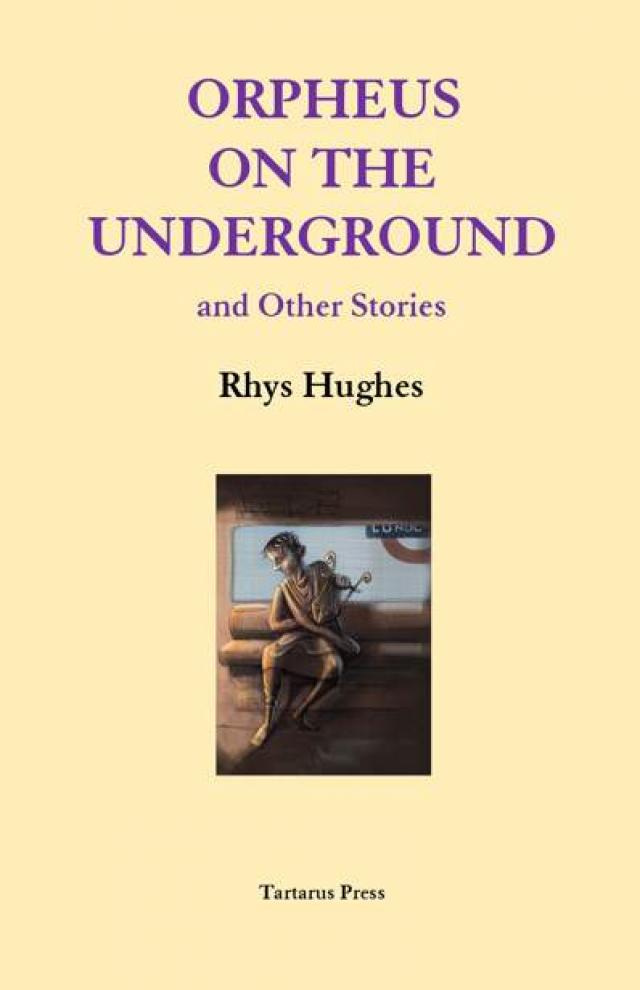
Orpheus on the Underground and Other Stories, page 3


T o t t e r i d g e a n d W h e t s t o n e
The present is another country; they do things differently here. It’s not as if the modern world is no place for the characters of the myths of ancient times. True, the modern world is stuffed full of its own myths, abrasive, tough and bleak; but they are attenuated or amplified echoes of the older kind. Old myths can flourish here, or at least survive. As for truth, that’s a different matter. What did the philosopher Heraclitus say? No man can cross the same river twice. And it should be true. The water flowing over feet is always new. But if there is a train waiting on the far bank, and if the man who has crossed the river jumps onto it, and if he allows the train to follow the river downstream, and if he jumps out again, yes, he can surprise the same molecules; and yes, the same water will flow over his feet a second time. That’s how the modern world differs from the old. There are other ways too; but that is the main one.
H i g h B a r n e t
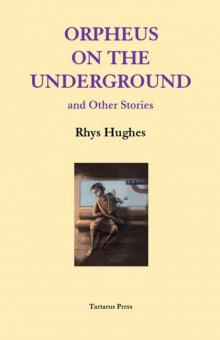
This is his stop. He gets out, trudges down the corridors, passes through the ticket barrier and rides the escalators up. The day is coming to an end outside; the sky is darkening. He is staying in a squat with some friends he met on a farm in Kent. He was dismissed from that job for playing to the animals. Cheap hotels, worn sofas; he has done it all. The meals in this house are communal; he showed them how to fuel lamps with the cheapest brand of olive oil. Hot water on tap, electricity, central heating; those are superfluous to a man who once made trees dance in ecstasy. His lyre feels heavier than it should. No use complaining of old age. He is a myth; and myths don’t get old in the same way as ordinary men. People lose respect for myths, play games with them, subvert them; but never wrinkle their faces, liver spot their hands, burn their joints with arthritis. It simply doesn’t occur to them to do that.
THE GARGOYLES OF BLACK WOOD
THIS DOCUMENT was discovered by a firewood collector felling dead trees in one of the most inaccessible parts of the woodland. As his axe swung into a blasted oak he was startled to discern the dull gleam of an object within the hollow trunk. It was a stout wooden box bound with bronze clasps. When he forced the lock he found a sheaf of papers covered in indecipherable scrawl.
The simple fellow used some of the pages to light his campfire, but he possessed enough sense to hand over the remainder to the doctor of the next town he visited. Happily, that doctor was an amateur scholar of historical curiosities who was able to decipher the writing, update the archaic style and publish the surviving text as a limited edition pamphlet. Thus it is to the venerable and sanguine Dr Dalrymple that we owe the following:
(i)
… off the path and I was utterly lost. The trees were thickly clustered and the undergrowth bristled with thorns. I knew that an uncomfortable night spent in the open would most likely be my fate. I felt less anxiety than perhaps I should have. But there were no wild beasts in the vicinity and I had a bag of provisions slung over my shoulder.
Wayfarers who find themselves stranded in such places generally make for high ground. I was sufficiently experienced to understand the error of this tactic. Human settlements tend to be in valleys, near rivers or streams, and it is always best to head downwards. The walking is easier and the results more favourable, so I descended every slope I encountered.
As the rays of the sinking sun slanted sideways through the treetops, I found myself on a precipitous incline, clutching at bushes in a vain attempt to stop myself plunging into the hideous depths of a gorge. It was dark and a rank smell assailed my quivering nostrils. I was unable to turn back, lost my balance and began sliding at considerable speed.
Fully expecting to be dashed on the rocks, I was overcome with relief when I plunged instead into a pool. But in the blackness I soon panicked and allowed my bag of provisions to sink into the unseen depths while I frantically splashed to the shore. Recovering my breath, I was unable to suppress a groan as the enormity of my predicament struck me. It was cold and I began to shiver and curse violently.
The best course of action I could take was to warm my frozen limbs through exertion. I stumbled forward, crashing through dense vegetation that parted before me like the decaying strands of an immense and ancient web. It was so devoid of light that I felt like a man swallowed by a giant, bereft of even a glimmer of hope. And then, all of a sudden, the moon rose and flooded the chasm with a soft light, dispelling the odious gloom with its beams.
I broke into a clearing where strange nocturnal flowers bloomed. Directly ahead of me stood an oddly shaped castle, made partly of gnarled wood and partly of crumbling stone. Twisted trees grew from the battlements like a mockery of flagpoles. As the moon rose higher it illuminated a row of curiously carved figures projecting from the wall that loomed above me, a set of fantastical beasts and monsters with gaping mouths. I peered more intently and then—
‘A visitor!’ said one of these gargoyles. ‘Welcome to our abode!’
(ii)
Needless to say I was shocked and baffled by these words; I even retreated a step and clamped my hands over my ears. I suspected that my brain had been damaged in my fall, that I was delusional and perhaps on the verge of incurable insanity. Yet I did not turn and flee. There is no point running from one’s own madness, for it will keep pace with you wherever you go. I merely watched in horrified fascination as one of the carved figures detached itself from the wall.
It leapt into the air and caught the branch of an overhanging tree in one of its disproportionately long arms. Then it swung from one branch to another, passing from tree to tree in a movement that took it around the entire clearing in a descending spiral until it was able to drop down to the ground without injury. I blinked at the thing as it advanced towards me on its stubby legs. The other gargoyles laughed and muttered incomprehensible remarks to each other.
The figure halted a few feet away and bowed courteously. It was less than half my height, but its arms reached to the ground. A beaked head glinted in the moonlight and I was reminded of the suits of armour of my great-grandfather’s day, before those steel shells were made obsolete by the invention of the arquebus. I waited for it to speak again but it seemed disinclined to say anything further. To end the eerie silence I briefly and absurdly introduced myself.
‘I am Wilton, a traveller, lost in the tangles of this vast forest.’
It may have been unwise to admit that I had no idea where I was, but the tiny figure betrayed no sign of malign glee at my predicament. It simply said, ‘You must be in need of food and warmth, friend, so on behalf of my master I bid you welcome to Castle Gargoyle and ask that you treat it like your own home for the duration of your stay. Follow me and I will take you to a place where the hot tongues of a blazing log fire will lick your damp clothes dry.’
He produced an iron key from some secret recess in his chest and led me to a narrow door in the mossy wall. There was no portcullis, only this unnervingly thin aperture. I felt as though I were a parasite breaking through the skin of a living being.
Finding myself in a narrow passage, I was encouraged to move forward by the glow of a lamp far ahead of me. The door was shut and locked and I heard the creature stamp along behind, clanking like an untuned bell with each clumsy step on the uneven floor. Reaching the lamp, which was hung from a hook on a chain, I was confronted with a spiral staircase. ‘Up, if you please!’ muttered the little voice of my escort, and I did as I was bid.
(iii)
The spiral staircase seemed to have been carved from the sturdy trunk of an immense tree. I formed the alarming impression that I was nothing more than solidified sap moving up to the canopy of a stately forest giant, and that I had been transformed during my ascent from flesh and blood into vegetable matter. Before my fears could come to fruition the stairway abruptly corkscrewed me into a weird chamber.
It was a circular hall. Everything sagged in unexpected places; the angles baffled my eyes and bewildered my reason. My escort took the opportunity of my confusion to detour around me and scamper toward the very centre of the room, where there was a fireplace faced by an ornate chair with unequal legs. There was no fire in the hearth, just ashes, but the dwarf or imp or whatever he was asked me to be seated.
‘I will fetch the logs and soon have a roaring blaze for you!’ he said.
‘Truly, sir, I am obliged,’ I replied.
He scurried to and fro, fetching sticks from the shadows, building the fire rapidly as the moonlight and paler starlight gleamed with difficulty through the hole in the roof that served for a chimney. I eased the aches in my legs by lowering myself into the chair. Positioned directly above the fireplace, supported on three long iron poles, was a large iron cylinder with a single window of crystal embedded in one side.
‘What is that vessel, sir?’ I asked.
‘I must beg you not to call me “sir” again or to address me in any such respectful fashion, for I am only a humble vassal and your true host is my master, who is absent.’
‘I am sorry to impose myself on you while he is not at home.’
‘I will follow the protocols as carefully as he instructed me to. You are his honoured guest whether he is here or not.’
The tinder flared into life and was applied to the dry sticks on the circular grate. The flames leaped higher.
‘May I be informed of your master’s name?’
‘Baron Demetrios Gibbon, the last survivor of his line. You may observe his warped portrait on the wall. He is the last lord of Castle Gargoyle.’
‘And you? What is your name?’
‘How might I be in possession of a name? I am one of the gargoyles.’
(iv)
I am happy to admit that I was stuck for words at this juncture; but as the waves of heat from the fire began to steam my clothes and my shivering was curtailed, I cared not to dwell too much on the peculiarities of my situation. Why fling up my arms and run shrieking back out into the dank woods before I had enjoyed the hospitality promised to me? Once, as I was sitting in an autumn field, a crow dropped a pear into my lap. I ate it without puzzling about the mystery.
And why should being served by a gargoyle provoke a more dramatic response from me than that? If we apply cold objectivity to the question, we can see that unreasoning panic is the foe of the man who, as was my case, has little to survive on but his wits.
Reader—if reader you be—permit me to confess that I am not the most honest of fellows, that my chosen profession of ‘traveller’ conceals a litany of misdemeanours. No roving minstrel or peddler I, no drover or messenger: I wander to escape my past and I survive by remaining alert to opportunities. I have accepted lodgings and scraps off widows no less ugly than my metallic dwarf. To complain at this stage of my poor life’s journey would betray a narrow mind.
The gargoyle passed me a dusty bottle of wine, good golden stuff.
‘What is the history of this place?’ I asked as he toasted bread and cheese for me on a trident suitable to his own dimensions. ‘And also of this region?’
The gargoyle sighed and seemed much dejected. Then he roused himself and served me the humble but delicious fare, and narrated the following story.
(v)
‘Our valley is the deepest and least explored in the realm, and since it was constructed in the time of King Stephen, this castle has remained the most remote and isolated structure of its kind. The land was in turmoil back then and because of the civil war it was possible for some men to achieve positions of power unthinkable in times of greater central authority. The first Baron Gibbon was one such; he was a scholar of ill repute, an alchemist who had been expelled from his university. His wanderings brought him here.
‘With gold that may have been manufactured by his dark and smoky arts, or have an even less respectable origin, he hired the strongest men of this thinly populated region to build his castle. There was no architect, no rhyme or reason, and the tools available were inadequate to the task. Entire trees were incorporated into the structure and most are still alive—branches form the joists of various floors and the rafters of the roof. It is a veritable labyrinth on the inside, a puzzle.
‘The castle finished, Baron Gibbon dismissed his workers and set to work on his alchemical experiments. Because of the chaos in the land, he was able to proceed without exciting attention; at least for several years. Even the monks in the tiny monastery that stood at the far end of the narrow valley were powerless to hinder his progress, though they frequently appealed to the king for help. It is doubtful if any of the letters they sent ever reached their intended recipient.
‘But I perceive that you are weary! I will speed along my tale as best I can. Nobody knows what experiments Baron Gibbon attempted, but there were many of them, a great many. Finally, the monks resolved to take matters into their own hands. They marched out one night, armed with enchantments of their own, and surrounded the castle. They cursed the alchemist in the most awful manner. All the fumes and vapours that curled from his flasks and retorts would fail to disperse henceforth. Instead, they would congeal.
‘Yes, congeal and behave like a sentient being, a monster of poisonous mist! And that is what happened in the following days, weeks, months. The smokes that poured from the vessels of Baron Gibbon never left the valley, never weakened on the winds above; they remained in the forest, growing thicker and stronger, acquiring an identity, a character, an implacable hatred of the alchemist who had created them. And so he was trapped in his peculiar abode, a lord with severely restricted influence. But he fought back. He created a living gargoyle, the first of my species.
‘Ordinary gargoyles project from roofs and spit water, but this one inhaled and digested fumes, the substance of that cloying mist monster. Soon he made another gargoyle, and so did his sons, though they are not easy to manufacture. And now there are thirteen in total and we keep the monster at bay. It drifts and coils through the forest, vainly seeking a weakness or opening. It desires nothing more than to choke the scion of the Baron, but it dare not enter the clearing and approach the walls. We would breathe it in and destroy it.
‘The last surviving monk managed a final enchantment before he withered away. If the number of gargoyles should ever drop below thirteen, the monster will be able to enter the castle unimpeded, for the lungs of the others will freeze. The present Baron Gibbon is the thirteenth to bear the title and he has no heirs.
‘But you are yawning and blinking furiously! Allow me to guide you to your bed for the night. The chamber I have reserved for you is small but cosy and I guarantee you will feel like a new man the moment you awake!’
(vi)
A hideous weariness had come over me. I was nodding off in the chair and the words of the gargoyle were like distant mockery. His hand was on a crank and I heard the squeaking of a pulley. I realised that the cylindrical vessel with the crystal window was descending onto the fire—its three legs were fully retractable. ‘In here!’ chuckled the gargoyle as the cylinder came to a halt on the logs. ‘This is your bedchamber! Locked inside and transformed!’
It seemed he intended to conduct some alchemical experiment on my poor body. I resisted with all the strength left to me, but I was helpless in the grip of his big hands on the ends of those abnormally long arms. I realised that I had been drugged—the wine, bread and cheese! He pulled me closer to the fire, to the cylinder and to the door that now swung open in its side.
‘You said your master was absent!’ I shrieked. ‘But the mist monster is still outside! I saw it on my way here. How did he manage to leave the castle safely?’
‘You fool! Have you not guessed?’ spat the gargoyle.
He attempted to pick me up and push me into the cylinder. I grappled with him and grasped his visor, which I raised, revealing not, as I had expected, an emptiness or a reflection of my own image, but the face of a mortal man!
‘What is the meaning of this?’ I spluttered.
‘Your doom! I am Demetrios Gibbon, thirteenth Baron of Castle Gargoyle, and soon I will be able to fully enjoy my birthright. This cylinder is an alchemical vessel for turning lost travellers into gargoyles! It will shrink you and then you can take your place on my walls, occupying the space I was forced to inhabit. Needless to say, wayfarers are rare around here. It was impossible to create thirteen gargoyles in time to thwart the last monk’s curse. So I had to play the role myself, breathing in wisps of my enemy and deceiving it as I hoodwinked you! Unable to leave the castle I had to wait for the next random guest.’
‘And here I am!’ I groaned despondently.
‘Such a long wait! Now in with you, in with you!’ he bellowed. I resisted, but it was futile. The other twelve gargoyles entered the chamber, and though they had once been like me they helped my tormentor lock me inside the cylinder. Waves of drowsy heat overwhelmed me, and the gargoyles danced outside.
(vii)
Inside my alchemical prison I crisped and dwindled. I was Wilton no longer, but merely the thirteenth and unluckiest gargoyle in the collection. The door was unlocked and I was helped out, too unsteady on my tiny legs to support myself. ‘You have made a grave mistake,’ I croaked, but before I could explain what it was, Baron Demetrios Gibbon interrupted me.
‘Surely you wish to know the reason for my diminutive size? I am a real man, not a gargoyle. A genuine midget! Alchemy stunted the growth of each subsequent generation. Thus I was able to impersonate one of these foul creatures most convincingly. Yes, I am a tiny human being; but I have stilts and I know how to use them. Watch me and be deceived again!’