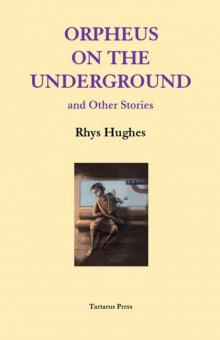
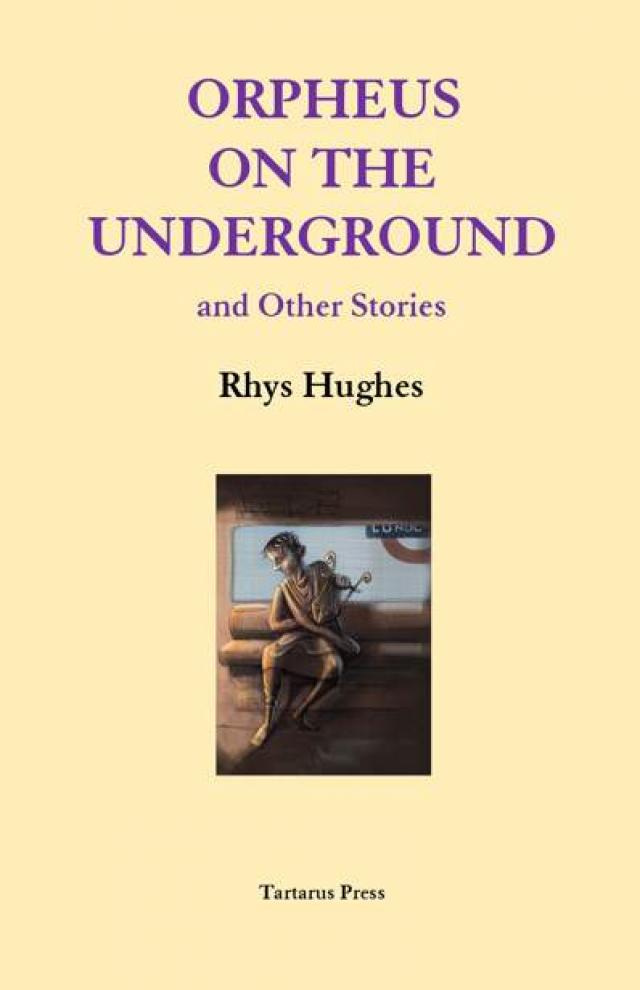
Orpheus on the Underground and Other Stories, page 17


‘Where is all this leading to?’ he wanted to know.
I jerked my thumb towards the ground. ‘Somewhere down there, how far I don’t know, may be found the earliest piece of music ever played. Think about it: a moment of history at least as important as the first spark of fire. I am burning to know what it sounds like! What was the primal tune? We are actually in a position to learn the answer! We can witness the instant of conception, the moment when the first musical seed was sown. It must have been a miracle and I want to be there when it takes place.’
He hugged himself tightly. ‘I won’t come.’
I snorted and suddenly I had no more fear. The thought of what waited for me down there was too beautiful. ‘Then I’ll go alone. I’ll be present at the birth of the human soul . . .’
At this point my guide made a mistake. ‘Music originated more than 50,000 years ago. That’s at least two thousand levels down. Our festival lasts three days. If you use only the stairs you’ll never get to the bottom in time. You are a foolish man.’
I blinked. ‘Only the stairs? You mean there’s another way down?’
He winced. ‘That was a slip of the tongue.’
‘You are an unconvincing liar. Tell the truth. What other way down exists? Don’t be a coward!’
He turned his face away. ‘An emergency access shaft. It is rarely used, but it’s there nonetheless and kept in good order. The rules require it. A pole runs the entire length of the shaft and once you are on it there’s no turning back.’
‘I understand. A man cannot slide upwards.’
‘No, you don’t understand!’
I licked my lips. ‘Here’s the deal. If you reveal to me the location of the emergency access, I promise never to breathe a word of what I have found down here. I won’t even tell my girlfriend. Nobody will know anything about your festival.’
He gasped, ‘You would really betray us?’
‘If I have no other choice . . .’
I can’t say he paled at my words, because he was already drained of all colour, but the sparkle in his eyes went out and he nodded like a lifeless puppet. ‘Then follow me.’
He led me to the edge of the festival area, far from the crowds and the action, where a thin door stood in the wall of rock. The music was muted here and congealed into a tasteless aural soup. He opened the door to reveal a roughly chiselled alcove wide enough to contain a man. But in the floor was a hole and another hole gaped in the ceiling. A pole ran through the middle of both. This was the emergency shaft, though exactly what kind of incident might be defined as an emergency by ghosts was a question I preferred not to ask. He nodded at the pole and clutched my arm with considerable force, trying to pull me back, but it was too late. I said, ‘Sliding down this pole is my aesthetic duty.’
The words sounded glib even as they emerged from my mouth, but all the same I spoke the truth. In contrast, my guide seemed to have lost the power of rational speech. I watched him splutter and twist his lips. ‘But to the very bottom, the very bottom!’
‘I take full responsibility for everything that happens to me,’ I added, but this didn’t reassure him.
‘Down there, where music began . . .’
‘That’s right,’ I said, slapping him manfully on the back. ‘I yearn to be there when it happens, to witness what was surely the greatest moment in the history of the human race.’
I reached out to grasp the pole with my hands and hold it as tightly as I could. Then I wrapped my legs around it. I didn’t look down. Relaxing my grip a fraction, I began to slide. Now I was committed to the descent and I saw that my guide was leaning into the shaft, his face glum, but he said nothing. Then he had dwindled to a speck. The levels raced past and leakage of light from the access doors provided the only illumination. Too late for doubts. I knew that friction would be a problem. I braked at intervals, feeling the blisters grow on my palms, but my main concern was to catch the snatches of music that faintly marked the passing of each level. Most of it was too distorted to register as anything more than a tantalising rumble.
Occasionally a few notes rang clear and true. The arpeggios of dreamy piano music, the sharper sounds of a harpsichord. I felt a little frustrated, but I knew that I would have the chance to sample everything on the way back up. I had vowed to count the levels as I passed them, but I soon missed a few and then gave up the exercise. My fear of falling was a pure abstraction, incredibly mild, as if the webs of sound from all the ages of mankind would act like safety nets across the interior of the shaft. I had to remind myself that a plummet from such a height would prematurely enrol me as a genuine participant in this multileveled phantom festival, and that was something I wasn’t yet ready for. Despite my desire to explore as much as I could, my world was still that of the living. I had a girlfriend to return to, a home, a job, a life.
I amused myself by imagining what musicians might be found at each level. Bartholomäus Aich, seventeenth century . . . Jacques Arcadelt, sixteenth century . . . Johannes Brassart, fifteenth century . . . Niccolò da Perugia, fourteenth century . . . Sordello da Goito, thirteenth century. . . . Further and further back in time. Yet I was still only a fraction of the way to my ultimate destination. The minutes scorched by, and how I didn’t fall I don’t know. Maybe fate was reserving me for one of the greatest and most terrible music lessons ever given? Hildegard von Bingen, twelfth century . . . Guilhem de Peitieus, eleventh century . . . Khosrovidukht, eighth century. . . . Before long I would reach the age of Orpheus. If he was a real figure, would he be as skilled as the stories claimed? I would discover that on the way back up. Maybe he was merely a myth. My thoughts focussed on what I knew about the supposed origin of music.
There were many different legends from many different cultures. That was to be expected. The Persian king Jamshid had been credited with the invention of melody, harmony and rhythm, as had Tubalcain, the son of Lamech and Zillah. We must not forget the legendary Chinese sage Ling Lun. And in several traditions music was a gift to the human race from animals or the wind. But I alone among my contemporaries was about to discover the truth. Would it turn out to be a disappointing discovery, a simple case of a Neanderthal blowing the most simple of tunes on a bone with a few holes in it? Or, an even more primitive hominid striking a log with a stick? Perhaps the quality of the performance wasn’t the issue. Merely to be present at that moment, to witness the birth of the soul, would reconfirm my humanity so powerfully that for the rest of my days I would require no more reassurance of any kind.
That was my hope. That was my assumption.
Perhaps I entered a trance. The passing of the levels created their own unintentional rhythm and I was lulled. Time had no meaning until suddenly I realised I was near the bottom. I sensed the end of my journey before I risked glancing down. Sure enough a solid rock floor was approaching and I tightened my grip on the pole. My hands weren’t burned as badly as I’d feared. I slowed my descent to the point where I touched the ground lightly.
I uncurled my fingers and stumbled through the door into the lowest cavern. There were no tents or stalls. The vast space was devoid of structures. I could see across to the opposite rock face. I berated myself for ludicrous expectations. Cavemen were unlikely to perform on stages, to clutch their instruments in the style of modern musicians, but then I realised that the wrongness was more basic than that.
What could I hear all around?
The truth was stark and I swallowed with difficulty.
Silence. Nothing but silence . . .
There were people present, hairy and bent, milling around aimlessly, but they uttered no sound. A few straightened their necks to peer at me or to jab from a distance with dirty fingers, but it wasn’t a healthy curiosity they demonstrated. They didn’t know what I represented and had no spare psychological space in which to process the fact of my arrival. Then I understood. I had descended to a level prior to the invention of music. This was existence before the soul was conceived, a travesty of human life, an unbearable condition. However, I was grateful that I had witnessed the zero point, because it put into context the importance of music.
The invention of music must have taken place one generation later. If so, it would be found on the next level up. I had no problem locating the stairway. I didn’t understand why these beings remained down here, why they didn’t mount those steps to a better life, why they wore faces of such dejection.
I began climbing the staircase. Eyes rolled to stare at me in Palaeolithic disbelief. I increased my pace, jumping up two steps at a time. Now I could hear something: a weird pulse, an intricate rhythm, and over it a sweet booming sound, a gentle rasp too, and a syncopated sort of sighing. This wasn’t the simplistic music of a primordial savage, but an exceptionally complicated and advanced work. It was polyphonic and polyrhythmic, full of carefully balanced consonance and dissonance. Hardly the sort of piece one might expect to find at the very beginning of the art!
I reached the top step and rushed into the cavern. Then I stopped in my tracks.
This cavern contained only one occupant, but he dominated it with the screaming force of his existence. His music was a form of radiation that bathed me in instant sweat. I stumbled to my knees. I fell on my belly and tried to slither back to the stairway. My only desire was to escape. But in the centre of my mind a voice told me that if I returned to the bottom level I would never leave it again. I listened to that voice.
I realised that not all those down there had been born brutal. Not all were cavemen. Some were explorers like me. Somehow I clambered back to my feet and lurched towards the danger. The stairway to the upper levels was on his far side. I hurried past, evading his mocking eyes, and bounded up the merciful steps . . .
On the next level, the third from bottom, I found human music again, but now it repulsed me and I pressed my hands over my ears. I had seen from what it derived. Our humanity was based on something wicked, demonic and grotesque, on a lie or mistake. The idea was unbearable but I couldn’t reject it, for I had seen the truth with my own eyes, heard it with my ears. I kept going. I was jabbered at, touched, even kissed, but nothing appeased me. I desired only to find each staircase, to ascend as many steps as possible as quickly as I could, to put as much distance as was feasible between myself and that presence, that vile benefactor, that abomination.
Three days shouldn’t have been long enough to come back up to the surface. But they were. I don’t know how. I didn’t run all the way. I was carried for many levels on the shoulders of dancing celebrants, a rare and respected visitor from the future, but the songs sung in my honour caused me pain. I didn’t sleep but kept going in a daze.
At last I neared the top, but my guide was nowhere to be seen. I found myself stumbling up the slope between the food stalls. I was back in the world of the living, at the climax of the festival I had paid to attend.
I wasted no time before running out of the site, finding my way to the bus station and buying a ticket home. I left my tent and possessions behind. Already I had started to withdraw into myself and my future existence as a recluse was sealed on the journey back. The driver turned on the radio and the songs that emerged chilled my innards. For him and the other passengers they were innocent examples of entertainment, but I knew them for what they really were. A legacy of immense evil carried on invisible waves through the air we breathe.
The years passed and I avoided music as much as I could. One day there was a knock on my door. I opened it and found myself facing the girlfriend I had failed to meet. It brought the horror back. I would have welcomed any distraction, even her anger that I had never bothered to contact her, that I had offered no word of explanation, but there wasn’t a hint of resentment in her expression.
She held up an envelope. ‘I was wondering, for old time’s sake. To show there are no hard feelings.’ She opened the envelope. ‘A pair of tickets to WOMAD.’
‘But you just don’t comprehend. You don’t know anything. It’s not human at all. Music isn’t sane. Our souls aren’t healthy!’
She ignored my despair and waved the tickets at me. With difficulty I persuaded her to leave. Then I shut myself in my bedroom. It’s the quietest room in the house, but even total silence doesn’t prevent the dreams from coming every night.
I fight my weariness, struggle to stay awake, but in the end I succumb. And then the nightmares claim me, and every night they grow worse and ever more clearly I see in my mind the outline of the first musician, his smile of ironic cruelty, his eyes like whirlpool galaxies, the demented arrogance of his bearing. I hear even more crisply the sound of the contraption he played, a device that was every known instrument in one. It was partly a xylophone made from a million human ribs, and partly an organ with thigh bone pipes, but also a harp strung with tendons and sinews and a carillon of leering skulls, and many other dreadful things besides.
I hear the result of all those components together, the cadences of our essential curse, the misery forced on us as an unwanted gift, the eternal torture we have learned to love. And I know with a certainty more final and terrible than death that he was my ancestor
.
NOT LOOKING
SPENDER WOKE FROM a dream and discovered that he had lost a slipper. The left one was next to his bed but the right one had gone for a walk, or a hop, on its own. He got up and went in search of it, one foot warm, one cold and resenting its brother, but he couldn’t find the slipper anywhere. It was not under the bed, or in the laundry basket, or in the bathroom, or any of the usual places. Then he recalled something he always told other people and headed for the kitchen instead.
A believer in dispensing unsolicited advice, Spender always gave friends and strangers the same gem of blatant and implacable wisdom, namely that if you look too hard, you won’t find what you are looking for. But, if you stop looking, then the thing, whatever it is, will come to you. Spender knew there was a name for this rule, but could never remember what it was. He just called it Spender’s Law, after himself, and made it wholly his own.
He claimed it had worked for him throughout his life. Lonely and in need of attention from the opposite sex? Don’t seek out love, but scorn it instead and trick it into coming to you. Short of money? Spend what little you have without any worry and very soon your coffers will be full again. Destiny, or chance, or whatever force governs the universe, prefers to confer particular favours on those who don’t ask for them. Spender’s recipe was a profound comfort.
At least, it was to him. He derived enormous satisfaction from broadcasting this formula to anyone who would listen, and he never paused to think how glib his words might sound. In essence his advice was tantamount to the accusation that a person’s troubles were entirely their own fault, that they had selfishness as their root cause; and that simple abnegation of desire, however false or insincere, would remedy everything.
So the man on the verge of bankruptcy, or the woman unable to conceive the child for which she ached, would be told to focus on something else. It was almost certain they would then get the things they wanted. It was a system encapsulated in the mantra: You have to give up to receive. And thus Spender progressed through life as a self-ordained guru, and lost many friends along the way. Not that he particularly cared.
‘One can always find new listeners,’ he told himself.
‘Especially if one never looks for them,’ he added.
The day when he doubted his own advice had not yet arrived, partly because, deep down, he didn’t believe it himself. It was a convenient ruse more than anything, a way to ease his conscience and earn his own forgiveness for not helping his fellow human beings, however acute their suffering. He didn’t regard his behaviour as that of a cheat or fraud; it wasn’t as if he sold his phoney wisdom like a quack retailing coloured water as medicine.
No, he had settled on a comfortable way of gliding over the miseries of his comrades and neighbours with a philosophy that appeared to have a mystical basis, but in fact was quite self-serving. The only profit that accrued from his method was that of keeping his moral and political apathy intact. For him it was payment enough; too generous if anything.
To be fair, his wisdom was no more pompous than that of any sage down the ages.
But this morning he had lost his slipper and a surprise was waiting for him. As soon as he had forgotten about it, devoting all his energy and concentration to brewing his tea, he discovered the slipper inside the teapot.
‘I’m not pouring boiling water on that!’ was his comment.
Yet he was shocked by the implications.
He had genuinely forgotten about the slipper: this was the important point. It meant that his philosophy was true, that his mantra was right; that he had deceived himself all these years into believing he was insincere whereas in fact he really had hit on one of the secrets of the universe. It was ironic and revelatory. It took him many minutes to regain his composure and order his thoughts.
The moment he was calm enough, he pulled out the damaged slipper. It fitted his foot badly, but the circumstances of its retrieval, painful at first, gradually became less irksome as he spent more time thinking through the implications. If he wished for something, all he had to do was not want it and it would appear; the trick or snag lay in genuinely having no desire for it. You couldn’t deceive your mind by only pretending that you didn’t want it, while secretly still yearning for it.
Forgetfulness was the easiest solution to the problem. The more a man forgot about what he wanted, the more likely it would reach him. To encourage the art of forgetting, one could cultivate the habit of distraction. Spender began to formulate new axioms for his philosophy as he swilled out the teapot. He had desired the slipper and the slipper had avoided him, then he had lost interest and the slipper appeared.
There was an analogue in this procedure, he supposed, with the old stratagem of a lover ‘playing hard to get’. Spender had been too eager at first to find the missing slipper and his desperation was repellent, but when he no longer seemed to need it, the thing had precipitated itself back into his life in the most impetuous and extraordinary manner.