Orpheus on the Underground and Other Stories, page 1
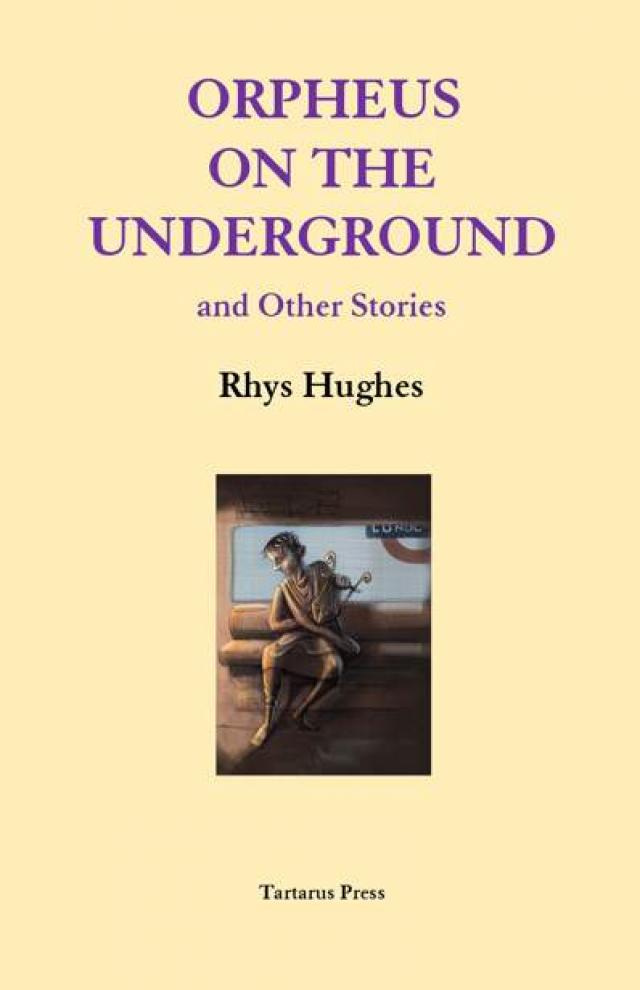


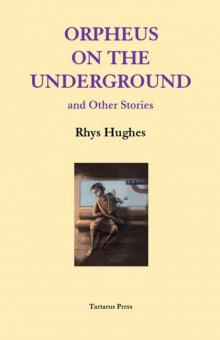
ORPHEUS ON THE UNDERGROUND AND OTHER
by Rhys Hughes
Illustrated by Chris Harrendence
Tartarus Press
Orpheus on the Underground and Other Stories by Rhys Hughes
Published by Tartarus Press 2014 at Coverley House, Carlton-in-Coverdale, Leyburn, North Yorkshire, DL8 4AY, UK
Orpheus on the Underground and Other Stories copyright Rhys Hughes/Tartarus Press, 2015
Illustrations copyright Chris Harrendence
'The Concise Picaresque Adventures of the Wanderlust Bridge' was first published in Strange Tales II, Tartarus Press, 2007
ISBN 978-1-905784-71-4
The publishers would like to thank Jim Rockhill for his help in the preparation of this volume
to Amira Ana Smyth
CONTENTS
The Upper Reaches
Orpheus on the Underground
The Gargoyles of Black Wood
The Despicable Bungling of Yorick Porridge
Behind Every Ghost
The Ghost Written Autobiography of a Disembodied Spirit
Double Meaning
The Nick of Time
The Bicycle-Centaur
The Quixote Candidate
The Pocket Shops
The Concise Picaresque Adventures of the Wanderlust Bridge
The Phantom Festival
Not Looking
New Improved Recipe for Disaster
The Great Me
THE UPPER REACHES
THIS TALE IS a true account of a haunting, but I want it to be read as a work of fiction. Presenting it is as yet another addition to the ghost story genre should increase its chances of publication. Readers may criticise the technique and plot, and perhaps the characterisation and dialogue, but they will not think to question its veracity, because they will assume it is purely a product of my imagination. This would be a relief. I could not bear to be thought a liar and compelled to defend my name by furnishing concrete evidence of my experience.
Such evidence does not exist. Far better to submit the piece as a supernatural tale and not have to worry about my reputation. I must admit, though, that I am doubtful it will be accepted, for it is traditional, old fashioned even, and contains none of those literary tricks so beloved of the modern reading public, such as self mockery, irony and deliberate anachronisms. It is not a parody but an honest yarn.
I have a duty to set down in plain words the events that so recently troubled myself and my colleague Cunningham. The location of these events was an unremarkable wood in a narrow Shropshire valley. I think it was our third night of open air living when it started. I had wandered some distance from our camp to collect firewood, and when I returned I saw that Cunningham was peering up into the sky and muttering to himself.
‘Too early for stars,’ I remarked.
He raised a finger to his lips and then crouched down and began digging into the layer of dead leaves and moss that carpeted the glade. I waited for him to request my assistance, but he abandoned the work before a minute had passed.
‘Nothing there,’ he announced.
‘What were you hoping to find?’
He shrugged. ‘Concrete, rusting metal, scraps of fabric.’
I lowered my bundle of firewood into the centre of a small circle of stones. I knew a fair bit about living rough—how to locate food, start fires by rubbing two sticks together, all that sort of thing—but to be honest we were well equipped and had no need to test our survival skills. I had a box of matches in my pocket and there was even a bottle of brandy. But I enjoyed making the most of our situation, building the fire carefully and glancing around at the circumference of the clearing in anticipation of wild beasts. Cunningham sighed.
‘You don’t seem very interested in what I was doing,’ he said.
‘Very well, tell me about it. I hope it justifies the fact that you haven’t fetched any water from the stream. We agreed to do all the routine tasks before sunset.’
Cunningham dug the toe of his boot into the ground. ‘Maybe it was those berries we ate for breakfast or the mushrooms we had last night, or perhaps I’m just more tired than I realise, but I had a funny turn. I had a vision, a vivid hallucination. It gave me a very strange sensation.’
‘We shared the same food,’ I pointed out, ‘and I feel fine.’
‘Well maybe I’m not ill, but I can’t think of any other explanation. One moment I was standing in this clearing, the next all the trees had gone and I was in the middle of a runway. There was an aerodrome but it didn’t resemble anything I’ve seen before. The aircraft were strange, big clumsy things, not the sort of machines one might expect to remain in the air very long. Do you recall the Tarrant Tabor? They reminded me of that monstrosity, only they had one pair of wings, not three. Anyway, all these men started walking across the runway and climbing into these contraptions. I called out to them.’
‘What did you say?’
‘I told them their aircraft were too heavy to fly. Even though I was in plain view, the men walked past as if I wasn’t there. One of them did turn and stare directly at me for a few moments, then shook his head and moved on. They were wearing strange masks over their faces—as if they expected a gas attack. I watched open-mouthed as the engines started up. They made a dreadful din! Really big aircraft have a nasty habit of crashing on take off, like the Tabor or the Capronissimo, and I was expecting an accident here, but I was wrong. These aircraft flew beautifully! One after the other they soared into the sky and I caught myself raising my arm to wave.’
‘And then?’ I prompted.
‘I followed them with my eyes until they became specks, then suddenly I was back in this clearing and you were standing next to me.’
I finished arranging the last piece of firewood, struck a match and applied the flame to a fistful of dry grass. The smaller twigs soon caught and the snap of dead wood and hiss of sap was as comforting as ever. Even the pungent smoke put me in a good mood. I smoothed my blanket on the ground and stood a can of water to boil on one of the fireside stones. Cunningham and I watched the blaze in silence, and every so often he glanced up at the sky, searching for his imaginary aircraft. I wanted to tease him but at the same time I was aware that delusions are no laughing matter. He might be seriously ill.
‘Gigantic aircraft have flown,’ I said, to humour him.
He snorted. ‘Not with the ease of the ones I saw. They soared into the air without any lurching or straining. Their engines were more advanced than anything I’ve encountered.’
‘Do you think they were supernatural in origin?’
He shook his head and leaned forward. ‘No, they were solid machines. But maybe the vision itself was supernatural. I mean, what if I somehow glimpsed a scene from the past? Those men looked as if they were going to war. What if they—and the aircraft—and the aerodrome itself—were ghosts? Maybe we’ve found the site of a secret base for experimental aircraft? We know such bases existed.’
‘Of course. But the war has been over for ten years. Even if the aerodrome was completely dismantled, these trees couldn’t have grown so tall in such a short time. Is that why you were digging in the soil? But you found no trace of a runway, did you? I can’t imagine that this forest has been anything other than a forest for thousands of years. Whatever you saw, it wasn’t from the past.’
‘Best to stay rational,’ he agreed.
‘It’s part of our job,’ I replied with a grin.
Both Cunningham and myself were pilots, test pilots in fact, so his vision had been peculiarly appropriate. We had flown in the war together and proved ourselves so skilful and calm in combat that we were withdrawn from the front and transferred to the Royal Aircraft Factory at Farnborough. There we were required to discover the performance limits of the latest aircraft. A typically idiotic bureaucratic decision. Many of the contraptions we were expected to fly were truly awful. Cunningham liked to joke that the designers might succeed where the Germans had failed—in finishing us off! When I saw designs like the B.E.9 Pulpit, in which the propeller came directly between the gunner and the pilot, and the pilot’s view was blocked by both, I did wonder who was working for whom.
Some of the designs were based on German prototypes, for example, our attempt to build an ‘invisible’ aeroplane. A Linke-Hofmann R.8/15 was captured in France and shipped back to Farnborough, where it was copied and supposedly improved. In an attempt to confuse anti-aircraft gunners the fuselage was constructed from transparent sheets of Cellon, but this highly reflective surface made the aeroplane more visible, almost incandescent, and its fragility meant that it was liable to disintegrate in hot weather. Our version of this ridiculous beast shone so brightly in the morning sun that it attracted thousands of insects and the pilot was forced to land, his vision almost completely obscured by a layer of flies.
After the war, Cunningham and I remained at Farnborough and continued testing military aircraft, not all of them the products of madmen. In fact, I was amazed by the advances made in the decade following the war, especially when it came to engines. Reliability was always a big question when flying something new, and we both avoided death by no more than a hair’s breadth on more than one occasion. We were experts at surviving crashes, and proud of the fact. (I should have given all this information at the beginning of my tale, but I am not a professional writer and flaws in the structure of my narrative are further proof that it is true. But I do not ex pect you to believe that. I may invent some ghost stories when I have the leisure to do so, but I shall exercise greater control over their form than in the piece you are presently reading.)
The evening passed slowly and I was troubled by the feeling that everything was repeating itself—the way we sat around the fire, our conversation, even the smallest and most insignificant details, like the hoot of an owl or rustle of a branch. I knew that Cunningham was suffering the same sensation. I could see it in his eyes. At last, the duty of preparing supper brought us back to reality. The can of water was boiling and we added to it the wild mushrooms and roots remaining from the previous night. I opened the bottle of brandy and we toasted each other and the ghosts in Cunningham’s vision. As I tilted my head back to drink I saw the stars and for a moment thought I detected the droning of an engine.
Cunningham heard it too. ‘Are they coming for us at last?’
I passed him the bottle. ‘No. They won’t bother searching at night. But I’m sure they will be here tomorrow.’
I think that was the last thing we said to each other. There was nothing much to do after supper so we curled up in our blankets and fell asleep. My own slumber was light and I remained rather anxious about our main task. It was long after midnight when I finally abandoned any hope of sleep and shook myself out of my blanket. Cunningham was snoring contentedly.
I picked my way through the undergrowth to the site of our ‘secret’. Guarding it from prying eyes was our primary duty, as well as staying alive. I found groping among the low branches and tall nettles extremely difficult in the dark. Something powdery brushed my cheek, probably the wings of a huge moth. I was on the point of turning back and waiting for daybreak when suddenly all the undergrowth vanished. There was clear space around me.
I wondered if I had ended up walking in a circle and stumbled back into the clearing, but I soon realised that I was standing on a concrete surface, a runway, and in the distance stood a collection of hangars and squat buildings. An enormous aeroplane with an enclosed fuselage sat silently to one side. It had four engines and reminded me a little of one of Sikorski’s designs, but it gave a far greater impression of brute strength. While I gazed at it and wondered how I had managed to enter Cunningham’s hallucination, I became aware of a figure strolling across the runway towards me.
When he reached me he lit a cigarette.
‘You’re the friend of the other one,’ he said.
I nodded. ‘You don’t have any difficulty seeing us?’
‘No, I’ve always been sensitive to things like this. Nobody else knows you are here. I couldn’t sleep so I came out for a walk. There’s a raid over Cologne tomorrow.’
I digested this and rubbed my chin. ‘I don’t know how to tell you this, so I’ll just say it straight. You’re dead. You are a ghost.’
He drew heavily on his cigarette. ‘Dead am I? Are you sure?’
‘I’m afraid so. The year is 1929, the war has been over for a long time. But don’t worry, we won. Remember that—the Kaiser will be defeated.’
He frowned. ‘The Kaiser? Don’t you mean the Führer?’
A chill entered my blood. ‘I don’t know what that means. I’m a pilot, just like you. I also fly experimental aircraft.’
I nodded towards the giant aeroplane.
He followed my gaze and laughed. ‘Experimental? Nothing experimental about that. It’s an Avro Lancaster, an ordinary bomber, one of thousands.’
‘Normal?’
He shrugged. ‘It’s very reliable, as good as anything the Germans have.’
I wanted to ask him more but suddenly he was no longer there and I was back in the forest, even the whiff of his tobacco smoke had vanished. I could hardly wait to tell Cunningham the truth about what I had seen. But I swallowed my impatience and continued towards the site of our crashed machine. This was our ‘secret’—the smashed fuselage of the aircraft we had been testing. There was nothing more of value I could take from it to make our camp more comfortable—we had already removed every item of practical value; the blankets, cans, brandy and matches. I was careful not to cut myself on the broken glass that glittered everywhere. The machine was truly a wreck.
Our orders had been, in the event of an emergency, not to abandon the aircraft but remain with it and guard it to prevent it from falling into the wrong hands. This was why we had remained in the forest for three days instead of seeking help. It was really only the engines that mattered. The rest of the machine—the control system, frame, wings, even the bombs in the hold—were all conventional examples of their type. But the engines were special. They ejected combustible gases in a powerful stream and had amazing potential for high speed flight. They were still imperfect, having a tendency to misfire and even explode. I was astonished by the fact we had managed to walk away from the crash with barely a scratch between us. A tribute to my flying skills, I suppose. No slur intended on Cunningham—I am sure he would have performed equally well had he been sitting in the pilot’s seat during the malfunction.
We had levelled seven or eight trees before coming to a shuddering halt. Fragments of fuselage lay scattered over a large area, but the engines were still intact. I could not understand why the rescue party was taking so long to come. If many more days passed in this manner we would have to walk out of the forest to the nearest village, orders or no orders. I judged our lives more important than the secrecy of our mission, which was after all only a practice bombing run over some deserted land in Wales. But I understood the need to keep the engines out of sight and away from public scrutiny. New designs had an astonishing ability to cross borders and end up in the hands of the enemy. Not that our country had any enemies at the present time. But my encounter with the apparition of the airman had destroyed my complacent belief that war was a thing of the past.
I returned to the clearing satisfied that everything was in order. I did not wake Cunningham immediately. I waited for dawn, and when I spoke to him, there was a quaver in my voice that I did not like.
‘I saw the airfield,’ I said simply.
‘Did you? So I’m not going mad after all! What happened?’
‘I had an interesting conversation with one of the pilots. Guess what? He’s a ghost sure enough but not a ghost from the past. That aerodrome exists in the future!’
‘Ghosts from the future? That’s absurd.’
‘It explains why you didn’t find any remains when you dug into the ground. There never was an aerodrome here, but there will be—sometime in the future, I don’t know when exactly, because I didn’t get the chance to ask. There’s going to be another war with Germany. The aircraft we saw on the runway are the ordinary aeroplanes of the future. That’s why they looked so strange. What we experienced was a premonition!’
Cunningham looked doubtful. ‘I have a different theory. I don’t believe in ghosts from the future.’
‘What do you mean?’
He turned to face me and rolled his eyes to the sky. He wore an expression of such dejection that I felt a pang in my heart.
‘Why hasn’t the search party come for us?’ he asked quietly.
I tried to sound optimistic. ‘Give them a chance. I’m sure we’ll be rescued today. After all, this will be only our third day out in the wilds.’
‘How many days?’ he growled.
‘Three. This is the morning of our third day.’
‘You said that yesterday. And the day before—and the day before that! Every day is only our third day. How long have we really been stuck here? Weeks, months, years? I don’t think those ghosts are from the future, I think they are from the present. In fact I don’t believe they are ghosts at all but living men, flesh and blood.’
‘Tell it to me straight,’ I whispered.
Cunningham paused, and then croaked, ‘I’m not sure we survived the crash.’
‘You mean we are the ghosts?’