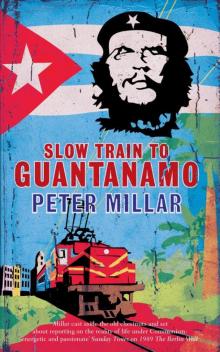
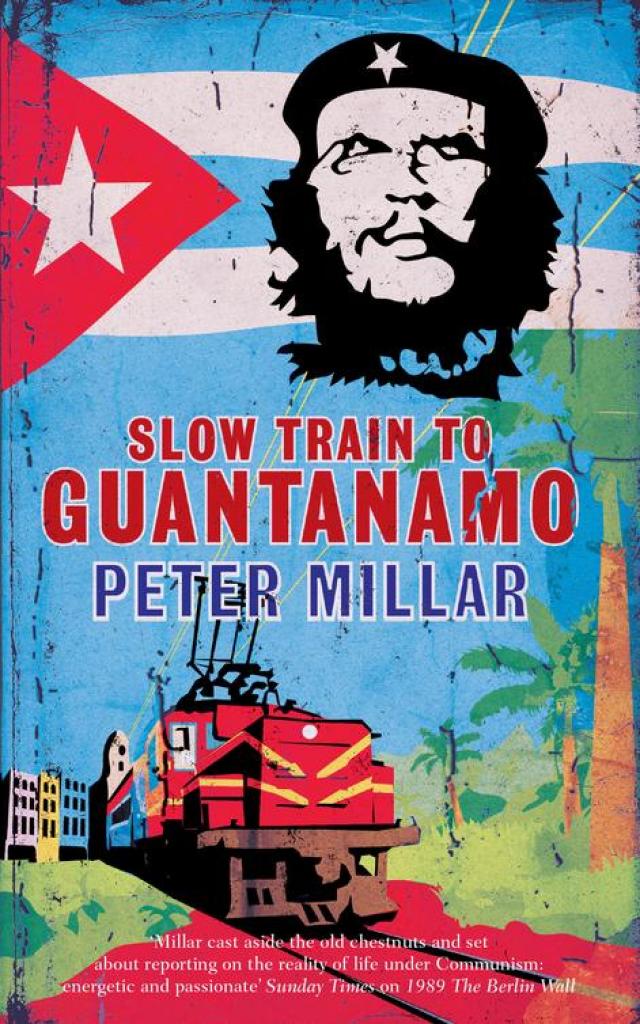
Slow Train to Guantanamo, page 5


La Moneda Cubana is one of the oldest of Havana’s paladares. It occupies a magnificent location near the western end of the Malecón with a fine view from its rooftop eating space over the cathedral square, the bay with the old Spanish fortifications on both the Havana and Casablanca sides. It is a great spot to watch the sun go down, and enjoy the spectacle at 9 p.m. each evening of a great old cannon being fired across the bay. It helps of course if you know about that bit in advance. I didn’t and ended up with a substantial splash of mojito in my lap when it went off behind me.
This time, as I was leaving in the morning and not at all sure what food would be like in the interior provinces, I broke my rule and had the lobster, or at least a small version of one in a mixed seafood platter. This was a private restaurant, after all. They could, I reasoned, be expected to be better cooks than the employees of the state-run hotels. I won’t make that mistake again.
I spent the remainder of the evening, while picking bits of rubberized seafood out from between my teeth, wandering the atmospheric streets of the old town, along Obispo and Obra Pia, names redolent with ancient Catholicism – Bishop Street and Pious Works Street – now awash with rum, beer, tourists and natives swaying to bands in ever bar playing trova, danzón, rumba, timba and son. Cuban music traditions, with their mix of Latino tunes, jazz improvisation and heady rhythms derived from African drumming are more than worthy of a book in their own right, but nothing quite equates to just soaking it up, or taking to the floor with the Cubans.
Sometimes that can be hard to avoid. Most bars have at least a proportion of working girls – and guys – in residence. This does not mean prostitutes. Prostitution is illegal in Cuba as well as the sort of sleazy sex industry that flourished in Havana when Meyer Lansky’s Jewish and Italian mafia gangs ran the girls and gambling emporia of the 1930s and later. Pimps are next to non-existent in Castro’s Cuba, but ironically it is one area in which freewheeling capitalism flourishes. There are more than enough girls – and guys – in Havana willing to give a tourist a good time – by no means necessarily involving sex (since prostitution is illegal) – as long as they get to share a taste of the good life they can’t otherwise afford.
Each bar will have at least one ‘dance instructor’ of each sex, who may well be just that – to encourage shy Canadian ‘snow geese’ to get up and enjoy themselves, maybe just to spend a bit more money behind the bar, maybe to splash out on a bit of ‘extra fun’. Or maybe not. The latter was the option I chose when unexpectedly an extremely giggly large round black lady perched on a stool next to me and asked me if I wanted to salsa. When I politely declined, she suggested I might prefer something a bit more piccante. Maybe I would like her to be my girlfriend for my holidays. Like they used to say at the News of the World, I made my excuses and left.
Which is how I manage to be relatively bright-eyed and bushy-tailed heading out of La Meson de la Flota at 7.30 in the morning, strolling with a fair wind at my back (or would be if there was any wind rather than the constant oppressive tropical heat) towards the ferry terminal in time to catch the 08.00 to Casablanca. There is supposed to be a 10.00 ferry as well but nobody is willing to swear to that, and I’m gradually getting the message that getting anywhere takes a lot longer than expected.
Except now that I’m there, it doesn’t look as if they’re going to let me on. A fierce woman with dangly earrings, the regulation state micro-miniskirt girding her ample derrière above the equally obligatory fishnets, is aggressively wielding a metal detector in the direction of my rucksack.
‘Bagaje, no,’ she insists. No luggage. This is something I hadn’t reckoned on. This is hardly an international flight after all, nor even a long-distance crossing. The journey time is no more than 10 minutes across the bay, and the ferry itself a single-decked square rust-bucket – little better than a motorized raft with a roof– with standing room only and place for a couple of bicycles.
But then I remember an anecdote I had heard and all but dismissed as a joke. Despite the wholly evident unseaworthiness of this dodgy looking excuse for a nautical vessel – the Woolwich ferry in South London is an ocean-going cruise liner in comparison – back in 2003 a gang of would-be emigrants hijacked one and tried to take it to Miami. It is perhaps 200 miles across the Florida Straits to Key West; these guys only got a few miles off the Cuban shore with 30 men, women and children as hostages on board before the Cuban coastguard boarded without firing a shot. The only shots that were eventually fired, were those that executed three of the hijackers.
That incident was nearly a decade ago, but it is undoubtedly still in the minds of government officials and their attitudes. On the other hand, as the routine at the airport suggested, there genuinely is in these latter, post-Fidel days of Cuban communism more of an air of official insecurity than anyone is admitting.
In the end, though, largely due to the influence of a younger woman who has already started going through my rucksack – partly I suspect in the hope of finding something worth confiscating – the tubby tyrant with the metal detector settles for giving me a brusque frisking. The only thing her colleague can find worth confiscating is my Gillette Fusion Power razor, especially after she plays for some time enthusiastically with the ‘smooth glide’ vibrating control. In the end her colleague insists that I remove and hand over the multi-blade razor head, clearly not suspecting (at least from a security point of view) that I might have a spare. If I really were James Bond I would have quipped, as I boarded the ferry, ‘That was a close shave.’
There are only a dozen of us on board the rusty motor raft as we pull out into the waters of Havana Bay, the cool breeze from the sea welcome in the sticky heat building already at even this hour of the morning. The fare is two pesos each, but again I am forced to pay in convertible ‘CUCs’ while the Cubans pay in nacional pesos. I am not one hundred per cent sure however that my fare is going straight to the government. Not my problem.
By 8.30 I’m clambering off the ferry onto a crumbling concrete jetty and looking up at the gleaming white giant Jesus which dominates the hillside above Casablanca. I’m actually surprised I can see him at all. I have a problem with large religious monuments. Or rather they seem to have a problem with me. It first manifested nearly 20 years ago when on a visit to Hong Kong I went out to Lantau island, home to the then newly erected world’s largest statue of Buddha, a 250-tonne seated colossus more than 100 feet high. By the time I got to its base the fog was so thick I could barely make out Buddha’s big toe.
Similarly on my one and only trip to Rio de Janeiro I took the funicular up the Corcovado mountain to the city’s famed landmark 130-foot statue of Christ the Redeemer. By the time I reached the top, the clouds had come down. It might have felt like an allegory of the Ascension, but as far as I was concerned the Saviour was invisible.
The first time I tried to see the Sistine Chapel in Rome, I discovered I was there on the one day in the year apart from Christmas when the Vatican’s treasures were off-limits to the public. As a convinced atheist, I think God is trying to tell me something.
Even on this occasion the 66-foot high Christ of Havana is clad in scaffolding, not enough to completely obscure it, though if I can see Jesus I’m not absolutely sure he can see me. Which may be just was well. This statue has a history of interventionism: it was inaugurated on Christmas Eve 1958, just 15 days before Fidel Castro entered Havana to celebrate the triumph of his revolution. As he did, a lightning bolt hit the statue knocking its head off. A mixed message at best.
Just to be sure, I tip a nod to Big Jesus – his head was subsequently restored – before making my way to a little concrete shed by the side of some rusty iron rails. This, according to the piece of scrappy white paper in the window announcing that the ticket office will open at 9.30, turns out to be Casablanca station. Not much of a place to kick your heels for nearly four hours. But I’m starting to realize that in Cuba waiting is a way of life.
There is not a great deal of local colour to take in. The station itself looks like a 1960s seaside bus shelter in peeling green paint and a slogan on the wall that reads, MI FUTURO – REVOLUCIÓN. In most of the world it seems history is condemned to repeat itself, in Cuba it would appear to be actively encouraged. Opposite me on the other side of the tracks, assuming these rusting bits of iron are actually part of a functioning railway, is a pile of concrete rubble that might once have been a house, overgrown with a crimson riot of bougainvillaea in full blossom.
My belief that a train might actually arrive is given an oblique sort of encouragement by the sight of man on a ladder doing some form of welding work near what seem to be overhead electric cables. I suspect doing welding near live cables might not fit the prescription of our own dear Health and Safety Executive, but then they probably wouldn’t approve either of the fact he isn’t wearing gloves or goggles, despite the flying sparks, and his ladder doesn’t look awfully well secured.
The noise of the welding gun is a counterpoint to the rattle of cicadas in the trees. There is a curious laid-back exotic romanticism to it all. It occurs to me that if I were Japanese I should compose a haiku, something along the lines of
Above rusty rails
Sparks fly, crimson flowers fade.
When will my train come?
A little pedestrian perhaps, but I think I’ve got the number of syllables right and the flowers are a seasonal reference, sort of. Then a cloud of dust billows down what passes for a road and one of those ancient black Chevrolets that the Russians modelled their 1960s Chaika limousines on, clunks across the tracks, does a three-point turn for no apparent reason and disappears again, swallowed up by its own sandstorm.
From out of nowhere, a scrawny, pale-faced elderly bloke with close-cropped grey hair in a black singlet hanging loosely over his emaciated frame stumbles into view, trips up on the tracks, steadies himself and then collapses onto the bench in front of me, takes a long swig from a can of Bucanero fuerte (the 5.7 per cent ABV variety) and belches loudly.
A few minutes later he looks over in my direction and mumbles something of which I pick up one word, borracho, amongst a slur of other syllables. Which is fair enough, because borracho means drunk, and he is at least applying it to himself. With a hiccup.
At this stage, however, I haven’t had long enough to work out that rather than saying estoy borracho (meaning I’m drunk) he might actually have said soy borracho (meaning, I am a drunk). Because the latter certainly turns out to be the case.
It did not take an awful lot of the three hours we were both going to sit there waiting for a train for me to realize that. Initially, he seems harmless enough, almost pleasant even. He even has some English: ‘Sorry,’ he says pleasantly apologetic when he realizes that my Spanish is substantially less than perfect, and I am having difficulty understanding him. ‘Please tell me if I am a problem for you,’ he says, embarrassing me into the usual, ‘No, no not at all’ disclaimer. Disclaimers I almost immediately come to regret as he says, ‘Sorry,’ yet again, before completely unexpectedly and very loudly bursting into song: ‘Sorry seems to be the hardest word!’
I am partial to a glass myself but 9.30 in the morning seems a bit early to be as wasted as this guy clearly is and singing to strangers in the street is definitely more than is called for.
Happily it doesn’t last. After a slight intermission, during which I suspect he has briefly dozed off, he comes to, apparently slightly sobered up. For the next half hour or so, we have a conversation in which he and actually tells me interesting stuff, such as the fact that just along the coast at Las Terrazas is where Hemingway kept his boat Pilar. As I noticed earlier, just about everybody in Havana has a Hemingway story.
The reason for his more than adequate English, he tells me, is that he has a son in Norway, ‘where everybody speaks English’. Then suddenly he goes quiet. ‘They are looking at me,’ he says. Who, I wonder, and then I notice a couple of policemen who have just come off the later ferry. They don’t seem to me to be paying any attention to anyone much. But then I am not Cuban. Or drunk.
‘When I was at the University of Havana, they said I was mad,’ the drunk, who tells me his name is Miguel, says. ‘Because I was an individual. You know what Stalin said, he said, one man is more of a problem than a million, a million is just a statistic. They watch me, you know.’
It is not impossible. I have lived in countries with secret police long enough to know you never know when they might be watching and when they are not. But in reality I suspect it is a long time since anyone has watched Miguel, or watched out for him. That does not mean he is paranoid. His Stalin quote is inaccurate, the original is a lot worse: ‘the death of one man is a tragedy, the death of a million is a statistic.’ But the fact that he knows it suggests he might indeed at some stage have been a thorn in the communist authorities’ side. It might also explain why now, in his fifties but probably not much older, he is unemployed. And a drunk. I ask him where he is going.
But the sleep-induced sobriety is wearing enough and instead of a destination I get something between poetic prophecy and drunken doggerel: ‘I don’t know where I’m going. No one knows, when the volcano blows.’
Over by the crumbling concrete jetty a café is opening up. A bite to eat might be a good idea. The timetable suggests the journey to Matanzas, barely 80 kilometres (50 miles) by road, will take nearly four hours as the train winds its way through the countryside and along the coast. It also gives me an excuse to escape Miguel’s now melancholy drunken ramblings.
The café staff are cleaning up, sweeping the bare concrete floor and my hopes of finding something edible are not great. But then a large man in a loud checked shirt comes over an inquires if I am a foreigner: the unavoidable de donde, amigo question: where do you come from, my friend? I tell him and he says he is the manager, that they are just getting ready to open in half an hour. I explain that I am waiting for the train and gesture towards the station where Miguel has once again burst into song, this time serenading an elderly couple doing their best to ignore him.
The manager shakes his head. ‘Take a seat, I will get you something,’ just taking the time to reassure himself – politely – that I can pay in CUCs.
Ten minutes later, much to my surprise and astonished pleasure, the kitchen has rustled up a bocadillito – a roast pork and grilled bacon sandwich served with some freshly made potato crisps. I settle down to eat under some dried palm fronds savouring the cool breeze from the bay and a cold beer from the fridge. If I’m going to have to put up with a drunk all the way to Matanzas, I’d better take some of his medicine.
By the time I get back to the platform a few more potential passengers have arrived. The ticket office isn’t open yet but there is a woman in an approximation of a uniform fussing around. I take my seat again opposite Miguel who has mercifully gone back to sleep. A woman with two children arrives and shouts the question which I have been warned is crucial etiquette in the unavoidable everyday Cuban experience, the queue: ‘Quién es último?’ Who’s last?
This is a remarkably civilized and in my experience uniquely Cuban attitude to queuing. Instead of having to stand in a long line for hours – and in Cuba queues frequently last for hours if not days – you find out who the person immediately ahead of you is. That way everybody is free to mill around or wander off until you see that person being called. It is a sort of chain reaction and happily, while I was feeding my face, the drunk Miguel has already established my place in it at the head of the line.
Eventually with much clanking and squealing of iron on iron an apparition which I can only construe to be our train lurches in. The drunk looks up from his sleep and says surprisingly lucidly, ‘I’ve been waiting for this moment all my life.’ I wonder for a poignant moment if he might actually mean it. Then all of a sudden he repeats the same line, at the top of his voice, in an impromptu karaoke version of Phil Collins. It seems his entire English vocabulary and syntax is a litany of pop song refrains strung together with a few conjunctions. (I suspect it was that which would put the Phil Collins line into my head arriving in the bleak Santa Clara dawn two days later.)
Glad as I am to see the train arrive, I find it hard to believe it will actually get us to Matanzas. The only time I have ever seen such rusted bodywork was in a scrapheap for ancient cars in the midst of the Montana desert. There are just two carriages and parts of the lower sections of each which look thin enough to push a finger through. The roof has long lost the bulbs supposed to fit in its horn-like headlights. The pantograph which provides the power from the overhead rails looks like if it stopped hanging from them the whole train would fall to bits.
But clearly everyone else is more optimistic. The ticket office is open. I pay my four ‘CUCs’ and finally get hold of my first Cuban train ticket, a little piece of paper with punched holes for each station you are allowed to stop at. I’m going all the way so it is virtually perforated.
My fellow passengers are an assorted lot: a massive handsome black guy who could be a double for the young Mohammad Ali, in a tight red T-shirt that shows off his pecs, a skinny, stereotypically Latino gangsta-looking bloke in designer sneakers and bright orange shorts with a spider tattoo climbing up his arm, a well-built mulatto woman in skin-tight day-glo pink pants and a tight low-cut top, and of course the drunk who is now giving English lessons of a sort to one of the children of the middle-aged woman who arrived last. The elderly couple I had spotted from the café apparently aren’t getting on the train all day: it seems they’ve just come to watch.
A quick look at the train suggests, to say the least, that it lacks even the most rudimentary toilet facilities, so I really need to lose some of that beer before getting on board. The difficulty is that there is no obvious sign indicating the whereabouts of the station conveniences.