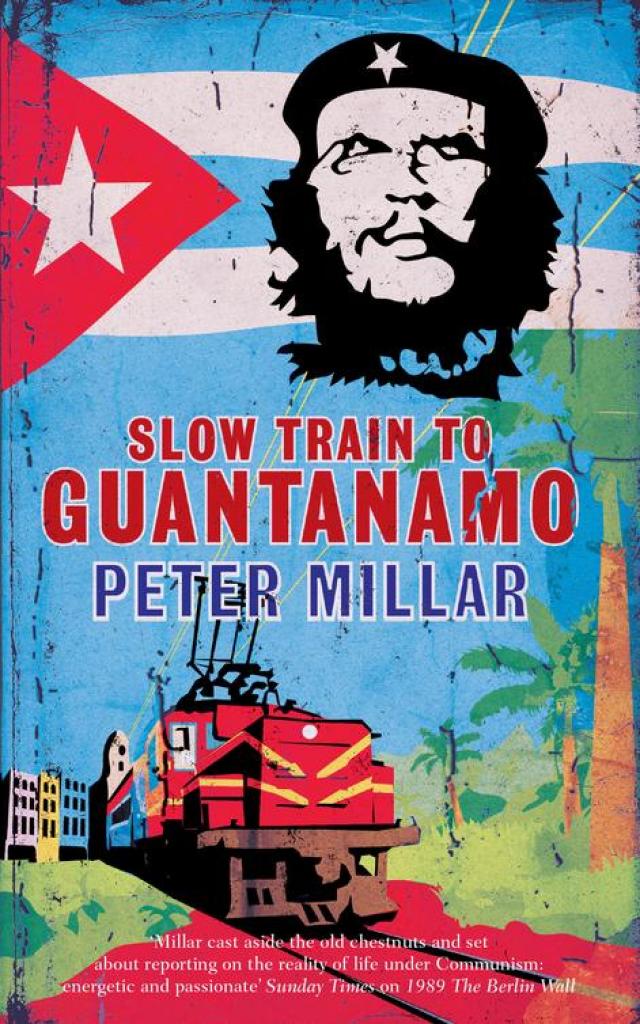
Slow Train to Guantanamo, page 10


After he was captured and brutally executed by Bolivian government troops aided by the CIA in 1967, the song which played on Che’s own slogan Hasta la victoria siempre, ‘Ever onwards to victory’, became an anthem, seen as a poignant farewell, a tribute to the legend made all the more powerful by his martyrdom. Here echoes round the palm-fringed square just as, almost on cue, a couple on a motorbike ride across it. The ‘easy rider’ thing is no joke: that combination of youthful idealism and footloose romanticism became the distilled essence of the 1960s, and despite the often bitter taste of harsh realism that has come to flavour the modern world, it is a mythology that is still remarkably easy to evoke.
The Che memorial complex is an extravagant devotional shrine. Whatever political changes engulf Cuba in the years ahead, it is hard to imagine any future government of whatever political persuasion demolishing it. Che himself, a giant warrior in bronze, looks out from the top of his granite obelisk, inscribed with his own wishful, visionary, prophetic words:
‘I feel myself strongly to be a patriot for Latin America, for any Latin American country, that at this moment if it were necessary I would lay down my life for the liberation of any of the Latin American countries, without asking for anything or expecting anything.’
Before entering the museum housed on one side of the base of the obelisk, I am required to check in my bag and camera. Along with groups of reverent Cuban schoolkids – who have begun every morning of their school life declaring ‘We will be like Che’ – I pass through the great doors to inspect relics, venerated as much as those of any saint. They are curiously touching: a copy of his original registration as a trained nurse, on which he comes across as a better-looking dark-haired Leonardo Di Caprio, a similarity that is even more striking on his name tag as an athlete in the Pan-American games.
This collection of objects brings the man closer. There is the Soviet Zenit camera he used in Mexico in 1955, a set of dental instruments he carried with him and, a testament to his own occasional frailty, an ancient leather and glass asthma inhaler.
Then there are the tools of his other trade, a Colt revolver, a Stevens rifle, a Thompson sub-machine gun, the M1 carbine he used in the Battle of Santa Clara. Next to me a twenty-something Cuban guide it would be easy to take for a California college kid in yellow baseball cap, shorts, sneakers and shades is explaining to his younger compatriots Che’s tactics with the bulldozer and farm tractors.
Another glass case holds the ‘Transoceanic Wave-Magnet’ radio he used to transmit news of the rebels’ victory, a cap he wore during voluntary work at wheat mills in 1962, at a time when he was a government minister, his fountain pen and the inkwell he used along with the banknotes bearing his signature from the period 1959–61 when the Marxist revolutionary was Finance Minister and president of Cuba’s Central Bank.
It reminds me of the former Bavarian royal residence, now the Münchner Residenz museum in Munich: they have enough pieces of John the Baptist not just to clone him but to rebuild his corpse several times over. We may not have body parts, but these relics are real; the saint died barely half a century ago.
There is even the Guevara universe’s equivalent of the crown of thorns: the black beret with the star worn in Cuban photographer’s Alberto Korda’s iconic portrait taken of him at a rally in Havana in 1960. Korda entitled the picture Guerrillero Heroico (Heroic Warrior) and it went on to become a global icon of revolution, for which Korda himself never received a cent, convertible or otherwise, for abuse of his copyright, insisting he favoured anything that would ‘propagate his memory and the cause of social justice throughout the world’. He changed his mind on only one occasion, in 2000, suing the vodka firm Smirnoff for using it in an advert, claiming he hadn’t intended it to be used to market alcohol. Even then he donated the US$50,000 settlement he received to Cuba’s healthcare system.
But there was another incident that helped the Korda image become a global icon. Improbably, but as so often in these things, it concerns an Irishman.
Apocryphally, Jim Fitzpatrick was working as a teenage barman in Kilkee in the south-west of Ireland one evening back in 1963 when who should come in and order a whiskey but Che himself. Guevara was on his way back to Cuba from Moscow and they had touched down to refuel in Shannon airport – where Aeroflot had established a refuelling base – and been stranded by fog. Deciding to make the best of it, the revolutionary had nipped out for a touch of local colour in the form of a drop of the hard stuff.
Stunned by his brief encounter, Fitzpatrick, an art student, followed the great man’s career and on his death adapted the Korda photograph into what he himself called a ‘psychedelic print’, in which Che’s ‘hair was not hair, it was shapes’, ‘it looks like he is in seaweed’. Fitzpatrick created the image for a Dutch anarchist magazine, but he also hand-printed thousands and gave them away on the streets of London. He said he wanted them to ‘breed like rabbits’. They did, becoming the icon of revolution that has adorned T-shirts and student bedroom walls ever since.
The final case holds mementos of his martyrdom: a copy of the fake Uruguayan passport he used to enter Bolivia, the water bottle and hypodermic syringe he carried, the saddle on which he rode through the Aguarague mountains to Camiri. There is even – the equivalent of the Holy Grail used at Christ’s last supper – the plate on which he was served food at a Bolivian school in 1967, just weeks before his capture and execution.
Just across a cool granite-walled hallway from the museum is the holy of holies itself: the mausoleum. Unlike the rubberized embalmed Lenin’s grim edifice in Moscow’s Red Square or Spanish dictator Franco’s grandiose mock medieval tomb carved into the heart of a mountain in the Valley of the Fallen, Che Guevara’s last resting place is one of the least intimidating, most curiously relaxing tombs I have ever come across.
For a start the room is gratifyingly cool, with low lighting, with gentle piped music, not religious, martial or mournful, just a cool, laid-back jazz, or gentle Latino folk music, the sort you might put on in the background after a dinner party with friends. The floor is solid wood, the walls made of flat polished granite blocs, thin like Roman bricks, interrupted here and there by a plaque with a bas-relief of the face of one of thirty revolutionary heroes, including the six Bolivians caught and executed along with him. In front of each is a small glass of water with a single flower.
Che’s is the same size and shape as all the others, no greater, no more elaborate, at the far end of the room, next to a little tropical garden, not so much a sepulchral shrine as an awe-inspiring fairy grotto. I was prepared for a riot of bad taste, and find instead a symphony of tasteful discretion.
It is also fairly recent, built in 1996 a year after Guevara’s bones were found in a mass grave in Bolivia, identified by the missing hands, cut off on the orders of the Bolivian president to be sent to Buenos Aires to identify his fingerprints, and a small pouch of tobacco given him by a helicopter pilot which was found next to the body. The remains were ‘repatriated’ to Cuba – he was bizarrely declared a ‘Cuban citizen by birth’ after the Battle of Santa Clara – and interred in the mausoleum built in his honour on October 17, 1997. He received a twenty-one-gun salute while a choir of school-children sang – what else? – Hasta siempre, Comandante.
‘It gets more than a million visitors every year,’ my bicitaxi man tells me as I climb back on board (the power of the convertible peso is such that he was waiting around for over an hour to be sure to catch me coming out). Conversation lapses though as he pants heavily to get us back up the hill to Santa Clara’s main square, stopping only briefly to visit a sort of children’s zoo where there is yet another statue of Che. I try to look impressed but I’ve had about as much hero worship as I can take for one day.
On the way we pass alternative examples of Cuban artistry: a white wall painted with satirical anti-American cartoons. They are mostly crude propaganda by state-sponsored artists, but not without humour: a grotesque overweight marine bristling with weaponry including rockets and machine guns, holds a mobile phone to his ear, saying, ‘Sure, Mom, I’ll watch out for the terrorists.’
Back in the main square, I climb out and over tip my bicitaxi man – with a 5 CUC note, a good week’s wages for anyone paid in national pesos. I hate the thought that I might be distorting the market, but he’s done me stalwart service and the impulse to put a smile on his face is just too great.
Apart from anything else I realize what I need after my morning of worthy worship at the city shrines is a stiff drink, and the bicitaxi man has pointed me in what seems the right direction, a bar called La Marquesina on the corner: ‘They have great music there in the evening too.’
Right now what I want is a shot of rum. Straight. I walk into a splendid dark room with a long dark Victorian hardwood bar and a guy in white shirtsleeves and a black waistcoat behind it. ‘What’s your best rum?’ I ask him, and without thinking he brings down a bottle of Havana Club 15 años, and pours me a shot, rich, dark and naturally sweet. I raise it only to see staring down at me, the iconic beret-clad face embedded in a Cuban flag, who else but the man himself? I raise my glass silently: Cheers Che!
Supper in Santa Clara is relaxed, the usual home cooking: barely done pork with some oily fried potatoes. But my host Pablo has procured me a bottle of red wine: Spanish tinto, absolutely ordinario but drinkable. He shares a glass with me (getting wine for his guests, paid in CUCs, is the only way he can afford to drink it) and we discuss the changing world. We are in the open courtyard which, as in Matanzas, here too is at the centre of the house, except that he has made a wet weather cover – of corrugated green plastic. Which turns out to have been a very good idea as the dark clouds above us have opened again and there is now a little line of steady waterfalls pouring onto the concrete floor. Pedro shrugs.
He makes a point of avoiding politics but points out ruefully that a surgeon is Cuba earns just 350 pesos a month (that’s about £12), though as he is charging me nearly double that per night (cheap for me, life-changing income for him). He is hardly impoverished. Nor does he need to advertise. My panic about getting a phone to call ahead and book rooms was unnecessary; I am here because he is a friend of the woman in whose house I stayed in Matanzas. And he has already organized my accommodation further down the island. They may have limited access to the internet in Cuba but social (and commercial) networking is doing fine on the telephone.
Like Isabel, the anaesthetist on the train, Pablo belongs to the generation for which communism wasn’t an aberration but an alternative global system. He served as a doctor alongside the up to 18,000 Cuban troops sent to Africa during the horribly complicated part-tribal, part-ideological battle for Angolan independence. The Cubans’ role was primarily to fight back against South African forces that invaded to set up a regime favourable to Pretoria. They ended up also fighting an invading force from Zaïre in the north and gave support to the SWAPO guerrilla movement fighting for the independence of South African-ruled South West Africa.
Pablo shakes his head when he thinks about it. It was clearly not a particularly happy experience – there were the usual allegations of atrocities all round – although as a doctor, he clearly believes the Cubans did a good humanitarian job. There are also those who believe that without the Cubans’ intervention, South Africa would never have allowed South West Africa to become independent as Namibia in 19894. But at least 2,000 Cubans died during the fighting.
Apropos of some comment or other Pablo decides he must look something up on the internet, clearly proud of having access to it. He leads me into an elegant dark-panelled, book-lined study and fires up an ancient-looking PC. I only realize how ancient when the bulky humming CRT screen finally comes to life and reveals it is running Windows 95. But just as he launches Internet Explorer and finds Google to locate the answer to whatever was on his mind, there is a crackle and simultaneously the screen goes black and the lights go out. ‘It’s a power cut,’ he mumbles tetchily. ‘It’s because of the rain. It happens,’ and then he says the phrase I have been waiting for, ‘Cuba e’ Cuba.’
This is where I play my joker. Packed in my rucksack, in an outer pocket so I know how to find it, is a torch. Not just any torch, but a wind-up torch. I had an inkling getting batteries in Cuba might have been a problem. It does the trick and gets a gasp of amazement. He’s heard about them but never seen them. That’s Cuba, it’s me that thinks it this time: the government spends a fortune on importing Chinese energy-saving light bulbs but nobody has wind-up torches.
But within minutes, he and his wife have produced a vast store of candles. Power cuts are clearly a regular occurrence. His daughter-in-law emerges from the kitchen to help light them while keeping in check the excited giggles of two of Pablo’s granddaughters. Then without warning the lights come on again. I decide it’s time for a nightcap at the Marquesina and head out leaving a scene of blissful domesticity: three generations, the grandparents in rocking chairs, gathered round the television, watching an ancient sitcom.
It could be anywhere, I tell myself.
But in the modern world, could it?
4. In early November, 1989, I was sent by the Sunday Times to Windhoek to report on the elections ahead of Namibian independence, but left early, only just in time to get back to Berlin to witness the fall of the Berlin Wall. See 1989: The Berlin Wall (My part in its Downfall) also published by Arcadia Books.
CHAPTER EIGHT
Sun, Sand and Rain
The next morning it is still raining. Santa Clara is a sea of umbrellas, which the locals of course call parasols. They mostly use them ‘para sol’, for the sun. Funny then that we in England who have practically adopted this ancient device as national costume call it an umbrella, a ‘little shade’. It takes the French to call it what we should: a parapluie. For the rain!
And when it rains in Cuba, it rains. It has been raining all night. Constantly. Heavily. Pablo’s inside-outside courtyard was on its way to becoming a swimming pool, watered from a green corrugated Niagara.
After a long conversation on the phone with the station Pablo has found what he believes to be the time of my next train connection, leaving at 9.30 in the morning, which would be a relatively civilized time if it weren’t that of course they recommend getting there at least two hours early. But Pablo thinks they might sell me a ticket any time on the same day, so in theory – a theory he miraculously believes will work – I might be able to pick one up just after midnight.
I walk up into the main square, with the idea of going to the bank to change money. The sign on the door says is open, but it is closed. A man inside shakes his head and points at the unlit fluorescent tube on the ceiling. The peso drops. The power has gone again. And even in Cuba, no power = no tills.
An improvising taxi-driver hustles me while I am gesticulating at the man on the other side of the door. ‘Later, it will be open later,’ he says. ‘You like a nice ride, out to country, see old church.’ Normally I would have brushed him away, but he’s also rubbing his thumbs and forefingers together, indicating he can change. So with just a little reluctance I climb in the back of his car, a relatively luxurious fifteen-year-old Peugeot.
In theory Cubans are not allowed to deal in foreign currency, even to swap CUCs for national pesos; in practice everybody does it. Anything that brings hard currency into the country is tolerated. It ends up in the government’s coffers anyway. Locals are of course allowed to change CUCs into national pesos and vice versa in a bank. One CUC buys you 24 nacionales but it costs 25 pesos nacionales to buy one CUC. Even under communism, there’s always a margin. On the street, Cubans will cut you exactly the same deal. It’s just that the government feels it’s somehow morally corrupting for its citizens to do what the banks do. Given our recent experience in the capitalist world, they may have a very good point.
For my taxi driver, whose name is Santiago, it’s a doubly lucky day: not only does he change some euros into CUC for me, he manages to persuade me to give a large part of them back to him in exchange for a guided tour of the countryside north of the city, including the little town of Remedios famed for its ancient church with thirteen gold altars. Given that the rain still hasn’t stopped and the streets are filled with yelping schoolkids splashing in puddles, it seems a better idea than sitting soaking up rum all day in La Marquesina.
Also, Santiago is quite the conversationalist. It turns out he is a trained engineer who has not only been abroad, but has a residence permit for the Canary Islands. But because he is not an EU national, he can’t get a work permit which means it is far too expensive for him to live there. Back home in Santa Clara he has a relatively decent car and because his family have a good sized house enabling them to let out a room for foreigners as a casa, he makes a reasonable living. Just about, he insists.
That does not make him a fan of the system. There is just one thing wrong with this country, he blurts out, in an admission I have not heard from any other Cuban yet: ‘Fidel Castro.’ And then, as if an afterthought, he adds: ‘And his brother.’
The irony is that Santiago is not necessarily a radical anti-communist, campaigning for the middle class to take back power from the proletariat: in some ways his attitudes are rather the reverse. ‘Look at our leaders. They’re all city boys. Or were. Lawyers. They make rules but they don’t understand how stuff works. What you need to make an economy run.’
‘Look at those fields,’ he cries almost in despair as we drive north from Santa Clara through scrubland where a few scrawny cattle are not so much grazing as mooching about with their mates wondering when the rain will end. ‘There are maybe 20 cows there. But it is a big field. Why not 200? We have sun, we have rain. It could grow grass for them to eat. But all the land belongs to the government. Then the government pays farmers just 80 pesos a month to work the land. Why would they bother?’