Slow Train to Guantanamo, page 24
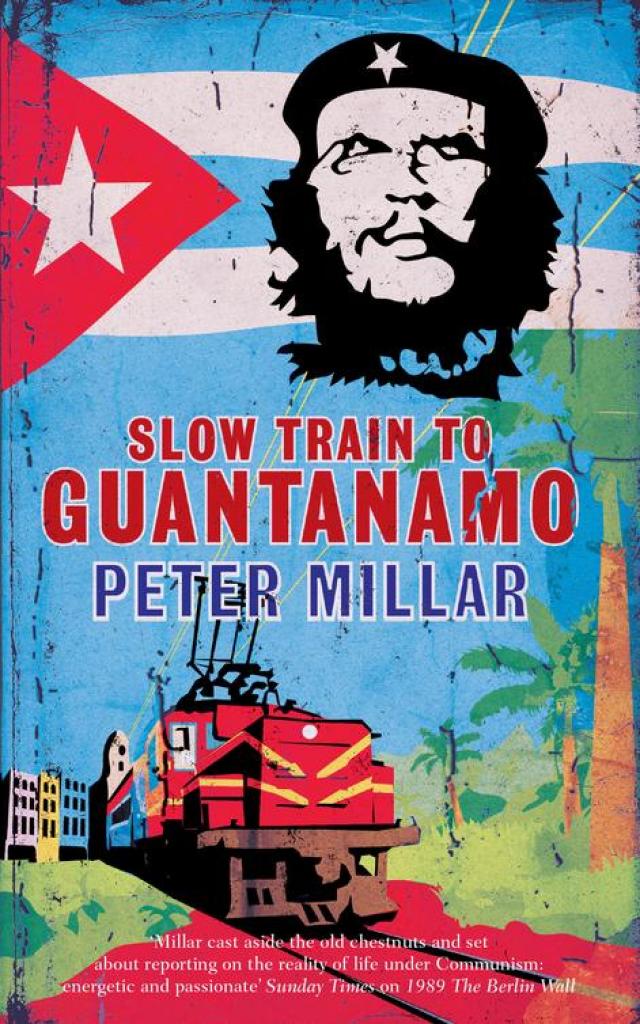


Che T-shirts may be Cuba’s biggest export after cigars but nobody here wears them. Or almost nobody. On a previous visit to Havana I did bump into a couple of characters at a parade dressed as Guevara and his late rival in Cuba’s pantheon of foreign saints, Hugo Chavez. But basically they were just lookalikes having a bit of a laugh. A carefully politically correct one.
The return trip to Guantánamo is something of an anticlimax, back past the rusting rails, the distant US watchtowers and the strange little isolated cemetery. The check-points barely register us going in the other direction. This may be the last frontier in the Cold War but it is a stale, abandoned front line where both sides claim the high ground and moral values have become fudged. Down here in Guantánamo, Cuba’s Oriente, for the time being, it really is all quiet on the eastern front.
10. Guantánamo is not the only consequence we still live with. As a result of the quarrel on their doorstep, the US got into a general war with Spain. It finished by making Cuba a puppet state, seizing the nearby Caribbean island of Puerto Rico but also intervening on the other side of the world. The United States attacked Spanish colonies in the Pacific, aiding the people of the Philippines in an anti-colonial rebellion, then suppressing them in turn and turning a Spanish colony into an American one which brought them Japanese occupation and eventual independence in 1946. The United States also seized the formerly Spanish island of Guam from where its troops today nervously watch North Korea’s military posturing.
CHAPTER EIGHTEEN
Da Coda: Santiago and the ‘French Train’
The Moncada Barracks in Santiago de Cuba, the island’s second city, capital of Oriente and chief rival to Havana, is the Castros’ Dunkirk: the place it all went wrong, where the revolution might have ended before it started. But because in the end the disaster was not total, the failure is remembered as heroism and the place itself a national shrine to what was actually an almighty cock-up.
I had thought I would visit the Moncada on my way to Guantánamo but, like the start of World War I, the train timetables dictated otherwise. So I am here on the first leg of the return journey. I have already cheated, and not taken the train, not least because there is indeed no direct train link between Guantánamo and Santiago and doing the journey by rail would require that change in grimy San Luis, which it seemed the Cuban railway system simply wasn’t prepared to accommodate unless I was willing to risk waiting up to two days at a railway station in the middle of nowhere.
Instead I promised myself a ride in the relative luxury of one of the state tourist industry’s Viazul coaches, the sort which normally ferry hard-currency-paying foreigners from their Havana hotels to their gated beach resorts. I had bought my ticket for CUCs from the reception at the Hotel GTMO and taken a taxi to the bus station. Not taking any chances, although Viazul’s reputation is much more reliable than that of the trains, not least because few if any Cubans can afford it, I arrive early only to find myself besieged by an army of alternatives: private cars hustling for enough fares to fill their vehicles. My taxi driver says I should take one rather than wait. The going rate he assures me is no more than 40 pesos, that despite the fact he has just charged me 4 CUCs, which is closer to 100 pesos for the short ride from the hotel.
We argue for a bit about the price. There is no way he is taking a gringo for 40 pesos. His starting price is 15 CUC. I laugh. He laughs back and says 10. I laugh again and say 5, pointing out I already have Viazul tickets. He looks disappointed, then laughs back and says ‘Vale’. Okay. He ushers me into pride of place in the front passenger seat, then disappears for 10 minutes for a cigarette and to hustle enough other passengers, probably all paying 40 pesos at most, to fill the rear cargo compartment. And then we’re off, with the sound of roaring rapper salsa howling from boombox speakers embedded in the leather upholstery above our heads, and every big round dial in the matching pillar-box red painted dash, from ‘TEMP’ to ‘OIL’ to the speedometer itself, set immutably at zero.
There is also the fact that I already have a ticket for what may even be an air-conditioned coach. But will it be real? The backpacker in me is shouting that it would be a cop-out now to take the comfy seat even if the middle-aged bloke with sore feet is hankering after it. Then all of a sudden the answer is in my face, in the shape of a huge great bright blue behemoth, an absolute monster of a vehicle with a great beaming monster of a man behind the wheel. With big brown arms the size of elephant’s thighs, this genial giant in a singlet and shorts is only too proud to show me what he claims proudly is a 1951 Willys Jeep Truck, lovingly cared for, protected from rust by a thick coat of royal blue gloss paint and upholstered throughout inside in plush shiny red leather. There is even a magnificent curled ram’s head motif on its nose though he admits that probably came from a Dodge.
Just forty-five minutes later after a thrilling rollercoaster ride over the hills that defeated the railway men he dumps me at what appears to be the unlicensed taxi clearing station in the Santiago suburbs. A cantankerous old bloke in a complete wreck of a 1950s Chevy – compared to the near immaculate Willys – offers to take me to my hotel, or rather his cousin’s casa, which I have no difficulty turning down looking through the holes in the foot well at his clunking gears.
I have booked myself in at the San Basilio, am absolute haven of sanity in a city supposed to be Cuba’s most frenetic. And it fulfils expectations, with a handful of elegantly decorated, blissfully high-ceilinged rooms around a little courtyard on the street of the same name, just a short walk from the city’s main square.
The guidebooks paint Parque Céspedes as Santiago’s thriving and just so slightly wicked heart, teeming with people high on hooch, fuelled by sex appeal and swinging to son or trova music. They must have been there on another day, because right now it reminds me more of Leamington Spa on a Sunday afternoon, with relaxed people enjoying cool drinks in the colonnade of the elegant Casa Grande hotel. There is a trova band playing outside but it’s more background music than in-your-face hustle.
I also have a bit of compulsory sightseeing to do, the scene of Castro’s classic débâcle. But first I need a new SD card for my camera, which I’m slightly worried might be impossible to acquire. But no, there is a shop off the main square which I am told has photographic equipment. Hmmm, I’m thinking Kodacolor rather than Secure Digital. But it turns out I’m wrong. They are available for sale, depending on who you are. The largest available is 2 gigabytes, the middle-aged lady shop assistant says proudly, which is almost the smallest available in most other countries, but it will have to do. But first I have to show my passport, then she has to fill out a form which I have to sign in duplicate and hand over a hugely expensive 30 CUC (£20/$30), vastly beyond the means of any native. But then so is the most basic digital camera. The whole process takes 20 minutes, including the time for her to write out a complex 6-month guarantee form without which she will not give me the card. Still, it’s one-up on Turkey where I bought a 10-gig card for less than half the price only to discover it was phoney and didn’t retain images.
And so to the Moncada, to see how the Castros’ revolution nearly foundered on their almost adolescent over-enthusiasm. Having got to town earlier than expected, and reluctant to face another unpleasant Santiago taxi driver, I decide to walk it which turns out to be a terrible mistake. First of all it is further out than I thought, secondly because it is hot and Santiago is remarkably hilly, and thirdly because I don’t recognise it when I get there.
Because the image hasn’t been drilled into me since childhood, as if has for most Cubans, I don’t initially recognize the big yellow building for what it is. So I do what nobody would expect: I ask a policeman. He looks a bit surprised. We’re standing next to the thing. There is also, just across the road a vast 30ft by 10ft banner adorned by the faces of both Castro brothers and the slogan: ‘Santiago is Santiago, a rebel city once, a hospitable one today, heroic forever.’
Walking up to the door the evidence of the heroism becomes obvious in the spray of bullet holes around the door. The only trouble is that they don’t actually date from the ill-fated action that took place here on July 26, 1953. The relatively minor damage done in the Castros’ attack was repaired soon afterwards. Then after the success of the revolution in 1958, Castro himself took a bulldozer to tear down the barracks’ outer walls. It was only in 1978 that with an old man’s eye to history and his legacy he had the outer walls rebuilt, the doorway re-‘sprayed’ with bullets and the building, which had been a school in the mean time, turned into a museum. Fidel may never have been to Disneyland, but that doesn’t mean he can’t take a lesson. A visit to the Moncada Barracks is a ‘must’ on the curriculum of every Cuban schoolchild.
The man on the door smiles at me – nice to see a foreigner come to pay homage to the birthplace of the revolution – and asks for two CUC. Feeling a bit cheeky I offer him two CUP, two pesos, which is what it costs ordinary Cubans. ‘Aren’t we all comrades?’ I get a mildly amused look but he still wants his CUCs. No confusing history with the present here.
The history itself relates that the attack took place on July 26, 1953, little over a year after the military coup which brought dictator Fulgencio Batista to power. The gaggle of well-to-do young men and peasant farmers who had gathered themselves around the illegitimate farmer’s son and Havana law student had deliberately planned their attack for the morning after Santiago’s annual fiesta. Fidel was counting on the forces inside still being drunk.
He had been thinking about his move for a long time. Fidel and brother Raúl had been recruiting and training opponents of the regime under the guise of a clay-pigeon shooting club. The 153 rebels were clad in blue army uniforms that had been stolen by a relative of one of the revolutionaries from the laundry of a military hospital. On the night before they gathered at a farm in Siboney – as it happens the place where the jolly university librarian woman I met on the train from Camagüey lives – which was where most of them were informed for the first time of their target. The idea was to take over the barracks, loot its store of weapons and use its radio transmitter to send false messages to the army command while broadcasting revolutionary speeches urging the people to take up arms.
Equipped with a random and varied selection of weapons from shotguns, handguns, an assortment of rifles and one malfunctioning submachine gun, they set off at 4.45, before dawn, in a convoy of sixteen vehicles, hoping to give the impression of a delegation headed by a senior officer from Havana. They had three objectives: one group, including the then just twenty-two-year-old Raúl, was to take the Palace of Justice, a second smaller detachment of half a dozen was to seize control of the neighbouring military while the main party, led by Fidel himself, was tasked with the main assault on the barracks.
Unfortunately for them, Fidel’s troops were indeed nearly all from Havana, or at least western Cuba, and they did the one thing that is absolutely unconscionable in a military operation: they got lost. Unfamiliar with the city, they ended up split into two groups, while the lorry carrying most of their heavy weapons never arrived. According to Fidel’s own account the soldiers on duty at the barracks realized there was something fishy going on, refused to move aside and as a result he drove his car straight into them. His dilettante colleagues, poorly armed and hopelessly outnumbered, thought they had broken through the gates and jumped out of their vehicles. In the ensuing firefight fifteen soldiers and three policemen were killed and two dozen others wounded. The rebels suffered nine dead and eleven wounded, four of them by friendly fire from their own colleagues.
The aftermath demonstrated a gruesome and astoundingly incompetent mixture of atrocity and leniency on the part of the Batista regime: within a few hours of the failed attack, eighteen captured rebels were summarily executed in the barracks’ firing range and their bodies strewn around the grounds to make it look like they died in combat. Of those who fled, a further thirty-four were murdered after admitting their participation. The remainder were rounded up but allowed to live to face trial, when a panel of three judges were harangued by Fidel presenting his own defence and complaining loudly about the ‘murder’ of prisoners.
As a result, nineteen of the rebels got off scot-free on lack of evidence while the ringleaders including Fidel and Raúl (who had actually succeeded in his own allotted task of capturing the Palacio de Justicia) were sentenced to thirteen years, later commuted to two. When they were released the pair wisely fled to Mexico where they continued to plot revolution now under the name Movimento 26 Julio, also known as M-26-7. As with Dunkirk, a disaster wisely handled can become a source of inspiration. Winston Churchill famously declared, ‘History will be kind to me, because I intend to write it.’ It was while he was in prison that Fidel wrote his famous manifesto ‘History Will Absolve Me’, and in the Moncada of today, he made sure of it.
The most remarkable thing about the museum to someone visiting it for the first time is how successful it is in making the visitor feel close to the actual events. Not just because it was just over fifty years ago, but because the artefacts on display still feel alarmingly contemporary, in the very real sense that they were ‘of the moment’ then, and surprisingly still don’t look too terribly dated today.
A glass case contains clothing worn by some of the impoverished farmers drafted into Fidel’s raggle-taggle army but rather than smocks from some peasant uprising or even Soviet-era army uniforms, they are denim jeans that look like they might have come from a retro stall at London’s Camden Market. Why wouldn’t they? I can’t see the label but they might well be Levis. These men, after all, were contemporaries of Elvis.
Perhaps the most poignant exhibit are the items of clothing belonging to the failed mission’s most celebrated martyr Reinaldo Boris Luis Santa Coloma: nice brown brogue spats and a pair of gold cufflinks. Impeccably middle-class. Even Cuba had its champagne socialists.
Two elderly Cuban women come up to me and ask me in English what I think of the museum, obviously just slightly apprehensive as to what a foreigner might see in it all. I nod at the display in front of us, the brogue spats, and say, ‘Nice shoes. Expensive.’ They smile to one another, not simply but knowingly. They can take a joke, these Cubans. Even at their own expense.
On the way out you are faced with one whole wall devoted to a photograph of Fidel in fatigues with backpack standing on a rocky crest gazing out boldly into his brave new world. If it weren’t for the superimposed background of the national flag and the profoundly nineteenth-century image of old José Martí, he could be some unshaven Aussie backpacker.
The Lenin Museum in Moscow which flourished from his death in 1924 to the dissolution of the Soviet Union in 1991 was subsequently transformed into Moscow City Hall for many years and is now the Russian Historical Museum, in which Lenin plays a dramatically reduced role. The Stalin Museum in his birthplace of Gori in Georgia was built around his tiny childhood home and filled with examples idolatry and hagiography. It endured more than 50 years after his death, though following the 2008 war over South Ossetia, the Georgian authorities announced plans to transform it into a Museum of Russian Aggression. What will become of Fidel’s act of homage to himself and his apostles is something which history that hasn’t happened yet will decide.
I have the vicissitudes of history firmly in mind as I make the trek back into town, thankfully mostly downhill.
The other great memorial site in Santiago, subject of my main interest the next day is thankfully only a short stroll way. It too is in many ways homage to a single man, one of the earliest of genuine globetrotters and will soon have endured half a millennium. The house of Diego Velázquez diagonally across from the Casa Grande on Céspedes Square is an unassuming building at first glance, just two stories high but built of ashlar stone with a Moorish grille balcony at first floor level, and a huge, square and rather imposing columned entrance. But then it is entitled to be imposing, given that it is the oldest building in Cuba and arguably the oldest European-erected building in the whole of the Americas.
Dating from somewhere around 1519–22, this was the home of Diego Velázquez de Cuéllar, the man who conquered Cuba for Spain and became its first governor, founding not only Santiago, but also isolated Baracoa, nearby Bayamo, as well as Havana itself, and incidentally exterminating most of the native Taino Indians and importing the first black slaves. With a record like that we perhaps don’t need to feel too sorry that he died here in 1524 a bitter man after sending Hernán Cortés to conquer Mexico but falling out with him and getting none of the mountains of gold he captured.
The house today has been remarkably preserved and restored, given the general state of decay of most Cuban buildings of lesser historical importance, and features items used for forging gold on the ground floor as well as a recreation of how the rooms might have looked in the sixteenth century, as well as a restored nineteenth-century interior in the house next door. Wandering around its cool dark rooms feels more like exploring some palace in Córdoba or Seville than the Caribbean, an intimation of how the sixteenth-century Spanish took their domestic world with them around the globe in much the same way the British built cricket clubs in India.
The Spanish roots of most Cuban music, however, have been much diminished by the vast surging drumbeats of Africa, the influences from French Haïti, especially down here in Oriente, and of course the remarkable, and purely Cuban evolution of the musical styles and cultures its natives have imported and invented. Perhaps the most dominant is son, with its derivative salsa which with its vivid syncopations, short choruses and swaying rhythms is perhaps the most distinctive Cuban sound.
Different but equally significant is trova, considered – just a little arrogantly – by the inhabitants of Santiago to be theirs. The word trovador has its origins in the mediaeval ‘troubadour’ which was a fair enough description of the groups of musicians who roved around Oriente in the nineteenth century playing music of their own composition, usually performing alone or in duos, as opposed to the bigger son and salsa bands. Trova songs are the classic Caribbean ballads, usually guitar-accompanied, romantic and slower than son, but still eminently danceable. But then it is a rule of thumb in Cuba that any tune is danceable; that’s what makes it a tune.
The return trip to Guantánamo is something of an anticlimax, back past the rusting rails, the distant US watchtowers and the strange little isolated cemetery. The check-points barely register us going in the other direction. This may be the last frontier in the Cold War but it is a stale, abandoned front line where both sides claim the high ground and moral values have become fudged. Down here in Guantánamo, Cuba’s Oriente, for the time being, it really is all quiet on the eastern front.
10. Guantánamo is not the only consequence we still live with. As a result of the quarrel on their doorstep, the US got into a general war with Spain. It finished by making Cuba a puppet state, seizing the nearby Caribbean island of Puerto Rico but also intervening on the other side of the world. The United States attacked Spanish colonies in the Pacific, aiding the people of the Philippines in an anti-colonial rebellion, then suppressing them in turn and turning a Spanish colony into an American one which brought them Japanese occupation and eventual independence in 1946. The United States also seized the formerly Spanish island of Guam from where its troops today nervously watch North Korea’s military posturing.
CHAPTER EIGHTEEN
Da Coda: Santiago and the ‘French Train’
The Moncada Barracks in Santiago de Cuba, the island’s second city, capital of Oriente and chief rival to Havana, is the Castros’ Dunkirk: the place it all went wrong, where the revolution might have ended before it started. But because in the end the disaster was not total, the failure is remembered as heroism and the place itself a national shrine to what was actually an almighty cock-up.
I had thought I would visit the Moncada on my way to Guantánamo but, like the start of World War I, the train timetables dictated otherwise. So I am here on the first leg of the return journey. I have already cheated, and not taken the train, not least because there is indeed no direct train link between Guantánamo and Santiago and doing the journey by rail would require that change in grimy San Luis, which it seemed the Cuban railway system simply wasn’t prepared to accommodate unless I was willing to risk waiting up to two days at a railway station in the middle of nowhere.
Instead I promised myself a ride in the relative luxury of one of the state tourist industry’s Viazul coaches, the sort which normally ferry hard-currency-paying foreigners from their Havana hotels to their gated beach resorts. I had bought my ticket for CUCs from the reception at the Hotel GTMO and taken a taxi to the bus station. Not taking any chances, although Viazul’s reputation is much more reliable than that of the trains, not least because few if any Cubans can afford it, I arrive early only to find myself besieged by an army of alternatives: private cars hustling for enough fares to fill their vehicles. My taxi driver says I should take one rather than wait. The going rate he assures me is no more than 40 pesos, that despite the fact he has just charged me 4 CUCs, which is closer to 100 pesos for the short ride from the hotel.
We argue for a bit about the price. There is no way he is taking a gringo for 40 pesos. His starting price is 15 CUC. I laugh. He laughs back and says 10. I laugh again and say 5, pointing out I already have Viazul tickets. He looks disappointed, then laughs back and says ‘Vale’. Okay. He ushers me into pride of place in the front passenger seat, then disappears for 10 minutes for a cigarette and to hustle enough other passengers, probably all paying 40 pesos at most, to fill the rear cargo compartment. And then we’re off, with the sound of roaring rapper salsa howling from boombox speakers embedded in the leather upholstery above our heads, and every big round dial in the matching pillar-box red painted dash, from ‘TEMP’ to ‘OIL’ to the speedometer itself, set immutably at zero.
There is also the fact that I already have a ticket for what may even be an air-conditioned coach. But will it be real? The backpacker in me is shouting that it would be a cop-out now to take the comfy seat even if the middle-aged bloke with sore feet is hankering after it. Then all of a sudden the answer is in my face, in the shape of a huge great bright blue behemoth, an absolute monster of a vehicle with a great beaming monster of a man behind the wheel. With big brown arms the size of elephant’s thighs, this genial giant in a singlet and shorts is only too proud to show me what he claims proudly is a 1951 Willys Jeep Truck, lovingly cared for, protected from rust by a thick coat of royal blue gloss paint and upholstered throughout inside in plush shiny red leather. There is even a magnificent curled ram’s head motif on its nose though he admits that probably came from a Dodge.
Just forty-five minutes later after a thrilling rollercoaster ride over the hills that defeated the railway men he dumps me at what appears to be the unlicensed taxi clearing station in the Santiago suburbs. A cantankerous old bloke in a complete wreck of a 1950s Chevy – compared to the near immaculate Willys – offers to take me to my hotel, or rather his cousin’s casa, which I have no difficulty turning down looking through the holes in the foot well at his clunking gears.
I have booked myself in at the San Basilio, am absolute haven of sanity in a city supposed to be Cuba’s most frenetic. And it fulfils expectations, with a handful of elegantly decorated, blissfully high-ceilinged rooms around a little courtyard on the street of the same name, just a short walk from the city’s main square.
The guidebooks paint Parque Céspedes as Santiago’s thriving and just so slightly wicked heart, teeming with people high on hooch, fuelled by sex appeal and swinging to son or trova music. They must have been there on another day, because right now it reminds me more of Leamington Spa on a Sunday afternoon, with relaxed people enjoying cool drinks in the colonnade of the elegant Casa Grande hotel. There is a trova band playing outside but it’s more background music than in-your-face hustle.
I also have a bit of compulsory sightseeing to do, the scene of Castro’s classic débâcle. But first I need a new SD card for my camera, which I’m slightly worried might be impossible to acquire. But no, there is a shop off the main square which I am told has photographic equipment. Hmmm, I’m thinking Kodacolor rather than Secure Digital. But it turns out I’m wrong. They are available for sale, depending on who you are. The largest available is 2 gigabytes, the middle-aged lady shop assistant says proudly, which is almost the smallest available in most other countries, but it will have to do. But first I have to show my passport, then she has to fill out a form which I have to sign in duplicate and hand over a hugely expensive 30 CUC (£20/$30), vastly beyond the means of any native. But then so is the most basic digital camera. The whole process takes 20 minutes, including the time for her to write out a complex 6-month guarantee form without which she will not give me the card. Still, it’s one-up on Turkey where I bought a 10-gig card for less than half the price only to discover it was phoney and didn’t retain images.
And so to the Moncada, to see how the Castros’ revolution nearly foundered on their almost adolescent over-enthusiasm. Having got to town earlier than expected, and reluctant to face another unpleasant Santiago taxi driver, I decide to walk it which turns out to be a terrible mistake. First of all it is further out than I thought, secondly because it is hot and Santiago is remarkably hilly, and thirdly because I don’t recognise it when I get there.
Because the image hasn’t been drilled into me since childhood, as if has for most Cubans, I don’t initially recognize the big yellow building for what it is. So I do what nobody would expect: I ask a policeman. He looks a bit surprised. We’re standing next to the thing. There is also, just across the road a vast 30ft by 10ft banner adorned by the faces of both Castro brothers and the slogan: ‘Santiago is Santiago, a rebel city once, a hospitable one today, heroic forever.’
Walking up to the door the evidence of the heroism becomes obvious in the spray of bullet holes around the door. The only trouble is that they don’t actually date from the ill-fated action that took place here on July 26, 1953. The relatively minor damage done in the Castros’ attack was repaired soon afterwards. Then after the success of the revolution in 1958, Castro himself took a bulldozer to tear down the barracks’ outer walls. It was only in 1978 that with an old man’s eye to history and his legacy he had the outer walls rebuilt, the doorway re-‘sprayed’ with bullets and the building, which had been a school in the mean time, turned into a museum. Fidel may never have been to Disneyland, but that doesn’t mean he can’t take a lesson. A visit to the Moncada Barracks is a ‘must’ on the curriculum of every Cuban schoolchild.
The man on the door smiles at me – nice to see a foreigner come to pay homage to the birthplace of the revolution – and asks for two CUC. Feeling a bit cheeky I offer him two CUP, two pesos, which is what it costs ordinary Cubans. ‘Aren’t we all comrades?’ I get a mildly amused look but he still wants his CUCs. No confusing history with the present here.
The history itself relates that the attack took place on July 26, 1953, little over a year after the military coup which brought dictator Fulgencio Batista to power. The gaggle of well-to-do young men and peasant farmers who had gathered themselves around the illegitimate farmer’s son and Havana law student had deliberately planned their attack for the morning after Santiago’s annual fiesta. Fidel was counting on the forces inside still being drunk.
He had been thinking about his move for a long time. Fidel and brother Raúl had been recruiting and training opponents of the regime under the guise of a clay-pigeon shooting club. The 153 rebels were clad in blue army uniforms that had been stolen by a relative of one of the revolutionaries from the laundry of a military hospital. On the night before they gathered at a farm in Siboney – as it happens the place where the jolly university librarian woman I met on the train from Camagüey lives – which was where most of them were informed for the first time of their target. The idea was to take over the barracks, loot its store of weapons and use its radio transmitter to send false messages to the army command while broadcasting revolutionary speeches urging the people to take up arms.
Equipped with a random and varied selection of weapons from shotguns, handguns, an assortment of rifles and one malfunctioning submachine gun, they set off at 4.45, before dawn, in a convoy of sixteen vehicles, hoping to give the impression of a delegation headed by a senior officer from Havana. They had three objectives: one group, including the then just twenty-two-year-old Raúl, was to take the Palace of Justice, a second smaller detachment of half a dozen was to seize control of the neighbouring military while the main party, led by Fidel himself, was tasked with the main assault on the barracks.
Unfortunately for them, Fidel’s troops were indeed nearly all from Havana, or at least western Cuba, and they did the one thing that is absolutely unconscionable in a military operation: they got lost. Unfamiliar with the city, they ended up split into two groups, while the lorry carrying most of their heavy weapons never arrived. According to Fidel’s own account the soldiers on duty at the barracks realized there was something fishy going on, refused to move aside and as a result he drove his car straight into them. His dilettante colleagues, poorly armed and hopelessly outnumbered, thought they had broken through the gates and jumped out of their vehicles. In the ensuing firefight fifteen soldiers and three policemen were killed and two dozen others wounded. The rebels suffered nine dead and eleven wounded, four of them by friendly fire from their own colleagues.
The aftermath demonstrated a gruesome and astoundingly incompetent mixture of atrocity and leniency on the part of the Batista regime: within a few hours of the failed attack, eighteen captured rebels were summarily executed in the barracks’ firing range and their bodies strewn around the grounds to make it look like they died in combat. Of those who fled, a further thirty-four were murdered after admitting their participation. The remainder were rounded up but allowed to live to face trial, when a panel of three judges were harangued by Fidel presenting his own defence and complaining loudly about the ‘murder’ of prisoners.
As a result, nineteen of the rebels got off scot-free on lack of evidence while the ringleaders including Fidel and Raúl (who had actually succeeded in his own allotted task of capturing the Palacio de Justicia) were sentenced to thirteen years, later commuted to two. When they were released the pair wisely fled to Mexico where they continued to plot revolution now under the name Movimento 26 Julio, also known as M-26-7. As with Dunkirk, a disaster wisely handled can become a source of inspiration. Winston Churchill famously declared, ‘History will be kind to me, because I intend to write it.’ It was while he was in prison that Fidel wrote his famous manifesto ‘History Will Absolve Me’, and in the Moncada of today, he made sure of it.
The most remarkable thing about the museum to someone visiting it for the first time is how successful it is in making the visitor feel close to the actual events. Not just because it was just over fifty years ago, but because the artefacts on display still feel alarmingly contemporary, in the very real sense that they were ‘of the moment’ then, and surprisingly still don’t look too terribly dated today.
A glass case contains clothing worn by some of the impoverished farmers drafted into Fidel’s raggle-taggle army but rather than smocks from some peasant uprising or even Soviet-era army uniforms, they are denim jeans that look like they might have come from a retro stall at London’s Camden Market. Why wouldn’t they? I can’t see the label but they might well be Levis. These men, after all, were contemporaries of Elvis.
Perhaps the most poignant exhibit are the items of clothing belonging to the failed mission’s most celebrated martyr Reinaldo Boris Luis Santa Coloma: nice brown brogue spats and a pair of gold cufflinks. Impeccably middle-class. Even Cuba had its champagne socialists.
Two elderly Cuban women come up to me and ask me in English what I think of the museum, obviously just slightly apprehensive as to what a foreigner might see in it all. I nod at the display in front of us, the brogue spats, and say, ‘Nice shoes. Expensive.’ They smile to one another, not simply but knowingly. They can take a joke, these Cubans. Even at their own expense.
On the way out you are faced with one whole wall devoted to a photograph of Fidel in fatigues with backpack standing on a rocky crest gazing out boldly into his brave new world. If it weren’t for the superimposed background of the national flag and the profoundly nineteenth-century image of old José Martí, he could be some unshaven Aussie backpacker.
The Lenin Museum in Moscow which flourished from his death in 1924 to the dissolution of the Soviet Union in 1991 was subsequently transformed into Moscow City Hall for many years and is now the Russian Historical Museum, in which Lenin plays a dramatically reduced role. The Stalin Museum in his birthplace of Gori in Georgia was built around his tiny childhood home and filled with examples idolatry and hagiography. It endured more than 50 years after his death, though following the 2008 war over South Ossetia, the Georgian authorities announced plans to transform it into a Museum of Russian Aggression. What will become of Fidel’s act of homage to himself and his apostles is something which history that hasn’t happened yet will decide.
I have the vicissitudes of history firmly in mind as I make the trek back into town, thankfully mostly downhill.
The other great memorial site in Santiago, subject of my main interest the next day is thankfully only a short stroll way. It too is in many ways homage to a single man, one of the earliest of genuine globetrotters and will soon have endured half a millennium. The house of Diego Velázquez diagonally across from the Casa Grande on Céspedes Square is an unassuming building at first glance, just two stories high but built of ashlar stone with a Moorish grille balcony at first floor level, and a huge, square and rather imposing columned entrance. But then it is entitled to be imposing, given that it is the oldest building in Cuba and arguably the oldest European-erected building in the whole of the Americas.
Dating from somewhere around 1519–22, this was the home of Diego Velázquez de Cuéllar, the man who conquered Cuba for Spain and became its first governor, founding not only Santiago, but also isolated Baracoa, nearby Bayamo, as well as Havana itself, and incidentally exterminating most of the native Taino Indians and importing the first black slaves. With a record like that we perhaps don’t need to feel too sorry that he died here in 1524 a bitter man after sending Hernán Cortés to conquer Mexico but falling out with him and getting none of the mountains of gold he captured.
The house today has been remarkably preserved and restored, given the general state of decay of most Cuban buildings of lesser historical importance, and features items used for forging gold on the ground floor as well as a recreation of how the rooms might have looked in the sixteenth century, as well as a restored nineteenth-century interior in the house next door. Wandering around its cool dark rooms feels more like exploring some palace in Córdoba or Seville than the Caribbean, an intimation of how the sixteenth-century Spanish took their domestic world with them around the globe in much the same way the British built cricket clubs in India.
The Spanish roots of most Cuban music, however, have been much diminished by the vast surging drumbeats of Africa, the influences from French Haïti, especially down here in Oriente, and of course the remarkable, and purely Cuban evolution of the musical styles and cultures its natives have imported and invented. Perhaps the most dominant is son, with its derivative salsa which with its vivid syncopations, short choruses and swaying rhythms is perhaps the most distinctive Cuban sound.
Different but equally significant is trova, considered – just a little arrogantly – by the inhabitants of Santiago to be theirs. The word trovador has its origins in the mediaeval ‘troubadour’ which was a fair enough description of the groups of musicians who roved around Oriente in the nineteenth century playing music of their own composition, usually performing alone or in duos, as opposed to the bigger son and salsa bands. Trova songs are the classic Caribbean ballads, usually guitar-accompanied, romantic and slower than son, but still eminently danceable. But then it is a rule of thumb in Cuba that any tune is danceable; that’s what makes it a tune.