Hurricane Season, page 3
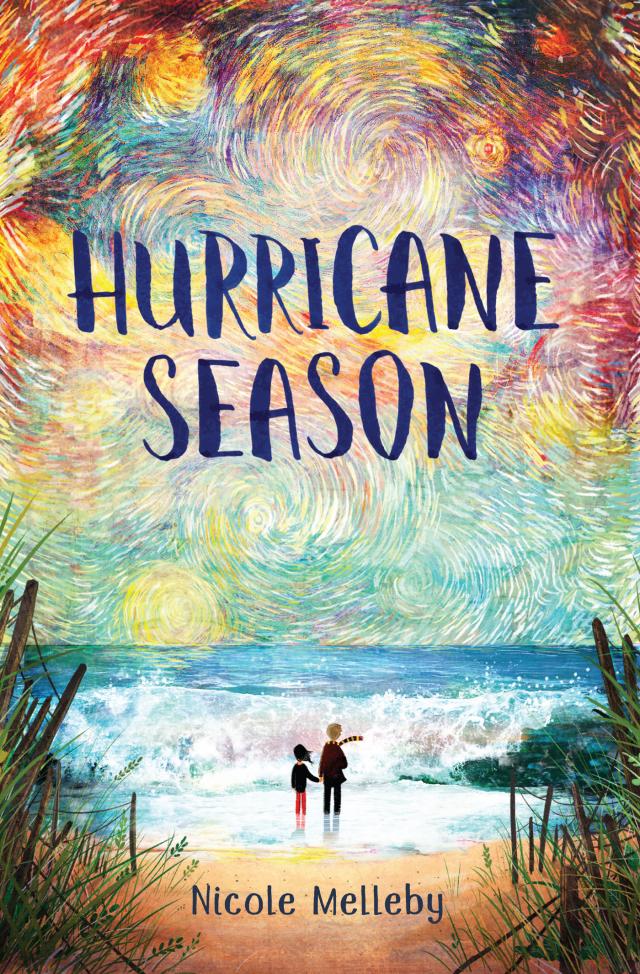


He blinked but finally turned away from the water to look at Fig instead.
“Right,” he said, running a hand over his unshaven face. “Pizza, then?”
As they walked back up the beach to the boardwalk, her dad kept turning to look at the ocean. Fig kept looking, too, hoping that maybe something out there would stand out, something in that view would make sense, but she saw nothing but the Atlantic. All the while the girls from her class lay on their blanket, listening to their music and forgetting that Fig was even there at all.
With pizza slices on grease-stained paper plates in their hands, Fig and her dad walked off the boardwalk toward home. Fig had pizza juice dripping down her chin, and she reached to steal the napkins her dad had grabbed and shoved in his pocket.
Turning the corner off the boardwalk and onto their street, Fig squinted as she recognized their new neighbor. He was jogging toward them, wearing gym shorts and sneakers. Fig jutted out her chin. “That’s our new neighbor,” she informed her dad.
Her dad made a noise that sounded like a question, but he was taking a huge bite out of his pizza—with hot cheese pulling off in strings as he tried to chew—so she didn’t catch a word of it.
The new occupant of the yellow house wasn’t a slouch; he was quickly approaching them. Fig heard her dad swallow loudly, and she knew it was coming before she could beg him not to. Once their neighbor was close enough, her dad yelled “Oi!” and immediately got his attention.
Their neighbor slowed to a stop, his eyebrows raised, as he pulled an earbud out of one ear. “Hey?” He said it like a question.
Fig wanted to go home. Their neighbors were cruel to her dad. This one was new—and here they were, greasy messes with half-eaten pizza and wind-wild hair from a couple of hours spent walking the beach and staring at the ocean, and who knew what one more bad phone call to CP&P could do.
Her dad didn’t seem to share her concerns. “Apparently you’re our new neighbor. You’re across the street, in the yellow house?” he asked, and their new neighbor nodded. “Thought I’d introduce myself, though I suppose better neighbors would have brought over a casserole. I’m Tim Arnold. This is my daughter, Fig.”
“Finola,” Fig said, before he could ask. “Fig’s a nickname.”
“Mark Finzi,” he said, introducing himself and holding out his hand to Fig’s dad.
They shook hands, and Fig couldn’t help but compare the two. Mark looked as sturdy as a pillar; he seemed strong enough to hold a foundation up. He had a full head of gray hair and worry lines along his face, but she wouldn’t look at him and dare to call him old. Her dad, on the other hand, always slouched to the point of looking crooked, and no matter how much he slept, he always had bags under his eyes. He wasn’t out of shape, but it wasn’t like he worked out, either. His hair also had a habit of sticking out however it pleased, and the salty beach air didn’t exactly help tame it.
“Finzi. Like the composer,” her dad said, and Fig suffered to keep from rolling her eyes. She held her breath and prayed the conversation would move quickly.
“Ah, I wouldn’t know,” Mark replied.
“Gerald Finzi—”
“Dad, he doesn’t know,” Fig interrupted, then addressed Mark, smiling and trying to get him to understand. “He does this, he can’t help it. Music was his life once—”
“And then I had Fig.”
Fig paused, taking a moment to keep the smile on her face. She knew her dad didn’t mean it like that, but still. She sometimes couldn’t help thinking she took that part of him away. “And then he had me. But he forgets that not everyone cares.”
Mark smiled, and his face looked gentler. Not younger, exactly, but fuzzier and softer around the edges. “Not that I don’t care. Just not really a music guy.”
“And here we were getting on so well,” Fig’s dad said. “Well, nice meeting you. Sorry we aren’t the casserole type.”
“Dad . . .”
Mark kept smiling. “I’ll see you two around, then.”
He gave them both a wave as he put the earbud back in and began jogging. Fig sighed in relief. As far as first impressions go, this was possibly one of her dad’s finest.
“He seems nice,” her dad said as they watched Mark go.
At home, as her dad attempted to get the sand off his feet before going inside (“I swear this sand is like glue!”), Fig decided to crack open the large, heavy art book Miss Williams had lent her.
She was familiar with some of the paintings she saw as she flipped through the pages. She recognized the work of Picasso, had seen a couple of Salvador Dalí’s paintings before. She knew Edvard Munch’s The Scream, knew Da Vinci’s Mona Lisa, knew Van Gogh’s Starry Night.
“Homework on a Saturday?” her dad commented as he entered the living room with newly donned socks on his feet.
“Art project I told you about.”
“Ah. See anything you like?”
“This book is mostly men,” Fig said, pulling a face. “But look. This one kind of looks like you.” She held open the book to a page of one of Vincent van Gogh’s self-portraits.
He snorted. “I’m not ginger.”
“The rest of it,” Fig said. “Especially when you don’t shave.”
“I’ll shave later.”
“Thank you.”
“Maybe get one of those straw hats, too.”
Her dad plopped onto the couch and turned on the Weather Channel. Fig continued to flip through the Van Gogh section of the art book, then pushed it to the side and pulled over her dad’s laptop to do a Google image search to look at more. She didn’t understand all of his work—particularly what was so fascinating about a bowl of fruit or a chair—but she thought Van Gogh’s landscapes were pretty. And his yellow house reminded her of Ms. Minkle—and now Mark—across the street.
She thought about the self-portrait, Van Gogh’s art, and about the last piece of music her dad finished—the one titled “Finola” that he kept in his desk. He named that song for her, and sometimes, when he was okay, she could convince him to play parts of it. Sometimes her dad couldn’t find the words for his thoughts; sometimes they got lost or trapped in his head. Those times, he’d play her song, and Fig would know—she would know—that even on his worst days, he loved her more than everything.
Those days, she really did believe things would be okay.
Fig liked that Van Gogh’s portrait reminded her of her dad the way her dad’s music sometimes reminded him of her.
She closed the heavy art book.
Maybe Vincent van Gogh would be a good place to start.
4
Tree Roots
Fig was hesitant as she approached Miss Williams’s desk. She didn’t know how to act. Miss Williams saw past her dad’s confusion to what was really going on. She knew too much that Fig didn’t want her to know. She didn’t want to give Miss Williams a reason to call CP&P (or anyone) for help ever again but didn’t know how to prove everything was okay.
Maybe if she did well in this class, not only would she be closer to understanding her dad, but Miss Williams would also see that she was fine. Maybe she could get her dad to come to the Fall Festival, and look at her painting and be okay, and everyone—including her classmates and Miss Williams—would see that.
Miss Williams was speaking with Jeremy about his project. He didn’t look particularly into it. He sighed, running a hand through his cowlick as he turned to Fig and said, “Can your dad come interrupt so we can get out of art class again?”
“Jeremy!” Miss Williams snapped, startling Fig (and her classmates, who immediately went silent). Miss Williams never yelled, and the back of Fig’s neck grew warm as she felt the attention drawn to her. “Go sit down, now, and get started on your work.”
Jeremy looked confused, but he didn’t need to be told twice.
Miss Williams looked up with her kind eyes and an apologetic smile, which made Fig gaze down at her toes. “I’m sorry about that, Fig. That sort of thing is not okay, and—”
Fig quickly held out the big, heavy art book for Miss Williams to take, stopping her from saying anything more. Jeremy was just being a pest. Miss Williams was the one who was turning nothing into something.
“Did you get a good look?” Miss Williams asked, taking the hint. Fig nodded. “Find anything helpful?”
“Do you have any more books on Vincent van Gogh? I Googled him, but our internet’s slow.”
Miss Williams smiled her wide, toothy smile. “Van Gogh, huh? That’s an interesting choice. What about Van Gogh caught your eye? A lot of students your age are drawn to the swirls and colors in The Starry Night. Or his sunflowers.”
“I liked the ones he painted of himself. And the one of the yellow house.”
Fig wanted to paint the look on Miss Williams’s face and keep it forever: her eyes sparkling with a real smile that was just for Fig. It was the kind of look that had no pity, and that she hadn’t seen in nearly two weeks. “You surprise me, Fig. You know, he actually shared his wing of the yellow house with another artist, Paul Gauguin. It was a very formative time in Van Gogh’s life, both personally and as an artist,” Miss Williams said, and then laughed. “They drove each other crazy.”
Fig wasn’t surprised. She knew full well how difficult living with an artist could be.
“I don’t think I have anything else here, but let’s see if we can’t find something for you to check out from the library.” Miss Williams opened her laptop, clicked away at the keys, and before the class was over, wrote down five different book titles for Fig.
The problem, Fig realized as she stared at the sheet of paper in front of her, still blank, was that even though she was interested in Van Gogh, she still didn’t understand a thing about art—and still didn’t have a clue about what to paint. So at the end of the school day when she got off the bus (she knew her dad had lessons to give), she decided to go straight to the library.
The library wasn’t large, but it was big enough, and she hoped she’d find most of the books Miss Williams wrote down. It wasn’t that busy—just a few people at computers and some parents with their young children browsing shelves. Fig wished her father were the kind of dad to do a project like this with her, so she didn’t have to do it alone. But she was used to this. She had a library card that had miles’ worth of use from the time she spent last year reading about hurricanes and their typical patterns—and how often they happened in New Jersey.
Back then, a high school boy named Tom worked behind the library counter after school, always looking like he was on the verge of falling asleep. But now, as Fig walked up to the counter and stood on her tiptoes to see over the top, there was a teenage girl standing there. Fig waited for her to stop sorting books and notice she was there.
The girl, like Tom the year before, wore the local private high school uniform: a green plaid shirt, which she wore unbuttoned, with a purple tank top underneath. Her dirty-blond hair was pulled back in a loose ponytail, wisps falling over her face the way Fig’s did on the days her dad’s braids were too loose to stay in place.
“Excuse me?” Fig worked up the nerve to say.
The girl leaned against the counter, looking at Fig. Her eyes were dark, and Fig felt herself blushing under their gaze. “What can I do for you?” she said. Her name tag read: Hannah.
“What happened to Tom?”
“My brother left for college, and I was lucky enough to get his job for the next two years until I can leave.” Hannah didn’t sound like she really thought it was “lucky.” “What do you need?”
Fig placed the paper with the Van Gogh book titles from Miss Williams on the counter. “Can you help me find these books, please?”
Hannah sighed, but she took the list anyway. She scanned the titles and tilted her head to one side. “You from the art club?”
“Um, no. I have a school project.”
“On Vincent van Gogh?”
Fig nodded.
Hannah grew quiet, and Fig was about to give up. But Hannah shrugged and said, “Cool.” Fig felt warm inside from the approval.
Hannah clicked away at the computer. “Okay, follow me.” She didn’t wait to make sure Fig was behind her as she headed toward the stacks of nonfiction books on the other side of the library. Fig did her best to keep up.
Hannah kept her eyes on the shelves as she looked for the books, and Fig kept hers on Hannah. Hannah had three piercings in one ear, and none of the earrings matched. Fig liked that. She liked how Hannah kept trying to push the loose strands of hair behind her ear, even though they didn’t stay there.
Hannah handed Fig a book, and Fig got caught staring. “What?” Hannah asked.
Fig’s eyes were wide as she blurted, “Your earrings don’t match.”
Hannah laughed. Fig’s cheeks were on fire.
They found three out of the five books Miss Williams wrote down. When all three books were in her hands, Fig said “thank you” so many times she was pretty sure Hannah was laughing at her. She thought she might go up in flames.
“You know, you’ve got an overdue book,” Hannah said as she swiped Fig’s library card. “Like, way overdue. Like I probably shouldn’t let you take these books until you either pay for or return it.”
Fig knew exactly what book it was. It was about storms from New Jersey’s history, about the biggest ones to hit the coast, and about the damage each one had done. The book had caught Fig’s dad’s eyes (she figured he was pulled in by the photographs). And the water damage the book sustained while in her dad’s arms as he stood too close to the ocean made it too damaged to return—the words bleeding together and the spine weathered and disintegrating. It was now hidden away under Fig’s bed.
“Can I take these books and bring the money for the other one when I return them?” Fig asked. Her dad said he would pay for the overdue book, but he kept forgetting. “Please?”
Hannah sighed. “All right. Just if Mrs. Gregory asks, you better not tell her I said it was okay.” She paused, and Fig thought she was going to change her mind. But instead, she winked at Fig. “It’ll be our secret.”
Fig was practically sweating. Hannah had a great wink. “Thank you!” Fig said.
“Don’t forget!” Hannah said.
“I won’t!”
Fig started to walk away, but she couldn’t take her eyes off Hannah. Which was why she immediately bumped into the boy behind her, successfully dropping all three books in the process. “Oh, sorry,” she said as she bent to pick them up again.
The boy, she realized, was Danny from school. He bent down to help her. “I was trying to get your attention, but I guess you didn’t see me,” he said.
“No. Sorry.” They both stood, and he looked at the book now in his hands. Fig turned back to Hannah, hoping that Hannah hadn’t noticed how clumsy she was. But Hannah was focused on shelving books again, Fig already forgotten.
Danny swooped his bangs to the side with a quick jerk of his head. “You’re reading about Van Gogh? Are you coming to art club?”
“It’s for class, for Miss Williams,” Fig told him.
“Oh,” he said, and then glanced around the room. “Where’s your dad?”
Fig scowled. Danny, like all of Fig’s friends and classmates, probably had a head full of questions. “He’s not here,” she said.
“Oh,” Danny said again.
She didn’t like the disappointed look on his face. “I have to go,” she said.
“Wait! You should come to art club,” he said quickly, before she could leave. “We meet here, at the library. That’s why I’m here. We don’t talk about Van Gogh, but we learn how to draw.”
Fig didn’t say that she thought Danny already knew how to draw, that he was already probably the best student in art class—even if he constantly changed his mind about what to draw or paint, and his desk was always covered in eraser bits. “Do you know anything about Van Gogh?” she asked.
“I just know some of his paintings,” Danny said. “Oh—and that he cut off his ear.”
“He did what?”
“Yeah, I think he was crazy or something.”
Danny continued talking, continued sweeping aside his shaggy hair, but Fig did not continue listening. She held the books in her hands a little tighter; she didn’t want to open them and learn that Van Gogh was crazy. She didn’t want him to be crazy.
He already reminded her too much of her dad.
“I have to go,” she said, cutting Danny off. “I’ll see you at school.”
Fig left the library, holding the books tightly and close to her chest with one hand and tugging at her earlobe with the other.
Fig’s immediate plan was to get home, check that her dad had both his ears, and read the Van Gogh books to learn that he was a normal, well-respected man. Besides, Fig told herself, just because a painter from more than a hundred years ago happened to look like her dad, it didn’t mean they were alike in any other ways.
Fig was so caught up in her thoughts, she didn’t register anything around her. Not the cars that drove by or the crunch of leaves under her feet. Nothing registered, until she was close enough to her home to hear the slightly out-of-tune keys of her dad’s piano ringing out across the front lawn and down the walkway and into her ears. It was a pretty tune, one that she had heard over and over in different keys, different patterns, and she couldn’t help but smile at the sound of it. She noticed that, across the street, Mark was doing the same.
He was standing by his truck in the driveway, his hand gripping the toolbox in the bed of it, as if he had been about to take the truck out but got distracted and forgot. He was staring across the street, at Fig’s house—listening to Fig’s dad’s music—and Fig’s shoulders tensed.