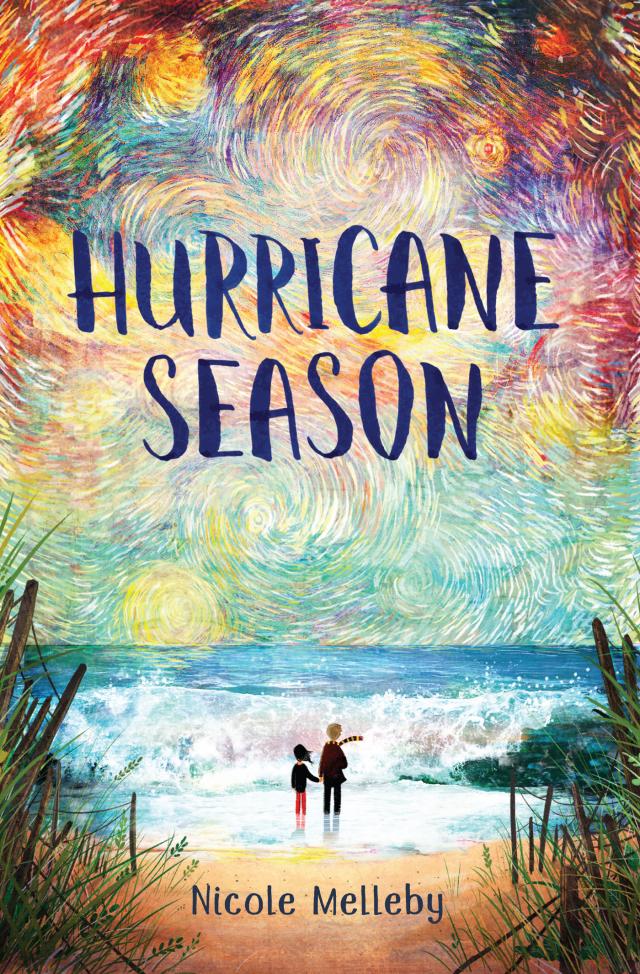
Hurricane Season, page 18


Fig’s cheeks were warm, and when she looked over at Mark, he was fighting back a smile. “Thanks, Molly,” she said. “You look really pretty, too.”
“I’m so excited to hear your dad play,” Molly said.
The ushers were now taking tickets, and people started moving into the hall to take their seats. Molly’s parents called Molly back over, and Mark started moving, too, but Fig froze. Mark looked at her, confused. “I’m nervous,” she whispered. And then she quickly explained, “Excited. But nervous.”
Mark nodded. He understood. “We promised we’d be front and center the moment they turn those lights on him,” he said. “What do you say we go and keep that promise?”
The ceiling of the theater was high and arched, ornate with gold-painted patterns and chandeliers. The seats were clothed in red velvet. Fig gazed ahead to the stage, wide and high in front of them.
When the floor lights went down, Fig held her breath—and Mark’s hand.
The stage lights illuminated a black grand piano. And front and center, sitting tall as if he belonged there—and Fig believed he always belonged at a piano—as if there were nowhere else in the world he could possibly want to be, was her father.
He looked taller, even seated there on a piano bench, than she’d ever seen him before.
Fig’s father looked out into the crowd, and for a moment she saw that familiar expression in his eyes, the one that seemed to signal he was temporarily lost to himself. Fig had to fight the urge to run onstage and into his arms to shield him from what could prove to be an unforgiving audience.
But then, even across the bright lights and the large crowd, his eyes found hers. And that lost look disappeared from his face.
“This song is the most important piece I’ve ever written, and I’ll never write anything that means more to me than this,” he said.
He looked right at Fig and smiled.
“It’s called ‘Finola.’ ”
Acknowledgments
You hear a lot about how stressful and difficult the publishing journey is when you’re trying to achieve it, but no one prepared me for how anxiety-inducing writing these acknowledgments would be. So many people have supported and helped me throughout the years, and the thought of leaving anyone out makes me want to curl up with Netflix and procrastinate.
(Which I did indeed do for a couple of days.)
But, because all of these people deserve their due, I’m going to suck it up and do my best to show how much I appreciate them.
I still remember having to change my clothes after sweating through them during my first phone conversation with my wonderful editor, Elise Howard, because I was so nervous. But she understood everything I set out to accomplish with this little story and promised me right from the beginning that Algonquin would take good care of Fig. Editor Krestyna Lypen has also been such a blessing, not only with Fig, but with dealing with my anxiety-ridden emails. And there are a lot of them.
To my entire Algonquin team, you have all kept that promise to take care of Fig and have done so with more heart and attention than I could have ever asked for. Thank you.
I also will never forget being at the gas station when my agent, Jim McCarthy, called me up to tell me that we had an offer. He laughed joyfully right along with me, as I was so flustered by the entire ordeal I popped my trunk instead of my gas tank. I couldn’t ask for anyone better to trust my career and stories with—especially someone who knows exactly what I mean when I reference the Bring It On musical.
By now my parents are wondering when I’m going to mention them, so here you go, Mom and Dad. Thank you for buying me countless composition notebooks to fill with stories back when I was eight, and for allowing me to find my own path, even if we didn’t know if that path would ever pay. I never felt like I couldn’t go after my dream, and I never felt like that dream was impossible with your support in my corner. (And to my brother, Matthew, who didn’t really do much to help my writing but has been a pretty solid brother, so I’ll mention you anyway.)
I might have convinced myself it was all impossible, however, if not for my mentors, Donna Freitas and Eliot Schrefer. From you both, I’ve learned to be confident in both my writing and with who I am (even if Eliot makes fun of my inability to remember passed vs. past, and Donna will never let me live down the witch book I started at the beginning of my MFA program).
To Liz Welch, you are my Theo; I am pretty useless without you.
And to my wonderful group of friends who are willing to read draft, after draft, after draft (and who put up with my neurotic self while doing it): Christine Headley, Sarah Warren, and Briana McDonald—thank you for all those times I needed reminding that this was worth it. Viva la Fig!
As my debut novel, this is a coda of everyone who has helped me throughout the years, and while it will be impossible to name everyone, I need to try: my big Italian family (all of you Moseras and Sciallos), Laura DeVincenzo (for blessing me with fried Oreos, vinegar fries, and a godson), and everyone at Fairleigh Dickinson’s creative writing MFA program, especially my MFA buddies, Ryan Whitaker, Mariella Diaz, and Ken Pearson. And because I promised, foolishly, nearly a decade ago that I would: Remember the Boohbahs!
I would also be foolish not to thank the tour guide at the National Gallery of London (who had no idea I was eavesdropping on the tour I did not pay for) for speaking of Vincent van Gogh with such passion that I cried in the middle of the museum. And to my uncle Freddy and aunt Christine, thank you for allowing me to crash your family vacation. London is where I was introduced to Vincent—where I discovered how easy it was to relate to an artist from over “a hundred bloody years ago”—so to that beautiful city: I thank you, too.
Last but not least, to Vincent van Gogh, for his beautiful art and his beautiful words. And to Jo van Gogh, for sharing these words with us. I needed them just as much as Fig did.
Published by
Algonquin Young Readers
an imprint of Algonquin Books of Chapel Hill
Post Office Box 2225
Chapel Hill, North Carolina 27515-2225
a division of
Workman Publishing
225 Varick Street
New York, New York 10014
© 2019 by Nicole Melleby.
All rights reserved.
Printed in the United States of America.
Published simultaneously in Canada by Thomas Allen & Son Limited.
Design by Carla Weise.
LIBRARY OF CONGRESS CATALOGING-IN-PUBLICATION DATA
Names: Melleby, Nicole, author.
Title: Hurricane season / Nicole Melleby.
Description: First edition. | Chapel Hill, North Carolina : Algonquin Young Readers, 2019. | Summary: Eleven-year-old Fig enrolls in an art class to better understand her father, a composer and pianist whose mental illness she tries to conceal from classmates, neighbors, and social services.
Identifiers: LCCN 2018033589 | eISBN 9781616209308
Subjects: | CYAC: Manic-depressive illness—Fiction. | Musicians—Fiction. | Fathers and daughters—Fiction.
Classification: LCC PZ7.1.M46934 Hu 2019 | DDC [Fic]—dc23
LC record available at https://lccn.loc.gov/2018033589
Nicole Melleby, Hurricane Season