Hurricane Season, page 16
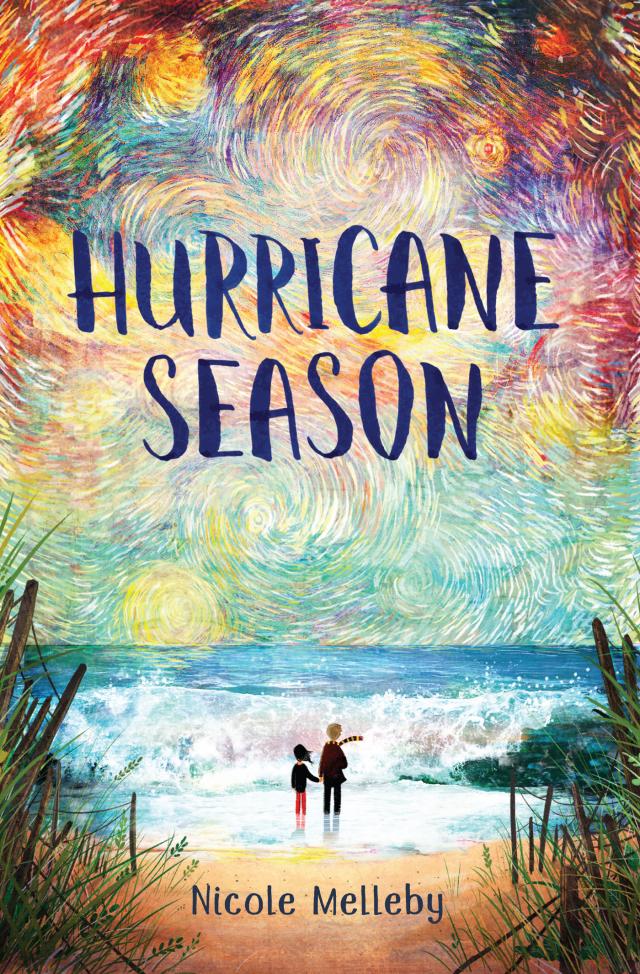


Fig felt . . . exhausted. Her arms and legs were achy, like before a fever begins. She tucked herself into a ball, curled closer into her dad. He wrapped an arm around her and pulled her closer still.
“Oh, my girl,” he whispered into her hair. “I want to yell at you so bad. I want to lock you in this room forever.”
He framed her face with his hands, and gently pulled her head up so he could look her in the eyes. “Why, Fig?” He swallowed, took a deep breath, and continued. “Why did you go out into that storm?”
Fig wanted to look away from him but couldn’t. His eyes were wide and wet and so focused on her. “I wanted to see what you see,” she told him.
His face crumpled, and tears fell down his cheeks (hers, too) as he asked, “Did you?”
She shook her head. “I don’t think so.”
He sighed. It sounded like relief. “I’m going to get you help. Okay? But I need to know when you’re feeling this way. I need to know when things like this happen in that brilliant little mind of yours.”
“Danny wanted to set you up with Miss Williams,” she found herself admitting. “He thought it would help.”
“Help?”
“You. Danny and I were trying to figure out how to help you,” she said. “But Danny’s not really talking to me anymore, and I’ve been so mad at Miss Williams because she called CP and P. I hate watching you get drug tested, Dad, and there are twenty-eight days until they come back, and that’s twenty-eight days something can go wrong.”
Her dad sighed. “Fig . . .”
“The kids at school treat me funny now. And I don’t know what to do because I know it’s not your fault, but I’ve been so mad at you.” Fig took a deep breath. “And Hannah at the library helped me find books on Van Gogh and bipolar disorder, and I read a lot, but some of it was too hard to understand, and that made me angry because I wanted you to explain it to me, but you never did.”
“Darling, I—”
“And I told Hannah I liked her, and it was stupid—I was stupid, because she’s in high school and why would she like me?”
“She’d be a fool not to.”
“I told you about her.” Fig was crying now. “I told you about Hannah. Why didn’t you tell me about Mark?”
“Oh, my girl. My darling.” He pressed his forehead against hers. “I was scared.”
“Of me?”
“Of loving Mark.”
“Why?” Fig asked, her brow furrowed against her dad’s. “Because he’s a man?”
“No. Well, yes. But no.” He shook his head with a soft laugh. “It’s been so long. And I’m . . . You of all people know it’s not easy loving me.”
Fig shifted in the bed, letting her feet tangle in the blankets as she tried to move even closer to her dad. “Did you know that when Vincent van Gogh died, his brother Theo got sicker and sicker and—”
“Fig.”
His voice was both sharp and broken, and she immediately stopped talking.
“I’m not Vincent van Gogh. I need you . . .” He took a deep breath. “I need you to stop seeing me as Van Gogh. I need you to see me as me.”
She reached out to gently wipe the tears off his cheeks, letting her fingers follow the tracks they made down his face. Fig often saw her dad cry. That didn’t mean it didn’t hurt every single time. “I’m sorry,” she finally said. “I’m sorry I went out into the storm.”
“I’m sorry, too,” he said. “And I’m going to get us both help, okay? We’re going to figure this out. I love you, Fig.”
“Double it.”
“Love you, love you. Even more than that.”
Fig pushed her face into his chest and let him hold her, let his fingers tap melodies against her back. “Was it my fault your mind got sick?”
She felt her dad still.
“What?”
“You were great before me. Your music was so great before me.” Fig spoke into his shirt, mumbling against the fabric. “Everything was different . . . after me.”
He pulled her away from his chest, cradling her face to look into her eyes. “Fig . . .” He paused, closed his eyes, and took a deep breath before continuing. “No. No. None of this is your fault. None of this happened because I had you. My life got so much better because I had you. And my mind . . . That just happened over time. Just because I’m sick. Just because it is. It was there before you, it got worse over time after you. But none of it was because of you. Do you understand that?”
Fig tried to be honest. “I don’t know. I tried to read and learn. But I don’t know that any of it makes sense.”
He pulled her close again. “Then we will figure out how to make sense of it together.” He pressed a kiss to her hair. “Is there anything else? Anything else you need to ask or tell me?”
She bit her lip. “Yeah.”
“You can tell me anything.”
She swallowed, thinking about the pouring rain and her drenched clothes. “My new phone was in my pocket last night.”
There was silence. And then he was shaking, pressing his face into her hair as he laughed. His laughter was wet, and it was wobbly, but still it felt good to hear.
Fig was unsteady on her legs as they left her bedroom. Her dad insisted on making her some hot tea, and she didn’t want to be alone, not yet, so she insisted on following him to the kitchen.
She stopped dead in her tracks when she saw Mark, asleep on the living room couch. Her dad turned to look back at her. There was a slight smile on his face. “He’s probably exhausted.”
Fig thought of her dad’s bed, empty and not slept in right down the hall. “Why did he sleep on the couch?”
“Best guess is he wanted to guard the door from the both of us.”
Fig quietly padded over to the rather small couch, which made Mark look like a giant. He was lying on his back with one foot placed firmly on the floor, as if he were ready in case he needed to get up quickly, as if he hadn’t expected to actually fall asleep. She studied his face. Sometimes she forgot he was older than her dad, but other times she thought he looked just as haunted and worn. She wondered if loving and losing his wife and now openly loving her dad meant he was a lot braver than she was willing to give him credit for.
She reached her hand out, wanting to trace the curve of his nose like she traced her dad’s, but she stopped, her fingers hovering in the air. She didn’t know if she was allowed, if she had earned that right.
Fig lowered her hand, and Mark slowly blinked open his eyes, looking at her with both exhaustion and worry. “How’re you feeling, sweetheart?” he asked, his voice rough and raspy.
Fig’s throat felt tight. She couldn’t answer him, so she nodded instead.
His eyes were so . . . so clear and blue and green, swirls of colors like a Van Gogh sky, and he smiled at her—a small smile but a real one. And those swirls of colors in his eyes grew blurry and wet (but maybe that was because her own eyes were filling with tears), and she knew, she just knew, that he would not leave them. He would weather the storm with them both.
She threw her arms around him and held him tight, and he held her right back.
17
Self-Portrait as a Painter
Fig’s dad asked her (and asked her and asked her) if she wanted to stay home from school the next day. So she did. She, her dad, and Mark sat down and made plans (and made plans to make more plans). Mostly about things they would do together, appointments they would make, doctors they would talk to. Her dad even asked, hovering and worried, if she wanted to stay home the day after, too, but Fig couldn’t stay home with them forever. She still had some things she needed to do alone.
When she went back to school, Fig found Danny before homeroom. She was slightly out of breath from pushing through the maze of students in their coats and carrying their backpacks and sports equipment as they climbed out of buses and their parents’ cars.
“Hey,” Fig said.
“Hey,” he replied. “How was the storm? Was your dad okay?”
Fig figured a lie by omission was appropriate in this case. “He’s okay.”
“Oh, good.”
Their homerooms were in opposite directions, but she followed him down the hall. “Danny, can I ask you something?” Fig said, stopping. If she didn’t turn around now, she’d never make it to class on time.
Danny pulled on one of the straps of his backpack so it sat more firmly against his back. “What?”
She took a deep breath, pushing past the nerves in her stomach. “Did you only want to help my dad because you wanted to be my boyfriend?”
“What? No,” he said, his eyes wide.
“I just don’t understand why you wanted to help if you don’t want to be my friend.”
“I did want to be your friend,” Danny said. “I picked up the paintbrushes your dad knocked over in class that day. I wanted to help him.”
“But why?”
“Because my dad’s sick, too,” Danny said, and Fig gaped at him. “Well, not like your dad, not really. He’s in rehab. I don’t get to see him. This is his second time, but he can’t help it, either. Just like your dad. My mom says there’s nothing we can do, but . . .” Danny shrugged.
The warning bell rang.
“I should go,” Danny said, and then turned to walk into his homeroom.
“Wait!” she called after him. And she worked up the nerve to tell him the one thing she wanted to all along: “I like Hannah.”
Danny froze. “What?”
“At the library. I like her. Well, I did, anyway, but that’s another story.” She shook her head. “What I mean is, that’s why I can’t be your girlfriend. Because I liked Hannah, and you’re my best friend.”
“Oh.”
“Is that okay?”
Danny just shrugged, looking down at his shoes.
Fig’s stomach sank. “I’ll see you in art class?”
“Yeah,” Danny said. “I’ll see you in art class.”
After school Fig once again ran into her father’s student Molly as she was leaving the house, her mom parked and waiting patiently in the driveway. Fig was surprised to see Molly. She didn’t think her dad was giving lessons that afternoon. Fig and her dad had decided they needed to take time to sort things out, to go to their doctors and to take care of themselves. “Did you have a lesson?” Fig asked.
“Oh, hi!” Molly said. “No, I had to drop off a check. And, well, I was hoping to maybe bump into you.”
“Me?”
“Yeah,” Molly said, and then hovered on the front stoop. Fig was about to say that she should go before her mom honked the horn, but Molly, in one quick breath, said, “Maybe you want to hang out sometime?”
Fig blinked. “Really?”
“If you want to. I could give you my number. Or, I guess your dad has it. But maybe I can come over sometime without having a lesson,” Molly said, her eyes open wide, and Fig really looked at them for the first time. They were brown with bits of gold, like sunflowers, and they matched the color of her hair when the sun hit it just right. “I really like you, Fig.”
“Me?” Fig said again.
Molly laughed as her mom honked the car horn.
“She’s getting impatient,” Molly said. “So, do you? Want to hang, I mean.”
Fig hesitated. “Sometimes . . .” She took a deep breath, looking down at her feet. “Sometimes my dad doesn’t feel well. He’s . . . sometimes he’s . . .”
“I know,” Molly said, and Fig’s eyes snapped up to look into hers. “My mom told me that’s why he cancels lessons sometimes. But maybe when he has a bad day, you can come to my house if you want.”
Fig didn’t know what to say to that. “Oh.”
“So . . . ?” Molly asked as her mom honked again.
“Yes!” Fig exclaimed a little breathlessly. “Yes.”
Molly smiled. Fig really liked that smile.
When Fig walked inside, her father was waiting on the other side of the front door. “Just got off the phone with your teacher, Miss Williams.”
Fig dropped her backpack. “School literally just got out.”
“I appreciate her being on top of things. She thought it was important.”
“Well, was it?” Fig asked, and glanced about the house. “Where’s Mark?”
“Working. Some people do that.”
“You finished a song,” Fig pointed out. “That’s work.”
“Not work until I sell them.”
“So sell them.”
“You make it sound so easy.”
They were already off track. “What’d Miss Williams want?”
He shook his head, as if he were unclogging his ears after jumping into a pool. He had explained to Fig that sometimes his medications made him foggy, and he had asked her to be patient with him—and never to let him off the hook. “She said you brought some flyer home you were supposed to give me. She wanted to make sure you did, and if you didn’t—which you didn’t—to make sure I knew to come to this Fall Festival. Apparently my daughter has quite the painting to show off.”
Fig felt herself blushing.
“Why didn’t you give me this flyer? Go get it.”
Fig didn’t move.
“What’s wrong?” She went to tug on her earlobe, but he reached out and gently pulled her hand away. “We said we’re going to be honest with each other, yeah? Even when it’s hard? You’ve mentioned this festival before. I know you’re excited about it. So why not give me the flyer?”
“It was . . . a long couple of weeks.”
“Understatement of the century, darling, but that doesn’t really answer my question.”
“It’s too soon. You’ve got that doctor’s appointment, and the CP and P visit is . . .” She glanced over at the calendar, where so much of November was already crossed off. “Five days later.” She shrugged. “It’s not the right time, that’s all. And they’ll let me bring the painting home when it’s over, so you’ll get to see it anyway, and—”
“The flyer, Fig.”
Fig sighed and unzipped her backpack. She pulled out a folder and found the flyer for the Fall Festival right in the front, with black paint smudges on the corner from where she grabbed it after finishing her work. She pulled it out, handed it to him, and watched as he read the information carefully, holding the flyer close to his face as he scanned it.
She wondered if he realized the school’s enrollment was at an all-time high, and that—between the teachers and everyone’s families—the auditorium that looked so big when empty was going to be full and loud and feel much smaller. That there would be science experiments, and art, and readings. That the Fall Festival would be an event overrun by middle schoolers, and the commotion would be . . . a lot. And that was if he had a good day at the doctor’s. That was if he had a good day at all.
“It’s okay if you can’t go, Dad.” She meant every word, and she wanted him to know that.
Her dad’s eyes didn’t leave the flyer. “If it’s okay with you, I’d still like to try.”
Fig nodded, didn’t know what else to say. “Okay.”
On the day of the festival, the students had to be at the school to set up before it started, and Fig’s dad and Mark were at his doctor’s appointment. They were talking about insurance and medications, options for therapy for Fig, and several other things they told Fig not to worry about.
So Fig stood alone in front of her painting, while parents and teachers and other family members began filling the auditorium. She and Danny stood side by side, not really talking, in that crowded auditorium in front of paintings they were both proud of. But Fig found she was nervous for anyone to look at hers.
“I don’t care that you like girls,” Danny suddenly said. Fig almost didn’t realize he was speaking to her.
“What?”
Danny shrugged. “It just sucks that you like Hannah and not me.”
“I can’t help it, Danny.”
“I know,” he said, looking down at his feet. “It just sucks, okay?”
Fig nodded. It hurt when Hannah didn’t like her back, which was why she now avoided the library. “It sucks not having you for a friend.”
Danny exhaled deeply, and then he gave her a shy smile that made her breathe easier around him for the first time in weeks. “Yeah,” he said.
Danny’s art club teacher from the library suddenly interrupted them, wanting to see his work. He gave Fig one last glance and a little wave, and she felt even more alone as he turned away from her to show off his painting.
Fig glanced at the clock—it had been only about a half hour since parents were allowed to come in. There was still time for her dad to show, but the possibility was feeling more and more unlikely. She kind of wanted to go home.
“Hey, you,” Miss Williams said, making Fig jump. “Oh, didn’t mean to scare you.”
“Hi,” Fig said.
“Some of your other teachers asked me about your painting. They were impressed.”
Fig didn’t respond.
“You know, your dad and I chatted for a bit the other day on the phone. I wanted to touch base with him after everything you and I spoke about. He . . . he likes to talk.” Miss Williams laughed as Fig rolled her eyes. “Oh, it’s sweet, though. He could talk about you for hours if I had the time, I’m sure. He told me a bit about what’s going on at home.”
Fig’s cheeks grew warm. “Oh.”
“He’s very proud of you, Fig. And he told me he was going to do everything he could to try and be here tonight.”
Fig frowned and once again looked at the clock. She nodded, unable to respond to Miss Williams, to tell her that she knew her dad loved her, she knew he would try, but she also knew that sometimes he just couldn’t. And that was okay—really, it was—but still . . . It sometimes made Fig want to cry anyway.