Hurricane Season, page 1
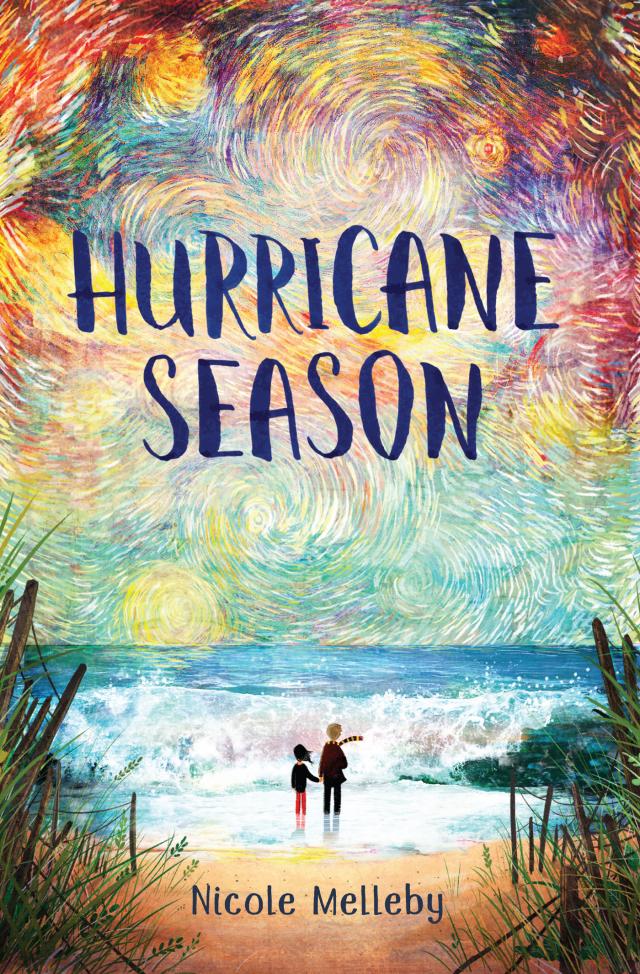


Hurricane
Season
Nicole Melleby
Algonquin Young Readers 2019
To Donna.
I don’t think it’s hyperbole to say “for everything.”
Contents
Part One: September
1. The Yellow House
2. Self-Portrait
3. A Pair of Shoes
4. Tree Roots
5. Landscape Under a Stormy Sky
6. Wheat Fields after the Rain
7. La Berceuse (Woman Rocking a Cradle)
8. The Starry Night
Part two: October
9. Sorrow
10. Undergrowth
11. The Sower
12. Portrait of Theo van Gogh
13. Three Sunflowers in a Vase
14. At Eternity’s Gate
Part Three: November
15. Twilight, before the Storm
16. Fishing Boats at Sea
17. Self-Portrait as a Painter
CODA: September, Again
18. Finola
Part One
September
The beginning is perhaps more difficult than anything else, but keep heart, it will turn out all right.
—Vincent van Gogh to his brother Theo, January 1873
1
The Yellow House
It all started the day Fig noticed the SOLD addition to the sign on her neighbor’s lawn as she left for school.
She sat at her desk in art class with her chin resting on her hands as her art teacher asked Danny Carter to pass out large, clean white sheets of paper. It was a warm day for September, and Fig kept her eyes focused out the classroom window at the bright blue sky as the class ticked by. Haley Flores was handing out paper plates, and Miss Williams was walking around the room, asking everyone to pick the three colors of paint they wanted to start with.
Ava Washington was playing with her cell phone under her desk, and Madison Sherman leaned over to ask, “Would it be stupid to say I wanted green paint?”
Sixth-grade business as usual.
Danny handed Fig a sheet of paper. “You could ask for blue and yellow instead,” he said to Madison. “You shouldn’t waste your pick on green.”
That was when the classroom door flew open and everyone turned with wide excited eyes to see what the disruption was. The school year had barely started, but any interruption from the routine of lectures and paint was a welcome one.
But the distraction was anything but welcome for Fig when she saw that it was her dad standing in the doorway. “Fig?” His voice was wobbly and small.
Everyone turned away from him to look, instead, at her.
Fig’s dad shuffled his feet as he entered the classroom, looking for her and bumping into one of the desks. He knocked over the entire box of paintbrushes in the process, causing Miss Williams to spill the jar of blue paint all over her hand. Fig stood, trying to get her dad’s attention as Danny began picking up the brushes, and Miss Williams said calmly, “Can I help you, Mr. Arnold? Is everything okay?”
Miss Williams gently grasped his arm with her now-blue fingers. Startled, he looked at her. “Is Fig here?” he asked. “I’m . . . I’m looking for Fig. I didn’t know where she . . . They said she was . . .”
“Right here,” Fig whispered. “I’m right here, Dad.”
His eyes were unfocused as they settled on her. It was a look Fig was familiar with, one she hated. One she didn’t want her classmates to see. “Fig. Come on, let’s go.” He reached for her hand as he stepped toward her, grabbing onto it a little too tightly.
She was about to follow him because she knew he needed her, but Miss Williams grasped his arm, again. “Mr. Arnold, why don’t we step out in the hallway for a moment.”
“I need . . . Look, I just need my kid.” His voice started nearing the desperate twinge Fig hated to hear.
Fig knew how to take care of her dad at home, but she had a hard time focusing on him now. All around her, her classmates were watching and whispering. Ava had her phone right there on her desk, and Fig knew how much she liked to take pictures. Haley was giggling with Madison, and Danny was still standing in the center of the room, too close to Fig’s dad, gripping the tin of paintbrushes tightly and staring.
“Fig, please,” her dad said, and Fig knew she would go with him.
But then Miss Williams held out her hand. “How about the three of us just go into the hall for a moment, okay, Mr. Arnold? Me, you, and Fig.”
Fig looked up into Miss Williams’s eyes, soft and kind and understanding. When Fig took Miss Williams’s paint-covered fingers and her dad quickly grabbed for Fig’s other hand, she felt like she had betrayed him. The whispers around Fig grew louder, and Miss Williams continued to hold her ground, continued to say her dad’s name.
“Mr. Arnold. Come with me, Mr. Arnold. Just come with me to the hallway.”
A week later, Fig could still hear her father’s panicked voice in her head, could see the hurt in his eyes. She was also discovering more and more repercussions of that moment, including the lady from Child Protection and Permanency who—and not for the first time—came knocking on their door.
Fig, try as she did, couldn’t stop thinking about CP&P, which was New Jersey’s department of social services—or how this time they would be keeping a close eye on her and her dad. Nor could she stop thinking about how her classmates might figure out how poorly his mind worked and how, because of that, CP&P could take him away from her. They were both—CP&P and her classmates—starting to ask a lot of questions. She leaned against the back of the living room couch, looking out the window at the small yellow house across the street, where her neighbor Ms. Minkle was carrying boxes outside.
Ms. Minkle was moving, and Fig had to blink back tears watching her. Ms. Minkle was a good neighbor. She kept to herself. Sometimes she’d wave, but she never made small talk, and every so often her boyfriend even brought in their garbage cans when Fig’s dad forgot and the wind blew the bins and the garbage all over the road.
Most important, Ms. Minkle never called anyone about her strange neighbors across the street, unlike Fig’s school and Miss Williams.
Fig watched from the window as Ms. Minkle packed her things into her bright blue car, while the voices from the weather broadcast on TV mingled with the sounds of Fig’s dad’s slightly out-of-tune piano being tinkered into submission behind her.
All of which added to the knot in Fig’s stomach.
“Is it a hurricane yet?” Her dad’s voice was a more welcome sound than his piano. She loved that she could still hear traces of his old east London accent that didn’t belong anywhere near their home in New Jersey. “I would like a hurricane.”
“Still a tropical storm,” Fig responded. She did not want a hurricane. “It won’t become a hurricane. It’s not strong enough, and it’ll make landfall soon.”
“I love the sounds of a good storm.” He climbed out from under his small wooden upright piano, leaving it open with its insides exposed. It always fascinated Fig how easily her dad understood the inner workings of a piano when neither of them understood the inner workings of him.
Fig reached a hand up to brush it through her knotty, messy hair. The last thing she needed was another reason to stand out in school. She really wanted to fade back into the background. It had been a long, long week of questions and gossip. “Will you braid my hair?”
Her dad rarely refused her when he was well, and he slid to one side of the piano bench and patted the spot in front of him for Fig to settle between his knees, which she did easily. She was small for her age, but she supposed he was, too. She never worked up the nerve to ask how tall her mother was—she had been gone since the day after Fig was born—but she could only assume she got her height from him. She handed him her hairbrush, and he ran his fingers through her bed-mussed black hair.
Fig may not have appreciated his musical skill, but she did appreciate his calloused piano-playing fingers as he scratched softly at her scalp with his cut-too-short nails. She’d be lying if she said he was good at braiding hair, but he was better at it than she, and he always tried hard, and, really, she had no better option. Truth be told, she could understand why her mother didn’t stay; her dad was a difficult man to live with.
What she couldn’t understand, however, was how her mother could leave her, little and pink and new, and Fig wondered what would have been different this past week if she hadn’t. It took a special sort of person to live with and love her father, and Fig considered herself mighty special, but she was still the one left to face her classmates. “Everyone at school has a smartphone, you know,” she said, flipping her subpar phone open and closed for effect.
“How lovely for them,” her dad said, and finished twisting the band at the end of her long braid. “All done.”
“Dad, I’m literally the only sixth grader without one,” Fig tried again. “This thing is embarrassing.” She flipped it open and closed again, holding it up like some sort of ancient artifact.
“Embarrassment builds character.”
“Not in middle school! It builds miserable children! Dad, you don’t understand.”
He leaned forward to press his forehead against hers, closing his eyes and humming along to a tune only he could hear, one that was trapped in his head and leaking out of h im the way songs often did.
The humming slowly came to a stop, the song in his head ending. His eyes met hers as he softly admitted, “A smartphone would be one more bill to stress over.”
That she did understand. And, considering all that was happening, it made her feel guilty.
He kissed her forehead, the stubble on his face scratching a bit, and sat back up. Fig made a face. He always forgot to shave when his mind was elsewhere. “When was the last time you shaved?”
Her dad gave her a sheepish grin, his eyes wrinkling at the corners. “I’ll do it later.”
She sighed and popped off the bench to go and grab her backpack and shoes strewn by the front door.
“Don’t I get a kiss?” her dad called after her.
She shook her head. “Not until you shave!”
He ran a hand over his too-scratchy-for-kisses stubble. Fig was starting to notice more gray in the light brown color of it lately. “Hold back a second, Fig.”
“I’m going to miss my bus.”
He didn’t say anything for a moment, and Fig hovered by the door. The knot in her stomach grew tighter.
“Everything is going to be okay,” he finally said. “I just . . . I want you to know that when they come back . . . it’s going to be okay.”
She glanced past him to the calendar they hung on the wall, right above his piano. It was where they wrote down all of Fig’s school things, all their appointments, all the notes needed so her dad wouldn’t forget or be confused about any of it. It was the first week of September. In three months, on November 30, written in heavy ink and circled twice in the little square space on that date, was their newly scheduled follow-up CP&P visit. It was also the very last day of hurricane season.
Fig wanted to tell her dad that she believed him, that everything between now and then would be okay.
She nodded instead.
“I love you, darling.”
“Double it,” Fig said as she opened the front door, stepping into the humidity that still clung to the early fall air.
“Love you, love you!” he called back.
Her bus stop was at the end of the street, past four more houses that looked identical to hers, all in various stages of repair. Their own white wooden door was splintered at the knob. Fig stood with three other kids who were older and taller and louder than she was. They all stopped talking when she got on line, and she looked down at her shoes, pretending the silence was just coincidence, even though she knew it wasn’t. Their school was small, and news spread fast, and the kids from her neighborhood already knew more than the rest of her classmates. The school bus pulled up with creaks and clanks, the door sliding open with a screech that Fig hated.
Before the doors closed behind her, she watched as Ms. Minkle drove away, and she was sad all over again. She could only hope that whoever moved in to the yellow house next would be just as quick to turn a blind eye on her dad.
2
Self-Portrait
Subjects Fig was good at: math and science and the other wonderful letters of STEM. Subjects Fig was not good at: anything related to art.
At eleven years old, Fig already knew a lot about budgets and bank accounts and checkbooks and credit cards. She knew what bills she and her dad had to pay, and how much money they needed to pay them. She may still have had a lot to learn about algebra, but she was bright enough to know how to make sure she and her dad had enough money to get on while still having some left over to buy her favorite cereal, and his favorite tea—neither of which were the store brand.
Her dad was the artist, and while he always claimed that musicians used the same side of the brain as mathematicians, Fig wasn’t so sure. Math she understood. Art and music, the whole language that her dad spoke and played and hummed, made very little sense to her.
Fig hated that. She hated that the one clear thing in her dad’s world was the one thing she couldn’t make sense of. Which is why, to the shock of her school counselor, she chose art instead of science lab as her elective.
But now, as she and her classmates sat in art class with instructions to sketch a piece that each of them would be painting in a few weeks, the only thing she wanted was for Miss Williams not to come anywhere near her. As everyone else scratched away, the sounds of pencils on paper mingling with the low murmurs of sixth-grade gossip and flirting, Fig stared at her blank sketchpad at a complete loss and utterly distraught over it.
It didn’t help matters that Jeremy Ng sat next to her, smelling like a bag of Doritos (the red-bag nacho-cheese kind, not the blue-bag cool-ranch kind). Ava Washington, followed by all her friends, filled out the desks on the other side. Ava always had her long hair in braids that were much neater and tighter than any Fig ever wore, and most of the noise in the art room came from her and her friends. That noise engulfed Fig, who was close enough to almost pretend she was a part of it as they planned an after-school trip to Starbucks, even though they hadn’t actually invited her anywhere all week.
Madison Sherman, from her usual spot next to Ava, caught Fig’s gaze. “You can come if you want,” she said.
Fig looked at their faces. The other girls didn’t object, but they didn’t exactly agree, either. None of them made eye contact with her, but they all exchanged glances with one another. “Really?” Fig asked.
Madison nodded, her short frizzy hair bouncing with her. No one else said anything. Still, not one of them objected. “Okay,” Fig said.
That was all it took for Haley Flores to change the subject, and for the rest of them to turn away from Fig and focus again on one another. Fig sighed and stared back down at her blank piece of paper.
“Do you know what you’re going to draw yet?”
Fig frowned as she turned to find Danny Carter sitting next to her. He had swapped seats with Jeremy, and Fig looked down at his paper, which was covered with pencil smudges and eraser bits. “I keep changing my mind,” he said, sweeping his floppy blond bangs to the side of his head the way that all boys his age with long hair seemed to do. He had a gap between his two front teeth that gave his words a whistling sound as he spoke.
“Uh, no. I don’t know yet,” Fig said. She hadn’t even picked up her pencil.
Danny pressed his lips into a thin line and gave Fig a determined nod. “You’ll figure it out,” he said.
“Having a hard time deciding what to draw?” Miss Williams asked, coming up behind Fig. Miss Williams smiled her wide smile full of large straight teeth, which Fig used to love but now made her stomach hurt.
Fig shrugged.
“Oh, come on.” Miss Williams gently bumped her shoulder into Fig’s. “We’re going to display these at the Fall Festival. Don’t you want to have something for your family to come and see?”
Fig didn’t respond. It didn’t matter to her what hung in the showcase. Her dad was all she had, and how could she ask him to come back to the school, in front of her classmates, where he could do something worse, where he could be laughed at, where she could be laughed at, where it could all get messed up again?
Miss Williams’s smile fell, and for a moment Fig felt good about that. Fig thought she liked Miss Williams. She thought she liked that Miss Williams’s hair was short and brushed up against Fig’s cheek when she leaned over to see Fig’s papers. She thought she liked that Miss Williams didn’t ever tell Fig she was bad at art, and that Miss Williams might be able to open up the world of art that Fig’s dad lived in and that Fig wanted to understand.
But Miss Williams was the one who had called CP&P.
“Maybe you need some inspiration,” Miss Williams suddenly said. “Wait right here.”
Fig watched as Miss Williams crossed the room to the bookshelf behind her desk and pulled out the biggest hardcover book on it. When she crossed back and dropped it onto Fig’s desk with a heavy thud, Fig’s eyes opened wide.
Danny’s did, too. “Oh, cool!” he said.
Fig didn’t think it was all that cool. “You’re giving me more work?”
Miss Williams laughed. “Just flip through it when you can. It’s a book of artists, all different kinds. Take it home. We won’t be painting for a couple weeks yet. You have time to figure it out.”