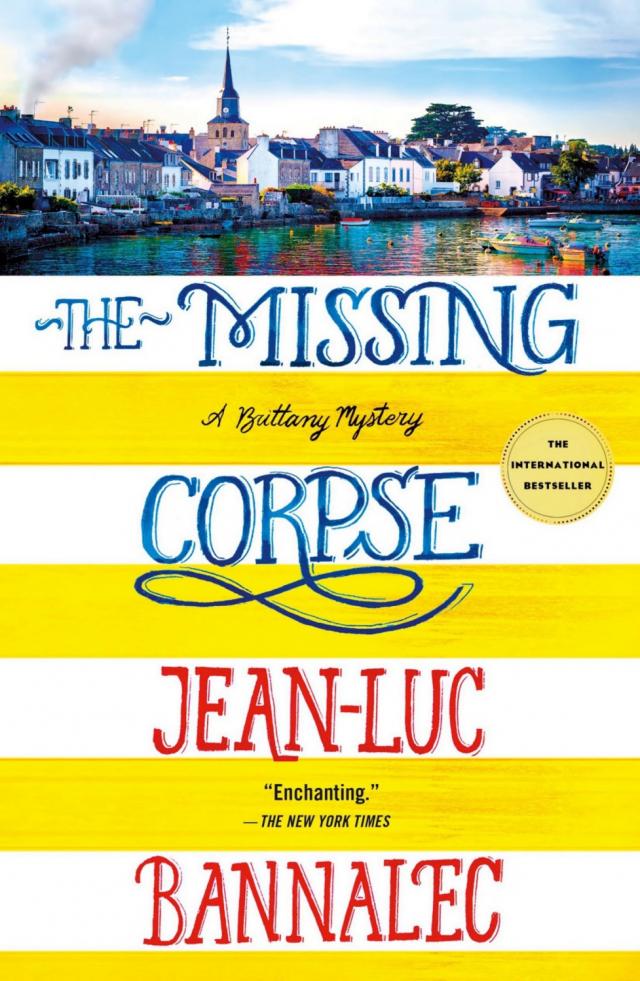
The Missing Corpse: A Brittany Mystery, page 9
part #4 of Commissaire Dupin Series


“What do you think, Monsieur le Commissaire?” Nolwenn cut across his thoughts.
“I … I’m glad.”
“Do you know what one of the topics was?” With her enthusiasm, Nolwenn could hardly be stopped. “America!”
“Very good. I’m sure Riwal gave a thorough account.”
A pitiful attempt on Dupin’s part.
“America exists thanks to Bretons! Who discovered America? Breton fishermen from the Île de Bréhat! And centuries before Columbus. They landed on Newfoundland. Everything is documented. American independence?” Dupin could practically see Nolwenn’s shining eyes. “Won by a Breton! The Marquis de la Rouërie and the corps he was leading dealt the English the decisive blows. And Halloween. But you know that, don’t you?”
Dupin hoped it had been a rhetorical question.
“All Breton! When it’s getting cold at the beginning of November, the Celts celebrate the Feast of Samhain. That night the hidden portals to the dark world open up and creepy creatures dash through our realms! In the eighteenth and nineteenth centuries, Celtic emigrants brought these legends and customs to North America and voilà: Halloween!”
That was genuinely interesting, but not right now.
“Don’t worry about Kadeg.” Nolwenn had seamlessly returned to harsh reality. “The prefect and I have thoroughly … let’s say spoken. And I’ve also made my opinion plain to the commissaire from Lorient.” It was on the tip of Dupin’s tongue to ask for details, but he refrained. “I think you’ll get him back soon.”
“Excellent.” Dupin would never have dreamed he would ever say that in reference to Kadeg. But this really was good news, and in truth it look a load off his mind.
“And Riwal is already on his way to you. Where exactly are you?”
“I’m standing in front of La Coquille. I want to speak to Madame Bandol. And then take another look at the parking lot. Where the corpse was.”
“So you’re still assuming that Madame Bandol saw a corpse?”
“That’s right, and I have a little theory that I want to test.”
“Has Madame Bandol trawled through her memory again? Has anything else occurred to her?”
“She saw the corpse during the night in a dream.” Dupin was aware that it sounded odd. “More clearly than in her memory. So she was able to see a few extra details.”
“Just like with Aunt Marguerite! When she’s dreaming, lots of things come back to her that have completely slipped her mind while she’s awake. Sometimes you ask her something and she says you’re to ask her again tomorrow morning. And that’s how it goes: she knows it again then. That, Monsieur le Commissaire, is nothing unusual.”
Any worries that Nolwenn might doubt his sanity had been completely unfounded; he might have known. For a Breton, the truthfulness of dreams was self-evident.
“Who knows, maybe even more things will come to her this way—it’s astonishing sometimes. In any case: don’t let yourself be put off, Monsieur le Commissaire, even if you don’t have anything concrete yet. You know the Breton motto: nothing is more real than what you cannot see! The world is an enchanted forest. There’s hidden meaning everywhere. And dreams are a tried and tested signpost. I”—again the switch to practical things was seamless—“will tell Riwal he’s to meet you at the parking lot.”
Dupin was already pacing up and down outside the entrance of the restaurant with the dozens of colorful signs. Huîtres de la Bretagne. Le plaisir à l’état pur, promised the largest of the signs: “Pleasure in its purest form.” He was impatient; he wanted to know what truth there was to his idea. Perhaps it was just too far-fetched.
“Thanks, Nolwenn. I—”
“Your party the day after tomorrow,” she said, sternly now, and Dupin jumped, but luckily she didn’t say what he was afraid she would. “You won’t be dealing with that today, you’ve got things to do, the murders come first. I’ve confirmed the menu with Alain Trifin. Almost everyone has accepted. Even Commissaire Rose let me know today she’s coming. As long as a crazy shoot-out in the salt marshes doesn’t get in the way, of course, I’m to tell you, and: ‘wind and sun permitting.’ That’s it. Any comments?”
“No.”
“Then I’ll call Inspector Riwal now.” She hung up on the last word.
Dupin was standing in front of the door to the restaurant. He took a few deep breaths and then went inside.
Jacqueline nodded to him from the bar. She seemed to have been expecting him.
“It’s over here.”
She gestured to the end of the bar with her head, where a package lay.
“Brilliant.” With a satisfied expression, Dupin picked up the package as he walked past. Magalie Melen had completed the small task immediately.
Madame Bandol was sitting at the same table as yesterday, which was absolutely fine by Dupin—it was in keeping with his way of quickly developing habits everywhere. Her dog was standing at the terrace door today, his nose on the windowpane. He seemed excited.
“Come on, Commissaire, come on! What is it? It seems extraordinarily urgent.”
Madame Bandol practically pulled Dupin toward the table. She was dressed in shades of pale blue from head to toe, another long skirt and a simple blouse with a wide, round neck. She looked almost girlish, her hair even wilder than yesterday, expertly wild.
“I’ve got to show you something, Madame Bandol.” Dupin had remained standing. “You spoke about shoes with birds on them. On the phone earlier. Is that right?”
“Oh yes.”
“Shoes with birds on them. Which was what came back to you in a dream. One of the new details.”
Dupin had pulled a pair of sneakers out of the package. Covered in mud, they had clearly been heavily used in all kinds of weather. But the thing he was interested in was still clearly visible. In a garish neon green on dark blue. A kind of elongated check mark—or even: a stylized bird.
The trademark.
“I’d like to know—”
“You really know a thing or two, Commissaire! You’d never think it to look at you! They were different colors—I’ve just remembered, the shoes were black and the birds were red—but yes: that’s them! The shoes that the dead man was wearing. Just like those! We’ve got the man.”
Somewhere in the recesses of his mind the thought had been sparked when Madame Bandol had talked about the “shoes with birds on them.” That’s often how it was for Dupin: the associations, the deductions began and he only really realized later. One of the reasons why he really disliked talking about his “method.”
“Are you one hundred percent certain, Madame Bandol? Absolutely certain?”
This was a crucial point.
“I swear it! I did tell you, I could see the birds down to the last detail in the dream.”
“And now you even recall the colors?”
“As if I were seeing them in front of me.”
Dupin sat down.
“Nikes. The victim was wearing Nikes,” he murmured almost inaudibly.
“What’s that supposed to mean, Commissaire?”
Instead of answering, Dupin got out his phone. There was something else he could still check. This could be another lead. A further validation.
“A black shoe, you say.” Dupin was on the manufacturer’s website again. He put in the color and a few moments later he saw the range. “With a red symbol,” he said, going through the list model by model. “Completely black—apart from the red symbol, I mean. No other colors on the soles or anything?”
“Completely black!” Madame Bandol looked put out by the query.
“Here!” He had found what he was looking for. “Like this?” Dupin held the phone out to Madame Bandol.
“Exactly! The colors. The model. These exact ones! Bravo!”
Now for the most important thing. Dupin clicked on one of the extra pictures with a view of the tread. A moment later he saw it blown up: honeycomblike patterns and wavy lines. It was obvious. This model existed. This exact model: plain black Nikes with red symbols—and most importantly, they had the special soles that left footprints like the ones from the Monts d’Arrée.
Dupin ran a hand roughly through his hair. He needed to concentrate.
“Tell me what you’re thinking, Monsieur le Commissaire! How else can I help you?”
Dupin’s brow creased. “We’ve found exactly these footprints from this type of shoe,” he said, and pointed at the mobile screen, “by the place at the Roc’h Trévézel where the murderer threw off his victim. The perpetrator there was wearing shoes like this.”
Madame Bandol’s eyes widened, there was profound fear on her face. Then she steadily shook her head in a theatrical gesture.
“Then it was my dead body!” She was quite agitated now. “My missing body from the Belon—and he was the murderer from the Roc’h Trévézel! It’s got to be!”
The implication was spectacular. The exact same thing had struck Dupin. Assuming Madame Bandol was remembering the shoes (and anything else) correctly, they were dealing with a turn of events that was just as confusing as it was dramatic. He tried to express it as a potential sequence:
“The man with the Nike sneakers killed the man yesterday morning, whom we then found at the Roc’h Trévézel this morning. Only to be murdered himself a few hours later, a hundred kilometers away in Port Belon.”
The two cases—they would be one case.
“Maybe they were both just wearing the same shoes. The murderer yesterday and the dead man yesterday,” Madame Bandol said.
“I don’t think so.” His instinct told him this was no coincidence.
“I don’t either.” Madame Bandol gave him a conspiratorial smile. “And it’s much more exciting this way too.”
Dupin didn’t delude himself. It sounded far-fetched, highly speculative. Radical. But if the assumption was correct, there was a strict logic to the consequences.
“I’d like to have a facial composite of this man done—of your dead body. And send it round with the other photo. We might get lucky. Perhaps the pair of them have been seen together somewhere.”
They didn’t have enough details to produce a face, of course, but they did have some details of what the dead man—the perpetrator—had been wearing. They were clutching at straws to some extent. But they only had straws right now.
Madame Bandol shook her head again.
“The chances are definitely slim. But all right. Have a composite done! Maybe something else will occur to me then. We’ll see. Memory is a grab bag.”
“I’ll arrange for one of the sketch artists to visit you.”
If the story that was just emerging was true, the case would be on a large scale. There would be at least a third person involved in the matter. And still out there somewhere. The murderer of the murderer. Yet they didn’t have the slightest clue as to what it was about, what dramatic intrigues were going on. They were groping about in the dark.
Dupin felt an urgent sense of unease. He was used to feeling this way; it was a state he always got into if cases became complicated.
“Thank you, Madame Bandol.” Dupin stood up. “If anything else comes to mind, get in touch immediately.”
There was considerable disapproval in Madame Bandol’s expression.
“You’re not going to leave me here by myself with these extraordinary developments, are you? Besides, it’s lunchtime, you ought to have something to eat. And we can keep investigating together as we eat.”
Dupin reached for the sneakers and put them back in the crumpled package.
“I’ve got to go, Madame Bandol, I’m sorry.”
After a brief reflection, her generous, open smile reappeared.
“Well then, what are you waiting for, my dear?”
* * *
“I would narrow down the time of death to between eleven o’clock and twelve noon yesterday. And finally, I can confirm what the village doctor suspected: the man was strangled. He was already dead during the fall down the steep rock face. The broken wrist probably came from a struggle, along with a series of hematomas that occurred antemortem. Unfortunately, we didn’t find any tissue or skin from the perpetrator underneath the fingernails.”
“Anything else?”
The old Citroën groaned; Dupin had taken a sharp turn at too high a speed. The medical examiner had called him just after he got into the car. He had delegated some new tasks to Magalie Melen beforehand.
“At the moment, I’m assuming that the injuries sustained in the struggle, strangulation, and subsequent fall occurred within the space of an hour at most. When he was thrown off, he had not been dead for long.”
This wasn’t much, but it did to an extent make it easier to sort through the scenarios about the sequence of events.
“That means it could all have taken place there at the Roc’h Trévézel.”
“That’s possible. But another possibility is that the victim was murdered somewhere nearby and then brought there.”
Dupin liked the medical examiner’s precise, unflappable, and unassuming manner.
“Are there any clues to the identity of the dead man?” he asked.
“Nothing conclusive. Mid-sixties, one meter seventy-six, central European. Very bad teeth, conventionally treated, the dentistry could have been done anywhere. Heavy smoker. Not a balanced diet. But surprisingly healthy overall, on first impressions. Limited personal hygiene. Non-branded clothing and shoes. Nothing striking.”
“The tattoo?”
“We’ve taken a careful look at it. Unfortunately the right arm suffered severe injuries during the fall, and part of the tattoo was torn to shreds with the skin. We couldn’t fully reconstruct it. But what you can still make out looks maritime. A stylized sail, a kind of building, I guess, a letter, an S. One or more letters could be missing. An old sailor perhaps. He has had the tattoo for a long time.”
“A sailor?”
“Perhaps he went to sea in his youth. Or maybe not; maritime motifs have always been amongst the most popular ones. So perhaps it doesn’t even mean anything.”
“Can you send my assistant a photo of it?”
“Of course. There are the remains of a second tattoo on the left upper arm. He has had that one for a long time too. Unfortunately you can make out even less there due to the considerable injuries. Just a line, three centimeters long, that tapers at the top. I presume the rest is missing.”
“Just a line?”
“A kind of shallow wedge. Or beam. I don’t have a clue what it could be. I’ll take a photo of it too. That’s it for the moment.”
“Thanks. Call if you have anything else.”
As the call ended, Dupin turned onto the narrow road to the parking lot.
He ran a hand roughly through his hair again. It was maddening. What was all this about? On top of the statistical considerations, his instinct said something else pointed to a connection between the two cases: the utter mysteriousness. Two dead men suddenly lying somewhere and nobody knew who they were or where they came from. And nobody seemed to have reported them missing yet.
Dupin parked his car just outside the red-and-yellow tape that had been used to cordon off the parking lot. Magalie Melen had spent the morning making more inquiries round Port Belon and also Riec. Not one person had noticed anything unusual anywhere or had had anything to say about the—purely officially speaking—“potential” corpse.
The spot where Madame Bandol had seen the body was still cordoned off separately. The four neon yellow mobile pillars and the tape around an empty section of grass looked absurd. Especially in the middle of this desolate landscape.
Dupin stooped and slipped underneath the tape. He was now standing exactly where the corpse had been lying. Cautiously, ever so cautiously, he turned in a circle, not looking for anything in particular. Why this place? He had been wondering this all along. And the same went for the Monts d’Arrée. Why the Monts d’Arrée, why Port Belon?
The murderer of the dead man at the Roc’h Trévézel had—according to the hypothesis—come here in the afternoon—why? Or had he been murdered somewhere else and brought to Port Belon already dead? The fact that the corpse had apparently only been lying here for a short time before it disappeared pointed more to a spontaneous crime and not to a plan, let alone a clever plan. Which was equally true of the murder in the Monts d’Arrée and the disposal of the body there. How had the corpse been taken away from the parking lot—in a car? Taken away forever; perhaps it would never turn up again.
Dupin’s thoughts were interrupted by an approaching car.
A police car. But not Riwal. The car stopped directly behind his. A moment later the unpleasant policeman from yesterday was clambering out and heading straight for Dupin. Erwann Braz.
“What are you doing here?” Dupin grumbled irritably, having been glad to be alone briefly.
“I’m checking Madame Bandol’s statements. They are not consistent.”
“Excuse me?”
“She said she took the same route yesterday that she always takes. That is not true.” Braz spoke quickly and eagerly, but Dupin felt he also spoke with a brazen personal antipathy toward Madame Bandol. “I have two witness statements saying that she stays on the lower path along the Belon every single time she takes her daily walk, and walks as far as the cliffs, where you have a view of Port Manech. Then she turns around and walks back the same way. But not yesterday!” He was trying to inject some pathetic suspense into his long-winded sentences. “Yesterday she didn’t come via this path by the Belon, she came via the little path that leads to the parking lot! From that direction.” He pointed to where their cars were parked. “Beyond the first branch in the little road, where the left fork goes to the gîte and the right to Port Belon, there’s a footpath up from the river. That must have been where she walked. She left the path by the Belon before the estuary and came around here.”
“Yes, and?”
“So the statement that she came down the path from the hill is false.” Braz was acting as though he had solved the case with this extraordinary discovery. “She gave a de facto false statement. Possibly even deliberately.”