The Missing Corpse: A Brittany Mystery, page 33
part #4 of Commissaire Dupin Series


Alain Trifin, the marvelous owner whom Dupin thought so highly of, had arranged a long table on the terrace with white tablecloths. Nolwenn had said in advance that if it was warm enough, they would have the aperitif and the starter outside. And it was warm enough. With a pullover at least. They would go inside for dinner.
Claire and Dupin had parked down by the sea, not up at the restaurant. Everyone was already there, all of the guests, and having a great time.
There was Nolwenn; Kadeg; Riwal, back on Breton soil since 8:07 this morning; “his commissariat,” “his troops”; the gangly Goulch, a policeman from the coast guard who had helped Dupin enormously during the case on the Glénan; Marc Leussot, the marine biologist and amazingly ruthless ecologist who had become the new director of the renowned Institute for Marine Biology after his predecessor had been arrested as a side effect of Dupin’s investigation; his friend Henri and Henri’s wife Héloise; Paul Girard from the Amiral, of course, and Paul’s wife Corinne, Dupin had seen them just earlier; Fragan Delon, the old friend of the murdered hotelier in Pont-Aven whom the commissaire went to see occasionally; Docteur Garreg, who eyed Dupin skeptically—which was no doubt to do with the coffee ban and oyster regime he had prescribed. Dupin felt he had stuck to both orders, more or less. Commissaire Rose was not there yet, but he did spot someone who was clearly a spontaneous invitation on Nolwenn’s part: Magalie Melen. He had to admit he had grown somehow fond of her over these last few difficult days. He was seeing her in her civvies for the first time: a floral skirt, white blouse, and dark blue pullover.
Alain Trifin was celebrating with them, of course. (To make sure that the prefect was not celebrating with them, Nolwenn had researched a date very early on when he had an important evening meeting in Rennes.)
“Monsieur le Commissaire, glad to see you found your way too!” Nolwenn had spoken in a stern voice, but then a warm smile spread across her face. She had been waiting for him and Claire near the steps to the terrace. She greeted Claire with two kisses, then Claire and Dupin made their rounds.
Nolwenn had supplied them with glasses filled with Dupin’s favorite red wine at Alain’s, the one for festive occasions: Confidentiel, a Gigondas.
Dupin had sworn to watch his alcohol intake this evening but was, by the time they had finished their rounds of greeting everyone, already on his third glass.
“Let’s have one official toast. Even if you don’t like it.” Nolwenn had positioned herself at the head of the table, everyone else was around it, and had raised her glass: “To the commissaire! To you! To these five years! You’ve done a reasonably good job.” High praise indeed from Nolwenn. “With good teachers”—her gaze roamed around kindly—“you have completed the first steps on your way to becoming a ‘vrai Breton.’ Bravo!” There was laughter. “And the best teachers are vital, especially for a Parisian. N’hall ket an den ober ul lamm hir gant ur vazh verr! You can’t jump far with a short pole. So, to us all! Yec’hed mat!” The loud, festive clinking of glasses rang out.
The incredible amuse-bouches were already on the table: langoustines rôties, tartare de mangue et ananas, gelée de langoustines.
“And,” Nolwenn raised her glass again, “to Claire! The Norman who is becoming a Breton! A positive step!”
Claire smiled; it was clear she was moved.
They clinked glasses again.
Then Riwal took over.
“Boss, we’ve got something for you. Two things, actually. One of them is here.” He bent down and picked something up off the floor. A fishing rod. A magnificent fishing rod. With a reel and fishing line.
He carried on: “There are some things you’re not at all bad at, boss; there’s just one thing you’re terrible at. But we think you ought to learn it: relaxing. Docteur Garreg”—he looked over at Dupin’s GP, who nodded in agreement—“strongly recommended it to us. These are doctor’s orders: two or three hours of fishing at least once a week. And,” Riwal became solemn, “fishing will undoubtedly make you even more Breton!”
He handed the fishing rod over to Dupin with a ceremonial gesture and hugged him in a rather clumsily tight embrace. Everyone around them applauded.
Dupin didn’t know what to say. Anything to do with intentional relaxation just made him more anxious. He needed tips (or hours that happened to turn out as happily as today). But perhaps fishing would do the trick.
All eyes were turned eagerly to the commissaire.
“Excellent! I’ll go fishing then!”
Fragan Delon muttered in his bass voice: “I’ll take you sometime too.”
“I will too, if absolutely necessary.” Leussot grinned at him.
Henri looked conspiratorial.
Dupin knew how much this meant. For Breton men, fishing spots were sacred.
Suddenly, and this didn’t seem planned, Kadeg walked toward the commissaire, a bright red bucket in his hand.
“You’ll need this for fishing! I’ve just remembered.”
He put the bucket right at Dupin’s feet and looked rather embarrassed.
Then he held out a hand to Dupin.
“I … thanks—I just wanted to say that,” he stammered. Dupin knew that Kadeg didn’t mean the situation and the bucket.
He gripped Kadeg’s hand hard.
The loud bang of a car door being slammed with some force put paid to any more emotiveness. Every head turned toward the parking lot.
Rose—Commissaire Sylvaine Rose from the Gwenn Rann.
With supreme calm, she got a small package out of the dark Renault that Dupin remembered so well—he had even spent a night in that car. She walked toward the terrace at her own pace.
“Now for the sentimental gift.” Nolwenn took over again, solemnly presenting Dupin with a picture frame.
“An advance printing. An article that will appear in the Ouest-France tomorrow on the occasion of your work anniversary. Researched and written by Michel Guéguen, a distinguished Concarneau historian.”
Dupin didn’t understand a thing.
“Don’t worry, it’s not really about you, it’s about your heritage, your name.” Nolwenn took a deep breath. “In 1832, a particular Breton was born: Guillaume Dupin! In the Guérande. At first, he becomes a fisherman like his father, then at twenty-six he meets an extremely beautiful Concarneau woman, Mauricette Rocherdreux, who works at one of the sardine factories. He moves to Concarneau to be with her and the couple settle down in the Ville Close. He takes a job as a guard at the Institute for Marine Biology. And becomes a legend amongst the fishermen. He guards the famous barometer in the garden of the institute that gives the fishermen the crucial information they need every morning: set sail! Or: you’d better not. He could read it like nobody else! A question of life and death. He died in 1898. And left behind two sons, who both turned their backs on Brittany and in fact … guess where they went!”
Dupin still didn’t know what Nolwenn was trying to get at.
“Far to the east. Past Paris even.”
“To the east?”
“To the Jura!”
So this was the point. His father’s family came from the Jura.
“That could have been your great-great-grandfather, Monsieur le Commissaire! Guillaume Dupin. A Concarneau man.”
The essence of this was clear: the Dupins—they were in fact Breton, or, to put it another way: Brittany had made them!
“Remarkable.” It really was a crazy story. A truly lovely story. He would ask his mother about it when he got a chance. The Dupins weren’t a long-established family in the Jura, he knew that much. “Thank you so much!”
The lively conversations started up again straightaway, a festive wall of sound.
“Monsieur le Commissaire!” Rose was standing right in front of him now. “Wind and sun did permit me to make it.” She was wearing faded jeans, a tight black roll-neck pullover, and a longish black jacket, looking casually elegant as always.
She set down a little package for Dupin.
“That’s just for refills. The present is here.”
She pulled a tiny wooden box out of her pocket. No more than three centimeters long.
“You carry it on you all the time.”
She opened it up and Dupin immediately saw what was inside: fleur de sel! The little box was full to the brim.
“So that you never have to sprinkle any other salt on your entrecôte!” She eyed him briefly, then laughed. “You’ve earned it.”
Rose handed him the little box like a medal. It was very beautiful.
“Thank you!”
Alain Trifin had personally planned the celebratory menu for this evening: for the starter, terrine de foie gras maison with pineapple-and-apple chutney. The best foie gras in the world, legendary. The brilliant, crazy chef at the Ar Men Du, Patrick Le Guen, used a secret blend of spices for it that he only produced late at night and in small quantities, once everyone had left, so nobody could find out the recipe.
“The main dish today will be turbot rôti with galettes de pommes de terre.” Nobody could present the food like Alain Trifin, with no fuss, but with a huge impact. “Caught four hours ago, on a line, one by one, not in those nets that damage the flesh. They were caught by Philippe Briant, one of the local fishermen. The turbot was immediately gutted on the boat and wrapped in damp linen cloths. The flesh stays succulent that way.”
Dupin had seen the solemn ceremony before, when the fisherman—who kept his boat at the Pointe de Trévignon and sold fish there every day—arrived in his truck an hour before the restaurant opened. The chefs formed a proper guard of honor; everything else could wait.
“For dessert, a great classic: millefeuille à la vanille de Tahiti.”
Dupin’s mouth was watering.
Nolwenn leaned over to him. “I had taken the liberty of inviting Madame Bandol too. She called and says to tell you she’s ‘indisposed.’ And that she’s angry at you; apparently Kolenc is not the real culprit. But that she can imagine her anger will abate again. And that you might eat together at La Coquille when you get a chance.”
This made Dupin smile. That sounded just like Madame Bandol, and it also meant they were still friends. However, he could understand why she was not in the mood for celebrating. Dupin had already decided this afternoon that he would visit her soon.
“She impressed you, didn’t she, Monsieur le Commissaire?”
“Yes, she is one of a kind.”
Nolwenn looked out over the Atlantic. “One of the real greats! A strong woman. Just at the end of last year she lost her twin sister, that—”
“What?” Dupin couldn’t believe his ears. “She died?”
“A fashion designer who lived a very reclusive life in Paris. Sophie Bandol was really close to her twin sister. Last November. There were just a few small notices in some fashion magazines.”
Dupin almost jumped out of his skin.
“Really? That way round?”
Nolwenn looked at him, her eyes wide. And didn’t make any move to answer this obviously confused question.
That would mean Madame Bandol really was Sophie Bandol, the actress. And … Dupin pulled himself together; it didn’t make any sense to brood over it. Suddenly he had to laugh. And laugh loudly, which didn’t seem out of place in this cheerful atmosphere. It was crazy. And wonderful.
“Boss.” Riwal took the floor again. “Boss, there’s one thing we’d like from you this evening. You’ve finally got to tell us the real story of why you were given a disciplinary transfer to the End of the World. Why you were really fired in Paris.”
Dupin knew that new legends had been growing up around this for years. He had run over the toy poodle belonging to the chief of police’s wife. He had had a brawl with the mayor of Paris, knocking out one of his teeth. Or he’d picked a fight with the mafia and was in a witness protection program. In any case, it was rumored, he must have seriously upset somebody.
“I … let’s see how the evening goes,” laughed Dupin. “Who knows what it still has in store.”
It would be a long night.
A magnificent Breton night.
ALSO BY JEAN-LUC BANNALEC
The Fleur de Sel Murders
Death in Brittany
Murder on Brittany Shores
About the Author
International bestselling author JEAN-LUC BANNALEC divides his time between Germany and coastal Brittany, France. He is also the author of Death in Brittany, Murder on Brittany Shores, and The Fleur de Sel Murders. You can sign up for email updates here.
Thank you for buying this
St. Martin’s Press ebook.
To receive special offers, bonus content,
and info on new releases and other great reads,
sign up for our newsletters.
Or visit us online at
us.macmillan.com/newslettersignup
For email updates on the author, click here.
Contents
Title Page
Copyright Notice
Dedication
Epigraph
The First Day
The Second Day
The Third Day
The Fourth Day
Also by Jean-Luc Bannalec
About the Author
Copyright
This is a work of fiction. All of the characters, organizations, and events portrayed in this novel are either products of the author’s imagination or are used fictitiously.
THE MISSING CORPSE. Copyright © 2019 by Jean-Luc Bannalec. All rights reserved. For information, address St. Martin’s Press, 175 Fifth Avenue, New York, N.Y. 10010.
Translation copyright © 2019 by Sorcha McDonagh
www.minotaurbooks.com
Cover design by David Baldeosingh Rotstein and Rowen Davis
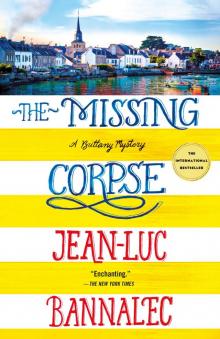
Cover illustrations: France © Boris Stroujko / Shutterstock.com; smoke © schankz / Shutterstock.com; hand-lettering by Lexi Earle
The Library of Congress Cataloging-in-Publication Data is available upon request.
ISBN 978-1-250-17336-2 (hardcover)
ISBN 978-1-250-17337-9 (ebook)
eISBN 9781250173379
Our ebooks may be purchased in bulk for promotional, educational, or business use. Please contact the Macmillan Corporate and Premium Sales Department at 1-800-221-7945, extension 5442, or by email at MacmillanSpecialMarkets@macmillan.com.
First published by Kiepenheuer & Witsch as Bretonischer Stolz
First U.S. Edition: April 2019
Jean-Luc Bannalec, The Missing Corpse: A Brittany Mystery