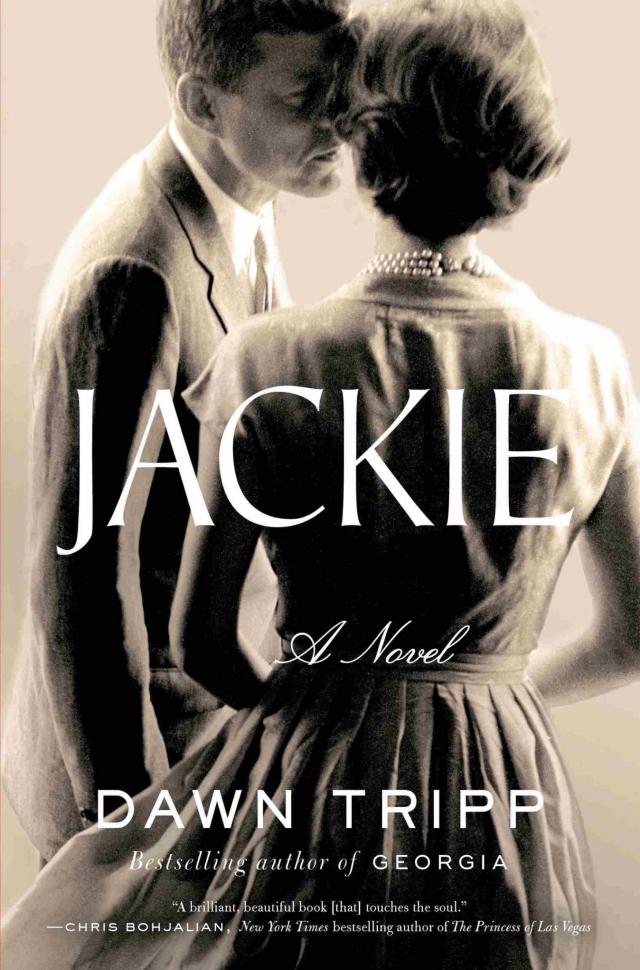
Jackie, page 9


Articles Excellent…But You Are Missed.
I slip the telegram into my pocket.
“Jack again?” Aileen says.
“Yes.”
I stand above that stubborn overfull suitcase. Books, and more books. Books he’ll read for pleasure. Books with ideas that might be useful to him. I’ve started to admit I want to be useful to him, necessary. In that whole suitcase, there’s not one book for anyone else. Not my mother or Hughdie. Not even for my stepbrother Yusha. Only Jack.
* * *
—
I meet an old friend, Demi Gates, for dinner at a small restaurant. We ran into each other at the post-coronation reception at the American embassy. He had traveled up from Spain to London. Tomorrow he’ll leave for Paris. We order our food and catch each other up on other people’s news. We talk about one summer years ago when we all met in the south of France. Yusha was there, and my friend Solange. There was a nightclub where we used to go dancing.
“Do you remember the violin music?” Demi asks. “Everything was right that summer.”
“It’s Paris I miss,” I say. “Strolling down the Champs-Élysées at midnight. Drinking grasshoppers and getting swanky at the Ritz.”
“Then come with me for a few days, Jackie. Before you go back. We’ll hit all the places we used to go: Chez Allard, L’Elephant Blanc.”
“I want to hear about Madrid and your new life,” I say.
He’s started a publishing company, he says, that does comic strips and some advertising. But then he says something else.
“So the talk about you and Jack Kennedy?”
My fork stops.
“He’s a gutter fighter, Jackie. You’re a class act.” He proceeds to drench me in tales of Jack’s womanizing, trying to talk me out of what I keep telling myself I’m not yet even in. I just sit there, peeling back the skin on my fish to separate flesh from the bone.
“You don’t want to be married to a politician, Jackie. You don’t even like politics. It’s a brutal world. Not your kind. There’s no poetry in it, no beauty, no art. Is it the money?”
They will say this forever, I realize. Jack Kennedy has money, so it must be the money I’m after. I could tell them he never carries cash. I’m usually the one who pays for movies, taxis, lunch. I could explain I’m never bored with Jack Kennedy. Never bored of listening to him or wondering what’s turning in that bold, intricate mind. I never get tired of how he looks at me or touches me, how his lips graze my cheek, my neck, the quickening of his breath mixed with mine, those more private and intimate moments of heat, skin, fire.
They will never say this.
I remember that day in the little bedroom when I knelt by the bookshelf and those worn spines: Byron, Tennyson, King Arthur and his knights. Jack just sat on the bed, talking about how those were the books that formed him. Stories of war, persistence, and failure, the getting up again and forging on when he was so ill as a child that he could barely make it from bed to bookshelf and back. Books about freedom and faith and the courage it took to fight on the right side of history.
“What makes that kind of courage, Jackie?” he’d asked me that day.
He is more than what they see. More than his father’s son or heir to his dead brother’s legacy. He wants more. Believes in more.
I can’t tell Demi this now. He won’t hear it.
Through the restaurant window, it is dusk, the sky steeped blue, city lights on the wet streets.
The day I told Jack I was going to London and would miss his sister’s wedding, I ignored my mother’s advice. I didn’t call. I met him at Martin’s and told him there. We sat at the table he’d begun to call “our table.”
“I understand,” he said. “You should go.” But he glanced at me, like he was going to say something else. Then he shrugged. “You’ll be missed.”
“You mean you’ll miss me?” I said gently, almost teasing, and he looked away, pushed a hand through his hair, glanced back at me, his eyes nervous for a moment, uncertain. He smiled.
“Yeah,” he said, “that.” I felt a bolt of warmth shoot through me, always, at that smile.
* * *
…
He is waiting for me when my plane touches down in Boston.
“You again,” he says.
“And you,” I say.
Silence falls between us, shy, a tide of other passengers streaming quickly past, heading to whatever lives they’ve come home to, or on to wherever else they are going, maybe a connecting flight they’re hoping to catch, all these other people, strangers, bound for other destinations.
For us, though, in that moment, everything feels very still and sharp and new.
“Come on, then, Jackie. Let’s go.”
He picks up my bag, takes my hand, and starts striding through the concourse, drawing me along with him, moving smooth and fast as he does sometimes, like his body just needs to keep up with his mind, which has already crossed into some future I’m not yet aware of, and we are like water, moving through all the other bodies in that airport, disparate faces, voices, lives. We reach the door that leads outside. He pauses and turns to me suddenly, an expression on his face I haven’t seen before—a kind of bewilderment, almost fear, but with a tinge of wonder, like a child’s fear.
“Are you okay with that, Jackie? You are, aren’t you?”
So sweet and unexpected—the vulnerability in his voice.
“Okay with what, Jack?”
“Going with me.”
I smile. “You’re where I want to be.”
* * *
…
On June 25, we are in The New York Times.
Senator Kennedy to Marry in Fall
Son of Former Envoy is Fiancé of
Miss Jacqueline Bouvier, Newport Society Girl
I have to resign from the Times Herald. I knew it was coming; perhaps I’d known all along. Jack doesn’t ask me to, which I appreciate, but I bring it up so he won’t have to. We’re at Martin’s. Brunch. Our table. The leaves are full and green on the trees. We order root beer floats. I ask for extra whipped cream.
“I know Eleanor Roosevelt had her own column,” I say, “but that was different, the focus was different, and she was the president’s wife. I’m sure there were strict orders on what she could and could not say. I can’t imagine the ambassador would appreciate having his, or your, ambitions at odds with anything the Inquiring Camera Girl might want to ask.”
He laughs, then, “Dad did ask if you were going to keep working. But I don’t want you to feel you have to stop.”
“I know,” I say.
* * *
…
Joe summons us to Hyannis Port. A family weekend, he calls it. Once we’re there, he mentions he’s invited a few people from Life magazine to stop by. He says it like he’s explaining why there will be green beans instead of broccoli for dinner.
“They want to do a story on the engagement,” he says.
I say, “You mean you want them to do a story.”
He grins. “Well, there might be a little of that.”
* * *
—
The crew from Life is there the next day. Jack and I are arranged, made up, our clothes styled casual, collars unbuttoned, sneakers barely tied, hair windblown, just enough. They snap photographs of me swinging a baseball bat and running with a football. Someone suggests the sailboat.
“I’m not really dressed for a sail,” I say to the editor.
“We only need you in there for the shot.”
“Of course,” I say, wondering if I’ll ever fit in the corners of this life I play so well. We climb into the boat and set off, Jack at the tiller. I’m beside him, the photographer crammed in the bow, asking me to move closer to Jack and asking Jack to tack, please, so it will look like we’re out in open water. The boat starts to heel; the photographer slides.
“That’ll cockeye the horizon,” I say quietly to Jack.
“Just look happy,” he says. “Almost done.”
An hour later, back on land, they ask him to hold my hand for a series of shots on the lawn.
“Put your arm around her,” the editor says, and he does, but we’re awkward, his arm like a metal hanger draped over my shoulders.
“It feels so fake,” he says under his breath. “I never stand like this. I hate being fake.”
“It’s all fake, Jack.”
He starts to laugh. They snap the picture then.
* * *
—
At the end of the day, after the crew has packed up their tripods and cameras and left, as I’m walking from the kitchen with my book and a glass of water, I overhear Bobby, Jack, and Joe in the sunroom. I hear my name. They’re talking about me like I’m some kind of asset, like I’m the state of Rhode Island. I feel a sharp chill and sit down.
There’s still a chance to get out.
But he’s brilliant. A maverick thinker, and when I am with him, I can feel my edges burn. He’s almost died three times. He is by turns impatient and nonchalant. He has Addison’s disease, recurrent malaria, and a spinal condition. The left side of his body is smaller than the right, shoulder lower, left leg shorter. He’s a clumsy dresser, lanky, that unruly shock of hair. He’s known, too well, for his sexual exploits, every woman smoothing her skirt when he enters a room like the room belongs to him, and—poof!—in seconds, it does.
By twenty-three, he’d published a bestselling book, Why England Slept, about how democracy can fail to perceive fascism rising in its midst; by twenty-six, he was a national war hero; thirty-six now and a senator. He told me once he feels like every minute is a race against the fast-circling arms of a clock. Edna St. Vincent Millay’s candle burning bright: It will not last the night. He’s a chary romantic. A fatalist. Who sees too clearly that fortune, health, and luck can all be erased in an instant.
And he needs me, which he won’t want to admit, but I can feel it when out of nowhere he’ll take my arm, or when he leans in to whisper, I’ll see you soon. In the warmth of his breath, I feel it. Or when we’re in a crowded room and his eyes search me out and he’ll fix me with that little look—the kind of burning extravagant hunger that makes you want to throw your soul right down.
And I love him.
The voices have stopped, I realize, just before Bobby and Jack walk out of the sunroom with Joe. The boys head to the window, talking about how the wind has come up, could be a good afternoon for a sail. But Joe pauses when he sees me sitting there. In his face, the slight calculation. I close the book and smile. He isn’t fooled.
“I’ve been looking into that house for you, Jackie,” he says.
Jack turns around. “What house?”
“There’s a little pink villa in Acapulco your girl wants for her honeymoon. That girl of yours who’s not so naïve as to give up her thoughts to anyone. She should have what she wants, don’t you agree?” Joe laughs when he says it, the laugh that masters a moment and now is meant to master me. His eyes on my face, I can tell he’s still wondering how much I might have heard and if it matters.
“I do love that pink villa,” I say.
Summer 1953
Early July, we go to Newport, my mother’s house at Hammersmith Farm, a Victorian enchantment perched on the hill above the bay. Egyptian-tiled gardens, lily ponds, stone walkways. A guest cottage and boathouse closer to the shore.
Just months from now, we will be married at St. Mary’s Church. Afterward, an outdoor reception on the Hammersmith lawn. More than eight hundred guests, it will take two hours to work through the receiving line. We will be photographed. My dress with its fifty yards of ivory silk taffeta, portrait neckline, bouffant skirt. I wanted something sleeker, more ionic-column, and I won’t be able to escape the sense that I look like a lampshade. After an alfresco lunch, as the Meyer Davis band plays, Jack and I will have our first dance, to “I Married an Angel.” In a toast, Jack will explain he had to marry me to remove me from the fourth estate so I wouldn’t write anything to scuttle his career. I will riposte that while, yes, it’s true that I gave up my position at the Times Herald, I plan to write a novel. As a wife with no job and time on my hands, I see no reason why that can’t be done.
That day in July, Jack’s mother, Rose, is meeting us at Hammersmith. She and my mother will discuss plans for our wedding.
“They don’t really need us for that, do they?” Jack asks. We are in the deck room. I took him over to the stables earlier to see the horses. He got wheezed up, and now we’re just lying around in the heat, the windows thrown open, the breeze off the sea fresh and cool.
“Let me guess, Jack,” I say. “You want to send the mothers off to lunch while we go tear around in a car.”
“Better a car than a horse.”
We laugh and, laughing, he starts to cough, as my mother walks in to say that his mother has arrived and it’s time to drive over to the beach for lunch and then a swim. We keep laughing, and Jack is coughing, and we try to catch our breath. We’re sprawled across each other. My mother stands in the doorway, surveying us, her mouth a stern line.
“Say, Mrs. Auchincloss,” Jack says, standing up from the couch, “how about Jackie and I take our swim before lunch?”
“It’s almost one already,” my mother says. “We should have lunch first.”
“Well, I worry we might get cramps if we swim after lunch. But you and my mother could order lunch for us. Jackie and I could take a quick swim and get back before the food comes.”
My mother gives a little frown. “I suppose we could do it that way.”
Then his mother is there, and we are all walking out to the car. We fall behind them.
“You knew she wouldn’t want to switch the order,” I say.
“That’s why I threw in the bit about cramps.”
“I love that she’s a little afraid of you, Jack.”
“I don’t think that’s it. I don’t think she approves.”
“Of us?”
“Of me.”
I feel something inside me catch. He might be right. I don’t want him to feel that way.
“That’s not it,” I say. “She can’t push you around, and she’s not used to that.”
We climb into the backseat of the car, the mothers in front. Their heads kerchief-wrapped, a collar of pearls around each pale neck. We’re like two bad kids laughing and joking in the back while the mothers talk about plans for the rehearsal dinner, brunches and luncheons and flowers. A tent in case of rain. September, my mother remarks, can be so fickle. Rose asks if my mother has given thought to bridesmaids’ dresses. If not, she has an excellent dressmaker she’d recommend.
“I have a girl,” my mother says smoothly. The white heat of the sun bores through the glass.
“Jack, open your window, please,” I say.
“This window here?”
“Yes.” I smile. “Yours.”
He gives a push at the handle, glances at me, that puzzled look. “It doesn’t seem to work.”
“Of course it works.”
He tries again.
“That’s the wrong way,” I say. “Clockwise. No, I mean counterclockwise.”
“I’ve tried both ways. It won’t budge.”
I lean across him, grip the window handle, and start to crank it down.
“What are you two up to back there?” my mother says.
“I was having trouble with the window, Mrs. Auchincloss.”
“Call me Janet.”
“Janet. The handle seems tricky. Jackie’s helping me figure it out.” His hands are underneath me, touching me, the window halfway down; his fingers run along my waist, my ribs, the edge of my breast, and the salt wind blows through the window, that cooler sweet summer air—bright and hard and fast off the sea. The car turns onto Ocean Drive, and we are falling over each other in the backseat, laughing and trying to stifle it but not trying too hard, and there is only silence, tight-lipped and prim, from the front. My mother’s cool dagger eyes in the rearview.
* * *
—
At the beach club, we spill out. I grab my bag and towel.
“A hamburger for me, please,” I say.
“A club sandwich,” says Jack. “Chowder too, if they have it. Thank you, Janet.”
We race past the steps that lead up to the veranda and down to the shore. We drop our clothes in a pile. The water is cold.
“Dive in,” I say.
“You first.”
I look at him for a moment, then ask.
Jack
“Do you love me, Jack?” she said.
“Of course. I’m marrying you.”
“That’s not what I asked.” Her voice with that flip edge, like she might have been testing him. The water was cold and clear. He’d seen that smile before.
* * *
—
It’s not that he doesn’t love her. Not that at all. The marriage is useful. He knows that, and everyone reminds him. Her breeding, the sheen of wealth. Well read, well traveled, well mannered, well bred. Not malleable, Bobby once remarked. Their father laughed at that, then said, “No, but she knows how it works.”
And she’s different. From his sisters, from other girls and women, the ones he still goes after. She is curious. A fiery wit. Ruthless insight. She makes him think. And when she’s quiet and he can see her thoughts tick, he feels a kind of thrill—the same thrill he felt when he first recognized the magnitude and reach of her mind.
No one else.
The thought strikes him. He knows it’s true, and he doesn’t quite want it to be.
She is not like anyone else.