Jackie, page 29


Jack,
her voice a tether
Can you hear me, Jack?
I love you.
* * *
—
Reach
* * *
—
The echo of that sound still, her face gone to pieces right before his eyes.
* * *
…
At the border was light.
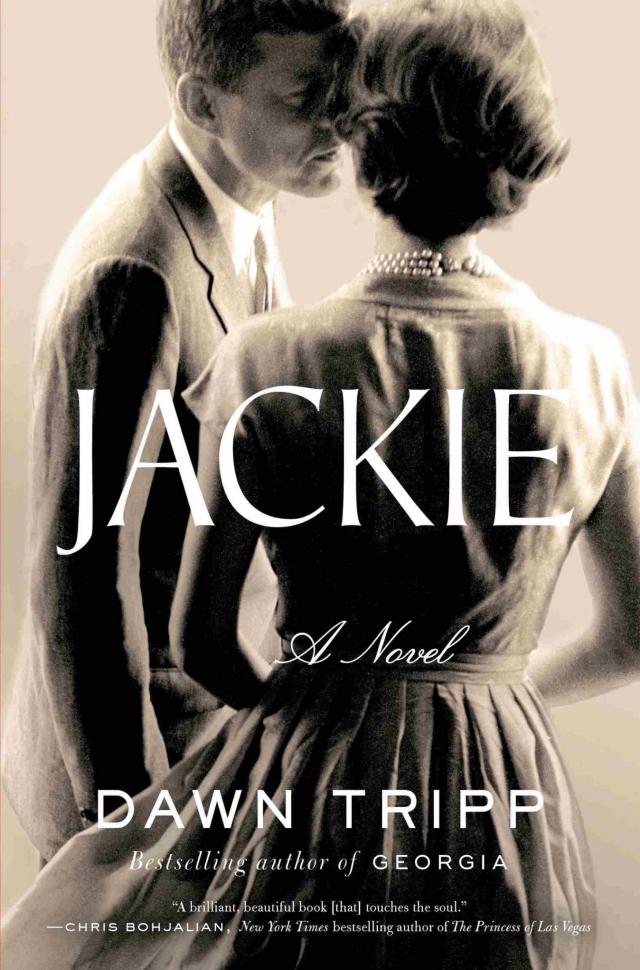
A photograph. She is with him, standing in the doorway of an airport. He is a senator, and it is June 1957. The year of the Pulitzer, the year of the Famous Five. He is boarding a plane and leans in to kiss her goodbye. Her skirt is full of wind, his face half in shadow, only the edge of his jaw lit. That soft knock of sun. Behind them there is brightness, the blurred nose of the plane, tarmac, the fatal and glorious sky. Her back is to the camera, but he remembers her face, her searching eyes; she had wanted something from him in that moment, in the rush of hot wind, a yearning he closed himself to, and the soft dusk of her voice. Jack. She was asking him something. He tries to remember now and cannot. What was it in that moment she had wanted?
* * *
—
Why can’t he remember?
* * *
—
I’ll be home soon, he must have said, something easy, bland, his mind already ticking off lists for the days ahead.
* * *
—
He was always saying words like that to keep her calm, to put her off.
* * *
—
Later
Soon
* * *
—
It passes through him now like some strange and awful bolt to light the life he will not live.
* * *
…
Now it is later.
Time is gone.
* * *
—
Parkland ER. Clint has pulled out a chair. Always with her, and now in the hall he pulls out a metal folding chair for her, then a second chair, empty, beside it. Someone hands her a towel. She starts to wipe her face, then puts it down. She says something to another man, who takes a pack of cigarettes from his trousers pocket and lights one for her.
“Thank you,” she says, but does not smile. She sits and smokes and stares at the wall.
* * *
—
There are things he will miss. Tiny nothing things:
His feet following his own shadow across the lawn
The scent of the Rose Garden
A bracing wind on the water, that cold salt soak, the mainsheet in his grip
His daughter’s hands
In Caroline’s eyes he could see the future, a searing infinite blue. He could feel that future as she hurled herself across the room toward him, flew fast and hard like she’d fly straight through his open arms through the window behind him into the great tall world.
* * *
—
His wife’s mind—sly, brilliant, not always kind—that meditative way she’d run her finger absently along the edge of a page she was reading in bed.
* * *
—
These throwaway details of a life.
* * *
—
“Look how beautiful, Jack,” she’d whispered to him once, her hand on his wrist, eyes fixed on a lit branch through a window, her face with no play in it then, just open and gentle and soft, and he fell in.
* * *
—
Once
Later
Soon
* * *
—
Her stare now in the hospital corridor, boring through him—mystical, vacant, relentless—looking off into some middle distance caught in the grain of the wall. Her lips tighten around the cigarette, the pull of smoke into her lungs and out again, yet underneath that stone remove, he sees her still: the girl he fell in love with all those years ago.
* * *
—
Admit it. Can you?
* * *
—
This is a love story.
Always was.
A love story.
* * *
—
He moves toward her, brushes through, and moves on.
Part IV
One day in a whirl of winged horses, the sun changed course
And turned his holy face away.
—Euripides (trans. Anne Carson)
November 22, 1963, 12:47 p.m. CST
They tell me they found no heartbeat, no breathing, no pulse.
* * *
—
In the hallway where I sit, a glacial coolness—white tiles along the wall, black linoleum floor. Clint is near me. Others cluster, voices anxious, hushed, someone walks away, someone else comes back. A nurse pushes through.
* * *
—
Three and a half seconds—that’s all it was—between the first shot, which missed, and the second, which did not.
* * *
—
If I’d been looking to the right.
If I’d recognized the sound for what it was.
If I had not been complaining in my head about the heat, or how close their hands and blurred faces came as the car took a turn, if I hadn’t been so focused on all that or wondering how I could slip off, with you, away from that grueling, unbearable sunlight to the cool dark of the tunnel ahead.
* * *
—
Take off your glasses so they can see you, Jackie. Let them see you.
* * *
—
A hypnotic burst of light off my bracelet as I waved.
* * *
—
And the roses were there, on the seat between us, spilling toward the floor, petals soaked, his blood, stems broken, the dark, wet iridescence of those roses crushed in the white-hot glare as I leapt to grasp a piece of his skull flying away.
* * *
—
I do not quite remember that last part. What happened after.
* * *
—
They killed you over that bill.
I know it.
The civil-rights bill.
That’s what they killed you for.
* * *
…
In the Parkland Hospital corridor, I sit in the folding metal chair and smoke, very still. They scuttle around—feet, voices, that awful hospital smell.
* * *
—
I look down at my lap, my skirt—then wish I hadn’t. I look back up, through the moving stream of them to the opposite wall.
* * *
—
“Mrs. Kennedy, shall we go into the restroom and get cleaned up?”
* * *
—
“We’ve brought you a new set of clothes.”
* * *
—
They keep saying things like that.
* * *
—
When the doors to Trauma Room 1 open, the corridor goes silent, and a doctor steps out, his face telling me what I already know. I stand up, stripped to nothing now, just a woman in the shape of a blade. I walk past them through the operating-theater doors to the body laid out that is mine, my lips to his feet, my face to his beautiful face, his lovely shattered head, no less beautiful, eyes open still. Not blank yet.
* * *
—
The world is shadowless. Time bent. No before or after. Just that hard brutal sound when everything slowed and your head jerked back, hands to your throat, that puzzled look. I remember thinking you looked like you had a slight headache.
* * *
—
We are made of stars, and I loved you from the first moment I saw you.
* * *
—
“Mrs. Kennedy, Vice President Johnson is going back to Washington and he would like you to go with him.” Clint is saying this. They have sent him to tell me. I look at him, then can’t.
We are back in the hospital corridor. Outside the closed doors of Trauma Room 1. The doctors are doing something else in there—I can’t remember what. We are waiting again, and Clint’s eyes are as young and raw and dark as I have ever seen them.
“Mr. Hill, please explain to Vice President Johnson that I am not going anywhere without the president.”
“Yes, Mrs. Kennedy,” he says, and steps away.
* * *
—
They wheel an empty casket in from outside. Bronze. Up on a metal dolly with small rubber wheels. O’Donnell and Powers step in front of me. What are you doing? I almost ask, then realize they’re trying to shield me, to block my view as it goes by. Another doctor comes and urges me to leave.
“Do you think seeing a coffin could possibly upset me?” I say. “My husband was shot in my arms.”
The doctor gets small in his white coat when I say this. Down the hall, Dave Powers is raising his voice to someone—the medical examiner, who is saying the autopsy must be held here according to Texas law. Their voices bounce off the linoleum, Dave yelling now, saying the vice president is waiting at Love Field for Mrs. Kennedy, and Mrs. Kennedy is waiting for the president, and the autopsy can be held in Washington no matter what the stupid Texas law says about homicide and jurisdiction. None of it matters. They argue, then figure it out. It is almost time to go. Jack is leaving soon, and I will leave with him. At a certain point, the casket with the large handles glides out of Trauma Room 1, and I know he is in it. I stand, and the casket is cool to the touch, and we walk outside to the white hearse. When Clint asks me to ride in the car behind, I have to explain, “No, Mr. Hill, I’m going to ride with the president.” I climb into the back of the hearse with Jack. Clint climbs in too, and we ride with our knees scrunched up to our chests.
Crusts of blood on my stockings. My left glove is missing. For a moment I wonder where I left it.
* * *
—
I should not have allowed you to come here.
I should have listened, seen it, known ahead of time or in the instant.
I should have pulled you down.
* * *
—
The casket won’t fit through the door of the plane. They try to wedge it in on an angle. I watch from the bottom of the steps; heat rising off the tarmac prickles my skin. I could tell them this won’t work. It will never fit. The men at the top with the casket exchange a few words, but from the base of the steps I can’t hear. Clint is with them. He glances back at me—a warning look, I realize, a moment before they break the handles off, that awful sound of metal ripped from wood. They jam the coffin through the door of the plane. I walk slowly up the stairs and follow it inside.
* * *
—
In the Presidential Cabin, someone has laid out a dress for me, a new jacket.
A light knock on the door. Lady Bird comes in.
“What if I hadn’t been there?” I say.
“Let’s get you changed,” Lady Bird says gently.
“No. I want them to see what they have done to Jack.”
She doesn’t seem to quite know how to answer that.
“Could you please send in Mr. Hill,” I say. “I need to give him a message for my mother and Miss Shaw. About the children.”
* * *
—
On the flight, I sit with Jack and the Irish in the rear of the plane. The crew has taken out the seats to make room for us. I do not take my hand off the coffin. Someone somewhere is eating soup. The smell makes me feel sick. They grumble about Johnson. Did he really need to take the oath of office in Dallas? Couldn’t he have waited? Johnson told them he talked to Bobby and that’s what Bobby told him to do, which Bobby never would have said. At one point, they break off, realizing I am watching them. There is blood on Dave Powers’s suit. For a moment I stare at it. I tell them about Abraham Lincoln’s funeral and the book in the White House library. I ask if one of them could please make sure Pam remembered to message J. B. West to find that book so we can use it to plan.
“We are going to have a funeral like Lincoln’s,” I say. “A riderless horse. I need to read again exactly what they did with that horse—the tack, how it was led. We will do that.”
* * *
—
The flight continues. They tell stories about Jack. They drink whiskey. They’ve insisted on pouring me a glass like I’m one of them now. They go on talking. I remember a late afternoon last summer. I was with the children, driving, just the three of us alone in the car. Up ahead was a bend in the road, and as the car took that turn, a slant of evening light shot through the green, the light like a portal; my heart kicked over, and I felt a sense of hurtling wind and speed, the future rushing through.
* * *
…
Moments after we touch down at Andrews Air Force Base and come to a stop, there’s a commotion at the front of the plane. Bobby. Pushing down the aisle, he blows right past Lyndon, Lady Bird, everyone, until he reaches me.
“Hey, Jackie. I’m here.”
His face is strange. Bright. Like someone who’s come through a desert. I just look at him, trying to catch up with that weird, ravaged distance in his face. He puts his arms around me, and I feel something deep inside dissolve.
There’s a helicopter, he says, waiting to take me to the children.
“Oh no,” I have to explain. “I am staying with Jack.”
* * *
—
Someone somewhere starts to cry.
* * *
—
God, I wish they wouldn’t.
I say this quietly, so only Bobby hears it. He takes my hand and we walk to the door and step off the plane into a deafening silence. At first I think the airstrip is empty, but as my eyes adjust, I can make out a dark mass where crowds of people stand. As I move forward, they appear. Bobby keeps hold of my hand; we walk together down the stairs, and something pure and irrevocable moves between us, and, from that moment on, there is no one else.
* * *
—
It is evening. But that sense of evening is no longer anchored in time.
* * *
—
He rides with me and Jack in the back of the ambulance to the Navy hospital at Bethesda.
“Do you want to hear what happened?” I ask.
“Yes.”
I tell him.
Afterward there is silence. He draws the curtain back and looks out the window.
“This is a long ride,” I say.
“We’re almost there.”
He is still looking out the window.
“What are you looking at?”
“Just outside.” He drops the curtain.
“I didn’t read the Skybolt report,” I say. “Before we left for Dallas, Jack asked me to read it and I didn’t.”
“It doesn’t matter, Jackie.”
“Do you know what he said when he gave it to me? He said, ‘If you want to know what my life is like, read this.’ ”
Again, Bobby looks out the window, like he can’t look at me for any length of time. He keeps reaching for the curtain and drawing it back.
“I could have stopped it,” I say, “if I’d understood sooner what was happening.”
“There’s nothing you could have done.”
You weren’t there, I want to say, then I realize he already knows this and it’s killing him.
“I held his brains in my hand,” I say. My fingers rest on the lid of the casket. Bobby is still looking out the window.
“What is out there, Bobby?”
He looks at me then. “It wasn’t about the civil-rights bill.”
“What?”
“They found the man who did it. Oswald. That’s his name. We think he acted alone.”
“No. It was that bill. That’s what they hated Jack for.”
“Oswald is a communist.”
“What does that have to do with anything?”
“Nothing.”
I let it sink in.
“So he died for nothing. That’s what you’re saying.”
He reaches for my hand, but I can’t feel it, I can’t feel or hear or see anything, only Jack—that puzzled look, his beautiful mind, and the life flooding out of it.
“We’re going to have to make some decisions,” Bobby says. “You don’t have to. I can take care of it.”
“It’s all in the book on Lincoln,” I say. “The lying-in-state, the rotunda, the riderless horse. I asked Pam to call Mr. West to ask him to find the book. Everything is there.” The force and clarity in my voice is surprising. Not the soft voice, but the voice I used to have.
Bobby tells me then he was eating lunch when Hoover called.