Jackie, page 12
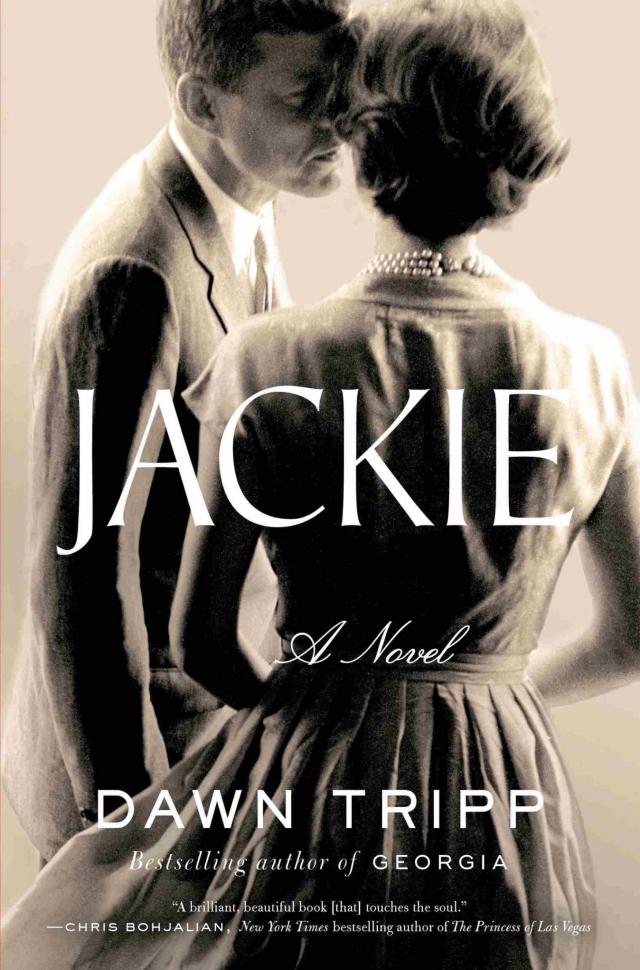


One Saturday in Hyannis Port, Jack and Teddy are down by the shore, messing around with the boat, trying to set the rigging for a sail. I stand with Bobby, watching them as Jack barks orders and Teddy fumbles around, doing it not quite right, or not the way Jack wants.
“Hey, Jackie,” Jack calls. “I left my jacket up at the house, can you get that for me? Don’t let that line go, Ted.”
“I’ll get the jacket,” Bobby says to me. “You stay here.”
I smile. “I’m pregnant, not an invalid.”
“Jack’s really happy,” he says as we walk up. “He talks about that baby all the time.”
“He wants me at the convention.”
“You should come.”
“Chicago in August, with a baby due in October?”
“Ethel will be there.”
“Oh, Bobby, your wife is an ace at being pregnant.”
He looks embarrassed.
“Do you think Jack really wants the vice presidency?” I say as we reach the porch steps.
Joe is there. “Don’t ask for my opinion on that,” he says.
“I wasn’t, Joe.”
“I don’t know why the hell he’d squander political capital to be runner-up. They’ll all lose to Eisenhower anyway.”
“We’re just getting a jacket, Dad,” Bobby says.
Joe follows us into the house. “I can’t imagine it’s been nice for you, Jackie, having them all underfoot when you’re trying to rest up for my grandchild.”
I laugh. “If this were a convenient campaign for you, Joe, would you be so concerned?”
“Schlesinger says Stevenson likes what he sees,” Bobby says. “We’ll let it play out.”
“And blow his chances for the real race?” Joe says.
“Jack’s being smart about the vice presidency, Dad. He’s not bragging like Humphrey or going around puffed up. Just the possibility of being named VP gets him into the center ring.”
Joe pretends to consider this, but he’s never put much stock in what Bobby brings.
“It’s going to be Jack,” says Bobby.
“I hope it isn’t,” I say.
“Why? Jack wants this.”
I smile. “To be second?”
* * *
—
At the convention in Chicago in August, heat ripples off the pavement. Over ninety degrees in the shade. I attend a champagne party for the campaign wives and overhear Perle Mesta complain to another woman she can’t believe Jack Kennedy’s wife would be such a beatnik as to show up without stockings. My feet and legs are swollen from the heat at the session where Jack nominates Adlai Stevenson as the Democratic candidate. I sit at the edge of the crowd. A hush comes over the convention hall as Jack speaks. His voice has begun to exert a new pull. My hands rest on my belly, marking the occasional slight push of the baby under my palm. I’ve learned to distinguish the turn of the head, the kick of a foot, what’s knee, what’s shoulder.
Estes Kefauver, not Jack, is selected to be Stevenson’s running mate.
“You’re disappointed,” I say to Jack in the hotel afterward as we pack. “But you didn’t really want the vice presidency, did you?”
He shakes his head. “Dad told me I was wasting it. It just burns that he was right.”
* * *
—
On the flight back to Hyannis Port, he is brooding, restless. He sits with Bobby and his closest aides, the Irish trio: Larry O’Brien, Kenny O’Donnell, Dave Powers.
“I’m going to get out of town for a while,” Jack says. “A quick trip. I’ll see if Teddy will come with me.” He’s talking to them, but this is his way of breaking news to me that I might not want to hear.
“What about the baby?” I ask later, once we’re back in the house alone.
“That’s October. It’s only August.”
“I’ll miss you,” I say.
“It’ll be a quick trip.”
He’s putting me off. He’s angry about the convention. I should let it go.
“I don’t want you to leave,” I say.
He is sifting through papers. His hands stop for a moment, gray eyes cool. “Don’t.”
A few days later, he’s gone. I leave for Newport.
* * *
—
“What was he thinking?” my mother says. “Leaving you alone only weeks before the baby’s due.”
“The convention was hard for him.”
“Well, it’s all been hard for you.”
I’m looking at a magazine of paint colors and nursery designs. Maybe I shouldn’t have chosen yellow. Maybe I should have done things differently.
“I know you think the trouble with me, Mother, is that I don’t play bridge with my bridesmaids.”
She doesn’t answer right away, then, “I don’t actually think the trouble is you.”
* * *
…
It’s my mother I cry out for that August morning when I wake to shooting pains in my lower belly that radiate down my legs. The pain is unbearable. A rush of water—pinkish, then darker.
Hours later, I surface in the hospital. Bobby sits by my bed. The room is very white, his face cut against that whiteness, concern in his eyes, the blue intensity hazed by something new. I try to pull my mind out of the heavy sleep. I notice he’s holding my hand. Something is wrong.
“Where’s my baby?”
He shakes his head. “We almost lost you.”
“The baby?”
“No,” he says. Then I know. I don’t want him to say it.
“Where’s my mother?”
“She’ll be right back.”
“Where’s Jack?”
“We haven’t been able to reach him yet.”
It’s right there, on the edge of me—the question about the baby, where it is, that tiny body, tiny self, what happened, how it happened—but the sadness in his eyes is too cutting, too awful and intimate. I need a glass of water. That’s all.
“We almost lost you,” he says again, moving the chair closer to the bed.
“A girl?”
He nods.
“Arabella,” I say. “That’s the name I wanted. I knew it was a girl.”
His eyes fill, and I look away. Outside, starlings in the trees. Clouds and sky in pieces, caught between the branches and the flourish of summer leaves. Everything so bright and violent. Just looking at the green hurts my eyes.
* * *
—
“We haven’t been able to reach the senator,” I hear Bobby tell the doctor an hour later. I know what he’s doing. Trying to establish a story before another takes root. “We’ve sent messages through his secretary, but the boat he’s on has no ship-to-shore.”
A lie.
Bobby glances up as if he hears me thinking it.
“I’m sure there’s an explanation, Jackie,” he says after the doctor has left and we’re alone. I’m sitting up in the bed, pillows propped behind my back. The wall feels hard against my skull. I need that sense of hardness, that ground. Bobby is just looking at me. Do I really have to break it down for him? The baby is gone, so in Jack’s mind, there’s no reason to cut his trip short.
“How is Ethel?” I ask.
“Fine.”
It ends there. Ethel is due within a week. And Jack’s sister Pat has just given birth to a little girl named Sydney. Bobby is still looking at me, a compassion in his face that swerves too close and makes me feel. I don’t want to feel.
“It’s just a mistake, Jackie,” he finally says.
There’s no mistake, I want to say. The affairs are not a mistake. The coolness, the jokes, the flip remarks that shut me down. Not a mistake. Nor is his fickle desire for me, proprietary at times, like a wife is an article he wants, as long as that wife is strong, put-together, sexual, witty in a passionless way, as long as she keeps herself intact and doesn’t need him—because when she’s wanting or vulnerable or weak, he has to get out, get away. He can’t be there when she’s breaking.
Bobby’s eyes search my face.
You don’t stay with someone because they hurt you, I could say. You stay for the slight and mythical promise of a dream that once meant so much you were willing to trade a different future for it. You stay for what you gave up.
“It wasn’t supposed to be like this, Bobby.” To his credit, he doesn’t ask what “it” is—the loss of the baby, the marriage, or some other loss not yet taken into account. He sits with me while I cry. He stays that night, late. He arranges everything. The service, flowers, funeral card. Everything.
“Good night, Jackie,” he says as he is leaving. “I’ll see you tomorrow.”
“Thank you.”
“I’ll always be here for you,” he says, glancing away like he feels foolish for having said it.
I smile. “So now you’re the one I’d put my hand in the fire for.”
* * *
—
Years later, I will remember that moment between us, and every time I remember, I’ll see some different aspect, a look in his eyes I didn’t register at the time, something desperately earnest in the silence, a little rushed as he looked away. Years from now, I will understand how much more complex that evening was than I gave it credit for. In the moment, all we see is what we expect to see.
Jack
The sea is calm. He sits on the deck, legs outstretched. There’s a woman nearby. Lying on a blue-and-white-striped cushion, half her face in shadow under the brim of her hat. She has pulled the straps of her bathing suit off her shoulders; her skin is tan, dirty-blond hair halfway down her back. The sun is hot. The kind of heat that erases what you’d rather forget.
He can’t forget.
* * *
—
An hour ago, he sent the message back: Say there’s no signal, you couldn’t get through.
* * *
—
Half an hour before that, he took the call on the radio. His brother’s voice through the static on the line. They spoke long enough for him to know there was no point in rushing home. He said something to that effect. Bobby landed on him like bricks. Jack hung up.
* * *
—
He needs time. A few more days before he has to go home and meet that crushing loss he knows is waiting in her face. Time to keep it at bay. The loss, the need, hers, his own. He’ll deal with it. Get through it. Soon.
* * *
—
The woman on the deck says his name. She asks him something. He doesn’t answer. His eyes are half-closed. The sun is a tattoo on his lids and burns.
The day after the baby is buried, Jack calls. They just put into port, he says, in Genoa.
“How are you, Jackie?”
It’s hard to believe he’s actually asking that question.
“Jackie? Are you there?”
“Yes.”
“Well, I’m going to be coming home.” He says it like he’s reading from a script, or maybe he thinks I’ll assure him, Oh, please don’t worry, Jack. Please stay and enjoy your time in the sun. I can’t quite imagine what he thinks. The air in the room feels wildly still.
“See you then,” I say.
“All right. Hey, Jackie—”
But I’m already hanging up the phone. The curved shape of the receiver in its cradle. My hand rests there. That smooth, metal-like cool.
* * *
—
He gets home. Everything feels horribly stilted, layers of glass between us.
“We’ll try again,” he says.
I don’t answer.
“Jackie?”
“It will have to be a very different kind of again.”
* * *
—
On our third anniversary, I’m still confined to bed. I haven’t cried since those days in the hospital with Bobby, but my body is a yawn of dark grief. When Ethel’s fifth child is born, I tell Jack to give the house we bought, Hickory Hill, to Bobby and Ethel. Or sell it. However he wants to handle the transaction, they should have that house, for their lovely uncomplicated marriage, its industry and Catholic sweetness and the babies that keep popping out. They should have the nursery curtains, the mobile, the crib.
He tells me his father has offered to rent something else for us in Georgetown.
“Why?” I say. “You’ll be at work or off campaigning for Stevenson. When they let me out of bed, I’m going to visit Lee.”
“But Lee is in London.”
“Yes.”
* * *
—
Someone tells someone there’s trouble in our marriage. Or someone takes a wild guess and hits a bit of truth. However it happens, a rumor finds its way into the papers that I’m planning to leave him and Joe’s offered me a million dollars to stay.
“Did you see that garbage?” Joe says to me.
“I thought it was a fine idea, but why one million? Let’s make it ten.”
Joe laughs. “I’m on your side, Jackie. Jack needs you.”
“For his political career?”
“And a lot more than he seems to realize.”
“Well, I hope he figures it out sooner, rather than—you know—later.”
Silence then. He waits for me to elaborate. We’re sitting in the living room of his house in Hyannis Port. It’s late afternoon. Everyone else is somewhere else.
He stretches out his legs. “You and Jack should take a trip,” he says. “The two of you, maybe around the New Year. Antigua?”
“Are you trying to placate or bribe me, dear Joe?”
He smiles. “Whichever you’d prefer.”
Your son never apologized, I want to say. He never said to me, I’m sorry for leaving when the baby was coming, I’m sorry for not coming home when she died.
“You need this marriage, don’t you?” I say. “Particularly now that plans are being laid for Jack to run.” I don’t have to say which race. There’s only one race that matters to Joe.
“This is no joke, Jackie. Divorce, or even the whiff of it, will kill his chances.”
“Then we’ll have to make this fun,” I say, “so I can be sure to survive it.” I smile. “I’ll need a small house at some point, and Jack will need new suits. He can’t get the hems so short. He can’t keep wearing those tired scuffed loafers in the evenings.”
“Did you hear what I said?” He peers at me through those thin wire-rimmed glasses. His eyes don’t dance.
“No unpleasantness, Joe. I’ve been heartbroken, and I need to climb out of it. Let’s think of things we can celebrate: Jack will have new suits, I will have a little house, and it looks like the Supreme Court is going to uphold desegregation.”
* * *
—
From then on, I am careful with my heart. I’ll stay in this marriage, at least for now. But I’ll keep myself slightly apart. Oddly, Jack doesn’t seem to notice. In fact, things between us seem lighter, like he’s relieved I’ve split myself and now he only has to reckon with half. How much simpler things become once I withdraw, once I’m less passionate, less present, less open and honest. Less in love. From time to time, it occurs to me with a stab of sadness that it might be precisely the less that makes me more the right kind of wife.
1957
That spring, we learn Jack will be awarded a Pulitzer for Profiles in Courage, and we learn that I am pregnant. I want a baby so much. I’m afraid to trust the joy.
We go to the Paris Ball at the Waldorf Astoria. Marilyn Monroe is there on the arm of Arthur Miller, her body like a vase in her black-halter sequined dress.
“That woman is outrageously beautiful,” I say to Jack in the car afterward.
“She’s a wreck.”
I feel a wave of anger. “A wreck brave enough to stand by Miller during his McCarthy inquisition.”
“Investigation. Besides, they were already having an affair.”
“Does that make her less brave?”
We ride in silence. The car pulls up to a traffic light. Two more blocks to the hotel.
“Lee is leaving Michael,” I say.
“What?”
“He’s grown too dull for her. I think she’s going to run off with a Polish count. My sister, the princess. Does that seem surprising?” I look out the window. The air in the car is altered. The news has thrown him. Divorce. The light turns green.
* * *
—
I take him to see a house I’ve found on N Street NW in Georgetown. Three stories, Federal style.
“It leans a bit to one side,” I say as we walk over. “The stairs creak.”
“Sounds like me,” he says.
“It used to belong to Oatsie.” He’ll like that. Oatsie is Marion Leiter. She’s close friends with the British spy novelist Ian Fleming. Jack loved Casino Royale.
In the house on N Street, Jack seems smitten with an old doorknob. We leave the realtor and her assistant downstairs.