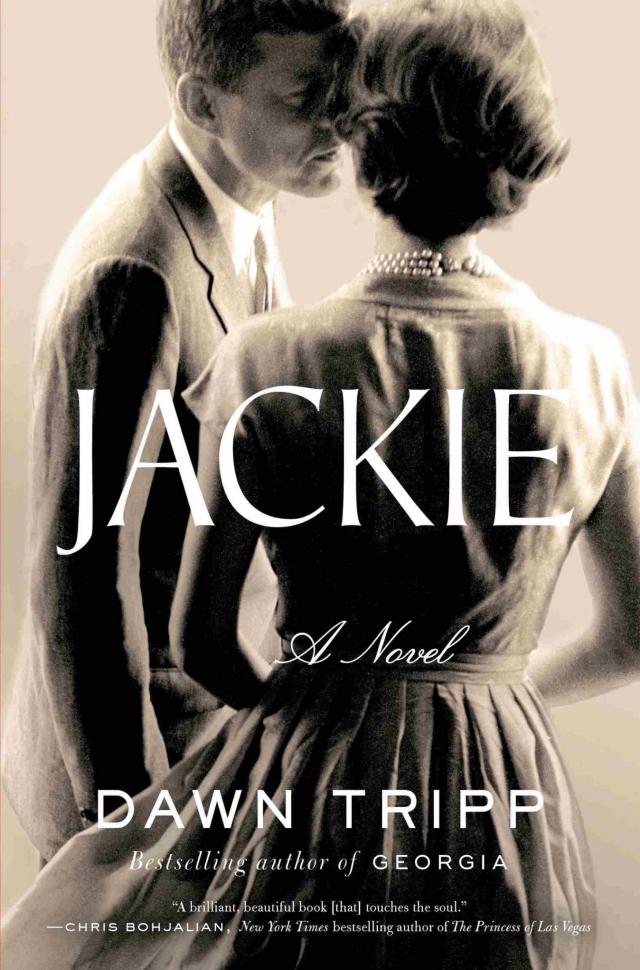
Jackie, page 30


“I could have done something,” I say.
“No, Jackie. There was nothing.”
He shifts, and I push into him like he is ground that will keep me from falling.
“Please,” I say. “Cut it out of me.”
* * *
…
My mother and Hughdie are waiting for us on the seventeenth floor at Bethesda. The Bradlees are there, Mary Gallagher, Pam, Ethel, the McNamaras. Bob McNamara is arranging a house where I can live with the children in Georgetown. We can move in anytime. I murmur my thanks. Dave Powers is mixing drinks. One appears in my hand. A smoky liquid like amber. I take a sip, taste nothing. I put the glass down and pull Kenny O’Donnell aside to explain that, at the hospital in Dallas, I made a mistake. The ring I tried to put on Jack’s finger didn’t fit; it wasn’t meant to be there, I know this now. I’d like it back. Can he take care of this for me? He nods and heads toward the door. He seems grateful to have something to do.
I learn the children were taken to my mother’s house at Merrywood.
“No,” I say. “Their lives shouldn’t be disrupted, now of all times. Tell Miss Shaw to bring them home so they can sleep in their own beds.”
Someone will have to tell them. I should be the one to do it. I want to be with them. I want to get them from my mother’s house and bring them home. But then I’d have to leave Jack, and I can’t do that.
I start to cry. My mother holds me until I’ve pulled myself together. The grief is a brick in my throat.
* * *
—
They are all so careful. They handle me like I’m a bit of glass. Ethel touches my arm. Her sincere, pretty face, telling me Jack went right to heaven, no stopovers.
* * *
—
The little blue pill I’m given doesn’t work, so Dr. Walsh gives me a shot. Shortly after midnight, Dr. Walsh has fallen asleep in the chair, and I’m wide awake, hunting around for a cigarette.
* * *
—
They’ve learned things about Oswald. Bob McNamara tells me this, not because he offers it but because I ask. He seems surprised I’d want to know.
These are the things they’ve learned:
The kind of gun he used.
That he spent thirty-two months in the Soviet Union.
That he was married to a woman named Marina.
McNamara sits with me while the rest of the room buzzes on, more slowly now because everyone is tired, but Bob, like me, is awake. As he talks, I feel like he’s holding me up with his eyes. The soft rectangle of his face, the neat circle of his glasses. Everything about him is ordered, calm.
“Do you want me to tell you again what happened?” I say.
“Yes.”
I glance around the room—my mother, Hughdie, Ethel.
“When I start to tell them,” I say, “they shrink. It’s too much, I think.”
“To hell with them,” McNamara says. That makes me smile.
“Dr. Walsh says I should say it as often as I need to and try to get rid of it.”
He nods.
“You see, the whole front of his head jumped out. He went to reach for it, but it wasn’t there. Are you sure you want to hear this?”
“Yes,” he says.
So I tell him the story. I tell it again, second by second, the way it happened, and McNamara just sits there listening, until I come to the end.
“I don’t think he should be buried in Brookline,” I say, “even though Patrick is there. What do you think?”
“We can work it all out,” he says.
“You’ll help me?”
“I will.”
He is sitting on the floor near my feet. I am on a low stool. Eight times since I came into this room, someone has asked if I would like to change my clothes. But Bob is not asking me this. He is just looking up at me with those clean wire-rim glasses, that arrow-neat part in his hair, and his eyes with their strength, their understanding of violence, decisions, consequence.
“Can I tell you again what happened?” I say.
* * *
—
Late now, after 1:00 a.m. Already Saturday. Everything is taking so long. Mr. West and Bill Walton have sent a message from the White House. They’ve found the Lincoln book. It wasn’t in the library, but they’ve found it and they have begun. And Bunny Mellon has arrived at the White House, Pam tells me. Lovely, generous Bunny. She flew through a tremendous thunderstorm, but she is there now, and she will do the flowers.
“Pam, please tell Bunny to use the blue vases.”
“Yes, that’s what you said.”
“Those large blue urns France gave us.”
“Yes.”
“Bunny will know what to do. Nothing too melancholy. It should be like spring.”
Pam looks down at her notebook and starts to cry, like these details have gotten the best of her. I put an arm around her. “Oh, Pam,” I say. “I’m so sorry. This is such a terrible thing for you.”
* * *
—
They keep telling me to rest.
I keep wishing you were here to tell them to shut the hell up.
They want me to rest, because they think that when I wake up, I will be like them again. I will see the world as they do. I will be able to fathom tomorrow. They do not understand that if I lie down, the dark will devour me.
* * *
—
“You should go home, Jackie,” Ethel says.
“I’m not leaving until Jack does,” I say.
* * *
—
At least they have finally stopped asking me to change my clothes.
* * *
—
After two in the morning, I think of it again. I’d thought of it earlier, then pushed the thought away. It was harder than any other thought. I go to find Bobby.
“What about your father?” I say.
“Teddy and Eunice have flown to Hyannis Port.”
I nod. I feel suddenly very cold, very still, like a hinge has snapped.
“Is there anything you need, Jackie? Anything I can get you?”
I shake my head. There’s a chair nearby. I suddenly have to sit down.
Blank, I want to say. What I need is to be empty, unbroken, blank.
Like the ceiling or the sky.
* * *
…
Four a.m. The motorcade winds through the wet city night. A light rain has begun. Bobby and I are with Jack again in the back of the ambulance. We should take a different turn, I almost say. The three of us. Take a turn and drive off.
“How much do you think they’ve done so far on the East Room?” I say instead.
“I’m sure they’re taking care of it,” Bobby says.
A pressure in my chest. I’m on the verge of starting to tell him again what happened, but I don’t. And I don’t explain that when I am not thinking about what happened, I am thinking about how an asymptote is a line that continually approaches an axis but never meets it.
The word asymptote comes from the Greek, not falling together.
In the back of the ambulance, Bobby pulls me to him. It is sudden and clumsy, his grief. My mouth faces into his jacket, my cheek near his chest; I can feel the thud of his heart, the rise and fall of his breath.
“I’m planning to walk,” I say.
“That might not work,” he says. “But we can talk about it later.” He is trying to calm me. His voice is kind and soft, and I wish I could let go and lie down in it.
* * *
—
In my head, I’ve begun to make a list of readings. No dull sermon. No Twenty-third Psalm. Jack never liked that. I want to find words he would love. I remember a coda he once made up to the chapter in Ecclesiastes: “There’s a time to fish and a time to cut bait.” We’d all laughed. “And now it’s time for a swim,” he’d said, standing up, strolling out the door.
* * *
—
In the car now, I want to keep driving. I don’t want the car to turn into the northwest gate.
The honor guard is there to meet us, young Marines in formation, their faces rinsed with rain. Beyond them, the drive is lit with flaming pots.
“We’d just begun to figure everything out,” I say to Bobby.
* * *
—
Inside, the staff is lined up. I cannot look at them as I walk by. I start to, then it’s too much.
Mr. West steps forward.
“Where are the children?” I say.
“Safe in their rooms, Mrs. Kennedy.”
What an odd word to use. Safe.
* * *
—
They carry Jack into the East Room. Swags of black crepe. The catafalque identical to the one used for Lincoln. Just as I asked.
It is only a few steps from the doorway to where they’ve set him down. I kneel, my forehead pressed against the wood. I kiss the edge of the flag and pray to a god that has ceased to exist, and when I stand up again, I am like light rising; I’ve left everything behind—hope, faith, rage, sorrow, even fear. My body is smoke. Beyond the doorway is the hall that leads upstairs to the bedroom where I will not sleep and the desk in the West Sitting Hall where I will sit and write thousands of words over the next few days. Lists of names to be invited. Lists of readings and music and hymns. There will be cross-outs and carets, the tip of my pen working into the page.
There is only one way this can be done, and that is how it will be done. I will walk next to Jack. It will not be Holyhood Cemetery in Brookline, where Patrick is buried. It will be Arlington.
* * *
—
Later someone will write: She bore the grief of a nation.
* * *
—
I didn’t do it for them. I was never that good or that generous. I did it so the children would have something noble to hold on to. I did it for you.
* * *
—
In the doorway of the East Room, I pause. Jack is on the catafalque behind us. Bobby is beside me. What will happen to you? I start to ask him. That same thing I’ve been asking each of them in turn. It bursts then, the wall in my heart giving way. I don’t realize I’m falling until he steps in to catch me. He pulls me against him, an arm around my waist, his face filled with a pain I don’t want to see. Somewhere in the room, someone is crying again, then someone else starts. Together, Bobby and I walk past the crying and out of the room.
* * *
—
Provi is waiting upstairs. I take off my clothes and lay the suit on the bed.
“Fold it, please, Provi,” I say. “Put it in a bag, the shoes and hat as well, even the stockings. Find the box Chez Ninon sent with it. Don’t let anything be cleaned. Just put it in the bag and put the bag in the box. Make sure my mother gets it.”
Provi takes a white towel and lays the stockings carefully into it. Bits of dark stuff flake out onto the white.
I run a bath. When the tub is full, I step into it.
* * *
…
I lie down on Jack’s side of the bed, that awful mattress like concrete. I do not sleep. It grows light outside. Raining. The wet shines on the windowpane.
I get up and write out a list of names to be invited.
The Bartletts
The Bradlees
Bill Walton
Aristotle Socrates Onassis
The Ormsby-Gores
On a separate sheet of paper, another list:
- Caparisoned horse
- Cadets from Ireland
- Black Watch Highlander regiment
* * *
—
Because you loved it when they came to play, you sat with me and the children on the South Portico to listen. There is a photograph of the four of us there, our backs to the camera, four heads, two light, two dark—Caroline’s small white gloved hand resting on your shoulder.
* * *
—
Take off your glasses, Jackie.
* * *
—
Yesterday, in the rooms on the seventeenth floor of Bethesda, Arthur Schlesinger told me I was your “full and inseparable partner in the most brilliant and gay and passionate adventure” he has ever known.
You would have smiled. You might have made a joke, rolled your eyes. You hated sentiment like that.
* * *
—
On a new sheet of paper, a list of things to put in the coffin:
- Inlaid cuff links
- Scrimshaw with the presidential seal
* * *
—
There’s a terrible noise from down the hall. Someone is sobbing. Shouting. Bobby, I realize. From the Lincoln Bedroom.
* * *
—
The first night we spent in this house, you slept in that bedroom where your brother is crying now. You threw yourself on Lincoln’s bed and yelled with joy that you had won and this was ours. You cried out at the ceiling like the joy would explode from inside you, like you were shrieking across time to the ghosts of all the men before you who had lived and led and died and worked and aged in this terrible house.
To think I almost didn’t go with you to Dallas.
What if I had been here or out riding in Virginia, or somewhere else. Not with you.
Raining now. Miss Shaw brought the children to me this morning after their breakfast. John climbed into the bed, cried for a bit, then asked about his birthday and when the party would be. Caroline came in pushing that huge toy giraffe you gave her. Jack, she was so quiet, like a clock gone still. Her face is not the same. I can feel it. A distance in her eyes, the incandescent wreckage of her face, like she knows something now about the word forever. In less than a week, our daughter will be six. This morning she wrapped her arms around me, pressing close, like she could dig all the way in. Miss Shaw told her last night before bed, and Caroline asked Miss Shaw if God would give you a job, since you always had so much to do here. Miss Shaw told her God had already made you an angel to watch over us and that you would look after Patrick, who is lonely up there in heaven.
Do you remember what I told you, Jack, when we lost Patrick? Do you remember how I said losing you would be the one thing I could not bear—
…
“He’s dead, isn’t he?” Caroline whispers. At the private Mass in the East Room, she kneels with me on the pew by the coffin. When I bow my head, Caroline bows hers. When my lips move, she half-follows, trying to keep up with the words. I stand, and my daughter takes my hand. She looks up at me. I see Jack’s face in her face. Someone is sobbing. Pam. Bill Walton puts an arm around her. The others try to manage their grief. If they can’t, they recuse themselves to the Green Room. I look for Clint.
“Mr. Hill, would you arrange for the children to be taken out this afternoon? To lunch with my mother, then for a drive.”
“Yes, Mrs. Kennedy.”
“Oh, and, Mr. Hill?”
“Yes?”
“Please tell Mr. West I want to go to the president’s office.”
I wait while Clint speaks to the other agents. Then he walks with me in silence to the Oval Office, where Mr. West is waiting. The new carpet I’d ordered was installed while we were in Dallas. Jack’s things are being packed up. I make a mental inventory: photographs, a small clock, scrimshaw.
“Do you remember how much he loved this desk, Mr. Hill? How excited he was when the children played hide-and-seek with the little trapdoor?”
I rest my hand on the rocking chair, and I’m startled when it moves.
Out the window, I can see the trampoline, the sandbox, the treehouse.
“Mr. West.”
“Yes, Mrs. Kennedy.”
“I need you to be honest with me.”
“Of course.”
“My children—they are good children, aren’t they?”
“Certainly.”
“They’re not spoiled.”
“No, indeed.”
“The president loved the Green Room most. It was his favorite room. I want to do something in that room for him that he would love.”
Mr. West’s eyes fall. That he would have loved, I realize. That’s how I should have put it.
“Also, I’d like to give small gifts, things of Jack’s, to members of the staff. They’ve been so good to us. Will you help me?”
“Yes, Mrs. Kennedy.”
“Oh, Mr. West—” My voice starts to break then, and I can’t let it. So I thank him and leave, Clint beside me; we walk along the colonnade. I look out to the saucer magnolias planted in the four corners of the Rose Garden. They came from a tidal basin, their branches silvered pale. In the rain, they glow. I remember a day in August 1961, when Jack and I came ashore from the boat to Bunny Mellon’s house on Cape Cod. We’d come for a picnic and, as we walked toward the low dune, Jack said to me, “I’m going to ask Bunny to design a garden like the ones we saw in France.”
“You should do that, Jack,” I said.
“I’ll tell her I’ve read Jefferson’s gardening notes and I want the same flowers he would have had in his time.”
“And you’ll tell her you won’t take no for an answer.”
“That’s the easy part,” he said. “I never do.’’ He reached for me then and pulled me close, his arm around me, as the house came into view. Then his arm dropped, he drew slightly away, and it was there again, that thin layer of remove that only really broke down in those last few months, after Patrick.