A Song for Quiet, page 4
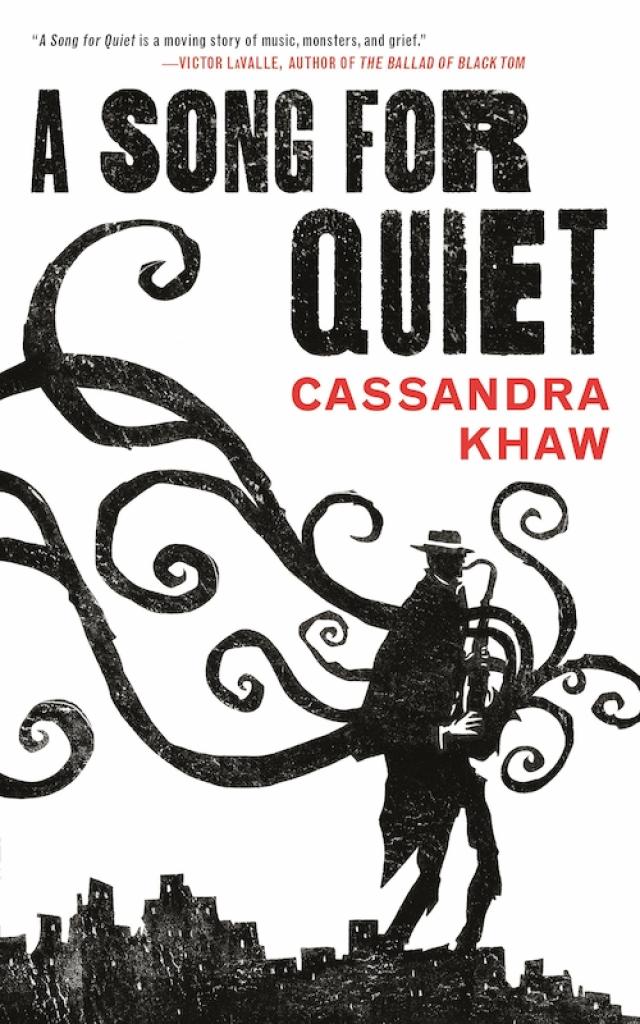


The possibility that this might be a bad idea suckles at Deacon’s attention but he puts it aside, the last twenty-four hours having wrung him of anything but the compulsion to leave. Hobbling, a muscle seizing in his left leg, the man inches up to the station building, its doors open despite the absence of interior lighting.
“Hello?”
A flame wicks to life in the penumbra.
“Don’t mean to be any trouble, but I was wondering if you could tell me when the first train out of Arkham might be.” Deacon grimaces at the sound of his own voice, the lower registers shaved to waste, breath fogging.
No response. The light begins to pendulum, occasionally washing across the outline of a figure. The inside of the station is curiously empty of amenities. There are signs that go nowhere, bricked-up walls where lavatories or ticket counters should be, alcoves scalloped into the masonry, as though someone had thought about putting something there only to change their mind. No benches. No stalls where commuters might buy a pastry, no newspaper huts, only a vastness of marble flooring and steel-wrought ribs jutting into the roof.
No glass either, Deacon observes, conscious of his breathing and the clack of his shoes, both too loud in this empty space. Nothing that might capture a reflection. Only glossy surfaces, enforcing the claustrophobic ambience, a mausoleum reappropriated for use in public transportation.
Another hello wells on his tongue. He keeps it there. The distant glow continues to bob, each swing barely illuminating a second presence. Two things occur to Deacon then: he should be able to see the station’s other occupant, and it should be more than shadows twisting on the walls, silhouettes without source.
The second is that whatever it is, it is coming closer.
Deacon backpedals toward the entrance, the hairs on the back of his neck tufted, and something in the air slides sidelong, the slightest twitch, like a leg maneuvered out of position. Reality dithers, gives way, a deviation so minor that Deacon blinks and misses it.
But he doesn’t miss what comes after. Not the fact that he’s suddenly standing at the center of the station, the roof arching above, its carbon-black sternum tattooed with murals, or the presence hunched over his shoulder, watching him, waiting. The light ceases its metronoming. Deacon moves his eyes up to the opposite wall, his silhouette a stark cut-out in the glare.
Behind him, just as he’d expected, a second figure.
It is a thing of hairs and wafting cartilage, three times as tall as Deacon, and bent over so far that its muzzle—spines and villi, no muscle or bone or skin in sight—almost brushes the top of his head.
Waiting. For Deacon to look up, maybe. To run. To acknowledge its existence. To begin whatever needs to be begun.
So Deacon does none of that. He stands, one hand balanced over his instrument case, armpits sweat-soaked despite the dry chill. The music itches behind his eye sockets, teasing almost, as though asking: what are you going to do now? It tendrils down to his tongue, where it congeals, a simple three-measure phrase, easy as can be. All at once, Deacon is certain that a transaction is being extended. Worship for salvation; the oldest bargain. One sweet note and the horror ends.
Deacon rolls a shoulder, the joint giving out a low and satisfying pop, and shutters his eyes, both hands gripped around his case. Well, fuck that, he thinks. He’s done hawking his soul.
Before he can take a swing, a voice pours into the hush, silver, sweet. A coloratura, murmurs a memory of an afternoon hazy with flies, the sky raw and blue. He’d been standing on a barge, sweat pearling under his collar, as the white folk in their finery discussed the differences between the blues and Italian opera, the uncouthness of one and the highbrow resplendence of the other. How their one coloratura, a high-cheeked child of twelve powdered to look legal, was worth ten backwater bluesmen.
Deacon hadn’t minded too much. They’d paid what they owed. But he wouldn’t forget that searing day, and he wouldn’t forget the sound of the girl—ethereal and soaring, chasing the complexities of her assigned aria like a starling at play.
This voice is purer still.
A girl minces into the light, singing words that the world hasn’t learned, a line of blood tracing a route from her eye. Her hair is a torrential halo around a face too grim to have ever been beautiful, all its softness long chewed away. There is only bone left. Bone, and hard-set lips, and dark, determined eyes—the face of someone bartered at the crossroads come back to find out what she was worth. She spreads her arms as she approaches, her song glissading to an impossible pitch, then held there with a defiant vibrato, her expression ferocious.
As Deacon watches, the girl balls both hands into fists. Reality shimmers, like heat rising from a highway, and cracks, tributaries opening, multiplying, a veining of fissures that spreads and spreads until the air resembles a pane of shattered glass. A breath, a change in pitch, and it all implodes, the nightmare thing sucked through a pinhole in the universe.
“Fuck.” She sighs, and hits the floor.
The crunch of bone on marble startles Deacon into motion. He rushes forward, instrument case banging against his spine, sinks to a knee, and scoops her into his arms. She’s lighter than Deacon had anticipated, frighteningly so: bird-bodied under the drape of her military jacket, the sleeves too long. An older brother’s leaving, or a lover’s discard.
“I’ve got you.” He strokes her forehead, her skin burning hot under his palm. He knows her somehow, he does, he does, her name is cut into the meat of his tongue. Yet why can’t he remember? “I’ve got you.”
Her eyes flutter apart. The sclera are soaked through with blood. But the smile, despite her exhaustion, is triumphant, teeth flashing white against waxy copper skin. “I’m guessing that means I got him then.”
Deacon chokes out a laugh. He can feel her vertebrae in the cup of his hand, can feel every small bone. “Yeah. Yeah, you did. My name is Deacon James and I think I might owe you a debt of gratitude.”
“Ana.” A pained gasp.
“Just Ana?” Deacon adjusts his grip, trying not to linger on her weightlessness, an arm going under her knees. Someone starved her. Someone hurt her. Kept her boxed somewhere lightless until her skin sallowed and sickened. If she’d been let under the sun, her flesh might have warmed to some color between his and April’s, burnt umber and glowing.
Deacon counts to three and gets back onto his feet, careful not to jostle the girl, her arm trailing from his grasp. Careful not to think about the how of bleaching fat from the body like that. The way you’d have to ignore the rattle-thump of small fists on a locked door. The way you would need to be okay with someone dying by degrees. “Is it short for anything? Anastasia? Annalee? It’s a mighty pretty name, no matter how you cut it. Short and easy. Rhymes with all kinds of things.”
You talk to the wounded. That’s what they told him, the war heroes, the sad-singing men with eyes too old for their heads. You keep them conscious. You keep them focused, keep them curious enough about the present that they don’t slip into past tense. You talk to dying men too. Like his father, eaten up from the inside by whatever had festered in his lungs, his roaring baritone watered down to a warble.
“Just Ana.”
“No family name?” How it works, of course, Deacon has no idea. Something about shock. Something about keeping on top of the patient’s condition. Something about reminding them that yes, there’s someone here who loves you so for god’s sake, please don’t go. He hooks his fingers around hers and searches the building for exits. Nothing but featureless wall and the cold growing worse by the heartbeat.
“Just Ana.” A bark of a laugh that leaves her shivering, the curl of her small mouth damp with blood. ”We need to go.”
“Just Ana. Uh-huh, I see. Well, it’s good to make your acquaintance, Just Ana.” His voice tightens around the joke, breath pluming into clouds. The girl couldn’t be more than ninety pounds. Hundred, at best. Much too small for her frame. “We’ll be out of here as soon as I can find an exit—”
“We have to go now.”
Deacon scans the interior again. “There’s no way out.”
No way out. The words thud in the air, echoing where none have before, refracted into something antumbral and ghostly. It strikes Deacon that the head house itself might be mocking him. Revenge, perhaps, for the loss of its guardian, or whatever it was that Ana banished with her incandescent song. No way out. The words are whispered again, this time by the bricks and the bones of the station.
“Get us out,” Ana says. Sing, moans a voice, not-voice inside his head, syrupy as love’s first kiss. The longing clamors in his lungs, pressing down on rib and diaphragm until his mouth is bloody with want. And even though he aches for it, like a priest without religion or a house without a child, he won’t.
“I can’t.”
Ana knots her fingers into his coat and pulls herself up with an effort. “It’s going to come back.”
“I won’t let anything happen to you.” Deacon says it with more conviction than he thought he carried in his lungs, the words coming in a rush. He’s compromised on so much in his life, but not this, not even if it kills him.
The girl blinks once. She laughs, a feeble noise, air gurgled out of lungs that barely function. All that power from before: gone. “It’d eat you alive.” Her timbre is matter-of-fact, not unkind, no accusation at all.
“If it can bleed—”
“It can’t. None of them bleed. They barely exist.” There’s a drowning look in her eyes when she says this, the conviction of the dying, and also an adolescent impatience, half-exasperated. Her lips press into a line. “When it comes back, it’s going to be angry. You need to get us out. You get need to get us out right now. Please.”
“I—” The song screams back, sloughing notes, sloughing sense.
A slit dilates in the wall, like a wound carved through someone’s belly, the corners flapping outward, billowing, the stones suddenly membranous, and Deacon can almost hear the damp flick of it. The night slops in, its breeze salt-silvered and sharp. And propped against the masonry, a cigarette drooping from his smirk, is Persons.
“The way I see it, you’ve got two choices. One: you and the bird stay put and take a flutter at convincing the bulls you weren’t trespassing. Two”—Persons extracts his revolver from a coat and sits the gun at his hip, his smile a sickle of white—“we lam out of here, and finally have that chat.”
Chapter 5
“What are you?”
Persons’s smile is all teeth, an incisor chipped where the bluesman struck him. “Kid, you don’t want to know.”
Deacon doesn’t reply, not yet. His vision has contracted to a single point of clarity, the pressure on his sinuses devolving the universe into white noise, white flashes of agony that pop each time his heart goes thump. Unlike every single time before, the song hasn’t gone away, or at least not the substance of it, melody and rhythm long excised so that only afterimage remains, like the glare of the sun cooked into his brain.
The bluesman pinches the bridge of his nose, trying not to linger on the television-static screel of his migraine, Ana’s fingers laced up tight with his. They’d moved—somewhere. A dusty office with the words “John Persons, P.I.” chiseled on the frosted-glass door, every corner of the room piled with boxes, brown manila folders gravid with dog-eared documents.
The sofa that Ana occupies has seen better years, her pillow—concaved, its hems gnawed to threads—better decades. Inexplicably, the duvet is new and slightly plasticky, printed with astronautical fancies: rockets and stars on sapphire fabric. A ten-year-old’s affectation, except there is no child in sight.
“Got any food?” Deacon asks, at last.
“Afraid not.”
Deacon nods, wincing at the migraine bracketed by his temples, even the act of swallowing a torment. Ana shifts under her coverings, a skinny scrap of skin barely tethered to its bones. Looking at her now, no one could be faulted for thinking her an ordinary runaway, a child and nothing more. Not a voice that can move worlds and jostle the firmament with a single thunderous word.
“Deacon—”
He thumbs a bony cheek. “Ssh.”
She sighs into his palm and Deacon thinks again, stomach lurching: a child, just a child. Ana couldn’t be more than fifteen, seventeen at the oldest. Nowhere near old enough for half the shit she’s lived. Strangely, though, what chews into Deacon is the thought of her desolation. How she must have been so terribly, inarticulably alone, screaming herself hoarse, nails scraped to stubs. How long can you keep a body alive without food? How long can it endure without drink?
Forever. The music spasms, and all of a sudden, Deacon knows, his head crammed full of images: nodules untangling from the crenellations of her brain, lengthening like shoots, flowering. Sometimes, it is the child who sustains the parent.
He disentangles his fingers from hers, closes his palm around hers, sick again with aching. The visions etiolate, a damask of ghosts. Her skin beneath his is clammy, cold, the texture not unlike meat fresh from the fridge. “Got any water instead?”
A grunt of acknowledgment and the sound of a tap being turned, gears squeaking, knife-on-chalkboard. “Here.”
“Thanks.” Deacon holds the plastic cup to Ana’s lips, the three silent, the room quiet save for the plumbing resettling, rattling through papier-mâché walls. It is only when Ana has drained the cup that Deacon speaks again, each word measured and decanted with care. “So, what do you need from me exactly?”
Persons props an elbow on a stack of old books, their covers red leather. He lights a cigarette. A scent of cloves, mingling with the smell of paper and gunpowder, woodrot and tin. “I need you to park your body for twenty minutes. That’s all.”
“And then?”
“Then you walk out.”
“Just like that?”
“Just like that.”
“What about Ana?”
“Same deal for her.”
“There has to be a catch.”
“No catch.” Smoke billows. “Twenty minutes. That’s all it’ll take—if nothing goes wrong, that is.”
Deacon bobs his head, no stranger to what-ifs. Had Persons offered Deacon a problem-free transaction, the bluesman would have recoiled. Everything has risks. A dribble of blood squeezes from Ana’s tear duct. Deacon mops the trail with his sleeve, an automatic motion.
Before he can reply:
“You drink scotch?”
“Yeah.”
Persons circles around his desk, cigarette between his teeth, and gropes through his desk. A clink of glasses as he fishes out two tumblers and a bulge-necked flask, the glass clear as the fluid within. “That actual white mule?”
“Sure is. Green-label stuff right here. Got it from Connie’s Inn down in New York before they closed shop.” He pours out two servings, almost to the brim. The air colors with it, Prohibition-era moonshine, straight from Deacon’s teens. Persons extends a glass expectantly, alcohol slopping over the lip, and the bluesman rises to claim his measure. A sip. It burns just like he remembers.
“So what’s the deal? On the train, you told me that there was something”—Deacon hesitates—“growing in my head?”
“A seed, yes.” He taps ash from his cigarette, his smile white and whole. “Just like her.”
“Ana?” Deacon glances back at her. “I—what? No, wait. You know what? Take it from the top, real slow. What the hell is going on here?”
“It isn’t complicated.” Persons drains his glass in a single draught, transferring cigarette from teeth to fingertips and back, smoke rising in snake-coils. “Think of your situation like a kind of . . . sickness. How do you catch any disease? Random chance. Sure, there are things that facilitate that. Coming in contact with a drip who’s ill. Exchanging bodily fluids. But by and large, bacteria doesn’t care about you. It’s nothing personal. It’s about breeding.”
Deacon takes another gulp of his drink, nearly drowning in its blaze. “You’re saying—”
“You were standing in the wrong place at the wrong time, I imagine. Or, more likely”—his eyes glide to where Deacon’s case lies beside Ana’s silent frame—“you made yourself susceptible to contagion.”
“I gather this isn’t something we can wait out.”
“No. But that isn’t important.” Persons stubs out the remnants of his cigarette, the flame burnt to the filter, and raises a hand. Behind the man his shadow festers into villi, crawling up the walls and onto the ceiling, fistulas dilating into mouths, spreading like a plague. “Twenty minutes and we all get what we want.”
“And what do you—”
“Get away from him,” Ana’s voice cuts in. Deacon turns to see her rising, duvet hissing onto the floor. Blood runs from the corners of her eyes, like warnings scratched across sunken cheeks. She’s terrifying in the dimness, a scrawl of brushstrokes like some nightmare creature, her gaze black from blood and something worse.
“Don’t start, sister.”
“I said get away from him.”
“I’m just here to help, toots. No need to get riled.” Despite his tone, Persons is already prowling forward, fluid. A hand slips beneath his coat.
“Don’t patronize me.” The word “don’t” detonates in silver-voiced coercion, lustrous, the E string on a violin, every version of its meaning shimmering over the men, cording them in a compulsion to halt, to listen. Even the shadows pause, hungry with waiting. “I know what you are.”
“And?”
“I could send you away.” A corner of her lips twitches up, an eyetooth bared. “You know I can.”
“You were at the diner, weren’t you?” The smile on Persons’s face is dangerous. “You were the one with the cello. I get it. I get it now. I see what’s going on—”