A Song for Quiet, page 3


“April—”
“I’m just trying to look out for you.” She exhales and Deacon breathes out in time, knowing that he’s already lost, that he’ll relent no matter what flimsy objections he invokes. “I promised your father I would. You’re not going to make a liar out of me, are you?”
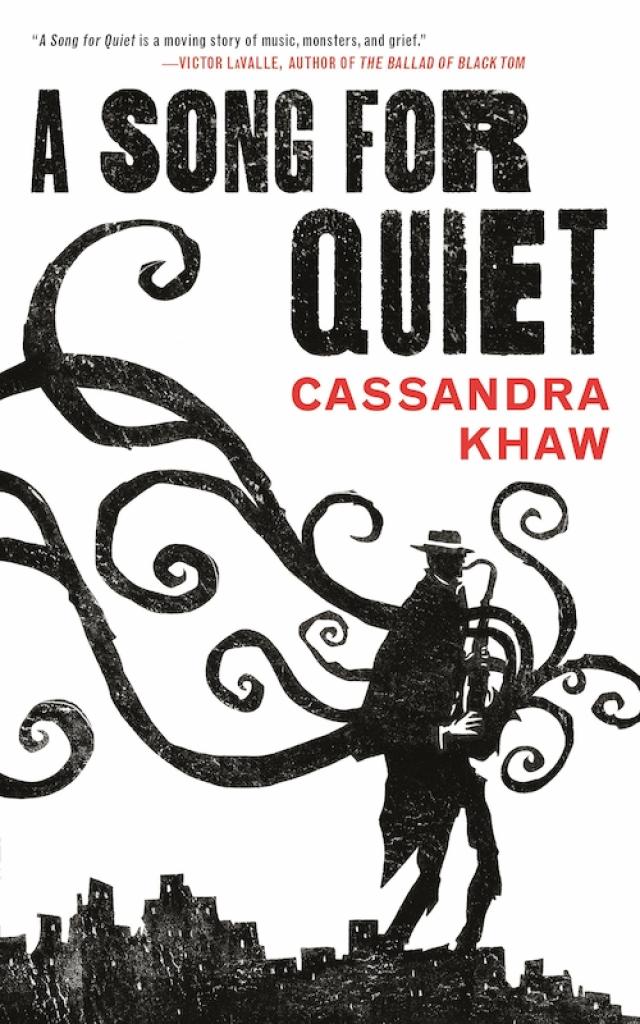
Deacon sets his hat in place, brim tugged over the eyes to shelter their sorrow. He learned early that best interests are always about practicalities, rarely about what the heart wants or the soul needs. So he smiles and tries shakily for nonchalance.
A bell clangs then. The door creaks open. Reflexively, Deacon glances toward the noise and his heart stops in its count. It is the man from the train, dripping rain, a marbling of brown along his right sleeve. If Deacon didn’t know better, well, he’d have assumed it was some careless splatter of an innocuous substance, sauce or chocolate.
But the problem is—he does.
“April. You got a back way outta here by any chance?” Deacon snatches his instrument case, thankfully adjacent, fighting to falsify some measure of apathy. He fails, of course, and how. A soul-sick vibrato threads through the tail of every word, his heart accelerated from sixty to a hundred and three, a gloss of sweat manifested on his brow.
“What’s the matter?” April shuttles a look between the two, too canny to miss the obvious. Despite her question, the woman doesn’t hesitate, slapping an arm about Deacon’s broader shoulders, ushering him forward.
They pass Sasha, who April signals with a curling of two fingers. The girl decants from her roost at the bar. She smirks, pure moxie. Her arm bumps against Deacon’s and, just for a second, the music in his head deepens, black earth and black waters.
“What have you done do?” April’s voice, sotto voce, bringing him back from the bone-deep, bone-marrow beat. “Deacon, are you in trouble?”
“It’s not like that.” They steer around a table occupied by drunks and their bottles, one slumped over, a second arguing with himself, the third and fourth subsumed by cards. “I’m not—” He sighs. “It’s complicated. I promise I’ve done nothing criminal.”
“That’s why I’m scared for you.”
“It’s nothing to do with me and everything to do with him.”
“Turn here.” Into the kitchen now, the doors swinging shut behind them, and Deacon has just enough time to look back. The stranger’s lost his broken-puppet jittering, his gait smoothed into something predatory, a hunch-shouldered stalk, like a hunting dog on the scent. “Tell me what’s going on.”
“No time.” Deacon peels from April’s grasp, adjusting the strap of his instrument case so it sits diagonal across his spine, breath coming in spikes. “I—look, I promise I’ll tell you. But not right now. I have to go, April. Trust me. He won’t cause no problems in the diner. Not if I leave.”
“Deacon—” Warning fletches the second syllable.
“Trust me.”
April sighs and aims a finger between the kitchen stations. Steam plumes from cast-iron pots, aromatic with spice and fat, clumping in gobbets along the ceiling. Two men—one Hispanic and lean, one too sunburnt to tell—drift between, alternating between hob-tops and ovens, first inspecting the stews and the chilis, then laving buttermilk mixtures into pans. A door stands beside a rack of spices, the rot-eaten shelving bent under a cabal of bottles and rust-spotted tins. “Out there. Take a right for a shortcut toward the pictures. Watch something. Let the trail cool.”
“Thank you, ma’am.” Deacon is already backing away through the cardboard boxes stacked across the floor, palms layered over his heart.
“Deacon?”
“Yeah?”
“Be careful.”
Chapter 3
Outside in the alley, the city reeks of coal and excrement, fumes weeping from the sewers, warm and wet even in the chill. Horse-drawn carriages clop through the streets, dragging a stink of animal musk. Under the slumping eaves of an adjacent building, a woman ignites her cigarette, illuminating a sharp jaw, a sharper haircut.
A baby warbles, unseen on the second story, its mother’s liquid voice swaying in lullaby. It’s beautiful, the song. The words aren’t anything that Deacon recognizes, though. No consonants, one vowel warping into the next, whalesong parsed by a human throat. The bluesman doesn’t think too long on it. He’s got places to be. So he tugs his coat closer, collar flipped up, before slinking toward the exit.
A shadow laps across the mouth of the alley, a tongue of ink, and Deacon hesitates, breath held, until the silhouette bisects into two sailors, an underbite hanging from each. They wobble past, arm in arm, singing about the woman they’d left in the deep. A girl with cold skin, eyes like the dying moon. Again, there’s something about the cadence, the rhythm that they’ve set, something familiar, but Deacon doesn’t have time to waste.
They walk on. Deacon waits until they’ve turned a corner before he emerges, footsteps keeping time with a newsboy’s entreaty to buy yesterday’s papers. A quick left-right glance: no sign of pursuit. He follows the side street toward a polyping of neon, the local cinema tumescent with billboards and bulbs, advertising attractions from this year, the next, the last.
There’s a crowd outside clustered around a cart, the smell of caramel and roasted chestnuts wafting from under a candy-striped roof. Deacon wades into the milieu, uneasy, past bare-armed women, their blue-white skin nearly fluorescent. One smiles at him and he ducks his head, wary of the attention.
“Will you be my escort for the evening?” A voice behind his shoulder, female and lyrical, fingers stroking the inch of flesh between his glove and his sleeve.
“No, ma’am. I’m sorry.”
Laughter walks him to the ticket counter where a man stands, posture immaculate. A red fez dangles its gold-tufted rope like a scar over his eyebrow. He smiles. “Evening, sir.”
“Evening.” Deacon looks about, unsettled. There are no indications of where he should line up. Which stairwell leads to which shabby balcony. Which concession stand will sell popcorn to someone like him. “I would like to buy a ticket.” He invests the word with a thimble’s worth of doubt. All around him, white faces, white skin.
The man doesn’t hesitate. His smile does not alter, billboard-perfect. “Which movie, sir?”
Deacon studies the posters, every face and stretch of flesh painted pale. “Whatever you have tickets for.”
The man quotes an unremarkable price and Deacon counts out the appropriate change before faltering. “I don’t see an entrance—”
“The door’s right over there, sir.”
“Yes. But.” Deacon doesn’t say it, won’t say it, nauseous with the idea of putting voice to a multigenerational humiliation, suspicion thumping like a second heart. He has to know what Deacon is talking about; the writing is on the constitution, after all.
A frown tethers the man’s brows together, drags his mouth down. Impatience flickers across his movie-star countenance: white teeth, white skin, pomaded, slicked-back hair so blond it might as well be white too. “We only have one entrance, sir.”
Still not what Deacon is alluding to. But he decides not to push it, not with the way the man hisses sir. It’s like he’s pronouncing a different word, really, a word they both know, upper lip transposed into a sneer. “And you want me to use it?”
“Yes. Now: next, please.” The smile never breaks, but the man’s eyes lift over Deacon’s hat, purposefully abstracted, the word “next” knifing through the ambient chatter, loud enough to turn heads.
Deacon swallows, counts down from ten, a fist balled in his pocket.
“Thanks.”
Turns. Leaves.
* * *
It isn’t a movie that Deacon has seen. Not that he’s watched particularly many, but he recognizes its pivotal conceits, having witnessed their countless incarnations played out over radio and gospel, lyric and prose. It is war as it never was, sanitized and romanticized, its roster of rogues only very slightly, sweetly, sympathetically broken. America, swaggering up with a breast full of medals, gleaming in the sun. Even when its young men bleed, they bleed gold and purple stars. Deacon sinks deeper into his seat, instrument case between his knees.
The monochrome palette of the film is softly luminescent, washing out imperfections; the stars black, white, supple gradients of gray. But never actually black, per se. Every larger-than-life figure is certifiably Caucasian, from the mustachioed hero to bit player number twelve. Deacon’s mouth twists under the brim of his hat, pulled low again. Under different circumstances, he might have commented, but these are unusual times, the strangest he’s lived in.
Still, the flickering mercury dimness does what he’d hoped it would: anonymizing him, one face among a hundred. If he’s slightly slower to laugh than everyone else, slower to appreciate the post-conflict fantasy, all its practicalities sliced off, no one seems to notice. The crowd is transfixed, their faces anointed with a radioactive pallor.
Onscreen, Gregory Peck spins a woman into his arms.
A light blinks on along the right wall. Deacon glances sidelong and catches a glimpse of the usher, a pert brunette in the traditional garb: vermillion fabric, a ladder of brass buttons descending the front, sleeves and collar black. And beside her—
The man from the train sniffs the air before putting on a smile wide enough for Deacon to see. Cold snakes down the bluesman’s spine as the usher directs her torch at the aisle in front of his own. The man follows the bobbing jag of light to his appointed seat, nearly swaggering, no fear of inconveniencing his captive peers.
He sits.
And Deacon expels the breath he didn’t even know he was holding, sliding lower, lower, fingers running circles along the strap of his case, the nylon rough beneath his touch. Had the man tracked him here? Did he know? The serendipity of their proximity couldn’t have been intentional, could it? Yes, Deacon decides after a beat, throat dry, tongue thick. Yes. It absolutely could. The only black man in the goddamned building—he wouldn’t be hard to find at all.
But still, still. Why sit there instead of a seat across where all he’d have to do is stretch and he’d be able to curl fingers into Deacon’s collar, the latter pinned by circumstances, unable to move without colliding with another.
Was he fucking with Deacon? Maybe. The bluesman eyes his adversary, sizing him up. From the back, he’s indistinguishable from the next man, save for the fact that he’d chosen to retain his hat, the crest of the trilby gashing across Peck’s throat. His posture is relaxed, his manner is unhurried. He could simply be here for the pictures. He could, he could.
But a dog doesn’t need to hurry when he’s got the hare in a ditch. He has time to wait. The man has time to wait. And Deacon, he breathes, he breathes, he breathes. Scared, shallow gasps. With a throb of effort, he elongates the gap between intake and outflow, enumerating the intermediary seconds: one, three, five, six. Exhale and repeat.
Slowly, he cultivates serenity, or some slapdash copy, close enough to real that it lets him pretend it’s all okay. Deacon slides his instrument case onto the floor lengthwise, considers his options.
First one: run. Get out of his chair and get going, quickly but discreetly. Evacuate the theater before the man realizes Deacon is here. But that plan means subscribing to the notion that this was all circumstantial, a mistake Deacon doesn’t think he can make.
Second one: stay. The gloam might be sufficient to prevent the man from recognizing him. If he keeps his head down, if he keeps his profile small, perhaps it’ll be enough to scrub him from the foreground. After all, Deacon’s neither well dressed nor white, his hand-me-down suit unremarkable except for the cravat, brass stitching on glimmering brown.
Onscreen, a blonde with corkscrew curls slaps a brunette of approximate stature, a choreographed rivalry; Gregory Peck stands nearby, a cigarette between his teeth, waiting for the winner. Except that Deacon can’t tell anymore if that’s the right actor, one of the hallmarks of Hollywood handsomeness being interchangeability, every actor a vehicle. It could be Bogart or even a rejuvenated Gable made massive on the silver screen, not that any of it matters.
Now, the music in his head is awake. Now, it thumps and shakes, feverish half-time beats scored by nonsensical arpeggios, jackhammering for attention. Now, his skull pulses until his teeth rattle. Now, it hurts, it hurts—
He breathes.
Option two, Deacon concludes, jaw clenched. He’ll wait out the movie, one eye on his pursuer, the man himself barely moving, hardly breathing, a puppet emancipated.
Onscreen, someone—Bogart or Gable or Peck, whichever white man that is—growls to the camera, “I’ve got all the time in the world, champ.” And just for a second, he sounds like someone else.
* * *
When the movie finishes, the words “The End” printed in block letters over the holocaust of Hiroshima, Deacon rises with the first wave of moviegoers; the distracted, the disinterested, the disgusted. The man from the train does not move, has not moved since he first sat down, neither slack nor at attention, but simply there. As Deacon moves away, popcorn and cardboard cups crunching beneath his stride, he glances backward, afflicted by a sudden paroxysm of curiosity. If he walked around to the front, what would he find? Wooden flesh, ceramic eyes, stigmata bored through the wrists, holes just large enough for a thin rope to pass through? An articulated mandible, like the ones you’d find slotted into a ventriloquist’s dummy? Somehow, the absurdity of it terrifies him.
The crowd sews together around Deacon, obstructing his view.
He breathes—
The air smells of cologne, salt-tang, frangipani and fruit distilled into women’s perfume. Something subtly rotten too, a miasma that makes him think of the docks, the sea. Someone laughs, shrill, closer than Deacon thought they’d be, and he jumps.
He breathes—
The throng clears as he hits the exit and he looks over a shoulder, finds empty space where the man had been sitting. Gone now. But where exactly? Someone shoulders into Deacon, propelling him forward. He staggers, slips, recovers in time to raise his head and make eye contact with the most beautiful woman he’s ever encountered. A woman so pale and translucent she might as well be a blown-glass sculpture, veins blue beneath her skin, her eyes immense and black. She smiles at him and
he breathes—
“Better watch it, cream puff. Dames like her love a busted flush. She’d eat your soul.” The man from the train, two inches from Deacon’s ear. He spins to see—
Nothing.
“You keep running from me, Deacon James. But we’re working the same side of the street. I’m not your enemy. In fact, I think I might be the only friend you’ve got.” The voice again, transatlantic crisp, now to Deacon’s right.
He’s toying with you, whispers the music, unmistakably irate, as though it too loathes the machinations of their opponent. Heat frissons, edged with rage. Give us a little something, it seems to say, a pound of flesh carved from your soul and maybe, maybe, an arrangement could be made. Deacon blinks. That thought made no sense. He—
“Keep running and it’s going to be worse for all of us.”
—breathes. Still no line of vision. Only the man’s voice, coming in from every direction. The crowd takes no notice, drifting on, carrying Deacon in its eddies. Above, the aphotic sky lies empty. “Who are you?”
“My name is John Persons. I’m the only person—heh—that knows how you’re going to get out of this alive.”
“Are you threatening me?”
“Depends, really.” The muzzle of a gun squares itself against Deacon’s head, cold as the devil’s bed. “Now, me? I like to minimize bloodshed. But sometimes, you got to wring a few necks to get what you want, and I am not against the concept of a Harlem sunset. Are you going to cooperate?”
The thing about pacifism is this: it is learned, not inherited, some people’s answer to a broken-glass universe full of bad, full of men and women who won’t think twice about suturing together a future from the corpses of those they see as lesser. It is a conscious decision, an active choice to stay kind. But everyone has their limits. And Deacon, winnowed to nothing, frightened, compromised, and starved for normal, no more than the raw-nerved impulse to stay alive, less now than animal, just fear and a kind of tired rage, he—
breathes
snaps.
A rippling of his shoulder as he swings the instrument case. The bag goes up, comes down on Persons’s head with a crack. The pistol flies from Persons’s hand, spinning grip over barrel into the crowd, which still hasn’t paid any attention, still hasn’t said a word about the armed confrontation, because of course they fucking wouldn’t. Persons stumbles, surprise sleeting across his face, and Deacon raises his makeshift cudgel again and brings it down.
Twice.
Three times.
Each time with a hideous snap, or a crunch when the case impacts cartilage, joints sliding out of position. Later, it will dawn on Deacon how suicidally stupid this all was. But not yet. Persons collapses and Deacon stares at his handiwork, chest heaving, horrified at what he’s done, the other man’s body down on the cobblestones, his face—
“I’m sorry,” Deacon mumbles. And the song in his head is a vibrant hosanna, holy, holy unto the nothing. A sound refracted in the crush of milling bodies, their gauzy laughter like a chorus, all singing oooouuuuuurs.
Chapter 4
Arkham swallows Deacon as he pounds the cobblestones, its air clearer now, the factories quiet. No constellations perforate the abyss overhead, a blackness unyielding. Even the moon is just a hole cut into the ink of the sky, a stub of white bone. Street lamps and shut doors turn the city into a single unending street, every pathway identical, every alley indistinguishable from the next.
But Deacon knows exactly where he’s headed. The train station. He’s had enough. He’s done with this place. It takes fifteen minutes, slightly less, before the edifice looms into view: a poorly lit head house overseeing two platforms, and a train shed like a mouth in the gloom. Deacon slows as he approaches its borders, wincing, legs jellied from the exertion.