A Song for Quiet, page 2


Yes. Yes. Yes. Yes. Yessss.
And just for a minute, reality unlatches, long enough and far enough that Deacon can look through it and bear witness to the stranger’s lurking truth: a teeming life curled inside the arteries of the man, wearing his skin like a suit. Not as much a thing as it is the glimmering idea of a thing, worming hooks through the supine brain.
It takes a fistful of heartbeats before Deacon realizes he’s screaming, screaming as though stopping has long since ceased to be an option. The music in his skull wails, furious, and all the while Deacon’s backing away, stumbling over his own feet. A door behind the stranger bangs open, admitting a conductor, scraggly and sunken-eyed from being dug from his sleep.
“Hey, what’s goin’ on here? You know you people ain’t allow in this carriage!”
The stranger turns and Deacon runs.
Chapter 2
“Thanks, April. You’re a lifesaver.”
Deacon laces his fingers around the warm mug, steam rising from its lip like lace. The New England weather is worse than he’d thought it would be, a biting chill coarsened by the ocean wind. But at least his coffee is hot, a chicory-cut brew with a finger of milk, woody and slightly sweet-sour.
He takes a sip and then dusts sugar from his beignet, before ripping the pastry in two, the smaller half consumed in a bite. The diner bustles around him, swaddling him in normal: the sounds of people coming and going, the clink of cutlery, soft conversation, the waitresses reciting six variations of do you need anything.
No place for monsters. Not with the till chiming and children bawling, the diner more packed than he thought it would be, nearly every booth occupied. Normal, Deacon repeats to himself, rolling the word like a rosary bead, even though a full house at 2 a.m. is anything but.
A frown rucks his brow. In the corner, someone sags against their cello, an arm around its neck. There’s something about the stick-boned form and the way it plucks solfège—dark to light, light to dark—that tugs at Deacon’s attention.
“Anytime,” April grins, hair tightly braided against her scalp, accent glazed with a New Orleans drawl. Her eyes follow Deacon’s gaze. “You know them?”
“Nah. Thought you did. Figured it was some opening act you hadn’t told me about.” Another bite. Another long draught of his coffee, still almost hot enough to scald.
“Jesus, no.” A jagged laugh and a grin to match. April skims a hand over her head. “Between taxes and everything else—well, you can see for yourself.”
Sofia’s is on the better side of dilapidated, its walls fresh-painted but its windows cracked. The diner could stand refurbishment. There’s no question of that. Better chairs, a better class of clientele. But Deacon, never one to impose an opinion, says nothing, and April, too tired to be proud, says nothing back. They both know better.
There are places in the gambrel-roofed city where a black man shouldn’t venture, sure. The cathedral, the hospital, the mom-and-pop shops slithering toward the sea. But Arkham is still a municipality that allows a black woman, fresh from Louisiana and married to a ghost, to operate her own business. In this day and age, that is something to cherish.
“Still, sorry about the setup.”
Deacon shrugs and walks his gaze to the makeshift stage, a four-by-six rectangle of planks stacked three inches tall. Dark, wine-colored stains blotch the unvarnished wood. A single stool occupies its center, no microphone in sight. Maybe it was a blessing that his father couldn’t make it here. There’d be no place to stand.
The thought hooks around a rib, tugs, and Deacon pushes down, down on an ache grown too familiar, that knee-jerk prayer. Anything, any price at all to buy his old man a ticket back. He swallows. “It don’t bother me.”
“Last man to blow through that door wrecked all of our equipment. I haven’t been able to cobble up enough scratch for a replacement yet.” Her mouth slims. Even at forty-two, April Blanche Simoneaux is anyone’s idea of handsome, statuesque and straight-backed, sandalwood skin lineless save for where it pinches at the corners of her heavy-lashed eyes. Barely any makeup either, a faint tinting along lips and lids. “Too many bills, not enough punters.”
An image from the train—a jigsaw of grinning mouths and curving horns massing in the dark, maggots packed into a soldier’s wound—awakens along with a tick-tick-tick, as though of a stick being struck against the rim of a drum. Deacon shudders, the lingering pang of a headache migrating to his jaw, heavy as infection.
“It’s fine.” He closes his hand over hers, the back of it warm and rough and real. “I promise.”
“You’re a good one, Mr. James. And again, I’m so sorry about your pa. I remember when he played here. He could sing the dead back to life, that man, although I think you can play the dead from their sleep. You two together? You’d have shook the heavens.” April drapes a palm over his knuckles, a grin fitted in place. “I’ll see about coaxing the crowd along, get those purse strings to loosen a little.”
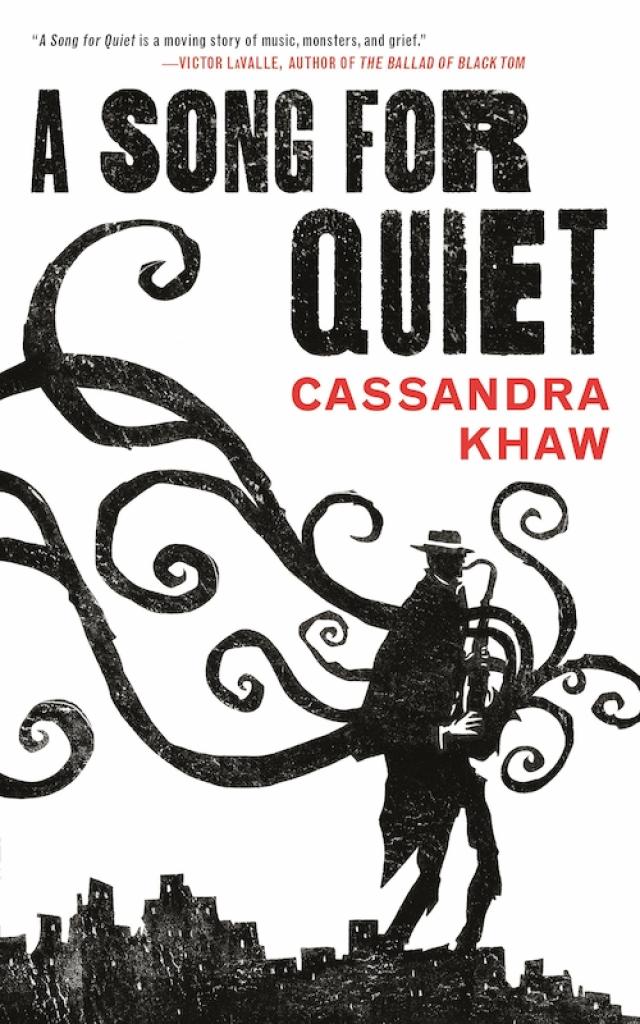
“Mighty gracious of you as always.” Deacon finds a smile as he rises, the remainder of his beignet popped into his mouth, sugar and fried dough still warm from the pan. Funny how the worst thing about grief turned out to be someone else’s sympathies, the way they cut through the stitching, drag out the hurt. But you take kindness when it’s offered. No need to be ungrateful. Still chewing, he unshoulders his case, and opens it with a flick-snap of locks; he extracts his saxophone from its bed of moth-bitten velvet, the lining dotted with pennies, a constellation of cheap change.
“Taking your hat, by the way.” April declares before he can move too far, snatching Deacon’s fedora—cheap wool, some shade of highway grit—from his head and pressing a chaste kiss in its place. “Seems traditional, don’t it?”
Deacon only smiles.
When he climbs the stage, his instrument a curve of sunlight against midnight skin, the room refuses to quiet, keeps churning at its meat and its drink, small-city gossip floating like the smell of fresh-ground coffee. But Deacon knows the subtleties of a crowd’s reluctant interest, and he’s not buying their sphinx act.
Discussions soothe to meandering small talk. Men put down their hickory-smoked ribs, licking black sauce from their fingertips. Mothers hush their babes. Bodies realign, legs recross, all canted toward the object of their curiosity like little blind cavefish searching for the sky.
There we go. Deacon grins, honeyed and knowing, and settles on his rickety stool, saxophone over his lap.
“Ladies and gentlemen, how are y’all doing? My name is Deacon James and I’m your host for the evening. Due to circumstances”—he sweeps the diner for April’s eyes and holds up a smile, just for her—“there will be no microphone or backup singers. Just you and I. So huddle close, you cats. I’ve got a few songs for you. Starting with Geeshie Wiley’s ‘Last Kind Words Blues.’”
He runs through the scales, the notes shimmering gold. Someone answers in descending counterpoint. The bluesman looks up. The cello player tips their bow, and Deacon grins at the salute. “Bit morbid, I know. But all life starts with death, don’t it? In the dark and the green, the places that only the worms go. Let’s all take a moment to reflect on that, on our place in this little planet.”
Deacon begins to play before anyone can say no, the air going crystalline with music, every note a sweet ache. And when he gets to the end, he doesn’t stop. Instead, Deacon leads them down darker roads: Son House, Skip James, Blind Willie Johnson, moaning sweetly. All the old men who’d been bled of their fancies, whittled to bad dreams and worse habits, their music too sad for a country sick of trying.
In between covers, he walks his audience along the dirt path that winds to his father’s grave, where his mother stood weeping under the veil of a willow tree, filigreed in the light. He plays them the sound of breath hitching, a brave woman breaking, the thump of feet on earth as a man is carried to his final resting place. Hurt with no structure, raw as can be, a note plucked from a heart that doesn’t know how it’ll keep beating.
And through it all, the cellist follows in adagio, their improvisations woodsmoke and rich shadow. Slow, like the minute before you reach the casket, that nowhere place where you can still make believe the dead are just sleeping.
Six songs later, Deacon comes up for air amid a hush, the split between grief and give, no agony in his body, baptized by the blues. “I know some of y’all are thinking: why does this brother got to play us something so sad? Because these are hard times, my friends, and every one of us is cradling some kind of hurt. But see, the thing about pain is this: you don’t have to carry that burden alone. The blues, you see, is the music of the ache and the grind, the letter from the front saying your brother is dead, the smile that reminds you of that girl you lost when you were too young to know better.”
A ripple of sympathetic chuckles cast low. April wanders the crowd, murmuring into ears, Deacon’s hat held out. Coins and bills gather in drifts. In that one dark corner, a figure halts their strumming, face turned up to Deacon like he’s the dying sun.
“Blues—” Deacon swallows around the words catching in his ribs, feeling them stick, all the goodbyes, all the things he’d left unsaid, a whole decade of should-have-beens and could-have-beens put aside for what? “Blues is about wanting and not having, about putting that need into someone else’s hands for a little while so you can pause and breathe.”
As he talks, his fingers court his saxophone, pure instinct, tracing its brass portraiture like the slope of a lover’s hip. But the next song doesn’t belong to it, no. Deacon slaps his palm against shining metal, a drowsing lugubre beat. Thunk. Thunk. Thunk. “The next piece is special. I wrote it on the train here—”
And between him and his mother choking through badly rolled cigarettes, neither smokers but both starved for numb; while alone behind the church, a half-emptied bottle of whiskey in grip, gaze on a starlit heaven crueler than he’d remembered.
“—just for you.” He shutters a dark eye.
More laughter from the crowd, louder than before, a little giddy, a little guilty.
“But seriously, folks. The next piece I’m going to perform for you—it won’t be like nothing else. It ain’t got room for a saxophone, for one. And you won’t ever hear it on the radio. Partly because I’m a black man.” Laughter again, slightly nervous. “Partly because this tune is raw as hell. The sound a heart makes when not even the grave will give it peace. Fair warning: I don’t got no title for it yet, or an end figured out. But maybe, we can figure out where it goes together.”
Deacon breathes in. What he breathes out is—
The lights shiver.
—cold.
Not the chill of the city without, fog-coiled and damp and reeking. But razorcut sharp, like the coming of a blizzard, or maybe, something worse, an emptiness on the hem of the universe. It seethes into his lungs, threaded with an oilier stench, viscera spread over black earth, a fortune written in its drape. And it is that that Deacon sings, the ice and the drooling gore, the pus soaking into the soil as something rises from the treeline, teeth and tongue and groping tendrils. A whole language of sensations, carried on words that grind his throat to blood.
Like nothing he’s heard. Like nothing that should be heard. And it’s wrong, wrong, wrong, Deacon thinks through a daze, the music twitching through him, stuttering, snickering.
Outside, the streetlamps blink wetly.
But Deacon keeps singing, bass rasped down to a croak, and the audience keeps listening, still and quiet as bones in a pot; not even the kitchen breathes, no sizzle of meat on the grill or clatter of plates, no noise at all except for Deacon’s voice. Except for that goddamned song, pounding in his temples, pounding through the air, a shuddering thing like the earth itself is in labor.
A burnt-pork stench. Deacon shuts his eyes, the world red-lit against his lids, and shapes move, tectonic, against the black. He breathes—
—the windows are full, full, every inch of glass occupied by grinning faces. No eyes, no throat, no frame of bones. Only mouth and lips atop circles of smooth flesh, teeth perfectly straight, mosaiced together like scales on a pike.
No words now. Just sound and sinuous downbeat, an incomprehensible ululation that goes beyond endurance. In the back of Deacon’s mind, he thinks, I might be screaming.
His eyes open. Every face in the diner is washed in light and bleached to the soapy-gray transparency of a fish that’d been left to die, swimming through its own cloudy waste, round and round, belly bloated, gaseous. They’re singing too, Deacon realizes, the thought slurred to a lisp as his voice falters and breaks. His song, but transposed to a higher register. And urgent, he thinks, head swimming, in a way that his rendition was not. Urgent and ravenous for something that stinks of dirt and depth and desire.
—the window opens, peels like rind into shavings of glass; something tall and stilt-legged steps lithely through, its head bending through the ceiling.
The sight of it—the head angled slightly, enameled horns ridged with strange growths—shatters his fugue. It’s real, Deacon thinks, waking, the revelation freezing in his lungs.
As the thing turns its regard toward the bluesman, Deacon gets up and runs. He trips, recovers, the slap of his shoes on the wooden floor the only sound—
The music is gone again. Not forever, of course. No, he can feel the nub of it lodged in the base of his skull, a square inch of rounded pressure, gently purring. Pleased. But the diner itself is silent save for his footsteps and the click of its hooves, the panting harmony of its breath.
Deacon makes a mistake then. Curious as Orpheus and Lot’s wife combined, he slants a look over his shoulder and chews down a shriek. The patrons’ faces—they’re melting, slowly, chunkily. Fat puddling in clavicles, warm yellow gunk. Sinew dripping, reknitting over eyes and noses, until only grinning mouths remain, the lips pulled so far back that every tooth goes on parade. One suddenly tosses its head like a heifer, hair expels in oily clumps; the scalp breaches, horns first straining against and then audibly popping through the cup of its skin.
And it turns. They all turn, every last one of them, down to a tow-headed infant, its cheeks cored of softness, an apple sucked dry of its meat; all smiling, all beaming, perfect pearly-white joy, indulgent parents waiting to welcome their long lost boy home.
* * *
A single note plays through the nothing: cantabile darkness, clean.
Like the sound of universes beginning.
* * *
“—thank God. He’s coming to his senses. Deacon? Honey? Honey, are you back with us?”
“What happened?” Deacon sits up, palms on the wooden flooring, the surface gummy with a crust of spilled beer. The back of his skull is tender but not excessively, a bruising no worse than any he’d been christened with. “Where’s my sax?”
“Your instrument is on the table. I put it away first thing. You passed out. Got a nosebleed midway through your last song. You looked up like you’d seen a ghost, touched your face, and next thing anyone knew you’d hit the ground.” April daubs his upper lip with a washcloth, the fabric already clotting with red. Her forehead rucks.
“Was I out for long? I’m sorry if I was—” Promises clog his throat, Deacon’s face going hot as he rubs the grime and sugar from his fingertips. It’d been a dream, then. All of that. The grinning faces, dripping fat. The thing coming through the wall.
Around him, the diner relaxes into welcome banality; cutlery scraping over crockery, harmonizing with the murmur of women talking, men grumbling; a slow undersong of kitchen work keeping time. A madrigal of ordinary, perfectly performed.
“No, no. It’s fine.” April unbends, one slender hand flapped, the other outstretched. “They’ll survive. How about you, though? You doing okay?”
“Back of my head hurts.” He clasps her forearm, Roman handshake–style, and lets all sinewy five-seven of the woman help haul him upright. As Deacon dusts the filth from his clothes, April grabs his hat from a table and shoves it forward, the crown sagging under a pebbling of coins. He takes the offering and flicks an indecorous look down. A generous haul. “But I’m fine, otherwise.”
“You been eating enough, Deacon?” April inspects him with a slight pucker to her mouth. She stalks a quick circuit around the bluesman, elbow gripped behind her back. “When my grandma died, I couldn’t even think about a slice of bread, let alone the effort of putting it into my mouth. Dead people have that way about them, you know? They get lonely. None of them ever mean it, but they’ve got a way of pulling us after them.”
“I’m fine, April. I promise. I’m just—” He considers his words, a platitude tottering in place, before at last compromising on something closer to honest. “Tired, I guess. It’s been a long ride. Didn’t sleep well on the train.”
“Did you ride the blind again?”
“No, ma’am.” He glances at a waitress as she shimmies past, slim-framed with dark, wavy hair, plates stacked high in both palms. A name tag is pinned to her ruffled shirt. SASHA, it says in brass. “Got a ticket all proper-like.”
“Good.” April halts, straightens and slings her blood-mottled washcloth over her shoulder, stance held wide and martial. “It’s better than it used to be, especially up here in the North. But there are still white folk who like to pretend Roosevelt didn’t say nothing.”
A strobing of memory: the cowboy’s face in its many permutations. It ends with a vision of the man heaped on a corridor floor, arm snapped, broken-off tip spongy with marrow. “Amen to that.”
“Anyway.” April pivots on a flat-soled heel, a look sliding over her shoulder. Somewhere nearby, a man with a baritone roar booms for his check while a child screams, high and thin. “You’re no good to me half-dead like that. Maybe you should take the night—”
“No. I can play.” The lie trips off his tongue, slightly too quick.
“You absolutely can not.” A pause between those last two syllables, tongue-tip between her teeth. “We both know that. Look, it’s normal to be out of it.” A half-turn as April gestures: an angling of the wrist, palm swept up and crooked, one shoulder raised. “No one’s going to judge you. Least of all me. If you need to take the night off, it’s fine. Only been a couple of weeks. No one expects you to be back in one piece.”