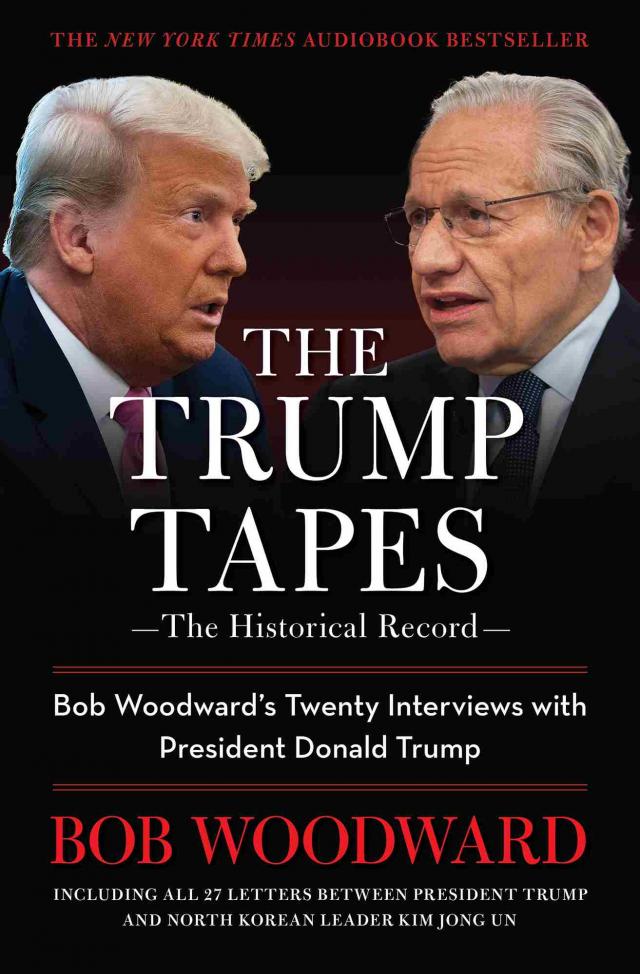
The Trump Tapes, page 1


Thank you for downloading this Simon & Schuster ebook.
Get a FREE ebook when you join our mailing list. Plus, get updates on new releases, deals, recommended reads, and more from Simon & Schuster. Click below to sign up and see terms and conditions.
CLICK HERE TO SIGN UP
Already a subscriber? Provide your email again so we can register this ebook and send you more of what you like to read. You will continue to receive exclusive offers in your inbox.
AUTHOR’S PERSONAL NOTE
Claire McMullen, 28, a lawyer and writer from Australia, was my full collaborator on this project. She poured over the Trump tapes for countless hours this past year, pushing me to reflect and explain my reporting methods and Trump’s presidency for listeners and readers. Her brilliant insights on American politics, the presidency and Trump were invaluable to me. This historical record—the transcript of more than eight hours of interviews with President Trump and my 227 new commentaries—is a testament to her hard work. I will always cherish her friendship and commitment.
Karen Pearlman, producer and director of The Trump Tapes, was also an extraordinary behind-the-scenes force on this project. This is the first time in 50 years of reporting that I have released full audio and transcripts of my work. Karen’s attention to detail and to the sound production quality was instrumental to the audiobook. Her energy and candor in the studio for days as I read the new commentary into the microphone made an unnatural process for me feel comfortable.
Thank you to the great Jonathan Karp, CEO of Simon & Schuster, for his counsel and unflagging support. My profound gratitude to Chris Lynch, president and publisher of Simon & Schuster Audio, for his advice at every step of the audiobook process. Chris understood immediately the value of these interviews. His full engagement in this project was a steady guide through new, uncharted territory for me. Many thanks to Elisa Shokoff, vice-president and executive producer, for her management; Robert B. Barnett, my lawyer and confidant, for being at my side for too many years to count; and Aileen Boyle, my publicist, for helping this project reach listeners and readers around the world.
Finally, my eternal thanks to my wife, Elsa Walsh, who has worked on 19 of my 21 books in the 41 years we have been together. She played an extraordinarily pronounced role in my book Rage that was based on these interviews. As you see in the transcripts, Elsa lived these interviews with me. Trump would call our home at any time, and I had the rare opportunity to be able to call him. Elsa jokes there were three people in our marriage. She is a brilliant and clear-eyed editor, always identifying the intrigue and the essential follow-up questions. I will never be able to thank her enough for her contributions to my work and our life together.
OPENING SELECTION OF EXCERPTS
OPERATOR:
Mr. Woodward, the President.
TRUMP:
Hi, Bob…
TRUMP:
My whole life has been deals. I’ve done great. Far greater than people understand.
TRUMP:
I respect Putin. I think Putin likes me. I think I like him.
TRUMP:
It’s law and order, Bob, law and order.
BW:
Why don’t you give me your taxes. No, seriously.
TRUMP:
I said to the king, King, you’ve got to pay us for protection. If it weren’t for us…
TRUMP:
We had a very good chemistry together. We talked a lot. We could’ve talked…
TRUMP:
I will consider this one of my greatest achievements: getting the scum out of government. And it’s scum.
BW:
Sir, you’re going to be judged by how you handle the virus.
TRUMP:
I have done a tremendous amount for the Black community and honestly I’m not feeling any love, because…
TRUMP:
Nothing scares me. If I were scared I wouldn’t be doing an interview with you today. I’d be under a table with my thumb in my mouth. Okay?
TRUMP:
I hope you treat me better than Bush, because you made him look like a stupid moron, which he was.
INTRODUCTION
I’m Bob Woodward. I’m doing something here that I’ve never done before, presenting the lengthy, raw interviews of my work. In the fall of 2019 through August 2020, I interviewed President Trump 19 times for my second book on his presidency, Rage. I had also interviewed him in 2016 when he was a presidential candidate.
I decided to take this unusual step of releasing these recordings after relistening in full to all 20 interviews earlier this year. Information from these tapes was used in Rage, but as I listened to them again I was stunned by their relevance to understanding Trump. Hearing Trump speak is a completely different experience to reading the transcripts or listening to snatches of interviews on television or the internet.
You will hear Trump as I did. Raw, profane. Divisive and deceptive. His language is often retaliatory. He pledges to even the score with his detractors and enemies. He is angry, feels abused and completely misunderstood. Yet, you will also hear him engaging and entertaining, laughing, ever the host. He is trying to win me over, sell his presidency to me. The full-time salesman.
I hope that you will feel you are in the Oval Office with me as Trump slams the Resolute Desk, or at his Mar-a-Lago estate in Palm Beach, Florida, as he plays concierge to his guests, including me. Or experience my surprise when Trump calls me at home out of the blue.
Trump’s voice is a concussive instrument. It is fast and loud. He hits hard or will lower his voice to underscore for effect. He is staggeringly incautious. And at times staggeringly repetitive, as if saying something often and loud enough will make something true.
During these interviews, I question and at times fact-check the president. But you will also hear me listen without interrupting even when I know what he says is wrong or unsupported. This is because I wanted to hear everything he had to say. Having an argument would not have achieved that purpose. In my book Rage, I only used information I was able to verify and in other cases I pointed out when he was inaccurate.
Here in this audiobook, I at times break frame from the interviews to add commentary to provide essential context or clarification. But for the most part the interviews proceed uninterrupted. When you hear Trump in his own words, in his own voice, it is an up-close, unvarnished self-portrait of him and his presidency.
I wanted to put as much of Trump’s voice, his own words, out there for the historical record and so people could hear and judge and make their own assessments.
All interviews were recorded with his permission. To improve clarity, we have edited out excessive repetition, irrelevant material, background noise, and unintelligible audio.
Our interviews took place during one of the most consequential years in American history. Trump was impeached, the COVID-19 pandemic erupted, and the murder of George Floyd sparked the largest racial justice protests in the United States since the civil rights movement. I pressed Trump on these topics as well as foreign policy and the economy. At times our discussions were heated. I often expected each interview to be our last. But the president kept calling and he continued to answer my calls.
On re-listening to the tapes, I discovered something surprising to me, which I had not realized at the time. I had become entangled in the disorder of Trump’s presidency. Knowing that he could call at any time and knowing that I could call him and inquire about anything—including the events of that day—was a once in a lifetime opportunity, but it was also unnerving. Trump became the primary focus of my life for nine months.
After my book Rage was published in 2020, two months before the presidential election, Trump said publicly, “it was a political hit job.” He also said:
TRUMP:
I said really good things in that book.
From the vantage of August 2022, it is, of course impossible to know the outcome of Trump’s political future and the future of Trumpism. The midterm congressional elections loom. The January 6 Committee is still investigating Trump’s efforts to overturn the 2020 presidential election. And many criminal and civil investigations into Trump’s conduct are ongoing, including the FBI search in August of his Mar-a-Lago estate to recover documents Trump took from the White House.
Some of the documents at the center of Trump’s disputes with the National Archives and the Justice Department were first revealed during these interviews and quoted in my book Rage. The extraordinary letters between Trump and North Korean leader Kim Jong Un are, for example, discussed extensively in these tapes.
But after Trump’s four years as president, there is no turning back for American politics. Trump was and perhaps still is a huge force and indelible presence.
“On history’s clock it was sunset,” the brilliant author Barbara Tuchman wrote of 1914 before World War I in her book The Guns of August. Just over a century later, the year 2016 and the election of Trump as president turned out to be another sunset. The old political order was dying and is now dead.
INTERVIEW 1: The Lone Ranger
Old Post Office Pavilion Trump Hotel
March 31, 2016
TRUMP:
I am a person that’s going to bring this country together; I’m a person that is going to unify the country.
COMMENTARY: This was March 31, 2016. Trump had the Republican nomination almost in his grasp. My colleague at The Washington Post, Robert Costa, a remarkable political reporter known for his objectivity and knowledge of Republicans, had suggested we go interview Trump together.
He did not think Trump was being taken seriously enough as a candidate. We sent Trump a two-and-a-half-page list of questions. I saw the interview as an opportunity to ask Trump questions about the presidency—many I had asked prior presidents.
This interview was held at a make-shift conference room at the Trump International Hotel in the Old Post Office Pavilion on Pennsylvania Avenue just blocks from the White House. It was still under construction. You will hear construction noise and hotel clamor in the background of this interview.
BW:
Where do you start the movie of your decision—
TRUMP:
Yeah, I saw that.
BW:
—to run for president? Because that is a big deal. A lot of internal/external stuff, and we’d love to hear your monologue on—
TRUMP:
Okay. I thought it was very interesting. I saw that.
BW:
—how you did it.
TRUMP:
Where do you start the movie? I think the start was standing on top of the escalator at Trump Tower, on June 16th… I mean, it looked like the Academy Awards. I talk about it. There were so many cameras. So many—it was packed. The atrium of Trump Tower, which is a very big place, was packed. It literally looked like the Academy Awards. And…
BW:
But we want to go before that moment.
TRUMP:
Before that? Okay, because that was really—
BW:
Because, other words, there’s an internal—
TRUMP:
Yeah.
BW:
—Donald with Donald.
RC:
Maybe late 2014 or—before you started hiring people?
TRUMP:
Well, but that was—okay, but I will tell you, until the very end… You know, I have a good life. I built a great company. It’s been amazingly—I’m sure you looked at the numbers. I have very little debt, tremendous assets. And great cash flows. I have a wonderful family. Ivanka just had a baby. And, you know, doing this is not the easiest thing in the world to do. You know, people have—many of my friends, very successful people, have said, why would you do this?
COMMENTARY: Let’s pause here to address Trump’s assertions about his finances. They have always been suspect and frequently exaggerated, at times wildly so. It’s never been clear what the exact numbers were, what he’d made and what he’d spent his money on. In the six years working on Trump, it is one of the continuing mysteries.
BW:
So is there a linchpin moment, Mr. Trump, where it went from maybe to yes, I’m going to do this? And when was that?
TRUMP:
Yeah. I would really say it was at the beginning of last year, like in January of last year. And there were a couple of times. One was, I was doing a lot of deals. I was looking at it very seriously one time, not—you know, they say, oh, he looked at it for many—I really, no. I made a speech at the end of the ’80s in New Hampshire, but it was really a speech—it was not a political speech, anyway, and I forgot about it.
BW:
And that was the real possibility? Or the first…
TRUMP:
Well no, the real possibility was the Romney time. This last one four years ago. I looked at that, really. I never looked at it seriously then. I was building my business. I was doing well. And I went up to New Hampshire, made a speech. And because it was in New Hampshire, it was sort of like, Trump is going to run. And since then people have said, Trump is going to run. I never was interested. And I thought that Romney was a weak candidate. I thought Obama was very beatable. Very, very beatable. You know, you had a president who was not doing well, to put it nicely. And I looked at that very seriously. I had some difficulty because I was doing some big jobs that were finishing up, which I wanted to do. My children were younger. And four years makes a big difference. And I also had a signed contract to do The Apprentice with NBC. Which in all fairness, you know, it sounds like—when you’re talking about “president” it doesn’t sound much, but when you have a two-hour show, primetime, every once a week on a major network…
BW:
So when did it go to yes?
TRUMP:
So—okay.
BW:
Because that’s—having made, you know, we all make minor decisions in our lives.
TRUMP:
Okay.
BW:
This is the big one.
TRUMP:
Big decision. Yeah, this is a big decision. And I say, sometimes I’ll say it in the speeches. It takes guts to run for president, especially if you’re not a politician, you’ve never…
BW:
When did it become yes?
TRUMP:
What happened is, during that time that I was just talking about, I started saying I’d like to do it, but I wasn’t really in a position to do it. I was doing a lot of things, and I had a signed contract with NBC. But I started thinking about it. And the press started putting me in polls, and I was winning in the polls. And I was essentially leading right at the top, without doing any work. Not one speech, not one anything. But every time I was in a poll, I did very well in the poll.
COMMENTARY: I intentionally asked Trump: when does the movie begin because I knew that Trump thought in terms of movies, visuals, big spectacular events. He wants to talk about his success, not his decision to run for the presidency.
The question for Costa and myself is why does he want to be president? Perhaps because it’s the biggest movie or the biggest stage?
RC:
What happened between 2011 and 2014?
TRUMP:
During this period of time, I said, you know, this is something I really would like to do. I think I’d do it really well. Obviously the public seems to like me, because without any…
BW:
Who are you saying that to? Your wife?
TRUMP:
To myself.
BW:
To your family?
TRUMP:
To my family, but to myself.
BW:
To yourself.
TRUMP:
Yeah, to myself, and…
BW:
This is interior dialogue.
TRUMP:
This is thought process.
BW:
Can you isolate a moment when it kicked to yes?
TRUMP:
I just felt there were so many things going wrong with the country. In particular, because I’m a very natural person when it comes to business, I assume—I mean, I’ve done really well, and I do have an instinct for that.
BW:
So when did you tell somebody in your family or your circle, I’ve decided to run. Other words, I’ve pulled the switch.
TRUMP:
Well, I would tell my family about it all the time. Don is one of my sons, and doing a really good job. He’s involved very much in this job. He’s here today, so I said come and meet—
BW:
Thank you.
DONALD TRUMP, JR.:
Of course.
TRUMP:
—the great genius and the current great genius. Right? The great genius of all time. But Don and my family, I would talk about it a lot. I would say, I can’t believe they’re doing it.
BW:
Did anyone recommend no? Did your wife, or did your son?
TRUMP:
Oh. Yeah.
BW:
Did anyone say, Dad, Donald, don’t do it?
TRUMP:
I think my wife would much have preferred that I didn’t do it. She’s a very private person. She was a very, very successful—very, very successful model. She made a tremendous amount of money and had great success and dealt at the…
BW:
What’d she say?
TRUMP:
She was, she said, we have such a great life. Why do you want to do this? She was…
BW:
And what’d you say?
TRUMP:
I said, I sort of have to do it, I think. I really have to do it. Because it’s something I’d be—I could do such a great job. I really wanted to give something back. I don’t want to act overly generous, but I really wanted to give something back.
COMMENTARY: This was standard presidential and political jargon about giving back. Something I had heard many times over 50 years of reporting.