Weird Tales #358, page 1


COPYRIGHT INFORMATION
Weird Tales #358 is copyright © 2011 by Wildside Press LLC.
All rights reserved.
www.wildsidemagazines.com
THE EYRIE, by Ann VanderMeer
Weird Tales Goes to Hell and Back
Yes…so…as I was putting this issue together I noticed quite a few stories that had Hell, demons and other underworldly creatures in them. (True, we also have some angels and Purgatory, plus some general overall weirdness…) People seem to get a big kick out of Hell, although I don’t think that’s the type of response all those fire and brimstone preachers had in mind with their sermons. So what is the appeal anyway?
Hell is a lot less boring than Heaven, isn’t it? There are very colorful creatures in Hell and although you might not want to be BFF’s, you know they won’t bore you. True, the singing might be a bit agonizing to hear, but who wants to spend all their days listening to perfect choirs? It’s warm there…and we’re all about the tropics. No one wants to spend eternity shoveling snow.
Not to mention, the Devil keeps making us promises, dangling enticements and tempting us with all those things we want but know might be terribly bad for us. He’s charming and hard to resist and we’re willing to follow him…well…into Hell. Even though we know what that means.
So of course we want to read stories about Hell and demons.
The Hell we bring you here in the pages of Weird Tales will thrill and delight. Are those the best words to describe it? Perhaps. It’s up to you to read them and decide.
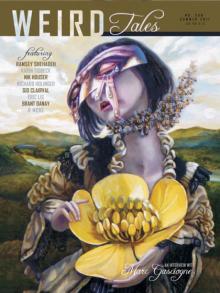
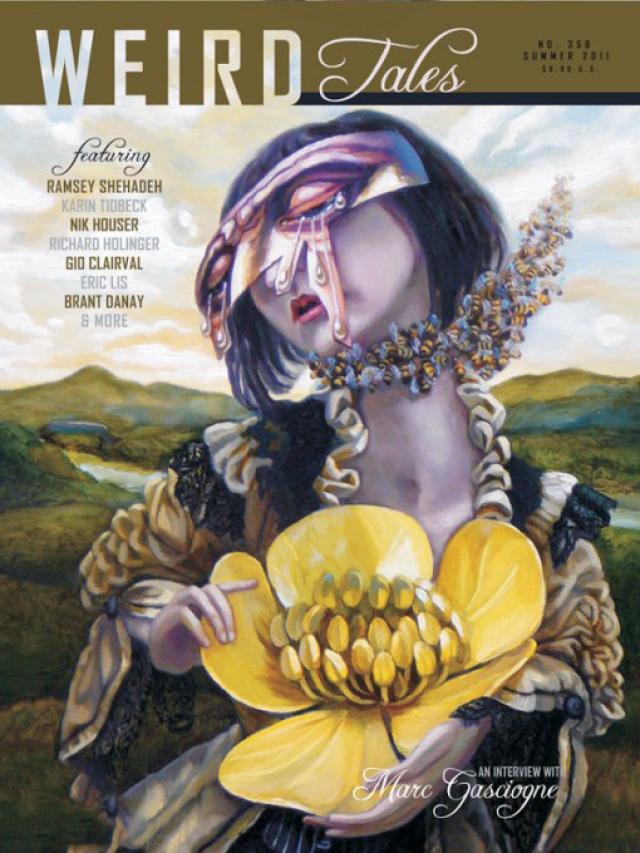
We start off with Ramsey Shehadeh’s “The Diner at the Edge of Hell” where we get to hang out with some of our favorite (reluctant) gangster angels. Then down the rabbit hole and into a brave new world with Karin Tidbeck and “Jagannath.” I promise you’ve never seen anything like this. Nik Houser shows us both the beauty and horror of building sandcastles for young boys in “A Beginner’s Guide to Sandcastle Alchemy.” You think you’re all alone and oh so unique until Richard Holinger shows you that this is not always the case with “Look at the Jam I’m In.” We are introduced to a hungry creature in Gio Clairval’s “The Hand,” while Eric Lis’s “A Contract Without Loopholes” shows us that not all demons are stupid and some of them have quite the sense of humor. And Brant Danay gives us a totally different view of Hell (and swamps, not to mention religion) in “Beezlebub’s Messiah.”
Has Weird Tales gone to Hell? Absolutely!
A SWEET DISORDER IN THE DRESS, by Genevieve Valentine
In October of 2009, Alexander McQueen unveiled his spring 2010 collection, Plato’s Atlantis, at Paris Fashion Week.
“Plato’s Atlantis” sounds like the title of a long-lost Star Trek episode, and the results on the runway were appropriately science-fictional.
His models were made-up like creatures who had crawled out of H.R. Giger paintings, their hair braided and teased into horned ridges clawing across their heads and down again. Charging down the runway on foot-high shoes shaped like lobster claws—later to be dubbed “Armadillos,” the models made wide circuits around two motorized cameras that projected their movements onto an enormous screen, presenting an illusion of an undersea alien metropolis, inhuman and magnificent.
The clothes themselves were the culmination of McQueen’s previous seasons of work with detail, print, color, and shape: cocktail dresses patterned like brightly-stained beetle autopsies; pants sculpted like coral reefs; spring jackets—the shape and translucency of a chrysalis—hovering several inches above the body.
McQueen had long been considered a designer whose clothes, and presentations, contained elements of costume ranging from subtle to overwhelming. This collection, however, far surpassed his previous work in its execution, theatricality, and celebration of the bizarre.
This was not McQueen’s first outrageous show. He once sent models down the runway wearing elaborate wedding dresses with net veils draped over antlers. In 2004, his collection was presented as a living game of human chess. He’s styled runway presentations around shipwrecks. He once closed a show by having two car-factory robots spray-paint a model wearing virginal white.
But the clothes of “Plato’s Atlantis” shown that October night went above and beyond all McQueen’s prior efforts. Although masterfully designed, the collection was aggressive, severe, off-putting. It was impractical. It was not, by conventional standards, pretty.
But then, that was the point.
McQueen had long been an advocate of the bizarrely beautiful, and this collection was the perfect synthesis of McQueen’s self-proclaimed love affair with “man and machine,” the triumph of wearable science fiction over seasonal marketing. And it was a collection that sent a compelling message amid the filmy sundresses flooding other runways: McQueen’s collection was a singular contribution to an aesthetic school positing that it’s just as worthy to be interesting as it is to be pretty.
It’s an aesthetic that had begun to resonate within a culture saturated by ever-narrowing beauty standards and an increasingly secretive/punitive dichotomy about women’s sexuality. McQueen’s rising mainstream appeal seemed to be an indicator of a growing counterculture interest in the beauty of the weird that is being celebrated in its cinema, its reading, and its music.
A ready example is Lady Gaga, a pop singer whose public image is less sexy starlet than Cubist painting come to life. Lady Gaga has consistently chosen the bizarre over the sexy, to great effect. She attends awards shows in gowns made of meat, headpieces big enough to have their own gravitational pull, and eggs, and strives to make the statement that she is bold rather than sexy. Her videos are surrealist playgrounds devoid of the teasing-nymphet or brokenhearted-violet tropes (she poisons and torches the men who done her wrong). It’s no surprise someone with a combative sense of style would champion the same aesthetic McQueen puts forth. She was the first person off the runway to wear the famed Armadillo heels in her “Bad Romance” music video, and she collaborated with McQueen to design costumes for her Fame Monster tour.
McQueen’s slightly sideways approach to beauty has sometimes received mixed reviews, with critical emphasis on the theatricality of the runway shows often overshadowing his undeniable craftsmanship (he’s a Savile-Row trained tailor). Usually runway spectacles like those in which McQueen reveled are reserved for couture spinoffs from fashion houses such as Givenchy (where McQueen worked before beginning his own label) and Dior, whose designers show off their haute couture offerings alongside their more market-friendly lines each season. McQueen, however, labeled each of his collections ready-to-wear.
This is not merely semantics. Ready-to-wear fashion feeds into a cycle of dictating to its market while creating an exclusive, aspirational brand image. McQueen presented well-cut suits and red-carpet standards cheek-by-jowl with golden bodices of anatomically-correct armor plate and cocktail dresses that looked like death’s-head moths; amid an industry that generally prefers to think, You Wish, Alexander McQueen’s body of work suggested, Why Not?
McQueen was one of a rising number of designers (including stalwarts like Isabel Toledo and newcomers like Rodarte) who treat fashion as performance art for women rather than as a costume one wears to attract the sexual attention of men. It’s beauty of a Tim Burton type, where it’s more than all right to be a little askew, and beauty relies less on societal standards than on being individually striking.
In this respect, Isabel Toledo is a more direct precursor of Alexander McQueen than any of fashion’s flashy John Gallianos. Toledo is, like McQueen, a master of tailoring, whose trademark is her manipulation of fabric and seaming to create dramatic shapes on the body, whether jellyfish blouses or origami jackets that fold perfectly flat. Her work generally skirts the spotlight, not least because she ignores fashion’s seasonal cycle and creates capsule collections on her own schedule with minimal marketing. Toledo’s clothes are not designed to make the wearer look either expensively dressed or sexually attractive (something a society trained to objectify and classify women generally expects from clothing). They’re experiments in shape, cut, and texture, designs meant to be worn by someone beyond the norm.
It is this individuality and attention to the singular over the industrial that dovetailed so neatly with McQueen’s own vision, and Toledo’s decades of small-scale, critical success were no doubt influential when McQueen was initially establishing his brand. (Many of his early collections showed the same attention to drape and seaming for which Toledo is known, themes he carried to a sublime level with Plato’s Atlantis.)
Alexander McQueen’s Spring 2010 show was that rare animal that appeals as much to fashion insiders as to Hollywood, that captivates both Anna Wintour and the casual blogger. The dialogue about what makes clothing beautiful, and what makes fashion art, has bled into far more places than a single fashion show can hope to reach. It was a watershed moment for fashion.
With the emergence of this niche aesthetic into the collective culture, the future of fashion was suddenly uncertain, exciting, and bound to be beautiful.
* * * *
On February 11, 2010, Alexander McQueen took his own life.
His final collection was shown at Paris Fashion Week in March 2010. The silhouettes were subdued in comparison to Platoâ
The garments boasted gold-stamped lions, bullion beading, embroidered filigree, silk-screened portraits from medieval paintings, and, repeatedly, angel wings. The collection was reportedly unfinished at the time of his death, and was presented with minimal fanfare.
It was a mature and ethereal collection, a meditation on the divine, which offered a quietly melancholy coda to McQueen’s body of work. (The fashion house itself continues under new creative director Sarah Burton.)
However, for the public and for fashion historians, Plato’s Atlantis will likely stand as the most memorable of McQueen’s collections; it was the magnum opus of a designer with strong vision and limitless promise.
* * * *
In May 2011, the Metropolitan Museum of Art will honor Alexander McQueen with a special exhibition to be premiered during the exclusive Costume Institute Gala. The exhibit’s curator, Andrew Bolton, has expressed a desire to keep the collection from feeling like a retrospective; instead, “Andrew McQueen: Savage Beauty” will highlight the designer’s tendency towards high romance. A screening room will be included where visitors can view his most memorable runway shows, and an aptly named “Cabinet of Curiosities to” display his millinery.
It’s rare that a single designer is the center of this fashion-world event; seminal figures have been represented (such as early twentieth-century master Poiret), but more often it is theme, rather than an individual, that serves as the subject. Past exhibitions have included “Dangerous Liaisons,” “Anglomania,” “Superheroes,” “The Model as Muse,” and “American Woman.”
For such an exhibition to be dedicated to McQueen is further proof that the aesthetic he developed throughout his career is considered outstanding and influential, both in the current state of fashion and in a more historical context. He was an artist who left his mark as a master of the uncanny.
* * * *
Genevieve Valentine’s first novel, Mechanique: A Tale of the Circus Tresaulti, is out now from Prime Books; she has published several short stories, and articles with Tor.com, Lightspeed, and elsewhere. You can find out more at genevievevalentine.com
WEIRD CINEMA, by Robert A. Kowal
Through the Lens Darkly
The “weird tale” transcends cultural boundaries, exceeds genre conventions, and implicitly defies narrative expectations. While it most comfortably inhabits the recognized speculative forms of fantasy, science fiction, and horror, the weird also occurs in poetry, literary novels, and even non-fiction. It has migrated to theater, cinema, and television not to mention its regular appearances in the fine arts over the last 150 years. Munch’s The Scream, for example, was completed in 1893, the year of the first public showing of Edison’s Kinetoscope.
It has populated our cultural landscape in a surprisingly brief span, yet an understanding of this very attribute—weirdness—has itself been elusive. The weird simultaneously attracts and repels us. We are fascinated by it but do not wish to examine it too closely, as if scrutiny would threaten its existence. Like some endangered animal it can only be properly appreciated in its natural habitat, observed from a respectful distance. The weird calls to mind Justice Potter Stewart’s comments regarding pornography, “I know it when I see it.”
Do we know the weird when we see it in cinema?
* * * *
Like the detective story, the literary form of the weird tale arose from the turbulent transitional era of the mid-nineteenth century. Darwin had overthrown the theological dogma of two millenniums, Freud was in the process of destroying the definition of self and the mind/soul dichotomy, and physicists were displacing inherited folklore, speculative theory, and the purely magical with concrete (if no less extraordinary) scientific explanations of reality. It was a cusp period; society teetered between inherited wisdom, parochial perspectives and a static comprehension of the past and the dynamic, progressive, and rational world we recognize still as modernity. The nineteenth century saw the promise of the Enlightenment enacted for the masses by industrialization.
Among the great inventions of the century was cinema. But, just as the literary forms of fantasy, science fiction, and horror had been incubating for much of the nineteenth century before reaching full maturity in the twentieth, so too had the precursors of modern cinema evolved long before the appearance of Edison’s Kinetoscope and the Lumières’ Cinematographe in the 1890s.
Magic lantern shows were enormously popular throughout the preceding century. (Basically a projector comprised of a light source, printed image, and lens in a portable apparatus, some versions of the magic lantern contained multiple lenses that allowed the operator to project images in rapid sequence to create a narrative progression.) Étienne-Gaspard Robert (1763 – 1837) toured Europe with a magic lantern show of macabre scenes of skeletons, ghosts and horrifying figures simulating lifelike motions.
From its earliest inception, cinema has been entwined with the weird and this predilection has persisted to this day. Fantasy, science fiction, and horror have always been staples of the commercial film industry. But these genres themselves are not weird; they have simply proven better suited to expressing the weird tale than others. Any story can veer into weird territory. One of the weirdest popular commercial films in recent memory is No Country for Old Men, which defies precise genre definition but which few would classify as fantasy, science fiction, or horror. There is nothing supernatural involved. Its setting is contemporary; its plot is almost tritely conventional. Its action is entirely plausible, if extremely brutal. Yet few viewers walk away from the film without a lingering queer sensation. It is not simple repulsion at the violence; nor is it indignation at the narrative’s debatable nihilism. It is the singular and the ineffable sensation the weird induces in the viewer. The same holds true for Eyes Wide Shut (1999), Blue Velvet (1986), or Crash (the 1996 film based upon J. G. Ballard’s novel). But how did these sublime examples of weird cinema develop barely one hundred years after birth of motion pictures?
* * * *
By the end of the nineteenth century the nascent literary genres of fantasy, science fiction and horror were well established. As Vivian Sobchack notes, “all three (genres) ‘realize’ the imagination.” It is this notion of the imaginary realized which is the key to understand the weird both in literature and cinema. Sobchack continues, “Horror, is the appalling idea given sudden flesh; science fiction is the improbable made possible within the confines of the a technological age; and fantasy adventure and romance is the appealing and the impossible personal wish concretely and objectively fulfilled.” Each could trace its ancestry back to folktales, myths, sagas or rites but the new forms were now endowed with the unifying characteristic of the “weird” which was heretofore impossible; impossible because the weird is predicated on a common and corroborated understanding of reality.
It has only been in the last two centuries that increasing literacy and education levels coupled with the rise of science and technology have produced, for the first time, a corroborated and uniform comprehension of the basic physical world we inhabit. This may strike us initially as odd but in our history (a history in which we have always told each other stories) a uniform reference of reality is a very recent development. For the vast majority of human history one could profess nearly any phenomenological explanation desired with credibility. The notion of invisible gnomes grinding morsels in one’s belly was as plausible as that of secreted acids breaking down your curds and whey. One could sincerely believe almost anything. By the end of the nineteenth century, science had greatly proscribed the range of the plausible. Yet both our ancient fables and our fantasized futures spring from our imaginations, which knows no such constraints. Imagination flourishes just beyond the real, the known, the concrete. The weird tale, in whatever medium, inhabits the elastic boundary between the rationally plausible and imaginatively possible.
Cinema emerged just as this common understanding of the rationally plausible was becoming ubiquitous. It is vital to note however that cinema is not simply another storytelling medium. It is fundamentally different from the written word or the oral tale, which may express the weird but are not intrinsically weird. The medium of cinema is uniquely fantastical, even magical (recall the magic lantern shows) because it recreates such a detailed and compelling sensory experience of reality—a simulacrum. Literature relies upon the reader’s internal imagination whereas cinema is the imagination relinquished and externalized. It is this dichotomy which conditioned the development of early cinema and which today still affects it. It is also this dichotomy which allows cinema to retain its weird potential even as narrative techniques and technologies evolve.