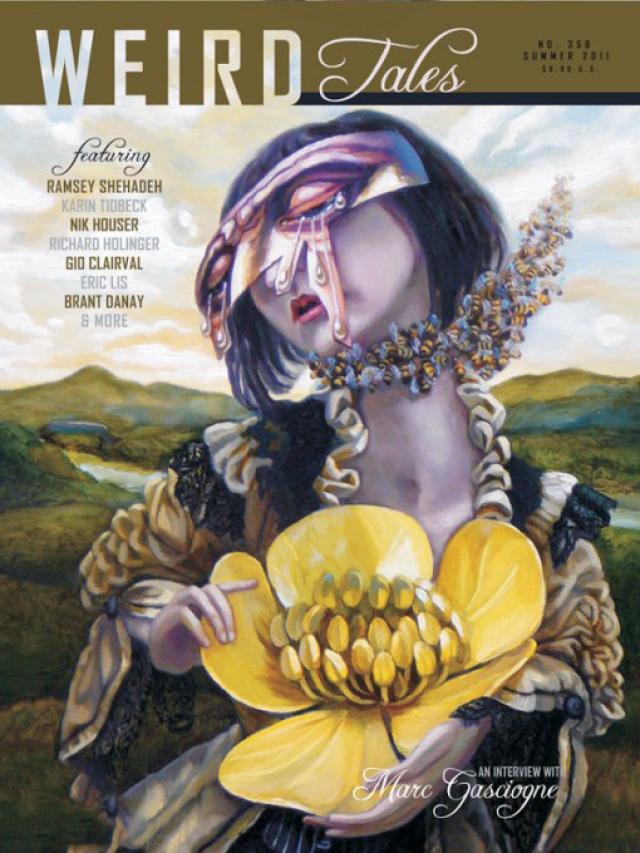
Weird Tales #358, page 11


Night Beetle retrieved his damp headdress of butterfly and moth wings and placed it back upon his skull, then fastened his belt of beetle-shells around his waist and balanced its pouches over his grotesquely swollen genitalia. With his turgid scrotum painfully dragging the green and brown waters of Crucifix Swamp, and his fevered mind half-thinking and half-dreaming about his pact with the Lord of the Flies, Night Beetle began the long journey home. Beneath the light of the full moon he carried the unfamiliar girth of his elephantiasis-ridden body through the marsh like a beast of burden, a beast who’s burden was its own flesh, blood, soul, and karma, for Night Beetle knew that he bore the burden of the Lord of the Flies along with it, and he could already feel the black maggot of Beelzebub’s messiah squirming in his entrails.
* * * *
Brant Danay is an author and poet residing in Southern California. His first novel, Demonmachy, was published by Severed Press in 2010. He is currently working on the sequel, which is scheduled for release in 2012. He describes his work as a psychedelic, verbose, ultraviolent mélange of dark fantasy, erotic horror, hentai, surrealism, Romantic/Decadent poetry, and heavy metal lyrics; a one-man genre he calls Phantasmagoria.
LOST IN LOVECRAFT, by Kenneth Hite
A Guided Tour of the Dark Master’s World
“West’s last quarters were in a venerable house of much elegance, overlooking one of the oldest burying-grounds in Boston. He had chosen the place for purely symbolic and fantastically aesthetic reasons, since most of the interments were of the colonial period and therefore of little use to a scientist seeking very fresh bodies.”
—H.P. Lovecraft, “Herbert West—Reanimator”
*
Although Boston only stars in one Lovecraft tale (“Pickman’s Model”) and one revision (“Out of the Aeons”), and comes onstage in four others (“Herbert West—Reanimator,” and three of the four Randolph Carter stories), HPL mentions Boston in thirteen other tales and three more collaborations. In total, Lovecraft uses or mentions Boston more times than Providence (six) and Arkham (fifteen) combined! Part of it, surely, is Boston’s pre-eminence in urban New England.
Lovecraft also mentions New York City fifteen times, despite setting relatively few tales there. But some of it must be Boston itself.
*
Like Herbert West, Lovecraft chose Boston for “symbolic and aesthetic reasons.” Two come to mind immediately, and echo repeatedly throughout Lovecraft’s work. First, Boston’s connection to Cotton Mather and the Puritan past, which Lovecraft deeply mined for horror, following Hawthorne’s lead in limning a “witch-haunted” seventeenth century, prone to paranoia and secret sin. As does Hawthorne’s House of the Seven Gables, Lovecraft’s ancient monstrous sinners reach back in lineage (or in horrific immortality!) to the heyday of Puritan Boston and Salem. Even Herbert West fears to dig up tunnels and graves of such figures, and fittingly in Boston the “dead past” catches up with him finally.
Second, Lovecraft exploits Boston’s cultural centrality: Daniel Upton studies with a Boston architect, Charles Dexter Ward and Wilbur Whateley seek out Harvard’s Widener library, and the “eminent Boston authority” Dr. Lyman examines Ward after such researches bear fruit. Moreover, both of Lovecraft’s Boston tales (“Pickman’s Model” and “Out of the Aeons”) seemingly center not on Puritanism but on Bostonian artistic culture. But of course, “Out of the Aeons” includes a sly yet horrific indictment of a long-dead theocracy (of Mu rather than of Massachusetts-Bay), Richard Upton Pickman comes of “old Salem stock,” and both tales involve the discovery that the dead past … isn’t.
*
“It’s my business to catch the overtones of the soul, and you won’t find those in a parvenu set of artificial streets on made land.… The place for an artist to live is the North End. If any aesthete were sincere, he’d put up with the slums for the sake of the massed traditions. God, man! Don’t you realize that places like that weren’t merely made, but actually grew? Generation after generation lived and felt and died there, and in days when people weren’t afraid to live and feel and die.”
—H.P. Lovecraft, “Pickman’s Model”
*
And thus Boston’s artistic culture grows in literally ghoul-haunted soil. Even Boston’s intellectual greats—“Holmes, Lowell, and Longfellow”—no longer lie buried beneath her, but have been digested and distributed throughout. The nineteenth and twentieth centuries feed the seventeenth: Pickman boasts that eight of ten “surviving houses built before 1700 … I can shew you something queer in the cellar.” Boston lives on a foundation of the uncanny past: not just burial vaults but “bricked-up arches and wells leading nowhere.” As we see in the story, Pickman believes that not all of Boston partakes of sufficient terror to fertilize his art, but he also believes that “the night-spirit of antique horror” is necessary to provide “overtones” to the soul. Pickman, even in this first tale, already collaborates with the ghouls of Boston. By the Dream-Quest of Unknown Kadath, he becomes a ghoul, a living tribute to his own art, sitting “on a tombstone of 1768 stolen from the Granary Burying Ground in Boston.”
*
“I’m interested to know that you’ve visited the Boston North End section mentioned in ‘Pickman’s Model.’ This region used to be a good deal more picturesque than it is now, and the sinister alley described in the story was more or less literally based on a real alley (Foster St., I think) which zigzagged peculiarly up from Commercial St. to Charter St. not so very far from Copp’s Hill [Burying Ground].”
—H.P. Lovecraft, letter to Earl Peirce (November 28, 1936)
*
Lovecraft apparently had a specific house in the North End in mind as Pickman’s studio, saying as much to Duane Rimel in 1934. Having promised to show Donald Wandrei some “curious sights” of “sinister quaintness,” they arrived in June of 1927 to find the whole section demolished. As Lovecraft tells Earl Peirce in the letter above, Pickman’s haunt had been renovated into “a barren waste of exposed foundations … the whole damn tangle of alleys had been torn down in the few months between December 1926 and June 1927, and I had nothing tangible to back up the glowing accounts…” A year later, he told Rimel, “the whole thing was covered up with a great brick building.” The “antique horror” of Lovecraft’s Boston was no more immune to the predations of modernity than was his “dead” New York.
*
“For know you, that your gold and marble city of wonder is only the sum of what you have seen and loved in youth. It is the glory of Boston’s hillside roofs and western windows aflame with sunset, of the flower-fragrant Common and the great dome on the hill and the tangle of gables and chimneys in the violet valley where the many-bridged Charles flows drowsily.… So to the organ chords of morning’s myriad whistles, and dawn’s blaze thrown dazzling through purple panes by the great gold dome of the State House on the hill, Randolph Carter leaped shoutingly awake within his Boston room.”
—H.P. Lovecraft, “The Dream-Quest of Unknown Kadath”
*
But like all of Lovecraft’s cities, as Robert Waugh reminds us, Boston is a “double city.” Against every Pickmanian shadow in the cellar, there shines Randolph Carter’s sunset vision on the hill. The above passage from Dream-Quest shows that Lovecraft’s love of New England had two centers: his own native Providence, and the “glory of Boston” revealed at the heart of Miskatonic Country. Carter’s rediscovery of Boston at the end of Dream-Quest echoes Lovecraft’s own rediscovery of Providence after the disaster of New York, and prefigures Charles Dexter Ward’s rediscovery of Providence after his European tour. Randolph Carter, as one of New England’s intellectual and aristocratic elite, was a Bostonian. “The Silver Key” connects “his Boston home” with our artistic theme: “hung in appropriate colours, furnished with befitting books and objects, and provided with sources of the proper sensations of light, heat, sound, taste, and odour.” Even, or perhaps especially, Pickman also sees the beauty of Boston: “these ancient places are dreaming gorgeously and overflowing with wonder and terror and escapes from the commonplace.”
Like most of his urban loves, Boston appealed to Lovecraft visually and artistically, through architecture and literary and poetic experience. This appeal could only be stronger in a city so associated, symbolically and aesthetically, with the arts and letters.
Lovecraft repeatedly visited Boston’s galleries and museums from his youth to his final illness; in Boston he heard Lord Dunsany read, and met his own future wife Sonia. Although some hint of “second city” resentment sneaks through on occasion, the son of Providence nonetheless willingly orbited the sun of Boston.
*
“With this friend, Joel Manton, I had often languidly disputed. He was principal of the East High School, born and bred in Boston and sharing New England’s self-satisfied deafness to the delicate overtones of life. It was his view that only our normal, objective experiences possess any esthetic significance, and that it is the province of the artist not so much to rouse strong emotion by action, ecstasy, and astonishment, as to maintain a placid interest and appreciation by accurate, detailed transcripts of everyday affairs.”
—H.P. Lovecraft, “The Unnamable”
*
But that “second city” resentment remains, channeled into arch mockery of Boston as unworthy of its own beauties and genius. Above, Lovecraft rebukes Henry James and the Boston social novelists of the previous century; with Thurber and Pickman, he casts Boston elites as ignorant and callow. The Boston Art Club is full of “fussy old women” unable to see Pickman’s genius: it refuses to exhibit “Ghoul Feeding,” and “the Museum of Art wouldn’t accept it as a gift.” To hear Pickman tell it, Boston features little but “pale-pink brains” and even “a club of supposed artists” shares “the feelings of a Beacon Street tea-table.” Indeed, “nine-tenths of the homes and clubs of Boston” would ostracize Pickman if they saw his art.
If anything, Lovecraft is even more sly in “Out of the Aeons,” repeatedly contrasting the stuffy elites and “austere neighbours” who patronise the Cabot Museum with the scruffy (but knowledgeable) hordes of proles and foreigners exercised by the “undesirable notoriety” of the mummy exhibit. His Boston is more than a little bit boring, in fact. Not only is it one of “the sections which modernity has touched,” capital of a drab New England full of “foreigners and factory-smoke, bill-boards and concrete roads,” it is ruthlessly, stiflingly conventional. The “eminent Boston authority” Dr. Lyman drastically fails to notice Ward’s changed identity, “Boston naturalists” are baffled by the “Horror at Martin’s Beach,” and another “expert Boston analyst” sheds no light on “The Green Meadow.”
*
“ ‘South Station Under—Washington Under—Park Street Under—Kendall—Central—Harvard—’ The poor fellow was chanting the familiar stations of the Boston-Cambridge tunnel that burrowed through our peaceful native soil thousands of miles away in New England, yet to me the ritual had neither irrelevance nor home feeling.”
—H.P. Lovecraft, At the Mountains of Madness
*
Boston also signifies mundanity by repeated appearances in contrast to horrors elsewhere in Miskatonic Country. The surveyor in “Colour Out of Space” flees back to Boston; the “capable Boston man” Zenas Low comes to work in “The Shunned House”; the Boston Globe trivializes the “Dunwich Horror”; and a “frank, prepossessing” clerk allows the theft of the black stone at Boston’s North Station in “Whisperer in Darkness.” Boston further emphasizes its mundanity in train-tables; there is an 8:20 to Boston from Arkham in “Thing on the Doorstep,” and the entire episode of the lost package in “Whisperer” turns railroad stops and routes into a prosaic labyrinth enmeshing the occult horror.
Lovecraft returns to that specific contrast in Danforth’s manic mantra quoted above. Danforth seeks the safety of the familiar world in Boston, even though Boston is specifically where his doomed expedition stepped off the grid. In Danforth’s litany of Boston subway stations, Dyer can detect “neither irrelevance nor home feeling,” implying instead relevant alienation. Perhaps that key reconciles our two Bostons: neither purely horror nor entirely home, Boston instead signifies reality itself. Pickman, after all, is a “thorough, painstaking, and almost scientific realist,” who paints “in stark objectivity” with “nothing…blurred, distorted, or conventionalised.” Randolph Carter leaves his dreams to find himself in Boston, the waking city behind his sunset vision. Both tales depict awakening to reality, the discovery that the seeming illusion—art or dream—was “a photograph from life!”
*
“I was glad that the first faint, fragmentary words were in a human voice—a mellow, educated voice which seemed vaguely Bostonian in accent, and which was certainly not that of any native of the Vermont hills. As I listened to the tantalisingly feeble rendering, I seemed to find the speech identical with Akeley’s carefully prepared transcript. On it chanted, in that mellow Bostonian voice…‘Iä! Shub-Niggurath! The Goat with a Thousand Young!’”
—H.P. Lovecraft, “The Whisperer in Darkness”
But reality, for Lovecraft, is horror, agreeing with Eliot that “humankind cannot bear very much reality.” When Randolph Carter returns again to Boston in “Through the Gates of the Silver Key” it is as a monster, “creat[ing] certain nightmare rumours… [in] Boston’s West End.” Pickman’s ghouls haunt not just Mather’s seventeenth century but the modern Boston subways, which prove ineffective at soothing Danforth’s mind even as they prey on Thurber’s. Joseph Curwen’s mummy-trading ship is “seen in Boston Harbour, though it never openly entered the Port of Boston,” and Francis Wayland Thurston, “of Boston,” discovers what happens when reality is allowed full reign. The “mellow Bostonian voice” on the cylinder in “Whisperer in Darkness” may well be that of Nyarlathotep himself—and was it not Nyarlathotep who revealed to Randolph Carter the reality of Boston behind the violet-and-gold dreams of sunset?
Next Stop: Hyperspace
Ann VanderMeer, Weird Tales #358