Weird Tales #358, page 2
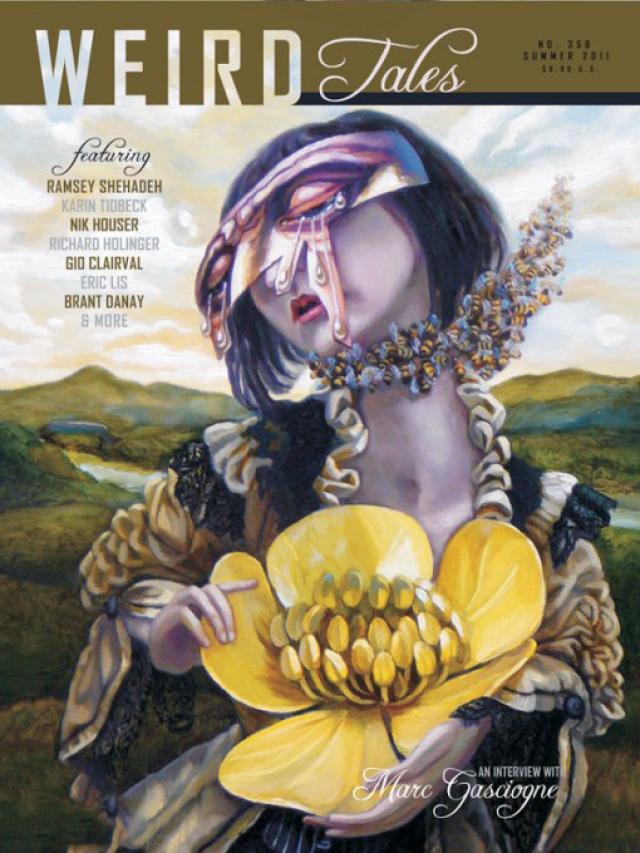


Since Robert’s phantasmagorical magic lantern show, the weird has always preferred to inhabit limbo. It hovers between the dead/living, the natural/supernatural, the original/duplicate, waking/dreaming, conscious/unconscious. So many of the familiar tropes (vampires, ghosts, doppelgangers, zombies) reoccur in the weird tale because they reside in a limbo state between the real and the unreal; they don’t date the way Robbie the Robot does. Due to technological advancement Robbie is no longer a plausible version of artificial intelligence but the vampire remains a plausible a version of the undead because death is still a mystery. Superficial details are updated to accommodate changing tastes but the vampire Eli (Let the Right One In, 2008) is otherwise a direct descendent of F.W. Murnau’s Nosferatu (1922) and both give us the creeps because the dichotomy of dead/undead and the natural/supernatural is as unsettling now as it was when Bram Stoker wrote Dracula in 1897. But let us more clearly define the weird to clarify that which specifically applies to cinema.
* * * *
Freud, in a departure from his clinical research, wrote of series of essays on art and literature sporadically over his career. In one of these, The Uncanny (1919), he offers both a psychoanalytic and aesthetic definition, “(the uncanny) derives its terror not from something externally alien or unknown but—on the contrary—from something strangely familiar which defeats our efforts to separate ourselves from it.”
While Freud’s uncanny and the weird are not perfectly synonymous, his definition does illuminate the idea precisely because it defines the weird not by any structural elements, but by the response it solicits.
Cinema, whatever the content, is an explicitly “weird” experience. Like still photography before it, cinema’s impeccable naturalistic reproduction of reality (the space framed by the lens) coupled with its compelling component of motion (hence time) evokes an uncanny response. That is: we see the simulacrum of “living and breathing” figures projected on the screen but, simultaneously, we are rationally aware of the unreal nature of the perception. This produces what is termed “cognitive dissonance” within the spectator. Simply stated, part of the brain interprets our perceptions as real, another part interprets them as unreal and this uncertainty induces the uncanny sensation.
We’ve all experienced this in a double take: we perceive something at the periphery of vision, it registers in our brains but something about it isn’t quite right. A reflex reaction compels us to look again. This momentary mental short circuit as the brain tries to determine if that blurry figure is real or phantom is a simple version of the weird/uncanny response.
Early cinema exploited this effect. Films from the 1890s were generally under a minute, often consisting of only one static shot. Content was, by our standards, banal. The Lumière brothers’ 1895 film A Train Arriving at a Station, in which—you guessed it!— a train arrives at a station and passengers disembark, was typical; cinema was essentially a technical novelty, categorically similar to carnival side show attractions. Seeing a film was akin to seeing an exotic animal under the big top—a fleeting exhilaration.
To the earliest audiences the amazing realism of motion pictures was enthralling and, in a trivial sense, weird, like the double take. It was not until cinema evolved into a narrative form in the first two decades of the twentieth century that its potential for richly weird tales (producing the uncanny through stories rather than spectacle) could be fully exploited. Nevertheless, it is important to note that cinema is intrinsically uncanny because of the power of its simulacrum which is constantly being technically improved.
* * * *
Modern viewers don’t find anything particularly weird, uncanny or dissonant when watching August and Louis Lumières’ train arrive at a station: the story (content) isn’t weird. As the medium developed, content and structure became more sophisticated and durations increased. In France, the Lumières were complimented by Georges Méliès who exploited the edit and the photographic superimposition to produce magical effects in a series of shorts from 1896-1907. Méliès was a theatrical magician and he brought the magical and the fantastic story to cinema. In one famous short from 1896, The Vanishing Lady, a seated woman transforms into a skeleton through camera “trickery.” To a modern viewer this little deception appears silly because we are all familiar with capacities of the edit and special effects. But at the time, the film was mesmerizing. A comparable example today would be the dragons of Harry Potter and the Goblet of Fire which delight us with their vivacity: astonishing, they don’t strike us as weird. The dragons are firmly on one side of the real/unreal line.
Let’s look at a few other contemporary examples to help narrow the definition of weird cinema.
* * * *
Avatar (2009) may well amaze us with its impressive visualizations and special effects but this emotional response is to the film’s technical spectacle not its narrative substance. It does not induce a weird experience in the viewer. Avatar will likely appear as dated and as dissipated in a century as Méliès’s A Trip to the Moon (1902) does to us now.
On the other hand, cinema which evokes the weird will likely persist. Even if the special effects of Solaris (2002) pale with time, the film will likely retain its weirdness much as Carl Theodor Dreyer’s 1932 Vampyre (dead/living) or, also from 1932, Todd Browning’s Freaks (real/unreal) or Alfred Hitchcock’s 1958 Vertigo (doppelganger) has.
Solaris provides an excellent example since the Russian version of 1972 had only modest financial resources for special effects, yet retains its power to disquiet us just as Soderberg’s more recent and lavish version will for audiences in fifty years: because the weird inhabits the story. Of course this is not to say that any version of Stanislaw Lem’s original story would be weird. The literary author or the film author(s) must deploy their resources perfectly to slip into the elusive limbo of the weird—the boundary between the rationally plausible and imaginatively possible: the imaginary realized. This boundary area fluctuates and migrates. It is, like the red curtained room in Twin Peaks, remote and elusive. It can be visited only briefly. Furthermore, it can only exist in opposition to our common reality.
The weird is induced and augmented by a gifted storyteller in the weird tale, but it is not stable condition. Our minds desire to resolve the indeterminacy of the uncanny. It is for this reason that the weird is most often found in short forms. Note the preponderance of short stories in weird literature. In longer structures —the novel or feature film— the successful narrative steers the viewer in and out of the weird because, to reiterate, the weird can only exist in opposition to a stable reality. Even Shakespeare’s many phantoms appear sporadically and briefly. Spend too long in limbo and the narrative becomes surreal or even anarchic, not weird/uncanny. To the audience, it may even become tedious.
David Lynch’s 2008 film, Inland Empire, fails in this regard. So too does Mathew Brady’s, The Cremaster Cycle (2003) despite all its visual brilliance. Each of these films is packed with bizarre, disturbing, and amazing imagery/sounds but both fail as weird tales because they are too far removed from any grounded reality; the dichotomies of the weird become monotonies and consequently monotonous. The surrealist film makers of the twenties and post-war avant garde knew this well; Dali and Bunuel’s Un Chian Andalou (1929) and Maya Deren’s masterpiece Meshes in the Afternoon (1943) run well under twenty minutes, as do the vast majority of surrealist, experimental, and avant garde films of the past century.
But the commercial market of cinema developed the feature film as its main product very early and hence those interested in weird movies must struggle with the genre demands and durations that undermine the weird. Many attempts fail completely, but those which succeed are irresistible.
* * * *
Although David Lynch’s Inland Empire is an example of an unsuccessful weird feature film, his Mullholland Drive (2001) is an outstanding success. Inland Empire was shot piecemeal and largely without a script. The result was a collection of fascinating but disjointed scenes. Most importantly the narrative did not establish a sufficiently coherent reality to ground its excursions into the weird. At nearly three hours in length, the film appeared to many more like a program of experiment shorts produced by several different hands. This is not to say the film is without merit, simply that it fails as weird cinema. Mullholland Drive, on the other hand, does incorporate anchors of reality, which keep the film from drifting too far. Its excursions into the weird (the cowboy, Club Silencio, etc.) are balanced by a recognizable and common reality confirmed by the characters and by the attentive viewer. Thus the film succeeds in evoking the weird in the viewer while maintaining our attention with its sensible narrative progress. Mullholland Drive may disorient us but it never loses us.
This is extremely rare in the history of feature films. We have perhaps one hundred examples of genuinely weird feature films in as many years of production. Weird cinema is rare and will always be so, but likewise its potency will remain undiminished, so long as there are realms beyond reality which our imaginations seek.
* * * *
Robert A. Kowal holds a B.F.A. in Film & Television from New York University. He resides in Portland, Oregon, with his one wife, two cats, and fourteen vintage typewriters on which he pounds out film commentary, slam poetry, radio humor, and the occasional screenplay.
Visit him at: www.robertkowal.com
THE LIBRARY by Cynthia Ward
OUR NEW ROBOT OVERLORD?
Angry Robot.
Sounds like a punk-indie record label or an industrial rock group or maybe a skateboard manufacturer. What it doesn’t sound like is a science fiction and fantasy publisher.
Unexpected, edgy, and memorable, the moniker’s “unsuitability” makes it, of course, most suitable for science fiction and fantasy’s newest major imprint, which—with appropriate punk attitude and industrial strength energy—is trying to reinvent genre publishing from the electron up.
It’s a good time for reconstruction. Publishing, in general, is going through literally vast and figuratively bloody changes with e-publishing and print-on-demand revolutions, the explosion of e-reader sales, the collapse of the Borders chain, and other economic and technological impacts.
And genre readership has changed. The fans who fueled sf/f’s first boom read the pulps and listened to Buck Rogers’s adventures on radio, and then watched him on screen along with Frankenstein, The Wolf-man, and The Mummy. Pocket-sized paperbacks emerged and novels followed, cinematic rocket ships took fans to the forbidden planets and snatchers invaded their bodies. The sixties brought The Twilight Zone, “New Wave,” 2001: A Space Odyssey, Dr. Strangelove, and A Clockwork Orange. Tolkien’s The Lord of the Rings finally found an audience.
Science fiction and fantasy readers of a certain age grew up with Heinlein and Varley, Howard and Crowley; Star Wars and Star Trek; Dungeons and Dragons, and maybe the Alan Parsons Project’s I Robot, David Bowie, or a Hawkmoon or Blue Oyster Cult album with Michael Moorcock lyrics. They probably encountered Romero’s zombies, The Rocky Horror Picture Show, Marvel Comics’ Killraven series, and perhaps a Stanislaw Lem novel translated from Polish or the English language mishmash of Space Cruiser Yamato (known to American viewers only as Star Blazers.)
Genre fans once evolved by reading a mixture of “classic” and new fiction, perhaps some comics. They viewed limited choices of film and television; gaming and music were, at best, peripheral pastimes
But the latest generation of sf/f fans—for whom the Michael Jackson video “Thriller” is an antediluvian art form, manned expeditions to another world are ancient history rather than the inevitable future, and microchips are as common as cornflakes—has grown up with the Internet, DVR, cellphones, and iPods; Shaun of the Dead, The Matrix, Harry Potter and Twilight movies; reality TV, True Blood, Fringe, and Supernatural; interactive RPGs and computer games and Wii; eyeball-melting CGI and pomo superheroes; geek rock and nerdcore hip-hop; anime and manga and manhwa. Living a post-feminist, multicultural, global existence, this new genre fan may never even consider reading sf/f.
Are any genre publishers specifically targeting this brand-savvy post-modern fan and the ever changing world in which s/he lives?
Enter Angry Robot Books, a publisher that puts that fan and world in its crosshairs from the beginning. They not only publish genre-bending novels and WTF fiction from authors from the UK, US, France, Israel, Australia, and South Africa, they’ve thoroughly colonized the e-world. AR offers the now-standard blogs, RSS, and Twitter-feeds, of course, but they also have DRM-free e-books and the new Robot Army (http://angryrobotbooks.com/robot-army/), a reader group which proselytizes for Angry Robot Books as well as receives free insider e-content from it.
“There are a lot of different strands to how we choose to operate, but quite simply what we’ve done is ask hard questions of every one of them from the beginning,” says Publishing Director Marc Gascoigne. “Readers, formats, content, packaging, marketing, channels, branding, territories, rights, authors... We took everything apart and looked at it with an If We Were Starting an Imprint Right Now frame of mind. That last part may sound a little screwy, because that is what we were doing, of course, but what I’m implying is that it’s easy, too easy, merely to copy what everyone’s always done in the past, including the methods that used to work but don’t now, and the downright moribund. We looked at all the main aspects with brand new eyes, and if something could be done better, we did it that way instead of the traditional way.”
The non-traditional approach is most obvious in the imprint’s atypical, punk-energetic name. Says Gascoigne: “Having previously been publisher at Solaris, I confess that when I was setting out AR’s strategy I found myself thinking along the same lines: Solaris’s initial pitch was classic SF and fantasy—books with spaceships and wizards on the covers. I was coming up with names that were just like every other SF/F imprint—vaguely science fictional terms that meant bugger all. We even had the company lawyer do trademark searches on a bunch.”
But the day Gascoigne got the list of the names that were free to use, he found himself looking at them despondently. “They didn’t grab my heart or mind, were just tired. Late into the night, I went searching for edgier inspiration online—skateboard sellers, T-shirt makers, online comics. I scribbled a bunch of buzzwords down into two columns and went to bed. In the morning, at the top of the list were Angry and Robot. It checked out, most of those who heard it went: WTF?!—so that was that.”
Doing things the non-SOP way did not bring automatic acceptance. “The name is one example of both our success and the sort of stumbling blocks we’ve met along the way. Some people within publishing have been distinctly sniffy about it, usually old-school editor/publisher types with leather patches on their elbows and spectacles they peer over (not necessarily old in age, I should add), whose place of safety sees them looking down their nose at anything fresh or more youthful.”
Gascoigne points out that “book publishing can innovate in all sorts of ways, but there is a strong streak of Tradition with a capital letter at the front, for good and ill. For some people, across every aspect of book publishing and book selling, doing something new frightens the hell out of them. So much of publishing is based upon Do What Sold Last Time for the Same Old Customers, and not Do Something New and Fresh to Attract New Customers. We try to do the latter 100% because we know our lovely readers who are already into what we do are already behind us.”
AR’s approach has, Gascoigne admits, meant “some doors have proved hard to open, and some minds hard to adjust. We get better reactions the more we sell, and the more critical acclaim our titles get, but for some channels we are fighting for every single inch of ground. But we are succeeding at that, and we’re certainly not going away.”
To date, the biggest stumbling block on Angry Robot’s path to unconventional success occurred when the imprint parted company with HarperCollins UK to join independent British niche publisher Osprey, mostly known for its detailed military and history guides, and their resultant legion of dedicated fans. As Gascoigne notes, “It slowed us up, in that we had to suspend releases for five months while we changed backers and arranged for new copies of books to come via our new distributors. It especially delayed our US launch, which perhaps lost us some momentum there, though new partners Random House have pulled out all the stops to get us in stores. But it also brought us into the family of a very smart, driven group of people who like us base their businesses on enthusiasts, people who are Into Stuff.”
If you’re thinking maybe that’s not so far away from the rest of publishing, you’re not alone. Gascoigne observes, “We’re not so different. We’re just of the Now, doing the things that many other outfits are already starting to do.”
And, ultimately, all publishers have the same goal: to put out books good enough to attract readers and keep them coming back for more.
How does Angry Robot fare in this quest?
Pretty well, actually; and they don’t shy away from the weird.
ANGRY ROBOT BOOK REVIEWS
Morlock Night, by K.W. Jeter
Angry Robot, April 2011
ISBN: 9780857661005 | 352 pages | PB | $7.99 (also available in ebook)
Steampunk is an increasingly popular subgenre across multiple media platforms, so it’s an excellent choice for the Angry Robot strategy. Amongst their new steampunk releases you’ll find a pair of classics by the American author K.W. Jeter. Re-releases, you say? Yes, because some things old may be new again. Morlock Night, first published in 1979, has been identified by no less an authority than Clute and Grant’s The Encyclopedia of Fantasy as the first true steampunk tale. It’s a pioneer of the form’s now-common practice of mashing up elements of Dickensian London, H.G. Wells, and Jules Verne: There’s a 20,000 Leagues-style submarine, and the Time Traveler has opened a route which allows the far-future Morlocks to invade Victorian England, precipitating a trans-temporal world war and threatening the destruction of time itself. However, the novel’s 1970s roots steer Morlock Night far from other now-expected tropes, like airships, steam locomotives, and Babbage engines. Jeter weaves in Arthurian, Celtic, and Atlantean elements, creating a dark steampunk fantasy the twenty-first century sf/f fan will find fresh and entertaining.