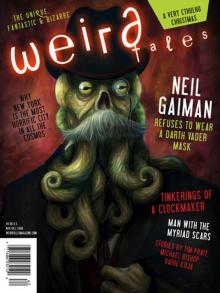
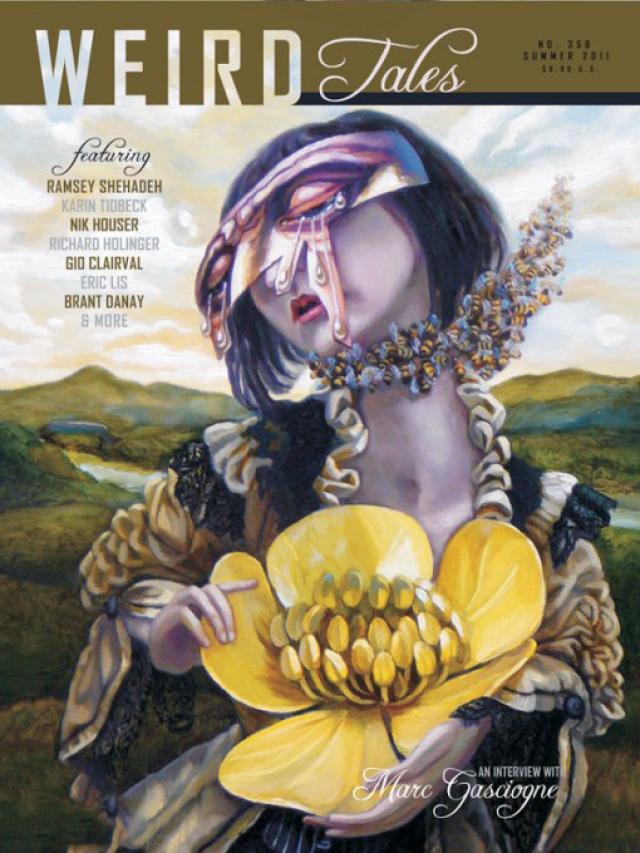
Weird Tales #358, page 3


* * * *
Infernal Devices, by K.W. Jeter
Angry Robot, April 2011
ISBN: 9780857660978 | 352 pages | PB | $7.99 (also available in ebook)
K.W. Jeter coined the term “steampunk” and wrote the first full-fledged steampunk novel. You can also argue Jeter invented clockpunk, in his delightfully imaginative and improper faux-Victorian novel Infernal Devices (originally published in 1987). Stodgy watchmaker George Dower is the son of a genius—a creator of exceedingly clever clockwork devices, who prefigures the brilliant Cosmo Cowperthwaite of Paul di Filippi’s notorious novella “Victoria”—but he has no ability to repair his late father’s outré inventions. He also takes no pleasure in learning they include a musically and sexually gifted automaton that looks just like him, and an Armageddon machine primed to destroy the world, if he can’t quickly figure out a way to disarm it. However, he may not even get a chance to try, since his curiosity and paternity have earned him the frequently violent attentions of (among others) a dying selkie race, a sinister Royal Anti-Society, a puritanical Godly Army, an aggressively activist Ladies Union for the Suppression of Carnal Vice, and a beautiful con artist with a distinctly unladylike attitude toward sex.
* * * *
Camera Obscura
by Lavie Tidhar
Angry Robot, April 2011
ISBN: 9780857660947 | 416 pages | PB | $7.99 (also available in ebook)
Israeli author Lavie Tidhar returns to the giant lizard-dominated alternate Victorian history of his acclaimed steampunk novel, The Bookman (Angry Robot, September 2010, $7.99), but shifts the setting from alien-colonized London to independent Paris as he centers his genre-bending new novel, the inventive Camera Obscura, on a new protagonist, known variously as Cleo and Milady de Winter. A gun-slinging Dahomean amazon who once performed in Buffalo Bill Cody’s Wild West Show, Milady now works as a secret agent for a covert governing body, the Quiet Council. Her independent streak puts her in opposition to their goals when a locked-room murder mystery sets her on the trail of a serial-killing phantom. In the mad mash-up tradition of Alan Moore and Kevin O’Neill’s League of Extraordinary Gentlemen, historical, literary, and pop-culture references abound, as Milady’s noir quest takes her to the Rue Morgue, an automaton brothel, an underwater city, Southeast Asia, the Chicago World’s Fair, and interstellar space.
* * * *
Servant of the Underworld: Obsidian and Blood: Book One, by Aliette de Bodard
Angry Robot, October 2010
ISBN: 9780857660312 | 432 pages | PB | $7.99 (also available in ebook)
Multi-genre mashups and an international list are central to the Angry Robot publishing strategy, and you’ll probably find no better representative of the upside to these approaches than US-born French-Vietnamese writer Aliette de Bodard. In Servant of the Underworld, she makes some difficult feats look easy. Writing skillfully in a language not her first, she deftly combines a complex murder mystery that “plays fair” with a dark historical fantasy that is saturated in the supernatural and set in fifteenth-century Mexico. De Bodard even makes you sympathize with the Aztecs, despite their propensity for frequent human and animal sacrifice—rituals that literally avert the end of the world. The Aztec gods are angry, capricious, and extremely powerful—and some of them are directly involved in the brutal murder under investigation by the High Priest of Death, Acatl, whose estranged brother, the Jaguar Knight Neumotec, has been accused of the crime, for which the penalty is execution.
* * * *
Harbinger of the Storm: Obsidian & Blood: Book Two, by Aliette de Bodard
Angry Robot, January 2011
ISBN: 9780857660763 | 416 pages | PB | $7.99 (also available in ebook)
Aliette de Bodard returns to the violent and fascinating world of her ambitious debut novel, Servant of the Underworld, with the dark historical fantasy-mystery Harbinger of the Storm, an even more ambitious work that raises the stakes for both the author and her protagonist. When the Revered Speaker (emperor) of the Mexica Empire dies, he leaves the mortal world vulnerable to demonic invasion and complete annihilation. Unfortunately, the succession is determined by vote, and the councilors put the fate of the world well behind their own imperial ambitions. Acatl, High Priest of Death, despises their scheming, but nonetheless finds himself involved, when his investigation of a series of gruesome murders reveals that the demons have already invaded the mortal world, and that one or more plotters have involved the pitiless Aztec divinities in their intricate intrigues. Acatl must enter the realm of the gods in a desperate gambit which, if it fails, will leave not only Acatl but the world dead. A rare example of the sequel that’s even stronger than its predecessor, Harbinger of the Storm resolves its storyline, but leaves readers eager for return visits to de Bodard’s unusual, well-developed setting. Her multi-genre Obsidian & Blood series deserves to cross over to a broad audience.
* * * *
Cynthia Ward (http://www.cynthiaward.com) has published fiction in Asimov’s, Front Lines, and other venues. Her nonfiction has appeared in Fantasy, Locus Online, and elsewhere. With Nisi Shawl, she coauthored Writing the Other: A Practical Approach based on their diversity writing workshop, Writing the Other: Bridging Cultural Differences for Successful Fiction (http://www.writingtheother.com).
CARRIE ANN BAADE, Interviewed by Ann VanderMeer
THE WEIRD AND THE SURREAL
Carrie Ann Baade is a painter whose work is often described as surreal and fantastical. Her art has been exhibited all over the world and featured prominently in various books and journals, such as Metamorphosis, High Fructose, NY Arts Magazine and others. Originally from Colorado, she has traveled extensively all over the world and currently lives in Tallahassee, Florida, where she is an Assistant Professor of Painting and Drawing at Florida State University.
The influence of the old masters can be seen in her work, as well as that of the Lowbrow/Pop Surrealist movement and outsider art. Her portraits of well-known personalities in history and mythology have a certain twist that infuses them with emotions clearly screaming for release. This somehow brings them closer to our contemporary human experience Carrie Ann Baade’s art tells the type of stories we at Weird Tales love to hear.
*
Weird Tales: Have you always known you would be an artist? What is your earliest memory of creating art and what did you create?
Carrie Ann Baade: Standing on a chair at the kitchen counter, I meant to draw a circle with a ballpoint pen, missed the connection and created a spiral instead. To complete the image, I peppered the surface of the page with dashes and announced that it was a “A Snail in the Rain.” I was two-and-a-half. What shocks me is that everyone isn’t born knowing exactly what he or she is and remembering ALL of their childhood. This seems to set me apart from other people and make me suspect of my art students. I was born knowing I was not merely an artist but a painter. Please don’t mistake this statement for arrogance. Because I did try to be other things…just to be certain. It was that I was exceptionally bad at everything else.
*
Describe your workspace.
I live in a house that is my entire studio…I try to keep paint out of the kitchen and bed. I enjoy covering the walls, halls, and floors with paper that I am working on in search of new compositions and relationships between images. I sit at an easel, and stare at paintings for hours. When I exit from this practice, like a recovering somnambulist or a corporeal poltergeist with amnesia, I enter my kitchen to find all the doors standing open, all the dishes dirty, food half eaten, and the cat pissed off. I am not really much of a housekeeper.
*
You’ve done quite a bit of traveling. What is your favorite place in the world and why?
I am really enamored with Bali, but please forget that I mentioned it or everyone will go there and this may ruin paradise. It is a truly magical place with the most beautiful people, both indigenous and ex-patriots. I am applying for a Fulbright grant to return and study more about the demons in their culture. I have never interacted with a population who was so in tune with the balance of black and white, good and bad energy. It is all very apparent and obvious to them. Blessings in the form of woven baskets with small offerings are placed daily at doorways, statues, and by streams; however, they are equally in the bathroom of a discotheque, because this too has a source of water in the bathroom tap and toilet. One place that I wondered about had many blessing at the opening of an alley, so I inquired. The people said it was because it was haunted. I walked up the edge of this alley and indeed, I would not disagree with them; it felt ominous.
*
How is art useful, necessary?
“Without culture, and the relative freedom it implies, society, even when perfect, is but a jungle. This is why any authentic creation is a gift to the future.” —Albert Camus
I reflect frequently on how art is useful…especially when I have a renewing group of students who have no idea why what they are doing is so important. Within art it is possible for the sacred, compassion and patience meet. It is one of the medias of the soul, permitting expression that can assuage the pain of living and also revel in the beauty of creation. When we have this outlet, we are allowed to shine in our living. It gives us both mediation as the creator and as the viewer. Our children require this practice in school so that they cultivate innovation and imagination in their lives, which in turn nourishes their future endeavors such as science and technology. Art and freedom of expression require defending and becomes threatened when there is too much control from the top down.
There are consequences for limiting human expression, for example Hitler was an artist who was out of sync with the fashion of art during crucial years. His feeling of being misunderstood created a darkness that not only threatened the art of his time by destroying thousands upon thousands of paintings in addition to people. It is my personal hope to assist my students to unlock their potential and realize their own personal expression for the improvement of their life. The more balanced and fulfilled people are in the world, the better the world may become. If I can enlighten them to the importance of their art practice, then perhaps there will not be an occasion in the future like that which occurred in China during their Revolution when they destroyed their art and relics. The curators at the Shanghai museum slept inside the museum at night to protect the art from the population who sought to destroy it. I think it is important that we not trade our rich history and future freedom to create art in an uncensored environment for promises of progress. We must each cultivate a deep understanding of our relationship to art and culture, so that there is a need to preserve its place in our life and in our civilization.
Carl Gustav Jung wrote: “Enlightenment is not imagining figures of light but making the darkness conscious.”
I look at art as a way of making the darkness conscious through its making I exorcise my own demons and through its viewing I hope to liberate others. I hope to open minds and bring the multitude of stars back to the night sky.
*
Last year you exhibited in the Lowbrow+Tarot project. How do Tarot cards figure in your work?
It is not so much the cards themselves as the process of asking questions of paper. It also started my practice of asking questions of inanimate things. The more peculiar thing is when an object answers or they solicit your attention. I think the world might be a little weird if everyone did this but it does make my life interesting. Most recently, I had an image I found on the Internet tell me it was the key to my painting. A gothic moth insisted that it was going into my painting about a rabbit. Cutting the wings in half and then reversing the image, the head of a rabbit appeared. It was the impossible solution to my paintings for the INLE exhibition at 1988 Gallery this month that has images of this symbol of death from Watership Down. Perhaps the brain of an artist is that advanced to decode and rearrange with a genius of gestalt, but you must understand I can’t find my car keys 12 times a day, so I prefer this more outlandish, magical way of thinking by way of explanation where the inanimate are anthropomorphized. I think there is magic in the world and larger forces at play; however, I am the one who misplaces my keys.
*
Grotesque art has been described by Wolfgang Kayser as “art whose form and subject matter appear to be a part of, while contradictory to, the natural, social, or personal worlds to which we are a part. Its images often embody distortions, exaggeration, a fusion of incompatible parts in such a fashion that it confronts us as strange and disordered, a world turned upside down.” We respond to it with paradoxical feelings, seeing both humor and darkness, being fascinated while also feeling threatened. When did you first encounter this type of work? How did it affect you?
Snapshots from my childhood: checking out Scary Stories to Tell in the Dark from the library over and over...sneakily watching The Exorcist and telling the parents of the girl whose house I was sleeping over at it was Dukes of Hazzard...scaring the whole girl scout camp with my stories until that the counselors had beg me to stop because no one was getting sleep...
So I was that Wednesday Addams child who refused to read a book that didn’t have a witch or a ghost in it…I thought Ramona Quimby was stupid. As a little kid, Bewitched and The Addams Family were just as interesting as Sesame Street.
However, H.R. Giger was the first artist who really scared the crap out of me. I remember getting a book of his art out of the library in high school and hiding it under the seat of my car because I was afraid of it. I have to admit…. I really enjoy that feeling. I love Giger most when the work is less misogynistic and satanic and just a tonal fantasy of darkness.
Additionally these artists have brought me joy: Ivan Albright, Otto Dix, Catherine du Monchaux, Rodin, Kiki Smith, Beksinksi, Ketut Budiana, and Stanislav Suzowski. This has been a long passionate affair with finding work that grips me. I felt many times growing up that I was born in the wrong time period or that I was the only one of my kind. However, in the last six years, I have seen the “rise of the dark art” by showing at such galleries as Paul Booth’s Last Rites in New York City. I no longer feel alone. How could I with hundreds of amazing, talented artists coming of age every season? It’s the best time to be alive as far as I can fathom. However, the rise of the dark also makes a genre that was obscure at once too accessible and so I sometimes mourn at the thought that there is so much of it…but I would rather have too much than go back.
*
You know that we here at Weird Tales celebrate the weird in all things. But not everyone feels this way. How do you see the beauty in art that others may see as “too weird”?
To see beauty in the carnivalesque or macabre, in freaks and monsters is a matter of aesthetics. While I can see the beauty in a Monet, I think far fewer people have made themselves accessible to the ecstasy of a lacy repetition of bones in catacombs. There is something that makes us uneasy in the weird. Those who appreciate the weird have come to anticipate and enjoy that sensation.
To explain how I see beauty in the weird is perhaps like explaining the joy I feel tearing the spine off a book, using scissors to cut the binding, and releasing the flowing pages onto the floor. This year, I had the pleasure of telling a room of librarians that I commit acts of libracide.
I don’t know how to make someone love the dark or share that eye. I think one might be born to it. One simply craves the esoteric, the distorted, and the sublime…or doesn’t. Nicola Verlato, Barnaby Whitfield, Richard Kirk, Kris Kuksi, Kate Clark, Judith Schaecter, and Jessica Joslin are few of my favorites who make extraordinary sublime art.
In the past, weird may have been a minority. However, the current generation of college students seems to really be into the weird. This is not going to be an underground movement any longer. Grotesque is going mainstream. I can’t tell you how many of my students love what I do and those that I show with. It’s not good for their development if they genuflect when you enter the room. It screws up the normal teacher-student dynamic where they are suspicious that their professor may be full of shit for the first half of the semester; and certain of it, the second half.
*
You are curating the Cute and Creepy show at the Florida State University Museum of Fine Arts in Tallahassee this year, October 7 – November 20. How did you conceive the idea? How did you select the artists?
I searched for a five-dollar word to name this exhibit and gave up. I just thought, screw it: it’s cute and it’s creepy…it’s what I like about contemporary art. I have actually been working on this for over five years. Sometimes one has to wait to see a good project through. Some of these are folks I know, or are folks I want to know. There are more amazing artists working now than ever before. It’s been such a pleasure to exhibit with the new dark artists and the pop surrealists that I just started growing this museum exhibit. Nancy Hightower, the author for the essay in the catalog for the exhibition wrote, “[The grotesque] is an operation, a process that occurs when one is caught in between a moment of humor and horror, or horror and beauty—held in perfect suspension so that neither overrides the other. We are left in a moment of paralysis, unsure of what to think, unable to look away.” I think all the work chosen for this exhibition are impossible to look away from.