Enduring Freedom, page 27
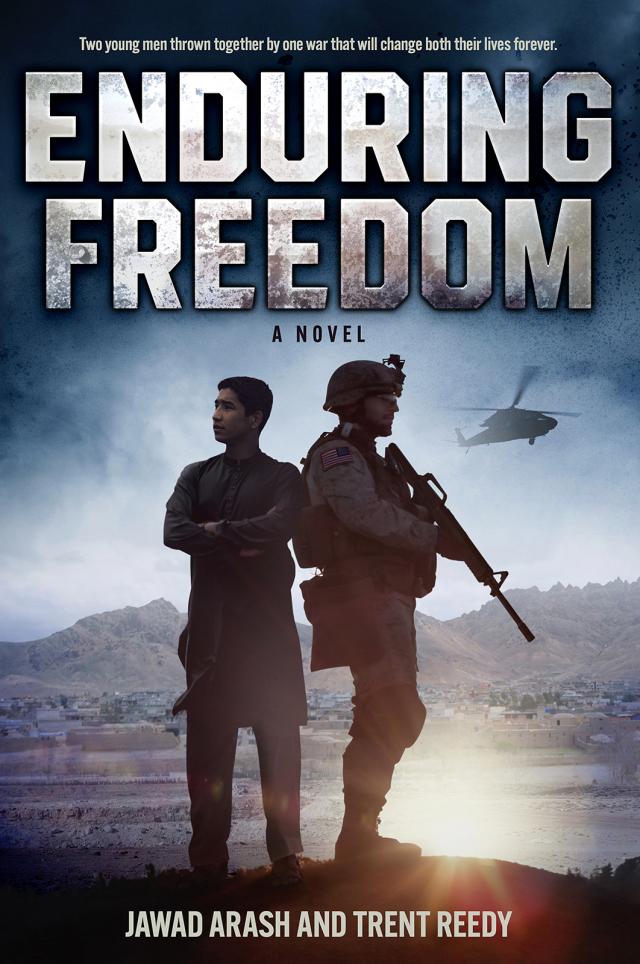


Notes from the Authors
Years ago, suffering from the brutality of Taliban-minded teachers in Naderia High School in Kabul, Afghanistan, I never imagined that one day I’d co-write a novel in English published in America. English doesn’t even use my primary language’s proper letters! Enduring the cruel farce of the education to which the Taliban had reduced my school, I wanted to get as far away from books as possible.
Like Baheer, I was given the choice between the shovel and the book, education or farm work, and remembering the beatings and Taliban inspections I’d received at school, I fled to the farm. Also like Baheer, I thought leaving school to work on my family’s farm was the best option for my future.
But my family, especially my late grandfather, Haji Mohammad Munir Khan, through his example of reading and studying his many books of Persian poetry, Afghan history, and Islamic philosophy, encouraged me to hold on to the promise of education. He was an amazing man, and I wanted to be as wise as him. Finally, in the western Afghan city of Farah, I dared to break from the routine of farm work to try school again.
After 9/11, Afghanistan experienced many changes, and I found out school was no exception. Teachers were friendly, and students were appreciated for what they knew and how hard they worked to learn. I was able to earn good scores in my first term, and felt the difference, a change in my life, right away. I still remember Mr. Ahmadi, our English teacher, who encouraged me to study and who asked me to start teaching English at his private institute. It was the first of many opportunities education opened for me.
Eventually we found out that American soldiers had moved to town. A friend from school told me one of the soldiers was an English teacher and that people could talk to him over the wall. I thought this would be a great opportunity to practice my English. I was happy for the chance to meet this American teacher.
But when I finally had the chance to talk to him, I was disappointed. Instead of being kind like my teachers in Farah, this soldier was rude. It was a hot July day, and I wanted to stand in the shade of the front wall of the American compound, but Corporal Reedy ordered me to back away into the hot sun. Afghans are friendly and will invite people closer to get to know them. But Corporal Reedy didn’t even invite me inside for tea. Eventually I realized that a large part of the Americans’ rude attitude came from their obsession with security. They were new to Afghanistan, and very afraid. Yet, American and British people were all over Afghanistan. I thought it would be worth it to overlook their strange ways because English would offer me more economic opportunities and, if I’m being honest, a bit of prestige.
Over the next several weeks I kept returning to the wall to talk to the American soldier. Trent and I continued to meet regularly, even after the soldiers moved to their base outside of town. I practiced English. He tried to work on his Dari and Pashto. Eventually, he knew a few phrases and could talk like a baby in my language. Over the weeks and months our language practice developed into a friendship that we maintained over email and then social media, even after Trent returned to America.
Speaking to Trent and other American soldiers, as well as sharing a fictionalized version of my story through this book, was only possible through education. Learning broadened my perspective and offered more possibilities in my life, and I believe that it is through education that Afghanistan will realize a new and better future.
These new opportunities for both men and women were made possible due to the efforts of American and coalition soldiers after their arrival in Afghanistan in late 2001. Their presence in our society opened windows toward a new horizon that profoundly affected the lives of millions of Afghans. Before what the Americans called Operation Enduring Freedom, men, boys, and especially women and girls were deprived of education and other basic freedoms. We were deprived of hope. Now, twenty years after the American war in Afghanistan began, and over fifteen years since Trent and I last spoke in Farah, my country still faces many problems. But we will not go backward. Today, many Afghan women go to school. They learn, they lead, and they teach other men and women. We are filled with a new creativity and hope.
Although I’ve received an education in English language and literature, co-writing this book was a real challenge. I often worried I would not be able to do it. Even after overcoming my fears, the difficulty of working on the book from opposite sides of the world was formidable. One of us slept while the other worked, and finally we made a story that is very close to our hearts. We wanted to show how our lives were changed by the 9/11 attacks and the war that followed.
Trent and I did our best to express the worldview transformation of an entire generation. Throughout history, the Taliban, Nazis, Soviets, and other evil forces have always targeted education because uneducated people are easier to rule. But now, the youngest generation of Afghanistan is educated and cannot be ruled by a group that doesn’t even know how to hold a book. I hope Enduring Freedom will convey the message of hope and the wonder of education to the world. I pray it will offer a clearer picture of the difficult struggle our people share. We will prevail. Insha Allah.
Jawad Arash
Herat, Afghanistan
October 2020
As I write this, I’ve been home from the war in Afghanistan for fifteen years. That’s the entire lifetime of some of my readers, and yet I think of my time in that country every single day. Many of the scenes and concepts in Enduring Freedom were inspired by events that occurred during my deployment. I have written fiction inspired by these experiences before, but every time I tried to write a novel directly from the perspective of a soldier, it wasn’t quite right.
I have been blessed to stay in contact with my friend Jawad Arash since I departed Afghanistan. One day, when talking about his desire to write fiction, we discussed his experiences with American soldiers and with the Taliban before them. I asked him how he found out about the 9/11 attacks on America and was fascinated by his answer. By the time he told me about his first encounter with American troops—the day he met me, when I was on guard duty at the wall of the Unsafe House compound—I knew we had found a story suitable for a novel.
Until Enduring Freedom I’d been unable to write a novel all about the Afghan war because the war isn’t about the soldiers. Not entirely. The mission in Afghanistan is to build a country where people are freer and better able to resist extremist ideologies. It is a mission shared by millions of indomitable, peace-loving Afghans across the country. And just as the mission is not the soldiers’ alone, this novel could never be only about Private Killian and his fellow soldiers. Joe’s experiences are meaningless without Baheer’s. The heart of the novel is in the seemingly unlikely friendship between the young men.
During different phases of PFC Joe Killian’s deployment, he suffers from terrible fear and anger and harbors hateful, ignorant ideas about Afghanistan, Afghans, and Muslims. To my everlasting shame, I held those same ideas when I first reached Afghanistan. Like Joe, my beliefs quickly changed once I met the Afghan people. I talked with Jawad extensively about the representation of those old prejudiced ideas in this book. We reasoned that showing a character’s heartfelt change from anger, hatred, and prejudice toward a more fair, informed, and friendly understanding of Afghanistan would be a more effective means of challenging the lingering prejudice that our readers might encounter in America than to present soldier characters who never faced that internal struggle for change. If we can accept that war can change a person, I beg readers to believe that my time in the war changed my attitudes completely. Nevertheless I remain ashamed of the prejudice I once harbored toward Afghans and Afghanistan, and I apologize for any offense the depiction of these ideas may have caused.
Jawad and I wrote Enduring Freedom because we wholeheartedly believe in the mission in Afghanistan, in the struggle to resist the evil forces of the Taliban while building a real, lasting, meaningful peace in which all Afghans, boys and girls, men and women, are free to pursue their own best destinies. We hope that Enduring Freedom will help readers better understand the importance of this mission, and that readers will be inspired to join this same struggle for freedom of thought and expression against those forces that would seek to limit and control people. Live free and read, people everywhere.
Trent Reedy
Spokane, Washington, USA
October 2020
Acknowledgments
Just as the mission in Afghanistan requires the support of thousands working together with tens of millions of great Afghans to build a new and better future for Afghanistan and the world, so do authors rely on a great deal of assistance in writing books. As with all my books, I am indebted to far more people than my publisher will allow me paper upon which to name them, so I apologize to those wonderful people I am unable to mention here. Nevertheless, I owe special thanks . . .
To the many soldiers who helped me get through my time in the war. As a lifelong English Major, book lover, and writer, I was never a natural soldier, but First Sergeant Scott Wolf, Staff Sergeant Ryan Jackson, Sergeant First Class Matthew Peterson, and—well, an army—of soldiers taught me and compelled me to do my duty. I owe my life to these soldiers, and I will forever be grateful.
To Staff Sergeant Ryan Jackson and Sergeant First Class Matthew Peterson, for answering many questions about weapons and other military systems. And special thanks to Staff Sergeant Jacob Pries, for being on call constantly to answer tons of questions about everything from loading a Mk 19 grenade-launching machine gun to drill and ceremony regulations. Thank you so much!
To many other people who helped me during my time in the war. The complete list is too long to include here, but special thanks go to my mother Lu Ann Hennings, my brother Tyler Reedy, my sister Tiffany Klima, my mother-in-law Rosemary Straubinger, my late father-in-law Lieutenant Colonel Dennis Straubinger, Matthew P. Allers, Sheri Stewart, Stephanie Luster, Mary Bardsley, all those who sent me letters or emails, and all who sent packages. America’s military could not succeed without—well, an army—of people back home supporting it. Thanks so much to all who support our military.
To Krestyna Lypen, the fantastic and utterly brilliant editor who helped Jawad and me hammer and then polish Enduring Freedom into shape. This novel was especially difficult to write because it was hard to closely weave together the experiences of Baheer and Joe, because the timeline of 9/11 through Joe’s deployment was difficult to pace, and because Army life consists of episodic and unconnected experiences that don’t easily fit a narrative story structure. Krestyna was very kind, patient, and insightful. Her ideas for the overhaul of this manuscript saved the book, and I’ll forever be grateful.
To my agent, Ammi-Joan Paquette, who reassured and encouraged me as we navigated the uncertain task of finding a new publisher for the first time in nine years. Thanks for believing in this project from the moment I mentioned the rough idea. I’ll never forget what you said on the first phone call about Enduring Freedom before one word of the book had been written: “I want this book yesterday!” Now yesterday is today, and I hope we’ll be working together for many tomorrows. Thank you, my friend.
To my dear friend, one of the very best writers in kid lit and the world, Katherine Paterson. Katherine, I will never stop thanking you for the way your novel Bridge to Terabithia saved my spirit and kept me going through the darkest part of my time in the war in Afghanistan. I was approaching my breaking point, and your beautiful story reminded me there is still hope even in the most difficult times. Thank God for you. Your book and the letters we exchanged saved me. Thank you for all your support in my pursuit of my writing career.
To my brave and brilliant co-writer, Jawad Arash. We did it, rafiq! A real book! Thanks for your patience with me and my fearful and misguided attitude during the early days of my time in your great country. Thank you for keeping me company during lonely guard shifts at the Unsafe House. Thank you for being willing to embark on the long, difficult journey of writing this book with me. Most of all, thank you for being a true patriot, a believer in the mission of promoting free thought, expression, and everyone’s pursuit of their own best destinies. I admire the way you have faced so many obstacles, never surrendering, working with millions of indomitable Afghans to build a new and better Afghanistan. You will succeed, rafiq. We will win. Afghanistan rising. Insha Allah.
To my daughter, Verity. I’m sorry for all those times I could not play with you because I had to be writing. Thank you for your patience and for the many compliments about Enduring Freedom while you were engaged in pandemic- inspired in-home online kindergarten and I was rereading the book aloud. Verity, you’re my best friend.
To my beloved wife, Amanda. No amount of “thank you” could ever be enough. I owe you everything, always.
Trent Reedy
It is difficult for me to adequately express my gratitude to everyone who was ever involved in my work and in my studies that made this work possible.
I would like to thank all the English teachers who directly or indirectly influenced my learning. Mr. Ahmadi, Mr. Aref Khan, and Mr. Mirwais Bedil Akbari are a few who taught me during my school years. Later, during my time at Herat University, I had the honor of learning under the guidance of Mr. Sarwarzada, Mr. Shams, and Ms. Muzghan Azizi, who really helped and supported me as I worked on my English. I can never forget Mr. Ramin Shorish, who pushed me to work harder and read as much as possible. Finally, I wholeheartedly thank Dr. Komali Prakash, my PhD research supervisor, for her patience and support for this book while I worked on my PhD dissertation. There are many other teachers, too many to name here, who shaped my abilities in language and my character in general. I thank every one of them.
I know I cannot thank enough those who worked so hard in providing the education system in Farah and in Afghanistan as a whole. They are all real heroes and great leaders. What they have achieved will provide the young Afghan generation an opportunity to work to bring the change Afghanistan so desperately needs. These education pioneers have done their part, and now the duty falls to a new generation to stand up and build a new and better Afghanistan. For all your work and sacrifice, thank you.
In Afghanistan family is everything, and our families are very large. Individually thanking every member of my family here would require too many pages, so I thank them all, with particular thanks to my parents, who always supported me, and my uncle Mohammad Basir, who supported me financially and morally throughout the journey of my education, from the beginning of school through my PhD.
I wish I could have thanked my uncle Kabir, who answered many questions for this book, my aunt Ayesha, who raised me from childhood, and my grandfather Haji Mohammad Munir Khan while they were alive. But I wish to say to them, “I was very blessed to have been born into a family of such wonderful people. You have made me a better person, someone who can share with the world your stories as well as the story of the struggle of all the people of Afghanistan. Thank you so much. Thank Allah for you.”
Thank you, Trent Reedy. If not for you, I wouldn’t be able to write this book. Your patience and continued support made this book possible.
I’m grateful to our editor, Krestyna Lypen, for her editorial wisdom and patience working across time zones, as well as for understanding my need for a pen name due to security concerns. Thank you very much, Ms. Lypen. I must also thank our agent, Ammi-Joan Paquette, who believed in the idea of this book only minutes after Trent and I first discussed it. I am a first-time novelist from a different country and English is not my first language, but Joan always knew I could do it and that our book would work.
Thanks to my son, Jawad, and my daughter, Ayesha, for being the best children a father could ever hope for. I write this book and work for a better Afghanistan for you.
Last, but certainly not least, I must thank Nadiya, my wife and soul mate, a brilliant woman and spectacular mother. I cannot thank you enough for all the support you have provided. Thank you for your sacrifice during my time in the United States as I earned my master’s degree. Thank you for all your help during the tough times in India as I worked on my PhD. Thank you most of all for being the perfect life companion. I will never be able to repay your kindness and love in my lifetime, but I will never stop trying.
Jawad Arash
Published by
Algonquin Young Readers
an imprint of Algonquin Books of Chapel Hill
Post Office Box 2225
Chapel Hill, North Carolina 27515-2225
a division of
Workman Publishing
225 Varick Street
New York, New York 10014
© 2021 by Jawad Arash and Trent Reedy.
All rights reserved.
Printed in the United States of America.
Published simultaneously in Canada by Thomas Allen & Son Limited.
The authors gratefully acknowledge Katherine Paterson for her permission to quote from Bridge to Terabithia.
Library of Congress Cataloging-in-Publication Data is available.
Trent Reedy, Enduring Freedom