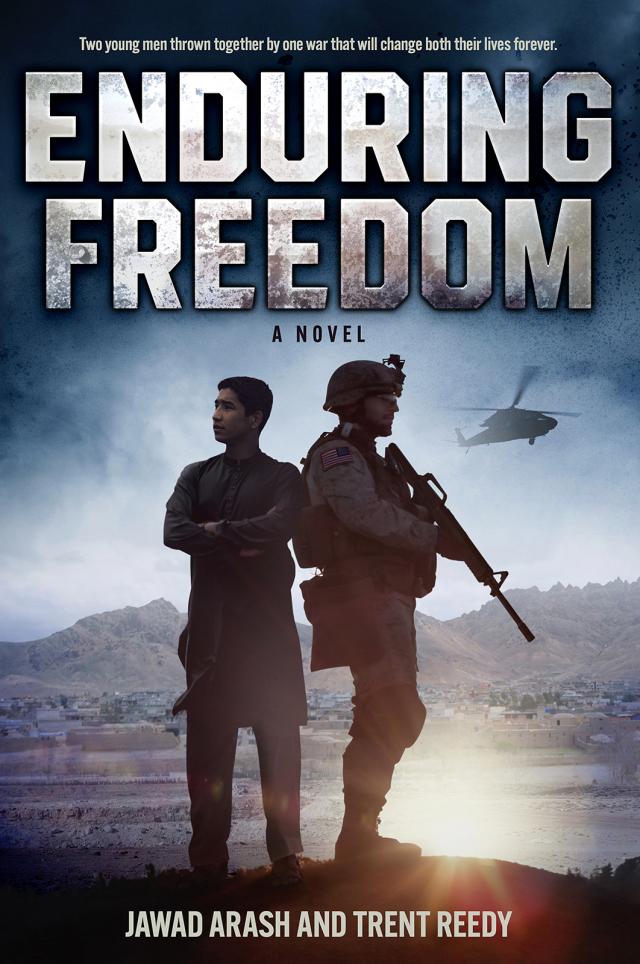
Enduring Freedom, page 26


Was this how Joe had felt after he’d encountered the girl who had been burned? No. Baheer shook his head. Joe hadn’t felt toward that poor girl quite the same as Baheer felt for Ayesha. Still, Baheer thought he understood his friend better now. He shared the crushing, consuming weight of that helpless anger, that frustration that burned in him every time he remembered the people lost at the school that day and the way nothing he did could bring them back.
He couldn’t do anything about changing the past, but he could work for a better future. His determination to help make Afghanistan better only grew stronger.
After the test he left the school for the last time that term, riding alone because Rahim remained at home recovering, and because Ayesha would never again brighten his path near the twisted tree. At home, he went to Baba Jan in his reading room.
“I finished my exams today,” Baheer said. “Forgive me if this sounds as though I am boasting, but I am certain I did well.” He bit his lip for a moment. “I’m the best student in my grade now. I will be in front of the line next term. Insha Allah.”
Baba Jan put aside the book he’d been reading. His eyes gleamed. He recited the same poem that had sparked in Baheer a great love for words when he first read it during his farm work: “Capable is he who is wise / Happiness from wisdom will arise.”
Say it, Baheer said to himself. How can you fight the Taliban at the school, but be too afraid to talk to your own grandfather? Baheer squeezed his hands into fists. He would not be afraid anymore. Too many had died for him, for any of them, to continue cowering in fear.
“Baba, if wisdom is that important, why can’t Maryam go to school?” Baheer knew what Baba Jan’s answer would be, but he still asked. He owed that much to Ayesha. He couldn’t let her death have no meaning. Girls had to be educated if they wanted to have a new, free, and prosperous Afghanistan.
Baba Jan looked around, the gleam in the eyes dulled. “What? After that terrible attack on the school? No.”
“Because of the attack on the school.” Baheer blinked his eyes. He would not cry. He would not back down. “Baba Jan, I fought them. I shot the taliban. They attacked children and little girls, all because they don’t want anyone to learn anything.” Baheer motioned to the books behind his grandfather. “If those evil, godless men would kill to prevent us from reading books like these, shouldn’t we do all we can to ensure they are read by as many people as possible? And Maryam is gifted. She has memorized so many parts of the books we love so much.”
Baba Jan held up a shaking finger. “It is not this that bothers me. Yes, it is good that she reads, that all my granddaughters might read. But to send Maryam or the other girls to school? Have them going about all over town? What will people say? It is our responsibility as men to protect the reputations of the women in our family.”
Baheer’s legs shook. Arguing with Baba Jan was always an intimidating experience. Baheer’s grandfather was a man who did not back down, even from the Taliban. But now, neither did Baheer. “Who cares about others? What matters at the end is what you think about it, Baba Jan. A long time ago, when we spoke on the roof after the United Nations compound had been bombed, you said it was the responsibility of my generation to build a new Afghanistan, one where we might finally have peace. How can we build something new and better without trying anything new?” Baheer coughed and shook his head. “Girls at that school believed, as you and I believe, as Maryam believes, in that new Afghanistan. The Taliban killed them. They died for that belief. I . . . I saw them, Baba Jan. Do we now back down in fear and hide behind our walls the way the Taliban want? Will we live in fear of the Taliban?”
Baba Jan’s eyes went wide. “Do you call me a coward, little boy?”
“I’m asking you this because I know you are not a coward. And I am not a little boy.”
Baba Jan did not speak. There was silence for quite a while.
Baheer tried more reasoning. “Last time you said the school is too far away. Now, it’s right next to my school. Sure there was a security problem, but the Americans fought it off. I fought it off. I almost died for that school. Some did.” He paused to regain control of his emotions as he thought of Ayesha. “Some girls did. We can’t let that be for nothing, Baba Jan. We can’t keep backing down from the Taliban. Please let Maryam and all the girls take the risk. We have to take the risk if our people are to have any chance of rebuilding our country.”
For a long time Baba Jan said nothing. Finally, he nodded. “When I heard about the attack on the school I feared I had lost two of my three grandsons. I tell you, this old man would not have survived such a catastrophe. I thanked Allah for answering my prayers to save you.” Baba Jan stroked his beard. “Your brother told me what he did, telling his friend about when the Americans would be at the school so his friend could tell the Taliban.”
How had Rahim survived such a confession? Baba Jan must have been furious.
“Baba Jan, I think—”
“He told me what you did, too, both at the school that day and passing information to the Americans. It seems you both used questionable judgment. But if you made mistakes, Baheer, at least it was in the interest of protecting people and opposing the Taliban. Rahim?” Baba Jan shrugged. “He feels terrible about what he has done, and as good Muslims we must forgive him.”
“Bale, Baba Jan.” Baheer nodded.
Baba Jan continued. “I think . . . Rahim’s terrible mistake was born at least in part from the same blind love of tradition from which I sometimes suffer. My entire life, things were not as strict as when the Taliban ruled everything, but still, there was a sense that it was not good for women and girls to go about doing all these things, school and such. I have heard Rahim say things like this, heard him clinging to old ways just as I hold on to my fear of people’s petty gossip. The Taliban hold too tightly and too extremely to such ways, ways that are challenged by wisdom and education. You are right, my brave grandson. A new and better Afghanistan requires courage, people who will no longer back down to the Taliban and their ideas. You tell your sister that if she wishes to go to school next term, she has my blessing.”
Baheer put his hand over his heart and bowed deeply. “Tashakor, Baba Jan.”
Baba nodded. “Thank you, my grandson.”
After the discussion, Baheer walked out into the sunny courtyard. It would be a hot day, but Baheer didn’t mind it. He spotted Maryam sitting on the porch at another house writing in a notebook. She was concentrating so intently on her work that she didn’t notice his approach until his shadow covered her paper.
“It would be even better if you could practice that writing in school,” Baheer said.
Maryam grunted. “Of course. Maybe someday.”
“Not maybe. Definitely next term. Baba Jan said so.”
She dropped her pencil and looked up at him in shock. “Really? You did it?”
“No. You did it. Your persistence, your prayers, and your hope did it. Allah helped both of us,” Baheer said.
Maryam hugged Baheer tightly and didn’t say a word. He felt her fast heartbeat. It was a feeling of great hope.
It was another week before Baheer could make it to the PRT to see Joe. With Rahim still recovering from his wound, Baheer faced even more farm work and simply could not get away. When he finally did find some time apart from his duties, he wanted to share all his great news with Joe, his friend, his American friend.
“Excuse me, sir,” Baheer said as he rode his bike up to one of the soldiers whom he had never before seen on gate guard duty.
“You speak English?” The soldier looked surprised, and a little alarmed by Baheer’s approach.
“Can I meet Joe?” Baheer said.
“Who?” the soldier replied.
“Joe Killian,” Baheer said. “Specialist Joe Killian.”
Before this soldier could say anything, another soldier with a broad chest said, “Oh. You’re Baheer?”
“Yes, sir,” Baheer quickly said. How could he possibly know my name?
“Specialist Killian’s unit rotated home a few days ago,” he said.
Baheer’s shoulders fell. He knew Joe had been discouraged about his mission after he encountered the burned girl. Maybe he would have been happy to know that his work and sacrifice, the work and sacrifice of all the other soldiers, was really helping Afghanistan. Maryam going to school might not seem like a world-changing event, but Baheer knew the opportunity to learn would change Maryam’s world. And who knew what she, in her lifetime, could accomplish? Real progress was happening. Joe should know.
“But he left this for you.” The soldier held out a big tan envelope with Baheer’s name on it.
Baheer took the envelope and said goodbye to the soldier. “Thank you, sir.”
Later that day, alone in his room despite the heat, Baheer opened the envelope. Inside was a book entitled Bridge to Terabithia, and a letter. He began reading it.
Date: May 19, 2004
Dear Baheer,
If you’re reading this, I’ve cycled out of Afghanistan on my way home to America. I’m sorry I didn’t get the chance to say goodbye in person. I hope this letter is better than not saying goodbye at all.
I’m super excited to be going home! I’ve been dreaming of the day when I’m finally released from duty ever since my deployment began. But what I did not expect was how much I would miss about Afghanistan, how much I would feel like I’m leaving home. I guess once you suffer for a place, bleed for it, breathe in its dust for a year, it becomes a part of you. I grew kind of fond of our little base built out in the garbage flats.
You and I have talked about the foolish ideas I had after my country was attacked on September 11, 2001 and when I first arrived in Afghanistan. I’m sorry for thinking those things. And I’m sorry for saying those things again when we argued shortly before that horrible day at the school. I didn’t mean the things I said. I was just so angry about what had happened to Shaista. I felt so helpless and hopeless. I’ve made a lot of mistakes in my life, but I have never been so completely wrong, never so totally changed my mind as with my attitude toward your country.
I’ve told you about how back in America I’m studying to become a writer, a journalist, how I’ve been trying to figure out how to write about the war in Afghanistan. Telling the truth has been much harder than I thought it would be.
But one truth I know about war: War isn’t about religion or resources. It’s about control. And the real battle for control is in the schools and libraries. Throughout history it has always been the same mission. Whether we’re fighting Nazi Germany, the Soviet Union, the Taliban, or some other terrible group, first they come for the books. They seek to control who can speak, who can express their ideas or their art. My friend, people like us always share the same mission. The forces of free thought and expression against the evil that would crush those things.
You and I were part of the same mission, and I hope you will carry on the effort. American bullets and bombs can help. They can send our enemy on the run, destroy a lot of them, but wars are won by teachers, librarians, and artists—the real peacemakers. Peace is more than just blowing up bad guys. Real peace comes from building something worth living for. Our Provincial Reconstruction Team tried hard to build up Afghanistan. Hopefully the new soldiers, our replacements, will embrace that mission as well. If they’re annoying or rude at first, give them time. Try to remember they’ve been trained to fight, not to fix, that they miss their homes, and that they are very scared.
But the real task of building a better Afghanistan is up to you, and people like you. I know you understand this. I know how hard you worked to learn English and everything else. I saw you fight for that better future at the school. Keep working for something better. Afghanistan is rising—Insha Allah.
You saved my life that day at the school, Baheer. You probably saved us all. I won’t forget that. I won’t forget you. And I know I’ll never forget my time in Afghanistan.
I wish you a great life and much success. I pray for the success of our mission.
And I know in Afghanistan you’re lucky if you have electricity. The odds of you having a computer or the internet are even worse. But Afghanistan is getting better. So I’ll leave you with my email address in the hope that we might stay in touch in the future. Email me any time at: J-Killian5@iowa.edu.
Good bye, rafiq. And good luck.
Yours,
Joe Killian
Baheer sat in silence for a while, thinking about all Joe had written, wondering how he’d ever manage to send him an email. Then he picked up the book. It was obviously in English, and Baheer had never read a whole book in English. Could he do it?
He smiled. He’d love to try. Then he noticed the bookmark near the beginning of the book, at the opposite end from the start of an Afghan book, since English script and books ran backward. He opened to the bookmarked page and found a passage, a sentence, with two parts underlined. Baheer knew almost at once why Joe had pointed this out to him.
He felt . . . that it was the beginning of a new season in his life, and he chose deliberately to make it so.
Baheer nodded and laughed a little. “Well, OK, Joe,” Baheer said quietly to himself. “You’re right. And I will make this a great new season in my life.”
Iowa City, Iowa, UNITED STATES OF AMERICA
July 10, 2004
Joe sat at a small table near the back of Terralon Coffee Shop on a Saturday afternoon, in front of his brand-new Apple iBook G4, trying, not for the first time, to write something coherent about the war from which he’d only recently returned. The last time he’d been in this place, he was still eighteen years old. But his teenage years had died long before he turned twenty. And now he felt much older.
His homecoming had been different than he always imagined it would be. When the Air Force “Freedom Bird,” that C-130, at last left the rumbling dirt runway next to the PRT at Farah, Joe wanted to cheer. He’d expected everybody to whoop and clap. Instead it was quiet. Everyone stared ahead silently, exhausted or relieved or having trouble figuring out what the departure really meant.
After some time at the airbase at Kandahar and another week of boring, long lines for medical and legal stations at Fort Hood, Texas, they were finally flown back to Iowa, touching down in Cedar Rapids. A bunch of Army Guard privates were on hand to transfer all the bags from the plane to a bus, and then they headed south to the welcome-home ceremony in Iowa City. Some officers and politicians gave some speeches. The politicians who wanted to be reelected kept their speeches short. Joe didn’t remember a word they said. He only wanted to be released from that formation and from duty.
Finally, Captain Higgins stood at attention before Delta Company in the hot sun, every man standing up straight with his hands behind the small of his back in the position of parade rest. “Company!” he shouted.
“Platoon!” said the two lieutenant platoon leaders.
“Atten-TION!” Captain Higgins called.
At once and in perfect unison, every man snapped his feet together, fists at his side, eyes forward, at the position of attention.
The captain saluted. “Dismissed!”
And just like that, a year and a half of total Army control was over.
That was a month ago, and Joe had been doing mostly OK since then. There were nightmares sometimes. He dreamed about the fight at the school, the dead kids there. He dreamed about Shaista and her terrible burns. But for the most part, he was fine.
The hardest part was trying to write about the experience. Ernie Pyle had written the most profound, relatable truth about World War II, and he had done so in a foxhole while being shelled. He hadn’t made it home, killed by a Japanese sniper.
Joe had survived, and he took a deep breath, grateful for that fact. But why did he have such a difficult time writing about his experience in Afghanistan?
War is hard to explain. It defies neat descriptions or easy comparisons, and one war idea contradicts another and another, all of them equally true. But I think what I’ll remember most from my time in war isn’t the homesickness, fear, pain, or even the mission and what it was all supposed to mean. I’ll remember the friends I made there. The soldiers with whom I served and the regular people there who struggled with us are some of the best friends anyone could imagine. War is about fighting to protect and to make life better for the people you care about. And maybe in that crazy, counterintuitive way, war is about love.
Was that too dramatic? He wasn’t sure. War was a dramatic enterprise.
Just then, the person he’d come here to meet walked in, and Joe stood up, his heart leaping in panic for just a moment as he reached to his side for his M16 and found it missing. He took a deep breath and let it out slowly. You turned in your weapon as soon as you got off the plane in Texas, Joe reminded himself. You’re not responsible for it anymore. You’re free.
“Hello, Joe,” his father said, reaching out to offer a handshake. “It’s been a long time.”
Joe smiled and shook Dad’s hand. “It has. I’m glad you’re here. I have so much to tell you.” A year ago, a much angrier Joe Killian would never have agreed to this meeting. But Joe was done with war—with all forms of war—and he was ready to live in peace.
His email dinged to indicate a new message had arrived.
“Got yourself a fancy new laptop computer there?” Dad asked as he sat down at the table.
“Yeah, sorry,” Joe said. “I’ll shut down the email so it won’t . . .” He smiled when he saw the name on the new message in the inbox: Baheer Siddiq. The subject line read: SALAAM RAFIQ!
He’d done it. He’d actually found a computer with internet and made contact. Joe laughed, nodding. Well of course he had. He was Afghan, after all, and the people of Afghanistan were indomitable. Joe looked up and smiled, grateful for the gift of being free to live in peace.