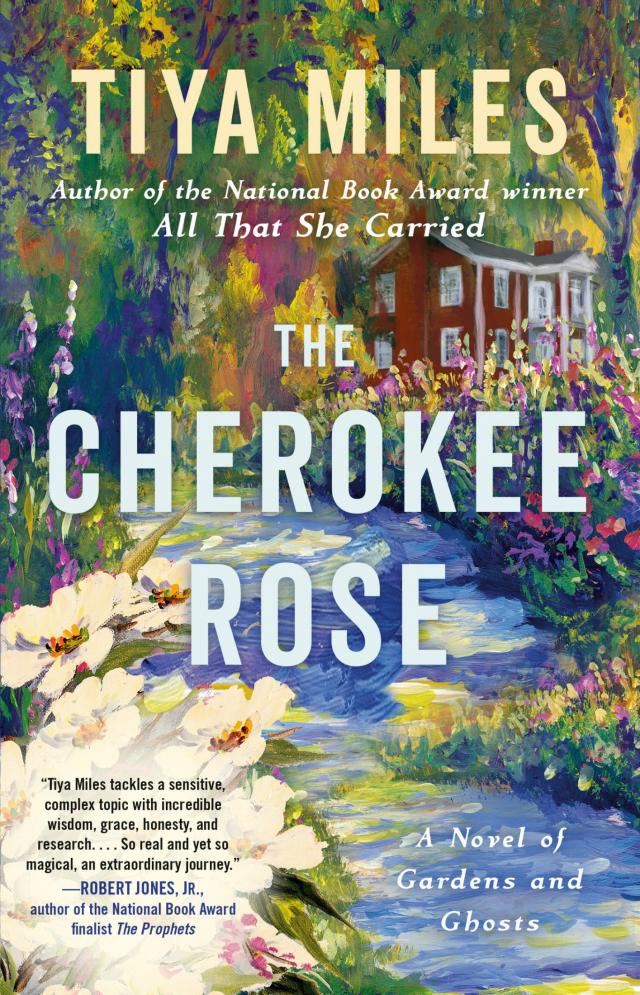
The Cherokee Rose, page 1


Praise for
THE CHEROKEE ROSE
“Few novelists can do what Tiya Miles can: conduct deep historical research to build a novel’s spine and write a compelling lyrical story and lovingly tend to the altars of Afro-Indigenous ancestors. The Cherokee Rose is a mic drop—an instant classic…. An invitation to listen to the urgent, sweet choruses of past and present.”
—Honorée Fanonne Jeffers, author of The Love Songs of W.E.B. Du Bois
“Tiya Miles tackles such a sensitive and complex topic with incredible wisdom, grace, honesty, and research. The Cherokee Rose is a fascinating exploration and enchanting examination of often hidden or misunderstood histories. It’s so real and yet so magical, an extraordinary journey.”
—Robert Jones, Jr., author of the New York Times bestselling novel The Prophets, a finalist for the National Book Award for Fiction
“Untold history blossoms vibrantly to life in Tiya Miles’s The Cherokee Rose. A triumphant arrangement—part ghost story, part historical mystery told with modern flair. A fascinating group of contemporary women are compelled by the forces of folklore to discover their interwoven ancestry. Miles seamlessly layers robust fact with immersive fiction in a revelatory investigation of Cherokee and Black American identity—a tale of division, unity, and awe-inspiring cultural resilience.”
—Afia Atakora, author of Conjure Women
“A timely, necessary tale that will transport readers to a time that should never be forgotten, but is rarely explored with such a close eye. Beautifully written and impeccably researched, this is a novel for history devotees as well as those with an appreciation for the enduring nature of the human spirit. Lovely.”
—Asha Lemmie, New York Times bestselling author of Fifty Words for Rain
“Dr. Tiya Miles’s fiction contains, perhaps, just as much truth about our forgotten histories as her nonfiction. Her imagination—rendered with intricate and beautiful sentences and clear yet expected indications of her meticulous research—enables our moral imagination to grow. We need this.”
—Caleb Gayle, author of We Refuse to Forget
“Poignant and essential storytelling. That only begins to describe Tiya Miles’s work. The Cherokee Rose is a book that, with a deft hand, illuminates a little-known, yet vitally important, facet of a past we all share. A wonderful read.”
—Jason Mott, National Book Award–winning author of Hell of a Book
“The history of the American slave-owning South is a history of erasures. With this novel, Tiya Miles overwrites the whitewashing, vibrantly imagining a complex and nuanced community within the Cherokee Nation where the lives of African Americans and Native Americans are interwoven in surprising and forgotten ways. But this is far more than historical fiction; it is a provocative and charming exploration of how one twenty-first century original, Cheyenne, reframes the past by the creation of a home meant to be shared.”
—Alice Randall, author of The Wind Done Gone
“The Cherokee Rose is a great story, a skillfully woven mystery about the way history unfolds in individual lives. It neglects neither the Indian nor African American side of the story. The novel’s characters, beautifully intertwined, teach us that disenfranchising community members always means a loss of our own selves, an erosion of the very things that make us tribal.”
—Craig Womack, author of Drowning in Fire
“In The Cherokee Rose, the award-winning and distinguished historian Tiya Miles demonstrates her equally impressive talents as a novelist. Peopled with richly conceived characters, driven by compelling human dramas that cross cultures and ages, and enlivened by graceful and evocative prose, this debut novel is an intimate study of the tangled histories and contemporary legacies of slave-holding in Indian country. The Cherokee Rose asks hard questions about race, power, and belonging and reminds us of the fierce love that centers the quest for justice. We need more novels like this.”
—Daniel Heath Justice, Canada Research Chair in Indigenous Literature and Expressive Culture, University of British Columbia
“An enchanting examination of bloodlines, legacy, and the myriad branches of a diverse family tree.”
—Kirkus Reviews
“With both modern-day and historical characters equally believable in their desires and life journeys, this novel tells a little-known story that is complex and captivating.”
—Foreword Reviews
“[A] wrenching yet enlightening saga. Readers will be taken with the way this novel blends past and present.”
—Publishers Weekly
“With the character arcs and the exploration of an often-overlooked area of history—the Native American ownership of African slaves—this is a solid choice for book clubs that savor meaty discussions.”
—Library Journal
The Cherokee Rose is a work of fiction. All incidents and dialogue, and all characters with the exception of some well-known historical figures, are products of the author’s imagination and are not to be construed as real. Where real-life historical persons appear, the situations, incidents, and dialogues concerning those persons are entirely fictional and are not intended to depict actual events or to change the entirely fictional nature of the work. In all other respects, any resemblance to persons living or dead is entirely coincidental.
Copyright © 2015, 2023 by Tiya Miles
All rights reserved.
Published in the United States by Random House, an imprint and division of Penguin Random House LLC, New York.
Random House and the House colophon are registered trademarks of Penguin Random House LLC.
Originally published in slightly different form by John F. Blair, Publisher, in 2015.
Grateful acknowledgment is made to the following to reprint previously published material:
HarperCollins Publishers: “Women” from Revolutionary Petunias by Alice Walker, copyright © 1973, 1972, 1970 by Alice Walker. Used by permission of HarperCollins Publishers.
Oxford University Press: “Gardens of Memory” by Tiya Miles from Historical Fiction Now edited by Mark Eaton and Bruce Holsinger. Reprinted by permission of Oxford University Press/USA.
ISBN 9780593596425
Ebook ISBN 9780593596432
randomhousebooks.com
Book design by Fritz Metsch, adapted for ebook
Cover design: Jaya Miceli
Cover art: Getty Images
ep_prh_6.1_143797785_c0_r0
They were women then
My mama’s generation
Husky of voice—stout of
Step
With fists as well as
Hands
How they battered down
Doors
And ironed
Starched white
Shirts
How they led
Armies
Headragged Generals
Across mined
Fields
Booby-trapped
Ditches
To discover books
Desks
A place for us
How they knew what we
Must know
Without knowing a page
Of it
Themselves
—Alice Walker,
“Women,” Revolutionary Petunias
The Cherokee were driven from their homelands in North Carolina and Georgia over 100 years ago when gold was discovered in their lands. The journey [was] known as the “Trail of Tears.” It was a terrible time for the people—many died from the hardships and the women wept. The old men knew the women must be strong to help the children survive so they called upon the Great One to help their people and to give the mothers strength. The Great One caused a plant to spring up everywhere a Mother’s tears had fallen upon the ground.
—“The Legend of the Cherokee Rose,” Cherokee Nation Cultural Resource Center, Tahlequah, Oklahoma
Contents
Cover
Title Page
Copyright
Epigraphs
Introduction
Prologue: Dust to Dust
Part I: The Three Sisters
Chapter One
Chapter Two
Chapter Three
Chapter Four
Part II: Talking Leaves
Chapter Five
Chapter Six
Chapter Seven
Chapter Eight
Chapter Nine
Chapter Ten
Chapter Eleven
Chapter Twelve
Chapter Thirteen
Chapter Fourteen
Chapter Fifteen
Chapter Sixteen
Chapter Seventeen
Chapter Eighteen
Chapter Nineteen
Chapter Twenty
Chapter Twenty-one
Part III: Our Mothers’ Gardens
Chapter Twenty-two
Chapter Twenty-three
Epilogue: The Song of the House
Dedication
Author’s Note
Gardens of Memory: Ghosts, Grounds, and the Archives
Notes
A Book Club Guide
By Tiya Miles
About the Author
_143797785_
Introduction
Welcome to the Cherokee Rose, a restored plantation in North Georgia with enchanting gardens and a haunted past. The white-columned manor house fashioned of ruddy, aged bricks opens into stately rooms furnished with fine antiques. The rear quarter of the home spills onto vast green grounds that encompass plots of colorful wildflowers, climbing roses, fruit trees, and river cane. As beautiful as this estate can be in the light of dawn or shadow of dusk, it was also the site of historical atrocity. Nevertheless, this is a place where three young women of African, Native American (Muscogee and Cherokee), and European descent join forces to honor their ancestors, reclaim the past, and save sacred ground, and as a result, find new meaning in their lives. As the characters in the novel discover, this compromised historic site where traumatic historical events occurred can nevertheless become a place where they belong.
For some, this will be your first visit to the Cherokee Rose. For previous readers, this will be a return trip to a place and story that will be familiar and, at the same time, much changed. This is a new version of a novel I wrote approximately a decade ago after completing an award-winning history about a plantation of majority Black residents owned by a Cherokee family in Georgia before they (enslaved people and Cherokee slaveholders) were forced west by the U.S. government’s Indian removal policy in the 1830s.[1] This version of The Cherokee Rose includes the same characters whom many readers have told me they came to love, as well as revised, rewritten, and new scenes. It also includes an updated Author’s Note, which details the research behind the writing (with a segment on the Southern plants in the book), as well as a recent essay in which I reflect on the novel as a work of historical fiction.
This last topic—how the genre of historical fiction relates to historical study—is the one I have been asked about most consistently. Readers of The Cherokee Rose have asked how I approach fiction writing as opposed to historical writing, what tensions I experience as an author working in both forms, and the benefits and costs I associate with each approach. I find deep satisfaction in plying the crafts of both history and fiction, and I feel that each allows for the open exploration of historical themes and stakes. In scholarly historical writing, argument, sources, context, and clarity are paramount, while in fiction writing, characters and the events of their lives in relation to the story take precedence. If history is intended to enlighten readers about change over time based on argument and evidence, fiction is intended to take readers on an emotional journey through identification with characters. The emotional truth that fiction writers can sometimes capture is often just out of the scholar’s reach due to the unforthcoming nature of historical sources. This distinction between history as explanatory and fiction as emotional is a lesson I have had to learn through trial, error, and practice, as my desire to convey information, transmit cultural ideas, and wrestle with social issues at times overtook my development of characters and their interpersonal relations in the previous version of The Cherokee Rose. Still, I believe that both history and fiction do theoretical work, and that both historical and fictional roads lead to enlightenment about the human condition and how we have and have not, should and should not, shape our communal lives—a fundamental subject of our time and all time. In my approach to both types of writing, I aim for the same kind of revelation—a realization that history matters to the present in both positive and negative ways, and that engaging the past can lend unexpected richness to life. I see the past—including personal and collective memories, and individual and group histories—as a powerful tool in our human kit for living meaningfully in the present and preparing intentionally for the future.
My works of history (which focus on race, slavery, women, and the environment in the United States) are always about the present and future as well as the past, and the same can be said for my fiction. Indeed, my brand of “historical fiction” might be more accurately described as time tandem fiction or historical bridge fiction, because of my attention to contemporary characters living modern lives that are always influenced by dynamics of the past, whether or not they know it. And while I am honored that professors of U.S. history and Native American studies have assigned The Cherokee Rose in courses, I want this novel to be a pleasure to read for anyone with an interest in women’s lives, family formation, racial identity, historic places, Black and Native American ties, genealogical research, spiritual conviction, or gardens. And this story may also appeal to mystery readers, romance readers, LGBTQ theme readers, and people with an interest in ghost lore, which, as I have written about extensively elsewhere, is a means by which Americans access ideas and express concerns about unresolved issues in the national past. Many of the ghosts profiled in regional tales and local tours represent larger experiences of crisis and trauma such as colonialism, war, and social disruption, hence the plethora of Native American ghosts and haunted “Indian” burial grounds, Civil War soldier ghosts, young bride and widow ghosts, incarcerated ghosts, and ghostly figures on the margins of society who were victimized by powerful people in life. Through the ghost—the aggrieved person who returns to expose a wrong or settle a score—contemporary readers and tourists can confront troubling aspects of social history in a way that feels intellectually and emotionally safe.
This book is about a haunting. There is, at the same time, a joyful element to The Cherokee Rose that springs from the bonds people form even in the most unlikely and difficult of circumstances. This sense of joy surfaces in the book through platonic and romantic moments of intimacy—between family members, friends, mentors, students, ancestral spirits, and would-be lovers, and between people and the natural world (particularly plants). Each of these intimacies must unfold on tarnished ground (in this case, plantation land) because this is the place where the characters find themselves due to historical forces, and indeed, where we find ourselves, as inheritors of American racial legacies. I believe that even the most stained places on our national landscape—like plantations where African and Indigenous people were exploited—are features of our shared cultural heritage that can be renewed and reclaimed to tell new stories of resistance, love, and hope. And indeed, these places must be confronted and reinterpreted, rather than erased and abandoned, if we are to acknowledge the wrongs of the past and move forward together. The experience of the women in the contemporary story line of this book suggests that such a transformation can only be built on a foundation of truth-telling about what occurred in the past lives of America’s places.[2]
The Cherokee Rose was born on the research trail when I was a graduate student in the late 1990s. I was among a small number of PhD students and early career academics who were working to revive and update the study of African American and Native American historical intersections, with a particular focus on the nineteenth century and the enslavement of people of African descent by citizens of Indigenous nations in what is now known as the American Southeast and Oklahoma.[3] Although we were inspired by the early scholarship of famous Black historians like Carter G. Woodson (the founder of Negro History Week, which became Black History Month) and influenced by ethnohistorical (conjoined historical and anthropological) scholarship by Native American history specialists of the 1970s through the early 1990s, we were raising new questions about the experiences of African-descended people in Indigenous spaces, about gender and mixed-race families, about race and law, and about how colonialism shaped these and other dynamics. While I was traveling through Oklahoma, Georgia, North Carolina, South Carolina, and Tennessee to conduct research for my dissertation and the two books on Cherokee slavery that followed, I found myself just as fascinated by the other people pursuing this research for personal reasons, especially genealogists and tribal members, as by the archival materials I was uncovering. It was clear that contemporary people in all walks of life—and not just eager young scholars like me and my colleagues at the time—cared deeply about this history. The stories of those who found it immensely important to trace their family lines and heritage places to Indian Country became the loose inspiration for the contemporary characters, composites of sorts, in the novel. And many of the tensions and incidents of wishful thinking and disappointment described in the book are drawn from my observations of people I encountered in state archives, at conferences, and at community events.